
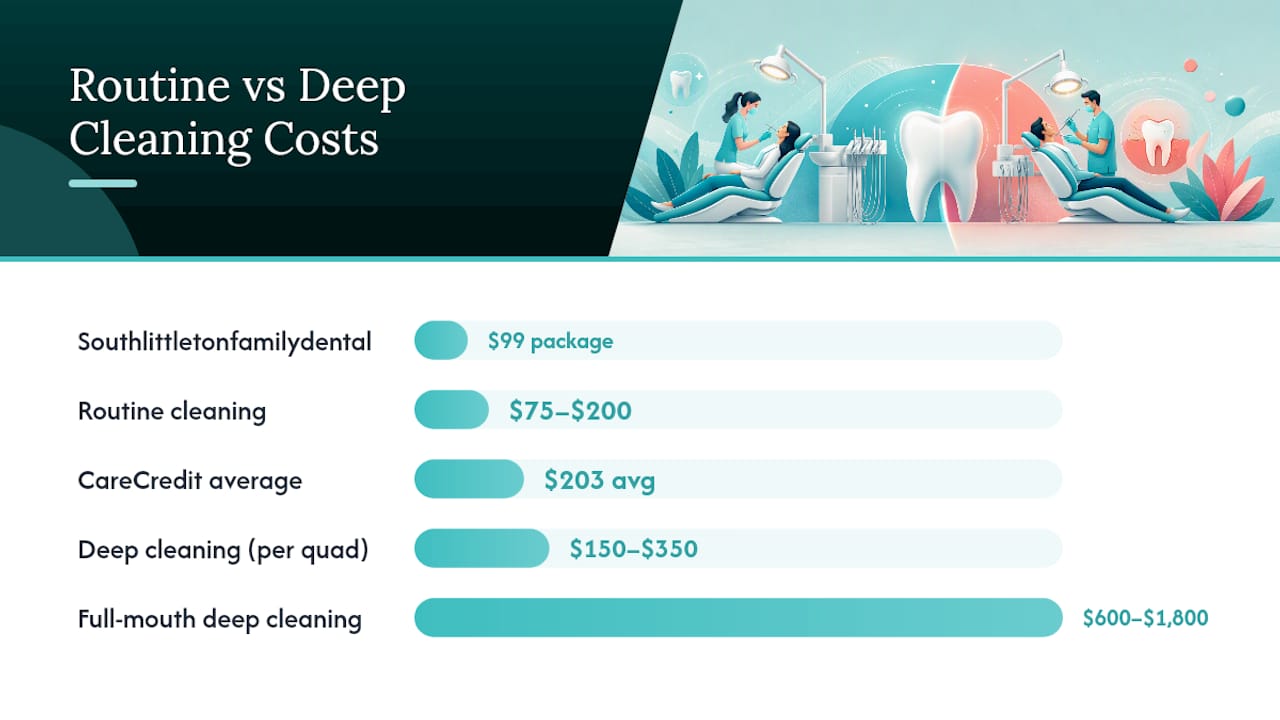
A routine dental cleaning runs about $75–$200 out of pocket, with CareCredit’s national average landing near $203. Bundle that with an exam and X-rays and the total often lands between $100 and $300. Deep cleanings (scaling and root planing) are a different story: expect $150–$350 per quadrant, or $600–$1,800 for a full mouth. At the low end, dental school clinics and community health centers can cut those numbers significantly. At the high end, a private practice in a major metro can push well past those ranges.
Insurance changes the math considerably. Without any coverage, GoodRx notes that geography and provider type are the two biggest drivers of what you actually pay.
Key trust signals worth knowing upfront: the American Dental Association (ADA) sets the CDT billing codes that determine how your insurer prices every procedure, CareCredit offers financing for out-of-pocket balances, and Southlittletonfamilydental in Littleton, CO offers a $99 cleaning package for patients who want a predictable local price.
Table of Contents
-
What’s actually included in a cleaning appointment (and what costs extra)?
-
A note on pricing transparency from Southlittletonfamilydental
-
Affordable dental cleanings in Littleton, CO at Southlittletonfamilydental
-
What the most important people who skip cleanings learn the hard way
-
Southlittletonfamilydental makes it easy to budget for your next cleaning
What does dental cleaning cost, and which type do you need?
Not all cleanings are the same procedure, and the billing code on your claim determines both the price and what your insurance will cover.
-
Routine prophylaxis (D1110/D1120): The standard twice-yearly cleaning for patients with healthy gums. D1110 is for adults; D1120 is for children under 14. This is the cleaning most people picture, and it’s the one preventive plans cover at 100% in-network.
-
Scaling and root planing (D4341/D4342): The ADA classifies SRP as quadrant-based periodontal therapy for patients with active gum disease. D4341 covers a quadrant with two or more teeth requiring SRP; D4342 covers a quadrant with one to three teeth. Pricing is per quadrant, which is why a full-mouth deep cleaning costs four times the per-quadrant rate.
-
Periodontal maintenance (D4910): Once a patient has completed SRP, they typically move to D4910 visits every 3–4 months instead of standard prophylaxis. These cost more than a routine cleaning because they include more thorough subgingival work.
-
Gross debridement (D4355): Used when heavy tartar buildup prevents a proper exam. It’s a preliminary procedure, not a substitute for a full cleaning, and it often triggers a follow-up appointment.
| Procedure | CDT Code | Typical Cost Range | Who It’s For |
|---|---|---|---|
| Routine prophylaxis | D1110 / D1120 | $75–$200 | Healthy gums, regular patients |
| Scaling & root planing | D4341 / D4342 | $150–$350 per quadrant | Active gum disease |
| Periodontal maintenance | D4910 | $75–$200 | Post-SRP ongoing care |
| Gross debridement | D4355 | $75–$150 | Heavy buildup, pre-exam only |
Knowing your code before you call a dental office or insurer is the fastest way to get a real price, not an estimate.
What’s actually included in a cleaning appointment (and what costs extra)?
A routine cleaning appointment typically covers the hygienist’s prophylaxis, a basic exam by the dentist, and polishing. That’s the core. What varies is everything else.
Standard inclusions:
-
Hygienist scaling and polishing (the cleaning itself)
-
Dentist exam (often billed separately as D0120 for a periodic exam or D0150 for a comprehensive new-patient exam)
-
Basic periodontal charting
Common add-ons with typical price bands:
-
Bitewing X-rays (D0272/D0274): $25–$75 per set; full-mouth series (D0210) can run $100–$200
-
Fluoride treatment (D1208): $20–$50
-
Sealants per tooth (D1351): $30–$60 each
-
Local anesthesia (D9930): $50–$100, common during SRP
-
Full-mouth debridement (D4355): $75–$150 as a separate line item
New-patient appointments almost always cost more. The office needs a comprehensive exam (D0150) and a full set of X-rays, which can add $150–$250 on top of the cleaning fee. CostHelper reports that a cleaning-plus-exam-plus-X-rays package typically runs $100–$300 or more, depending on the practice.
Pro Tip: Always ask for an itemized fee estimate before your appointment. Request the CDT code and the office’s full fee for each line item. That way you can call your insurer to confirm the allowed amount for each code before you sit in the chair.
How much do you pay with insurance versus without?
Insurance status is the single biggest variable in what you actually write a check for.
With insurance (in-network):
-
Routine cleaning (D1110): Often $0 out of pocket when the dentist is in-network and you haven’t exceeded your frequency limit. Most plans cover preventive care at 100%.
-
Deep cleaning (D4341): Typically covered at 50–80% after your deductible. On a $250-per-quadrant fee with 50% coverage and a $50 deductible already met, your share is about $125 per quadrant, or $500 for a full mouth.
-
Annual maximum: Most individual plans cap total benefits at $1,000–$2,000 per year. A full-mouth SRP can consume most or all of that in one treatment cycle.
With insurance (out-of-network):
Your insurer pays based on its “allowed amount” for your zip code, not the dentist’s full fee. The dentist can bill the difference (balance billing), so your out-of-pocket can be significantly higher than the in-network scenario. Always confirm whether an office participates in your specific plan, not just whether they “accept” your insurer.
Without insurance:
You pay the office’s full fee. Dental discount plans are not insurance but can reduce costs at participating dentists. They work differently from insurance: you pay an annual membership fee and receive a negotiated rate at participating offices, with no annual maximum or waiting period.
Statistic callout: In commercial dental markets, insurers typically pay 69.9–78.0% of list price, according to peer-reviewed research on dental insurance contracting. That 20–30% discount is the core value of staying in-network.
Quick checks before your appointment:
-
Call your insurer and ask: “What is the allowed amount for CDT code D1110 at an in-network provider in my zip code?”
-
Ask the dental office: “Do you accept assignment for my plan, and will you balance bill?”
-
Confirm your deductible status and remaining annual maximum before scheduling a deep cleaning.
How cleaning prices vary by state
Geography moves the needle more than most patients expect. A routine cleaning that costs $90 in rural Mississippi can run $175 in San Francisco. CareCredit’s state-by-state data shows the national average near $203, but state averages spread well above and below that figure.
Ranges are approximate and sourced from CareCredit’s state average dataset. Individual office fees vary.
Three factors drive the spread:
-
Cost of living: Rent, staff wages, and equipment costs are higher in dense metros, and those costs pass through to fees.
-
Insurance market concentration: Markets dominated by one or two large insurers tend to have lower contracted rates (more on this in the research section below).
-
Provider mix: Areas with more dental schools, FQHCs, and community clinics pull local averages down.
Use a state average as a sanity check, not a guarantee.
Practical ways to lower what you pay
The gap between the highest and lowest prices for the same procedure can be $100 or more. These options can close that gap.
Main cost-reduction paths:
-
Stay in-network: The contracted rate discount (roughly 20–30%) is the easiest saving available to insured patients.
-
Dental school clinics: Students perform cleanings under faculty supervision at significantly reduced fees, often 50–70% below private practice rates. Wait times are longer.
-
Federally Qualified Health Centers (FQHCs): Sliding-scale fees based on income. Find one at findahealthcenter.hrsa.gov.
-
In-office membership plans: Many practices offer annual plans ($100–$300/year) that include two cleanings, an exam, and X-rays plus discounts on other services. No waiting periods, no annual maximums.
-
Dental discount plans: Not insurance, but can reduce costs at participating dentists. Annual membership fees typically run $80–$200.
-
CareCredit financing: Spreads out-of-pocket costs over time, often with promotional 0% APR periods for qualifying balances.
| Option | Typical Savings | Trade-offs |
|---|---|---|
| In-network insurance | 20–30% off list price | Requires active plan; frequency limits apply |
| Dental school clinic | 50–70% off private rates | Longer appointments; student provider |
| In-office membership plan | Bundled value; no waiting period | Only valid at that practice |
| Dental discount plan | Varies by plan and provider | Not insurance; limited network |
| CareCredit | Defers cost, not reduces it | Interest applies after promo period |
Pro Tip: When calling a dental office to ask about pricing, say: “Can you give me the full fee for CDT code D1110 and let me know if you participate in [your plan name]?” That one question gets you a comparable number, not a vague range.
What actually happens during a cleaning appointment?
Understanding the sequence helps you see why deep cleanings cost more and sometimes require multiple visits.
Routine cleaning (typically 45–60 minutes):
-
Check-in and health history review
-
Dental hygienist takes or reviews X-rays if due
-
Periodontal charting (probing pocket depths)
-
Scaling to remove tartar above and just below the gumline
-
Polishing with prophy paste
-
Flossing
-
Fluoride application (if included or requested)
-
Dentist exam and any treatment recommendations
Cleveland Clinic’s patient guidance describes the standard check-up sequence and notes that the hygienist’s work and the dentist’s exam together form the complete preventive visit.
Deep cleaning / scaling and root planing (60–90 minutes per quadrant, often split across 2 visits):
-
Local anesthesia administered to the quadrant being treated
-
Hygienist or periodontist scales below the gumline, removing calculus from root surfaces
-
Root planing smooths root surfaces to discourage bacterial reattachment
-
Possible antibiotic placement (Arestin or similar) in deep pockets
-
Post-treatment instructions; follow-up periodontal maintenance scheduled for 6–8 weeks later
The anesthesia, extended chair time, and follow-up maintenance visits are exactly what drives the higher cost. A full-mouth SRP across four quadrants can mean two to four separate appointments, each billed individually.
Questions to ask your dentist or insurer before you pay
Getting an accurate price takes about five minutes on the phone if you ask the right questions.
Ask the dental office:
-
“What is your full fee for CDT code D1110 (or D4341 if a deep cleaning)?”
-
“Do you participate in [plan name], and will you accept the allowed amount as payment in full?”
-
“Will you balance bill if my insurer’s allowed amount is lower than your fee?”
-
“What X-rays are included, and what are the separate fees if they’re not?”
-
“Do you offer an in-office membership plan or new-patient special for uninsured patients?”
Ask your insurer:
-
“What is the allowed amount for D1110 at an in-network provider in zip code [yours]?”
-
“What is my remaining deductible and annual maximum?”
-
“Is D4341 covered, and at what coinsurance percentage?”
-
“Are there frequency limitations on cleanings or X-rays?”
Have these ready before you call:
-
Your insurance card (member ID, group number, plan name)
-
Your most recent Explanation of Benefits (EOB) if you have one
-
Your zip code (affects allowed amounts in many plans)
-
The CDT codes for the procedures you expect (D1110 for routine, D4341/D4342 for deep cleaning)
Pro Tip: Ask the dental office to run a pre-treatment estimate (also called a predetermination) with your insurer before a deep cleaning. The insurer reviews the proposed treatment and tells you in writing what they’ll cover. It’s not a guarantee, but it’s the closest thing to one.
How insurance market structure affects what you pay
The price you see on a dental fee schedule isn’t random. A peer-reviewed analysis published in PMC found that higher commercial dental insurer concentration in a market is associated with lower gross payments to dentists and larger discounts relative to list prices. In plain terms: where one or two large insurers dominate, they have more bargaining power and negotiate steeper discounts. Where dentists are more consolidated, prices tend to edge up modestly.
Research callout: In the study sample, preventive procedures averaged about $62 in gross payments, with insurers paying 69.9–78.0% of list price. The remaining 20–30% represents the discount patients capture by staying in-network.
What this means practically:
-
In markets with high insurer concentration (think large metro areas dominated by one or two carriers), in-network contracted rates tend to be lower, which benefits insured patients.
-
In markets with high provider consolidation (large dental group practices with pricing power), list prices and contracted rates can drift upward.
-
Uninsured patients in high-concentration markets may face higher list prices relative to what insured patients pay, because the list price is set partly as a starting point for insurer negotiation.
The ADA’s fee schedule negotiation guidance confirms that the dentist’s negotiated allowed amount is the single biggest determinant of your out-of-pocket share when using insurance. That’s why asking for the allowed amount by CDT code, not just the office’s full fee, gives you the number that actually matters.
A note on pricing transparency from Southlittletonfamilydental
At Southlittletonfamilydental, the approach to pricing starts with a simple premise: patients shouldn’t have to guess what they’ll owe. The practice offers a $99 cleaning package as a clear, upfront option for patients who want to skip the insurance guesswork, and itemized estimates are available before any treatment begins. For insured patients, the team verifies benefits and walks through expected out-of-pocket costs before the appointment. For uninsured patients, in-office payment options and financing through CareCredit are available. The goal is that every patient, regardless of coverage status, leaves knowing exactly what they paid for and why.
Affordable dental cleanings in Littleton, CO at Southlittletonfamilydental
The national average for a routine cleaning sits near $203, and a full-mouth deep cleaning can run $600–$1,800 before insurance. Southlittletonfamilydental offers a concrete local alternative: a $99 cleaning package that puts a firm number on what you’ll pay, well below the national average and without the uncertainty of waiting for an insurance explanation of benefits.
The Cleaning, Exam & X-Ray package bundles the three most common new-patient charges into one transparent price, so you’re not surprised by separate line items for the exam or bitewing X-rays. For patients new to the practice, the New Patient Special offers additional savings on a first visit. Insured patients benefit from in-network billing and pre-treatment estimates; uninsured patients can use the in-office membership plan or CareCredit to spread costs.
To book an appointment or get a price estimate for your specific situation, visit the general dentistry services page or call the Littleton office directly. Same-day availability is often possible for routine cleanings.
What the most important people who skip cleanings learn the hard way
Skipping a routine cleaning to save $100–$150 is one of the more expensive decisions a patient can make. A routine prophylaxis that costs $75–$200 prevents the tartar buildup that leads to gum disease. Once gum disease is active, the treatment shifts to scaling and root planing at $150–$350 per quadrant, periodontal maintenance every 3–4 months indefinitely, and potentially restorative work if bone loss progresses. The math is not subtle.
The patients who feel most blindsided by dental bills are usually the ones who went two or three years without a cleaning, not because they couldn’t afford $150, but because they kept putting it off. By the time they came in, a routine visit had become a multi-visit periodontal treatment plan.
Preventive care is the only category in dentistry where spending less now reliably costs more later. That’s not a sales pitch; it’s the consistent finding across cost guides like ToothCostGuide and clinical literature alike. Schedule the cleaning, ask for the itemized estimate, confirm your coverage, and go.
Southlittletonfamilydental makes it easy to budget for your next cleaning
Dental cleaning costs in the U.S. range from $75 for a basic routine cleaning to over $1,800 for a full-mouth deep cleaning, and the right preparation, knowing your CDT codes, confirming your allowed amounts, and choosing an in-network or transparent-pricing provider, can cut your actual out-of-pocket cost significantly.
| Point | Details |
|---|---|
| Routine cleaning range | Expect $75–$200 nationally; the CareCredit average is $203 with wide state variation. |
| Deep cleaning cost | Scaling and root planing runs $150–$350 per quadrant, or $600–$1,800 full mouth. |
| Insurance coverage rule | Preventive cleanings are often covered 100% in-network; deep cleanings typically at 50–80% after deductible. |
| Ask for CDT codes | Request the allowed amount for D1110 or D4341 from your insurer before your appointment. |
| Southlittletonfamilydental option | The $99 cleaning package in Littleton, CO offers a transparent, below-average local price for routine care. |
Sources
These resources give you real numbers and plan-specific rules, not estimates.