
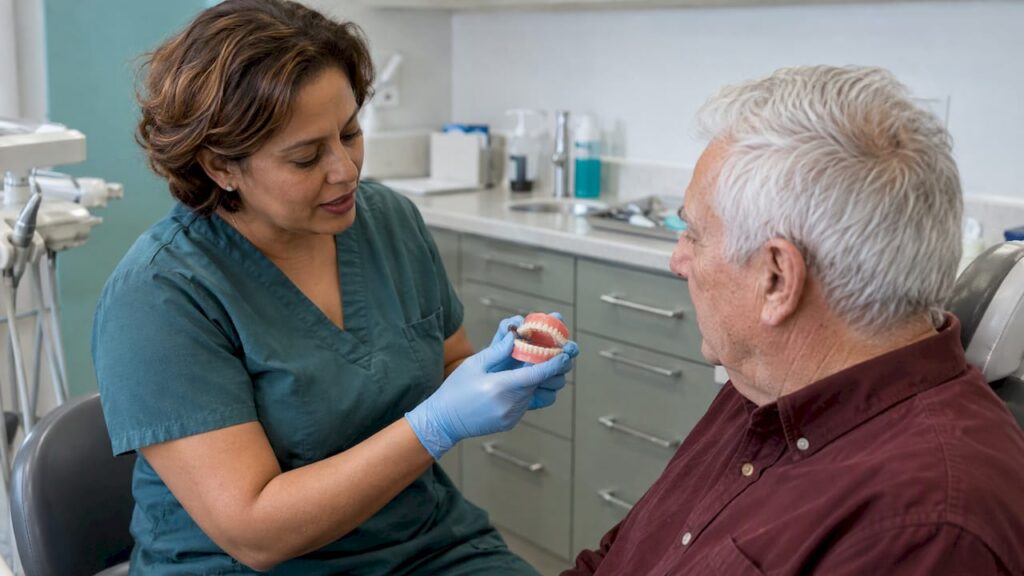
There are four main types of dentures. Full (complete) dentures replace a whole arch of teeth. Partial dentures fill the gaps when some natural teeth remain. Immediate dentures are placed the day teeth are removed. Implant-retained and implant-supported dentures anchor to dental implants for more stability. The right one depends on how many teeth you are missing, your jawbone, your budget and whether you want to take the denture out each day. This guide explains each type in plain terms, with typical US prices and care basics.
TL;DR
- Full dentures replace every tooth in an upper or lower arch and rest on the gums. Partial dentures replace several teeth and clasp onto the ones you keep.
- Immediate dentures go in the same day as extractions, so you are never without teeth. They usually need relining or remaking as your gums heal.
- Implant-retained (snap-in) dentures are removable. Implant-supported (hybrid) dentures are fixed in place and only a dentist removes them.
- National averages run from about $1,738 for a partial resin denture to about $3,976 for an implant-supported denture, before the cost of the implants themselves in some cases.
- A dentist decides what suits you after checking your gums, bone and bite. A personal exam is the only way to get a real plan and quote.
Table of Contents
- What dentures are, and why there are so many kinds
- Full (complete) dentures
- Partial dentures
- Immediate dentures
- Implant-retained (snap-in) dentures
- Implant-supported (fixed, hybrid) dentures
- Side-by-side comparison
- What dentures cost in the US
- Choosing a denture type as an older adult
- Alternatives to full dentures
- Caring for your dentures
- Our perspective on choosing dentures
- Talk to a Littleton dentist about your options
- FAQ
- Sources
What dentures are, and why there are so many kinds
A denture is a removable or implant-anchored set of replacement teeth made to match your mouth. The variety comes from three questions. How many teeth are missing? What holds the denture in place: gums, remaining teeth or implants? And how soon do you need teeth after an extraction?
According to Cleveland Clinic, the right denture depends on how many teeth are missing, how long they have been missing, whether you prefer removable or nonremovable teeth, the density and volume of your jawbone, the relationship between your upper and lower jaws, and your personal preferences. Those factors are the real “types” behind the marketing names you see online.
This matters for older adults in particular. The University of Arizona’s elder care guide, citing CDC data, reports that about a quarter of adults over 60 have no natural teeth. Choosing well is a common decision, not a rare one.
Full (complete) dentures
Full dentures replace an entire arch, upper, lower or both. Cleveland Clinic describes them as resting on the gums, with no natural teeth left to hold them. Most people wear them with a small amount of denture adhesive for extra hold.
Conventional full dentures are made after your remaining teeth are removed and the tissue has healed, which, as the American Dental Association’s MouthHealthy guide explains, may take several months. During that time you would have no teeth unless you choose an immediate denture (below).
Who they suit: people missing all the teeth in an arch who want a lower-cost, non-surgical option, or who are not ready for implants.
What to expect: new dentures may feel awkward for a few weeks. They can feel loose while your cheek and tongue muscles learn to keep them in place, and minor soreness is not unusual. Follow-up visits are normally needed so the fit can be checked and adjusted, according to the ADA’s guide.
Partial dentures
Partial dentures replace one or several missing teeth while you keep the others. Cleveland Clinic notes they have clasps that hook around your remaining natural teeth, which hold the partial steady. A partial is built on a pink gum-colored base, sometimes with a metal framework, with replacement teeth set into it.
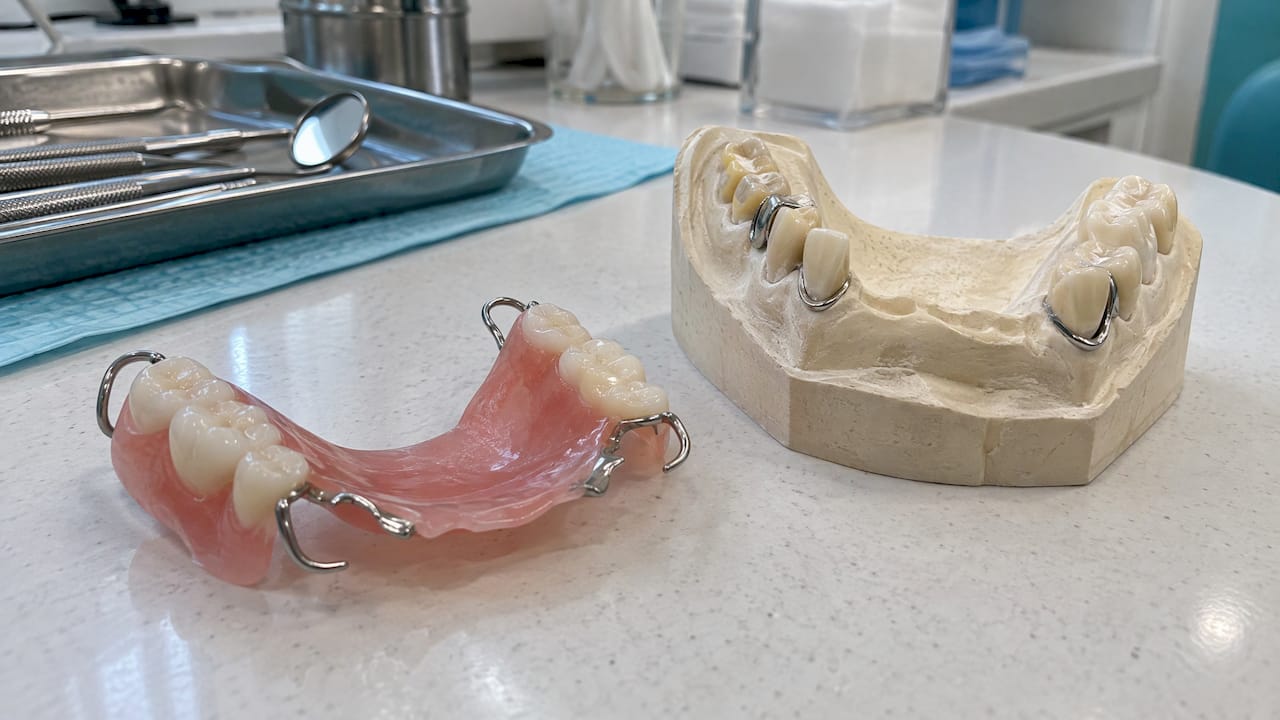
The common materials are resin and metal framework. Metal frameworks are typically thinner and more rigid, and resin partials are a common budget-friendly choice. Your dentist will recommend the build based on where the gaps are and how your bite works.
Who they suit: people with healthy remaining teeth who want to fill gaps, keep their bite balanced and avoid remaining teeth drifting into the space.
Partials need a careful daily routine so the clasped teeth stay healthy and the gums stay comfortable. Our guide to partial denture care and preventing sore spots walks through it.
Immediate dentures
An immediate denture is placed the same day your teeth are removed. According to the ADA’s MouthHealthy guide, it may need relining or remaking after healing. A 2025 systematic review in PMC says an immediate complete denture serves as a temporary solution during healing. It also protects the surgical area, supports function and helps preserve the look and shape of the face.
A 2014 clinical report describes two kinds:
- Conventional immediate dentures, which can serve as a definitive, long-term prosthesis.
- Interim immediate dentures, used briefly after extraction and then relined or replaced once healing is done.
Because the denture is made before your teeth come out, there is no full trial fit beforehand. The 2025 review points to that as the main challenge in making them, so a skilled, experienced team and a few adjustment visits matter. Expect those visits as part of the plan, not as a problem.
Who they suit: anyone who needs several or all teeth extracted and does not want to go without teeth during healing, for work, social life or eating.
If extractions are part of your plan, ask how they are coordinated with the denture. Our team handles tooth extractions and oral surgery in the same practice, which keeps planning in one place.
Implant-retained (snap-in) dentures
An implant-retained denture is still removable, but it snaps onto implants placed in your jaw. Cleveland Clinic says this gives more stability than a traditional denture and removes the need for denture glue. It is a popular upgrade for lower dentures, which tend to move the most.
In practice, a small number of implants act as anchors. You remove the denture to clean it and to sleep, then click it back in.
Who they suit: people who want the security of implants and the easy cleaning of a removable denture, and who have enough healthy jawbone.
Implant-supported (fixed, hybrid) dentures
Implant-supported dentures are the non-removable option. Cleveland Clinic explains that only a dentist can take them out. They are attached to implants and feel closest to natural teeth for many patients, with no clasps, no adhesive and nothing to take out at night.
Because they connect to the jaw through implants, planning is more detailed: scans, bone assessment and sometimes bone grafting or socket preservation first. You can read about the steps on our dental implants process page and the week-by-week implant timeline.
Who they suit: people who want a fixed solution and have enough bone, or can build it up. The University of Arizona guide notes that heavy smokers, people taking bisphosphonates, people with poorly controlled diabetes and those with limited bone are less ideal implant candidates. Your dentist will review your medical history and medications before recommending implants. Our implant candidacy page lists what we look at.
Side-by-side comparison
| Type | Replaces | Held in by | Removable? | Best for |
|---|---|---|---|---|
| Full (conventional) | All teeth in an arch | Gums, suction, adhesive | Yes | Lower-cost, non-surgical replacement |
| Partial | Some teeth | Clasps on natural teeth | Yes | Gaps with healthy teeth remaining |
| Immediate | Teeth removed that day | Gums (full) or clasps (partial) | Yes | No time without teeth after extractions |
| Implant-retained (snap-in) | All teeth in an arch | Implants and attachments | Yes | Better stability, easier chewing |
| Implant-supported (hybrid) | All teeth in an arch | Implants, fixed | Only by a dentist | Permanent, natural-feeling result |
What dentures cost in the US
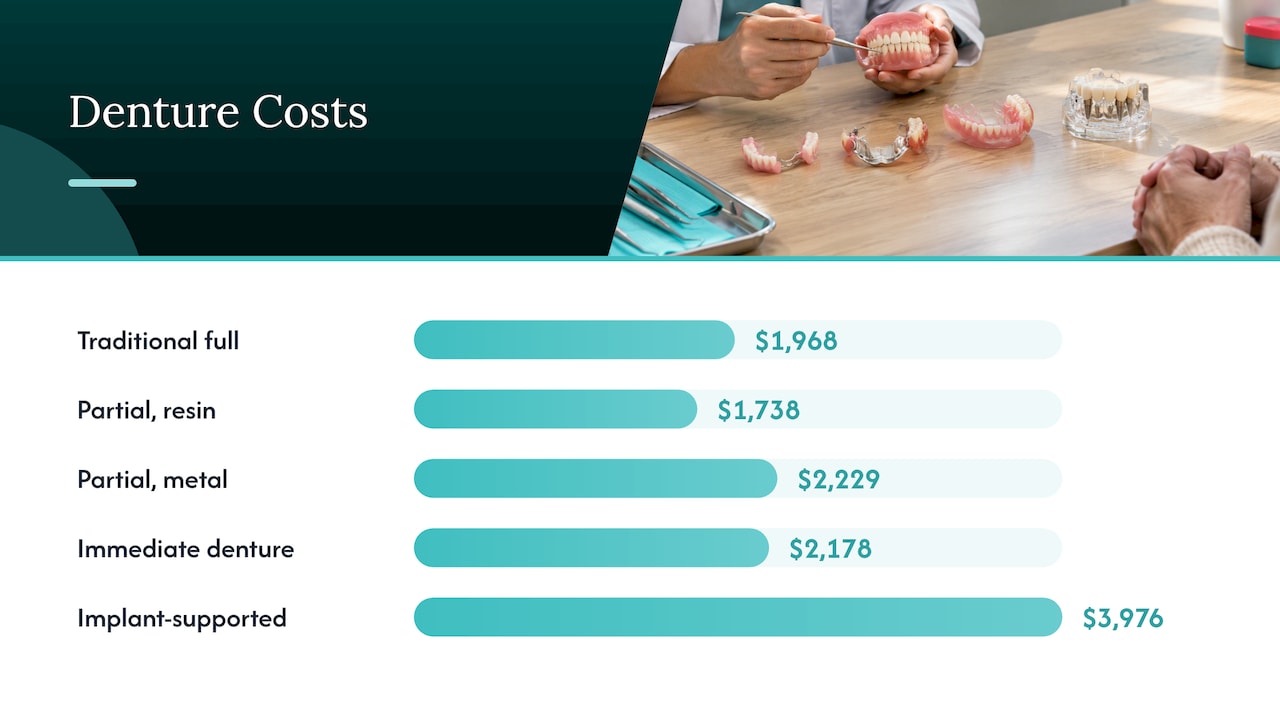
Prices vary by region, materials and what else you need (extractions, x-rays, grafting). These national figures are averages to help you budget, not quotes. A 2024 CareCredit cost study reports:
| Type | Average | Range |
|---|---|---|
| Traditional full denture | $1,968 | $1,520 to $3,648 |
| Partial, resin | $1,738 | $1,333 to $3,283 |
| Partial, metal | $2,229 | $1,728 to $4,203 |
| Immediate denture | $2,178 | $1,707 to $3,540 |
| Implant-supported denture | $3,976 | $3,055 to $7,294 |
Other sources land in the same area. The University of Arizona guide says a set of upper and lower complete dentures typically costs $1,000 to $2,000, partials run about $800 to $2,000 per arch, and a single implant averages $1,000 to $2,000, with possible extra diagnostic, imaging and surgical fees. AARP, citing Delta Dental’s estimator, says to expect $1,500 to $3,000 for a removable upper or lower denture, with prices rising significantly for implant-supported versions.
For implant-based options, the total depends heavily on how many implants you need and whether the quote includes surgery. Always ask whether a figure covers the denture only or the whole procedure. Our dental implants cost page explains what goes into an implant estimate.
Paying with Medicare or insurance
Many older adults ask how Medicare fits in. Coverage depends on the plan you hold, so read your plan’s dental benefits closely. If you are comparing plans, this overview of Medicare dental, vision and hearing coverage explains the kinds of options people look at. Our office works with patients paying through dental insurance or directly, and we offer flexible payment plans, so bring your insurance card and we will go over what applies.
Choosing a denture type as an older adult
Seniors often ask for the “best” denture. There is not one best type, but there is a best fit. Work through these questions with your dentist:
- How many teeth are missing, and how healthy are the rest? Healthy remaining teeth point toward a partial. An entire arch points toward a full denture or implant options.
- How much bone do you have? Bone density and volume decide whether implants are possible now, or after grafting.
- Do you want to remove it? Some people like a removable denture because cleaning is simple. Others want teeth that stay put.
- What is your health picture? Diabetes control, medications and smoking all affect healing and implant success.
- What is the budget, and what is the long game? A lower upfront cost may suit now. Implant-anchored options cost more upfront and add stability. Ask about payment plans.
- Can you handle daily care? Dexterity, vision and caregiver support all matter. Snap-in and fixed options can be easier to keep stable, while removable ones are simpler to clean outside the mouth.
Two practical points. First, the ADA notes that dentures generally need follow-up appointments after insertion to check and adjust fit. Second, gums and bone change shape after extractions, usually over about six months, according to the Swinomish Indian Tribal Community dental page. Expect relining or adjustments, and call your dentist if the fit feels off or you notice discomfort.
Alternatives to full dentures
If you are missing only one or a few teeth, dentures are not the only route. Common options include a single dental implant with a crown, a fixed bridge anchored to neighboring teeth, or a removable partial denture. In some cases, a tooth that looks hopeless can be saved with a root canal and crown instead of an extraction. Which is best depends on the neighboring teeth, the bone and your goals, and a dentist needs to examine you to say.
We offer implants, bridges, crowns, partials and dentures, so you can compare them in one visit instead of piecing together opinions from different offices. If you already have a bridge, our steps for cleaning under a dental bridge keep it healthy.
Caring for your dentures
Good care keeps dentures comfortable and keeps your mouth healthy. The guidance from health agencies is consistent:
- Clean daily. The ADA’s denture care guidance says the American College of Prosthodontists recommends soaking and brushing every day with a nonabrasive denture cleanser to reduce biofilm and harmful bacteria and fungi.
- Use the right brush. A soft-bristled brush made for dentures works best, and dentures should stay moist when not worn, per the University of Arizona guide.
- Skip bleach and powders. The ADA advises avoiding bleach and powdered household cleansers, which may damage the denture, and not using denture cleansers while the denture is in your mouth.
- Give your gums a break. The Illinois Department of Public Health says dentures should be out of your mouth at least eight hours a day, kept in water or diluted mouthwash, and that boiling water will warp them. The Swinomish page also advises not wearing dentures overnight, to prevent fungal growth.
- Be careful with adhesive. Guidelines reflecting American College of Prosthodontists recommendations say that properly used adhesive can improve retention and stability. If you use it beyond six months, have your dentist assess the denture and your gums periodically.
Partials with metal clasps need special attention: the Illinois agency warns that bleach will damage the metal. Ask your dentist which cleaner suits your denture.
When you start eating with new dentures, begin with soft foods and small bites. Our guide to eating with new dentures has a practical progression.
Our perspective on choosing dentures
We see the same pattern in our Littleton office: patients arrive with a label in mind, like “just get me dentures”, when what they really want is to chew comfortably, smile with confidence and not worry about their teeth slipping.
That is why we start with your goals, then look at your gums, bone, remaining teeth and health history. Our approach to care is individualized, and we explain each option clearly, with the details, so you know what each step involves and what it will cost before you decide.
We provide dentures and partials, extractions, bone grafting and socket preservation, and dental implants under one roof, which means your plan can be coordinated rather than handed off. For many patients, that means a denture that works today and a clear path to implant-anchored stability later if they want it.
Dental visits can be stressful, especially when teeth are being removed. We build in time to talk, go at your pace, and aim to keep you comfortable throughout.
the author
Talk to a Littleton dentist about your options
If you are weighing full, partial, immediate or implant-based dentures, the quickest way to a clear answer is an exam and a conversation. We will look at your teeth, gums and bone, explain what fits your goals and give you a written plan. New patients can see what we currently offer on our new patient page, and you can explore our full range of restorative dentistry services. If a tooth problem cannot wait, we also provide same-day emergency dental care.
Call or book through South Littleton Family Dental and bring your questions, your medication list and your insurance information.
FAQ
What are the main types of dentures?
The main types are full dentures, partial dentures, immediate dentures, and implant-retained or implant-supported dentures. Full dentures replace a whole arch, while partials replace some teeth and clasp onto natural ones. Implant versions attach to implants, either as a removable snap-in or a fixed denture only a dentist can remove.
What is the best type of denture for seniors?
There is no single best type, since it depends on how many teeth are missing, your bone density, health and budget. Removable full or partial dentures are a common starting point. Implant-retained dentures add stability for people with enough bone. Your dentist can match the option to your health and daily routine.
How long does it take to get dentures?
Conventional full dentures are made after your teeth are removed and the tissue has healed, which may take several months, according to the ADA. Immediate dentures are placed the same day as extractions, then adjusted or remade after healing. Implant-based options take longer because the implants need time to integrate.
How much do dentures cost?
In a 2024 national study, traditional full dentures averaged $1,968 and implant-supported dentures averaged $3,976, with wide ranges for each. Your cost depends on materials, extractions, imaging and whether implants are included. We can give you an estimate after an exam.
Sources
- What Are Dentures? Types, Care & Benefits (Cleveland Clinic)
- Dentures (ADA MouthHealthy)
- Immediate Complete Dentures: A Systematic Review (PMC)
- Immediate denture fabrication: a clinical report (PMC)
- Elder Care: Dentures (University of Arizona)
- 13 Types of Dentures and Average Costs Explained (CareCredit)
- Does Medicare Cover the Cost of Dentures? (AARP)
- Denture Care and Maintenance (American Dental Association)
- Caring for Your Dentures (Illinois Department of Public Health)
- Denture and Partial Care (Swinomish Indian Tribal Community)
- Guidelines for the care and maintenance of complete dentures (National Elf Service)