
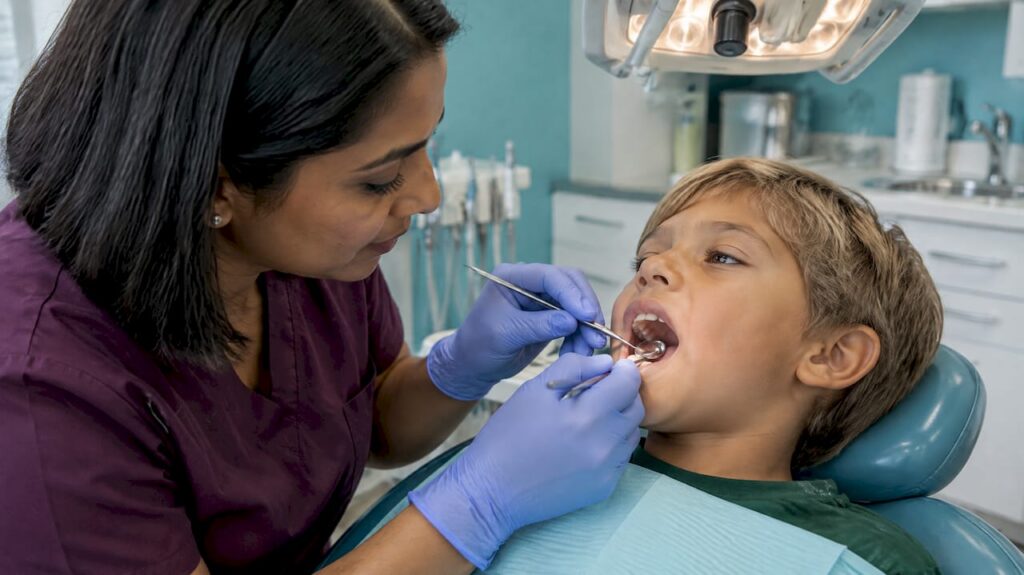
A stainless steel crown is a pre-made, silver-colored metal cap that covers a decayed or weakened baby tooth, usually a molar. It stays on until the tooth falls out naturally. Dentists use it when a filling isn’t strong enough to do the job, and for children it is one of the most dependable restorations available. This guide explains when a child needs one, how it’s placed, whether it’s safe, how long it lasts and what to do in the days afterward.
TL;DR
- A stainless steel crown covers the whole baby tooth, so it protects a badly decayed molar better than most fillings can.
- The American Academy of Pediatric Dentistry (AAPD) says these crowns last the longest of the restorations used on baby teeth and rarely need replacing.
- Research finds no cytotoxic risk to surrounding tissue. Allergic reactions are uncommon, but tell your dentist if your child has a known nickel allergy.
- The crown comes off with the baby tooth, usually when the permanent tooth pushes through.
- Call the dentist if the bite feels wrong, swelling grows, the crown comes loose or pain doesn’t ease with over-the-counter medicine.
Table of Contents
- What a stainless steel crown on a baby tooth is
- When a child needs one
- How the crown is placed
- Are stainless steel crowns safe?
- How long a stainless steel crown lasts
- What it costs
- What to expect afterward
- Talking to your child about the crown
- Our perspective
- Care for your child’s teeth in Littleton
- FAQ
- Sources
What a stainless steel crown on a baby tooth is
The AAPD describes stainless steel crowns, also called silver caps or preformed metal crowns, as metal shells made of iron, chromium, nickel and other metals. The dentist adapts one to the individual tooth and cements it in place. Because the crowns are pre-made in many sizes, the dentist doesn’t need a lab, an impression or a second visit to get a custom restoration.
The crown wraps the entire visible part of the tooth. A filling replaces only the part that was drilled away, and it leaves the remaining tooth walls to take the chewing forces. A crown holds the whole tooth together from the outside, which is why it works so well on molars that have lost a lot of structure.
Crowns are used almost entirely on primary teeth, and mostly on the back ones. Front baby teeth are seen and chipped less often in routine decay, and many families prefer a tooth-colored option there. Back molars are the teeth that do the heavy chewing, and they are the ones that have to last longest. A child’s first and second primary molars stay in the mouth until roughly ages 10 to 12, so a repair on one of them has years of work ahead of it. For the timeline of when those teeth are replaced, see our guide on when molars come in.
When a child needs one
Dentists recommend a stainless steel crown in a handful of situations:
- Large cavities. The AAPD says the crown is for teeth that are badly decayed or not strong enough to hold a filling.
- Cavities between teeth. Decay that spreads across more than one surface of a molar, especially between two teeth, is hard to restore with a filling that lasts.
- After a pulpotomy or baby root canal. When the pulp (the nerve tissue) in a tooth needs treatment, the tooth becomes weaker. The AAPD states that in these cases a stainless steel crown is the restoration of choice, because it protects against new infection and fracture.
- High risk of new decay. Children who get cavities easily benefit from full coverage, because there are no edges where a filling can leak and decay can restart.
- Very young children. The AAPD’s restorative guideline notes that crowns may be considered for multisurface cavities in children younger than 4 to avoid having to redo the treatment.
- Enamel or developmental defects. Teeth that formed weak may not hold a filling, and a crown shields them.
Why saving a baby tooth matters
Parents sometimes ask why a tooth that will fall out anyway deserves a crown. The answer is space. The AAPD’s review of crown use explains that the main job of primary molars is to hold space for the permanent teeth coming in behind them and to support the growth of the face and jaws. When a failed restoration leads to a lost tooth or a collapsed cavity wall, neighboring teeth can drift, and permanent molars can lose room to come in. A tooth that stays intact and pain-free also lets your child chew normally and sleep through the night without a toothache.
How the crown is placed
There are two main methods. Your dentist chooses based on the tooth, the amount of decay and your child’s ability to sit comfortably.
The conventional method
The steps are usually these:
- The dentist numbs the tooth and the gum around it.
- Any decay is removed. If the pulp is affected, the dentist treats it first.
- The tooth is lightly reshaped so the crown can slide over it.
- A crown of the right size is chosen and trimmed and contoured so its edges sit snugly at the gumline.
- The crown is cemented in place and the bite is checked.
This typically takes a single visit. The AAPD’s treatment notes make a point about fit: crown adaptation matters because a poorly fitted crown becomes a place for plaque and bacteria to collect, which is the reason the dentist spends time on trimming and contouring.
The Hall technique
In the Hall technique, the dentist seals decay under the crown without removing it. According to Leeds Teaching Hospitals NHS Trust, if teeth are very close together a small plastic separator is placed between them for up to two weeks. At the next appointment a correctly sized crown is pressed over the tooth and cemented, with no tooth removal and no numbing.
A 2020 review of the evidence found that survival rates for both approaches were above 90% after two years, with no statistically significant difference. At one year, survival was 94.5% for the Hall technique and 96% for the conventional technique. For some children, particularly anxious ones or those who dislike needles, a no-drilling, no-numbing option is a real comfort. It isn’t right for every tooth, for example one with pain or signs of infection. Your dentist will tell you which route fits your child.
Are stainless steel crowns safe?
For the great majority of children, yes. The material has been used in children’s dentistry for decades, and the studies point the same direction.
A 2022 laboratory study found that stainless steel crowns posed no cytotoxic risk to surrounding tissues and had a low probability of causing hypersensitivity. The authors concluded the crowns are suitable for rebuilding damaged primary molars.
The nickel question deserves a straight answer, since it’s what most parents are really asking. The crowns contain nickel, and a small number of people are allergic to it. A 2020 systematic review of the biological responses to these crowns found that evidence of allergic reactions in children is limited and mostly low quality. Some studies measured nickel release lower than what a child takes in from the daily diet. Others found more nickel in saliva in acidic conditions. The reviewers called for further long-term studies, and advised that dentists tell parents about this when many teeth in a young child are being restored.
The practical steps are simple:
- Tell the dentist before treatment if your child has a known nickel allergy, or has reacted to jewelry, watch backs or belt buckles.
- Mention it if your child has a history of eczema or metal sensitivity, so the dentist can discuss options.
- Report any rash, swelling or irritated gums around the crown afterward. A child with a confirmed nickel allergy should see the dentist, or an allergist, to decide on the right material.
Parents who ask about the metal are doing exactly what they should. A good dentist welcomes the question and answers it for your child’s specific situation.
How long a stainless steel crown lasts
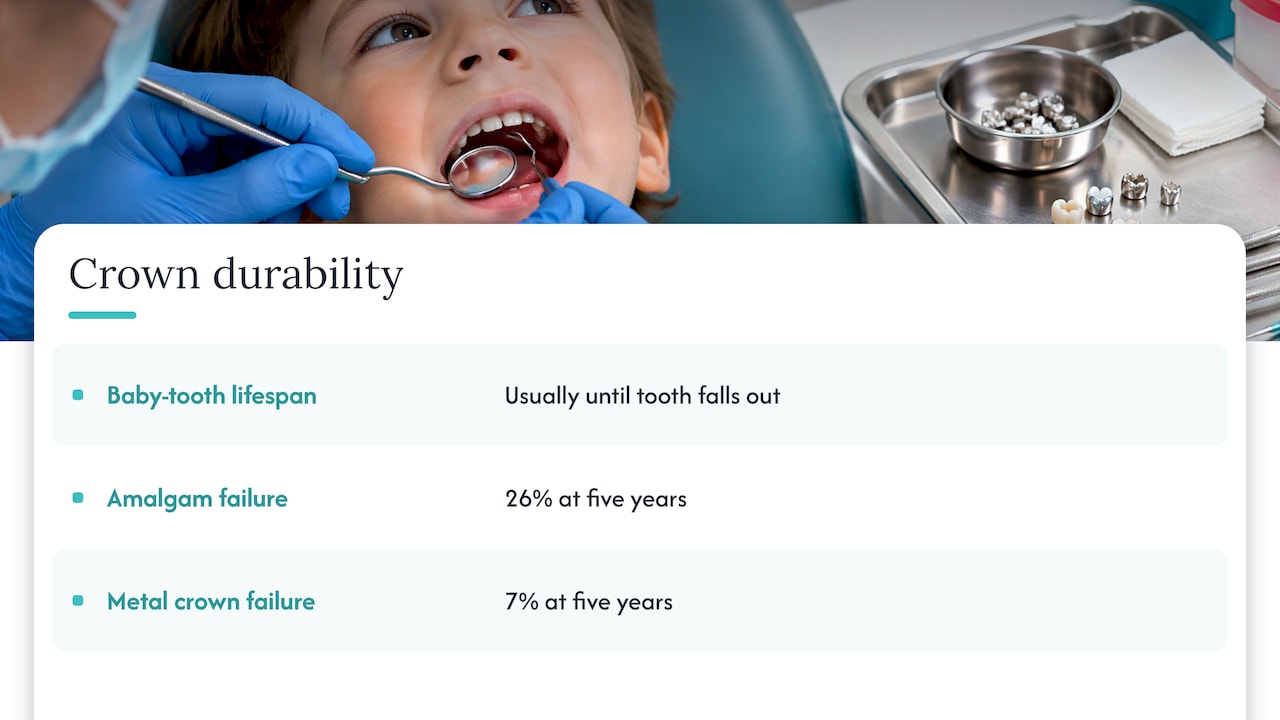
On a baby tooth, usually until the tooth falls out. The AAPD says these crowns can withstand biting forces and rarely need replacement.
The comparison with fillings is where the durability shows. A review of the evidence found that failure rates for Class II amalgam fillings (the kind that cover the biting surface and the side between teeth) ran two to seven times higher than for stainless steel crowns, averaging four times higher. The AAPD’s current restorative guideline reports that in five retrospective studies, the average five-year failure rate was 26% for amalgam and 7% for preformed metal crowns.
That durability also affects cost over time. The same review ran an exercise using 2000 Medicaid fees, where a Class II amalgam cost $55 and a crown $91. Even so, replacing failed amalgams over 100 restorations cost about 2.4 times more than the crown group. Those fee figures are old and not today’s prices, but the logic holds: a restoration you do once costs less than one you do twice.
For adult teeth, crowns are a different story, with different materials and lifespans. Our page on how long dental crowns last covers that.
What it costs
Prices vary by office, by whether a pulpotomy is needed first, whether sedation is used and by what your dental plan covers. Many dental plans cover crowns on baby teeth at a percentage, but the benefit depends on the plan, so ask the office to check your coverage before the appointment. We don’t publish a fixed price for crowns, because the right quote depends on your child’s tooth. Call us and we’ll walk you through an estimate, what insurance is likely to pay and the payment options available.
What to expect afterward
Most children are back to normal within a day. A few practical points from MedlinePlus, the U.S. National Library of Medicine, which notes that stainless steel crowns are pre-made and that the crown falls out when the child loses the baby tooth:
- Numbness. If your child was numbed, keep an eye on them so they don’t chew their cheek or lip until the feeling returns.
- Floss gently. Slide the floss out sideways instead of lifting it up and out, so it doesn’t pull on the crown.
- Avoid sticky foods. MedlinePlus lists gummy bears, caramels, bagels, nutrition bars and gum. Try to have your child chew on the other side for the first day or so.
- Brush as usual. Fluoride toothpaste and good brushing around the gumline keep the tooth under and around the crown healthy.
- Expect a different look. The crown is silver and shiny. Some kids like it, and most stop noticing within days.
When to call the dentist
MedlinePlus advises contacting the dentist if swelling gets worse, the bite feels wrong, the tooth feels out of place, a crown is lost or pain isn’t relieved by over-the-counter medicine. In practice, that means:
- The crown feels loose, or your child says it moves.
- Your child bites down and the tooth feels high.
- There is a bump on the gum near the tooth, a bad taste or a fever.
- Pain wakes your child at night or lasts beyond a couple of days.
If the crown comes off, keep it and call right away. Our guide on what to do when a crown falls off lists the steps. Swelling, fever or severe pain is urgent, and our emergency dentistry service offers same-day care.
Talking to your child about the crown
Kids handle dental work best when they know what’s coming. A few approaches that tend to help:
- Describe it in simple, concrete words: the tooth has a hole, and the dentist will put a little silver hat on it to keep it strong.
- Skip words like “hurt,” “shot” and “drill.” Let the dental team choose the words.
- Tell your child they’ll be able to ask for a break.
- Schedule the visit when your child is rested, usually in the morning for little ones.
- Stay calm yourself. Children read a parent’s face.
If your child is nervous, say so when you book. A practice that sees children regularly can plan the visit around that.
Our perspective
At South Littleton Family Dental, we treat parents’ questions about crowns as a sign that they’re paying attention to their child’s health, and we answer them plainly. A badly decayed baby molar is a problem that doesn’t go away on its own. Decay keeps spreading, and the child ends up with pain, infection or an early tooth loss that affects the teeth coming in behind it.
We built our practice around compassionate, personalized care with modern technology, and for children that means two things: fixing the problem in a way that’s meant to last, and making the visit as calm as we can. A full-coverage crown is a strong, proven way to protect a molar that has lost too much structure for a filling, and the research from the pediatric dental community supports it.
We write a care plan for each child and walk you through it before we start: what we found, what the options are and what each one means for comfort, timing and cost. Nothing should come as a surprise to you or to your child. And when something can’t wait, we offer same-day emergency care.
the author
Care for your child’s teeth in Littleton
If your child has a toothache, a visible cavity or a dentist’s recommendation for a crown, we can see them and explain the options. Our children’s dentistry team treats patients of all ages in a family-friendly setting, and our restorative dentistry services include dental crowns and fillings. We also see new patients for a $99 cleaning package, and an emergency exam is $49.

Call the office or book online through our site and tell us what’s going on with your child’s tooth. If you aren’t sure whether it’s urgent, call anyway.
FAQ
Are stainless steel crowns safe for kids?
For most children, yes. A 2022 study found no cytotoxic risk to surrounding tissues and a low probability of hypersensitivity. The crowns contain nickel, so tell the dentist about any known nickel allergy before treatment. Report a rash or gum irritation afterward.
Does a stainless steel crown hurt?
With the conventional method, the dentist numbs the tooth, so your child shouldn’t feel the work, though the cheek and lip feel odd for a while afterward. With the Hall technique, no numbing or tooth removal is needed. Some pressure and a tight feeling are common for a day or two.
What happens to the crown when the baby tooth falls out?
It comes out with the tooth. MedlinePlus notes that the crown falls out when the child loses the baby tooth. The permanent tooth beneath erupts normally, so you don’t need to do anything special.
Can my child eat normally with a crown?
Yes, with a short adjustment. For the first day, avoid sticky foods such as caramel, gum and gummy candy, and have your child chew on the other side if the area is tender. After that, regular meals are fine, and the crown is made to handle chewing.
Is a crown better than a filling for a baby tooth?
It depends on the tooth. For small cavities, a filling may be enough. For large or multi-surface cavities, or after nerve treatment, the AAPD points to the crown, and its guideline reports a five-year failure rate of 7% for metal crowns against 26% for amalgam. Your dentist will recommend the option that fits your child’s tooth.
Sources
- Treating Tooth Decay, American Academy of Pediatric Dentistry
- Pediatric Restorative Dentistry, American Academy of Pediatric Dentistry
- The use of stainless steel crowns, Pediatric Dentistry
- Stainless Steel Crowns in Primary Dentition, StatPearls
- Evaluation of the microbial, cytotoxic and physico-chemical properties of stainless steel crowns, PubMed
- Biological responses to pediatric stainless steel crowns, PubMed
- Hall Technique for Carious Primary Molars: A Review, PMC
- The Hall Technique, Leeds Teaching Hospitals NHS Trust
- Dental crowns, MedlinePlus Medical Encyclopedia