
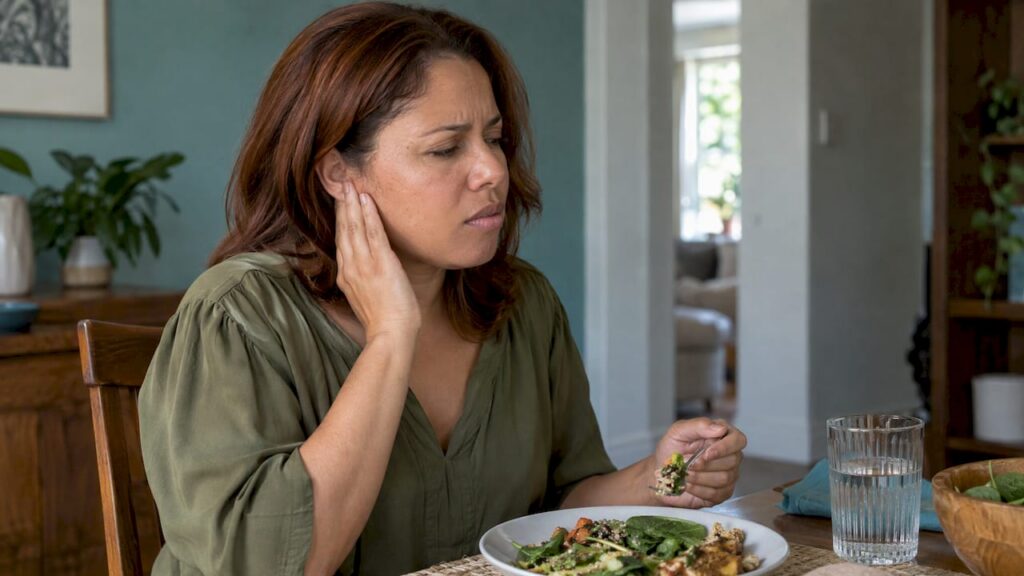
Jaw pain when you chew most often points to a temporomandibular joint (TMJ) disorder, but a sore tooth, gum disease, a sinus problem or nighttime grinding can produce the same ache. Cleveland Clinic names TMJ disorder as the most common cause and advises talking to a healthcare provider if the pain lasts more than a week. Until then, soft foods, heat or ice and fewer jaw-straining habits are the usual first steps. Jaw pain that comes with chest pain, or after a blow to the face, is a different story and needs 911 or the ER.
Below, we walk through what causes the pain, what you can safely do at home, how clicking fits in, and when a dentist should look at it.
TL;DR
- TMJ disorders and tight chewing muscles are the most common reasons for jaw pain while chewing. Tooth infections, gum disease, arthritis and sinus trouble are others.
- For a new flare-up, eat soft foods, skip gum and chewy foods, and use ice for sharp pain or warm, moist heat for dull aching, 15 to 20 minutes at a time.
- Clicking without pain is common and usually needs no treatment. Painful clicking, locking or pain beyond a week is worth an exam.
- Jaw pain with chest pain, a possible broken or dislocated jaw, or trouble breathing is an emergency: call 911.
- If a tooth is the suspect, same-day emergency dental care in Littleton, CO can find the source and relieve it.
Table of Contents
- Why your jaw hurts when you chew
- TMJ disorders and tight chewing muscles
- When the problem is a tooth or gum
- What about jaw clicking?
- Safe relief you can start today
- What a dentist or doctor will do
- When jaw pain is an emergency
- How to head off jaw strain
- Get your jaw pain checked in Littleton
- FAQ
- Sources
Why your jaw hurts when you chew
Chewing uses the jaw joints, the muscles around them and every tooth and gum surface in your mouth. A problem in any of those shows up when you bite down. Cleveland Clinic lists common causes of jaw pain: TMJ disorder, an abscessed tooth, arthritis, teeth grinding (bruxism), gum disease, infections such as sinusitis, mumps and trauma.
A useful first sort is where and how it hurts:
| What you notice | What it may point to |
|---|---|
| Ache near the ear, tenderness in front of the ear, pain that spreads to the face or neck | TMJ disorder or overworked chewing muscles |
| Sharp pain on one tooth when you bite, or pain with heat and cold | A cavity, cracked tooth or infection |
| Swollen, tender gums, especially at the back of the mouth | Gum disease or an infected flap of gum over a wisdom tooth |
| Pressure across the cheeks and upper teeth, worse when bending over | Sinus congestion |
| Morning jaw soreness and headaches | Clenching or grinding during sleep |
This table is a starting point, not a diagnosis. The causes overlap, which is why an exam matters if the pain sticks around.
TMJ disorders and tight chewing muscles
The temporomandibular joints sit on each side of your head, just in front of your ears. When the joint or the muscles that run it become irritated, you get what are called temporomandibular disorders (TMD).
Mayo Clinic’s symptom list for TMJ disorders includes pain or tenderness in the jaw, aching pain in and around the ear, difficulty or pain while chewing, aching facial pain, a joint that locks, headache, neck pain and tooth pain alongside jaw tenderness.
The Merck Manual describes temporomandibular myofascial pain syndrome as the most common disorder in this region. It is caused mainly by muscle fatigue or overuse, sometimes from clenching or grinding the teeth while awake or asleep, and it notes that clenching and grinding during sleep exert far more force than when you are awake.
Who is more likely to get it
Mayo Clinic lists these risk factors: arthritis, a jaw injury, habits like gum chewing, nail biting and teeth clenching, certain connective tissue diseases, stress, anxiety or depression, conditions such as fibromyalgia, sleep disturbances and smoking. Stress and sleep often travel together. If you wake with a tired jaw, how sleep affects oral health is worth a read.
The encouraging part: the American Academy of Family Physicians reports that as many as one third of adults have one or more TMJ symptoms, that most improve without treatment, and that as many as 50 percent of patients improve within a year and 85 percent completely within three years. That 2007 review is older, but it matches the current national guidance that conservative care comes first.
When the problem is a tooth or gum
Not every jaw ache is a joint problem. The American Dental Association’s MouthHealthy lists possible causes of jaw and facial pain that include sinus problems, toothache, infections, arthritis, injury, tooth grinding, periodontal disease and problems with the jaw joint itself.
A few patterns we see are worth knowing:
- A deep cavity or cracked tooth. Pain when you bite down and release is a classic sign. A filling, crown or root canal may be what ends it.
- An abscess. A swollen gum, a bad taste, fever or throbbing pain that radiates into the jaw needs prompt attention, because infection can spread.
- Wisdom teeth. Back-of-the-jaw pain that worsens with chewing can come from an impacted or partly erupted wisdom tooth. Our guide to wisdom tooth pain covers relief and when to call, and the pericoronitis symptoms page explains swelling and a jaw that is hard to open around a partly erupted tooth.
- Sinus pressure. Upper back teeth and the cheek can ache together. Our sinus tooth pain checks help you tell the two apart.
The ADA notes that a dentist’s treatment plan may include a mouth protector, muscle relaxants, exercises, anti-inflammatory drugs, antibiotics, root canal therapy, periodontal treatment or extraction, depending on the cause. That range is exactly why finding the source comes first.
What about jaw clicking?
Many people searching for jaw pain also hear clicking and wonder if it is the same problem. Often it is not.
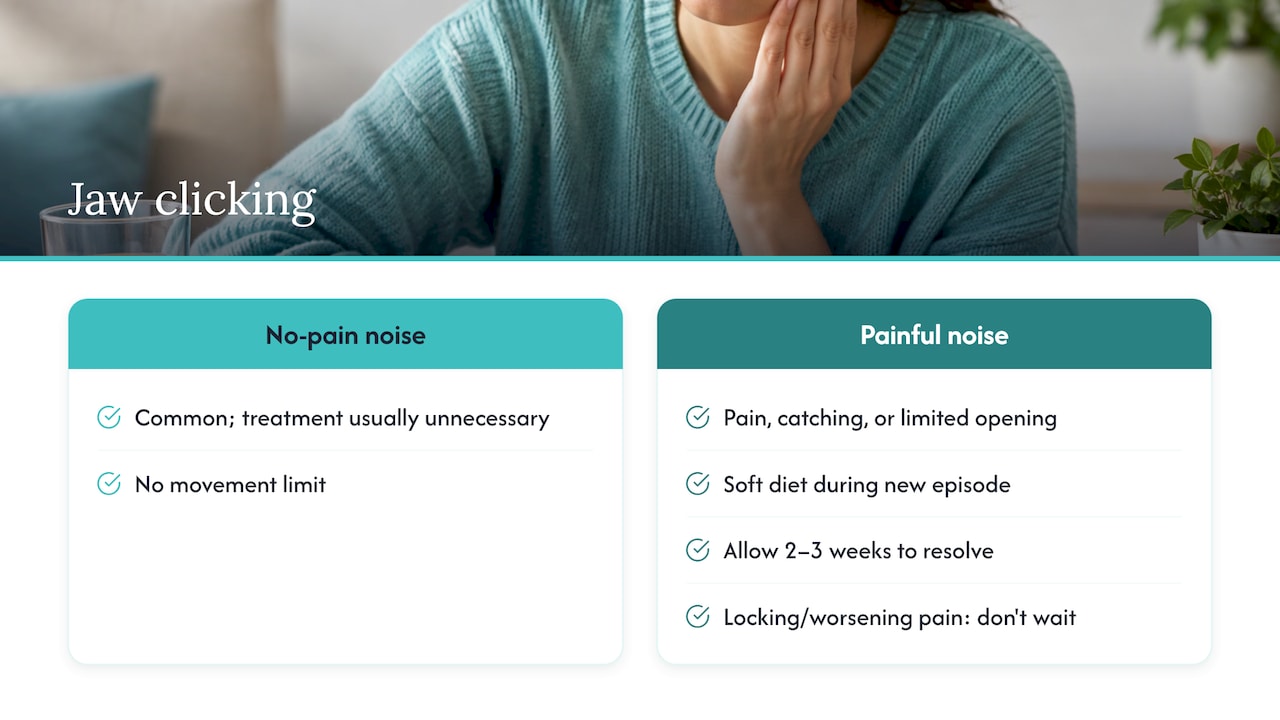
NIDCR says clicking or popping in the TMJs without pain is common and does not require treatment, while painful clicking, popping or grating when you open or close may signal a TMD. Mayo Clinic agrees: if there is no pain or limit in movement tied to the clicking, treatment is likely not needed.
So the question is not whether your jaw makes noise but whether the noise comes with pain, catching or limited opening. If it does, University of Utah Health quotes a specialist advising a softer diet to reduce jaw function during a new episode, and giving a first episode two to three weeks to resolve on its own before seeing a dentist. A jaw that locks, or clicking that keeps getting more painful, should not wait that long.
Safe relief you can start today
Most first-line care is simple. Mayo Clinic recommends:
- Heat or ice. Apply warm, moist heat or an ice pack to the side of the face for 15 to 20 minutes, several times a day. Ice suits acute pain, and heat suits chronic, dull pain.
- Soft foods. Think eggs, yogurt, soup, pasta, mashed vegetables and smoothies.
- Small bites. Cut food into small pieces so you open less and chew less.
- No sticky or chewy foods or gum. Caramel, bagels, jerky and gum all load the joint.
- Don’t open wide. Keep yawns and big bites modest, and chew on both sides.
- Gentle stretching and massage. Mayo Clinic says combining heat or ice with stretching has been found to be very effective.
NIDCR adds that over-the-counter pain relievers such as NSAIDs (ibuprofen, for example) may be used, and that cutting back on clenching, gum chewing and nail biting helps. Check the label, and ask your doctor or pharmacist first if you have stomach, kidney or heart conditions or take blood thinners.
Gum deserves its own mention. Cleveland Clinic explains that the side-to-side motion puts extra force on TMJ muscles, and a specialist there recommends limiting gum in general and stopping it if you have persistent jaw issues.
Hands-on care can also be part of the picture for some people. If you are exploring options beyond the dental chair, chiropractic care for TMJ pain is one approach people look into for easing muscle tension.
Habits that quietly make it worse
Mayo Clinic advises becoming more aware of stress-linked habits like clenching, grinding and chewing pencils, and avoiding overuse of the jaw muscles. A simple check: lips together, teeth apart, tongue resting lightly on the roof of your mouth. If your teeth are touching during the day while you are not eating, that is clenching. Set a phone reminder for a week to catch it.
Our perspective: find the source before you treat the symptom
When someone calls us with jaw pain while chewing, the most useful thing we can do is work out which structure is hurting. Jaw pain is a symptom, and the same ache can come from a joint, a muscle, a cracked molar or an infection under a tooth. Treating the wrong one wastes weeks.
That is why we start with a thorough exam and, when it is warranted, x-rays. We look at your teeth, gums and bite, listen to how your jaw moves and ask about habits, stress and sleep. Our approach is built around individualized care plans, so the plan follows what we actually find, not a template.
If the cause is dental, we can usually act on it. Our general dentistry covers exams, x-rays and fillings, and our restorative services include crowns, root canal therapy and extractions for teeth that can’t be saved. Because we offer same-day emergency care, a tooth that is making chewing miserable does not have to wait on a long appointment calendar.
We also know that jaw pain and dental anxiety often go hand in hand. Tense visits tighten the jaw. We aim for a calm, family-friendly office where you can ask questions and understand every step before we begin.
the author
What a dentist or doctor will do
According to Mayo Clinic, a provider will discuss your symptoms, listen to and feel the joint as you open and close, check your range of motion and press around the jaw for tender spots. Dental x-rays, CT or MRI may be needed.
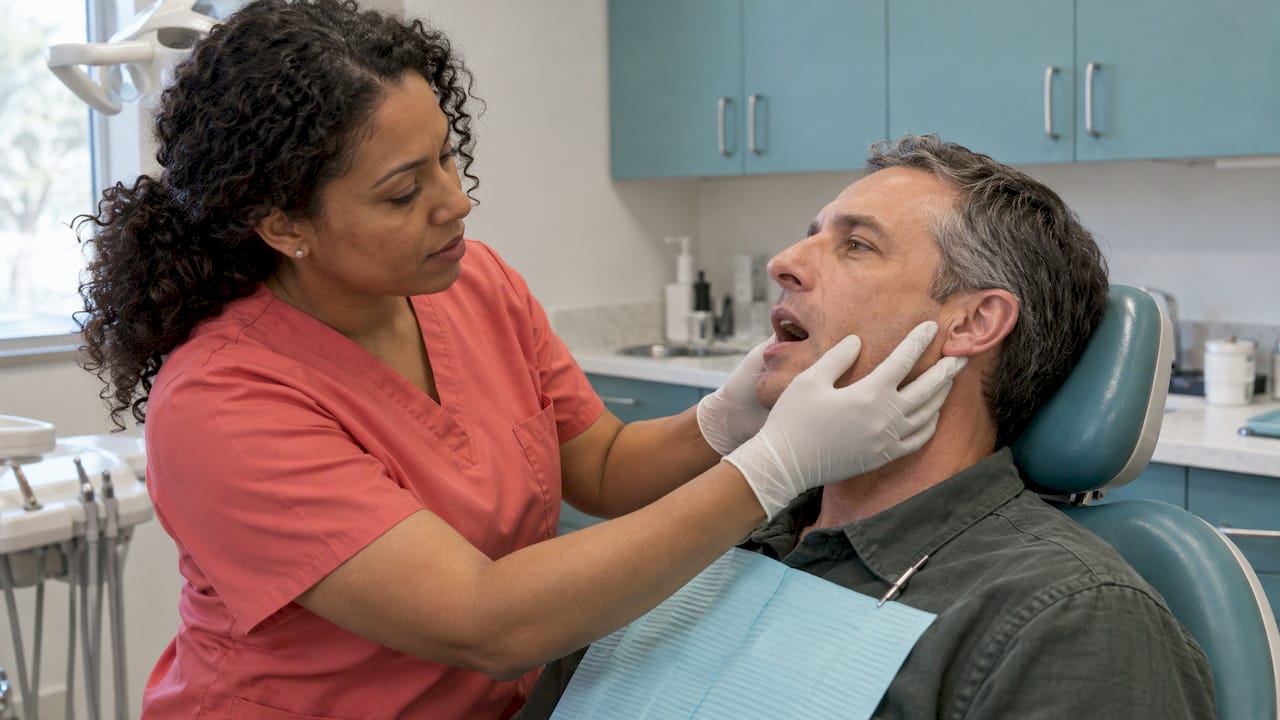
There is no single test. NIDCR states that no widely accepted standard test exists for TMDs and that symptoms overlap with other conditions, so the provider takes a detailed history and examines the head, neck, face and jaw.
Treatments, from gentle to more involved
Because evidence for many TMD treatments is limited, NIDCR says experts recommend conservative treatments and avoiding ones that permanently change the jaw joints, teeth or bite, or that involve surgery. Common conservative options, per Mayo Clinic:
- Self-care: heat or ice, no clenching, gum chewing or nail biting, and a relaxed resting jaw posture
- Oral splints or mouth guards
- Physical therapy, including stretching and strengthening exercises
- Counseling about behaviors and factors that worsen pain
MedlinePlus adds that if self-care is not enough, a provider may suggest physical therapy, cognitive behavioral therapy and biofeedback, medicines, or an oral splint. If your exam points to a joint or muscle disorder rather than a tooth, your dentist can talk through which of these routes fits, and which professional to see for it.
When jaw pain is an emergency
Most jaw pain is not dangerous, but a few situations are. Cleveland Clinic says severe jaw pain from a broken or dislocated jaw is a medical emergency. MedlinePlus says a broken or dislocated jaw needs prompt medical attention, and that difficulty breathing or heavy bleeding means calling 911 or your local emergency number.
The heart is the other big one. The American Heart Association lists pain or discomfort in the jaw, neck or back as a common heart attack warning sign and says to call 911 right away. Harvard Health quotes a physician explaining that heart-related jaw pain can occur without chest pain or shortness of breath, and that sudden neck and lower jaw pain can be an emergency, especially with known heart problems.
Call 911 rather than a dental office if:
- Jaw pain starts in your chest or shoulders and moves up
- You think your jaw is broken or dislocated
- You have trouble breathing or swallowing, or heavy bleeding
- Your jaw is locked and you cannot open or close it
Call a dentist the same day if
You have swelling in the face or gums, a fever along with a toothache, pain that wakes you at night, or pain on one tooth that makes eating impossible. Those are signs of a dental problem that is not going to improve with a soft diet. Our toothache remedies guide covers what to do while you wait for your visit.
How to head off jaw strain
Cleveland Clinic’s prevention advice is practical: protect your jaw from injury with a seatbelt and protective headgear for contact sports, keep up with brushing, flossing and regular dental checkups, and manage stress, since grinding may be the reason you hurt.
Regular checkups matter here because a dentist can spot worn enamel, chipped teeth and gum changes that hint at grinding or early decay before they become a painful chew. Our general dentistry visits include exams and x-rays for exactly that.
Get your jaw pain checked in Littleton
If chewing hurts and you are not sure why, we can help you find out. At South Littleton Family Dental, we treat patients of all ages, from kids to seniors, and we offer same-day emergency dental care when pain can’t wait. Whether the answer is a filling, a crown, a root canal or an extraction, we explain your options clearly and build a plan around you.

If a tooth is the likely culprit, start with emergency dentistry. If the pain is mild and you want a full look at your teeth, gums and bite, book a general dentistry exam. Restorative options for damaged teeth are on our restorative dentistry page.
FAQ
How do I fix jaw pain while chewing?
Start with soft foods, small bites, no gum, and ice or warm, moist heat for 15 to 20 minutes several times a day, as Mayo Clinic recommends. Cut back on clenching and nail biting. If the pain lasts more than a week, or you notice swelling or a painful tooth, see a dentist or doctor.
How do I reset my TMJ?
There is no reliable way to pop a joint back into place yourself, and forcing it can irritate it further. Gentle stretching and massage, heat or ice, and a relaxed resting jaw are the safe steps. A jaw that is stuck open or locked shut needs prompt medical care, not home manipulation.
When should I be concerned about jaw pain?
Be concerned if it lasts more than a week, comes with swelling or fever, or follows an injury. Call 911 if you think your jaw is broken or dislocated, or if the pain spreads from your chest to your jaw, as Cleveland Clinic advises.
Does jaw clicking need treatment?
Not if it is painless. NIDCR says clicking or popping without pain is common and does not require treatment. Painful clicking, grating, catching or limited opening is worth having examined.
Why does my jawline hurt when I chew?
Pain along the jawline can come from tired chewing muscles, a TMJ disorder, a back tooth, a wisdom tooth or gum infection. Where it hurts and what triggers it help narrow the cause, and an exam with x-rays can confirm whether a tooth is involved.
Sources
- Jaw Pain: Common Causes and How To Treat It, Cleveland Clinic
- TMJ disorders: Symptoms and causes, Mayo Clinic
- TMJ disorders: Diagnosis and treatment, Mayo Clinic
- Temporomandibular Disorders, Merck Manual Consumer Version
- Jaw Pain & Teeth Grinding, MouthHealthy (ADA)
- TMD, NIDCR
- Temporomandibular Disorders, MedlinePlus
- Broken or dislocated jaw, MedlinePlus Medical Encyclopedia
- Temporomandibular Joint Disorders, American Academy of Family Physicians
- Why Your Jaw Pops or Clicks, University of Utah Health
- How To Relieve TMJ Pain at Home, Cleveland Clinic
- Common Heart Attack Warning Symptoms, American Heart Association
- Is that dental pain an emergency? Harvard Health