
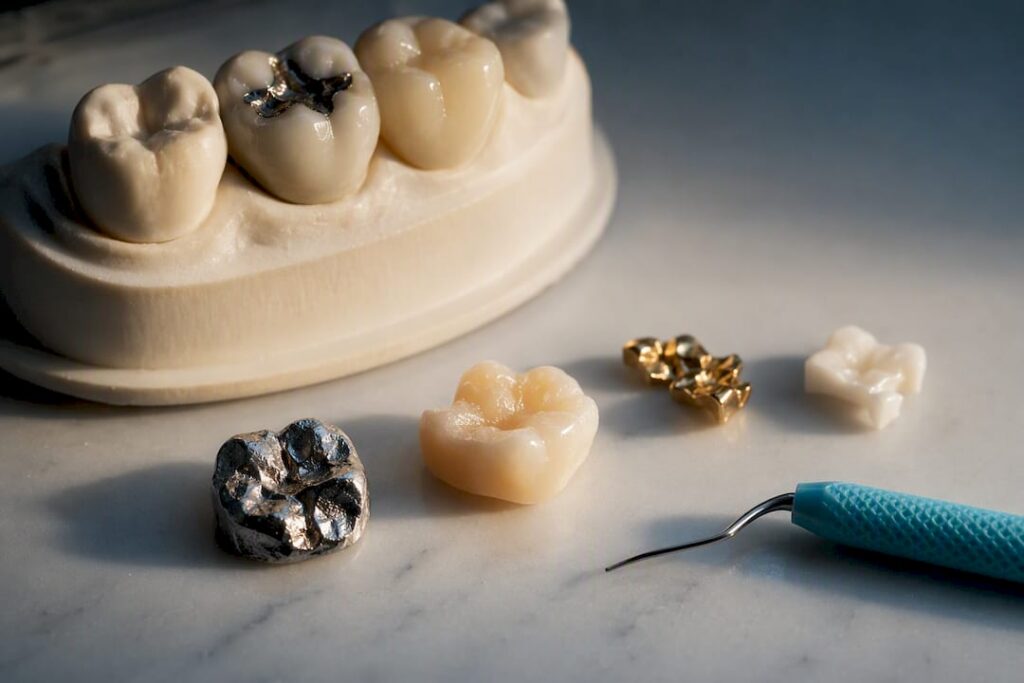
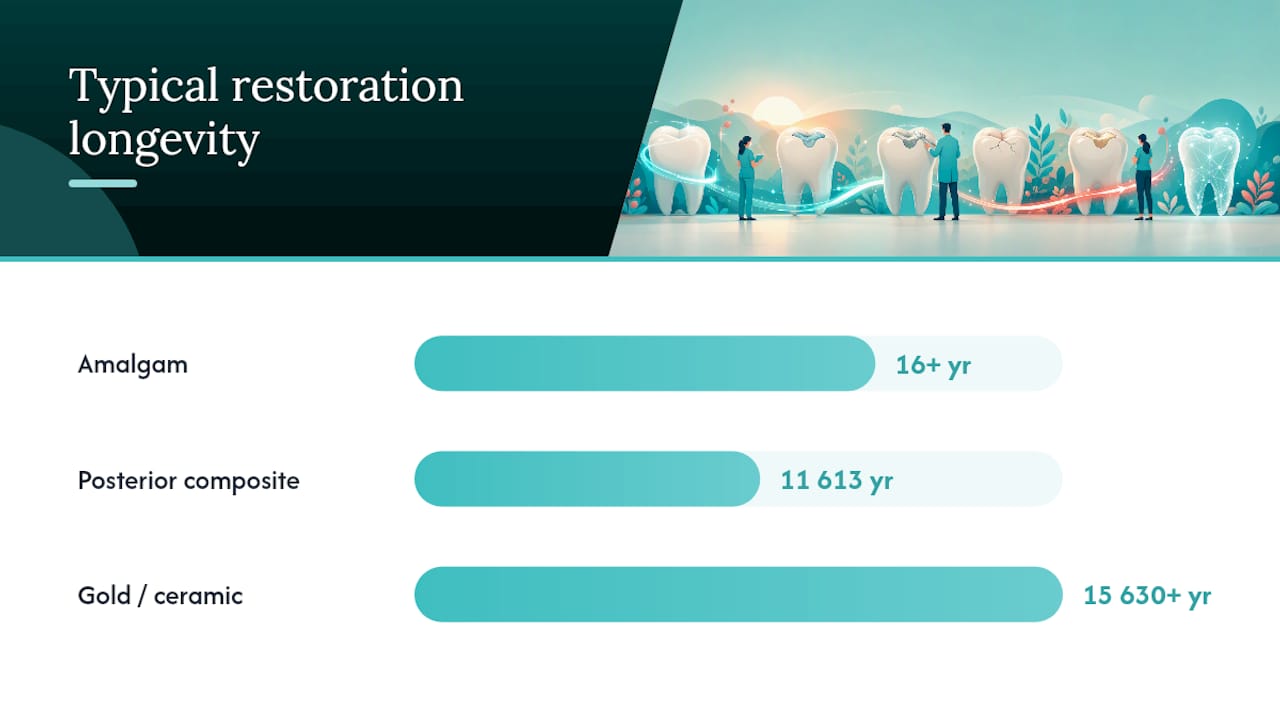
Amalgam fillings hold up longest, with a median survival topping 16 years and roughly 94.5% still intact at 7 years. Composite fillings run shorter, with a median around 11 to 13 years. Gold and ceramic restorations often outlast both, lasting many years, while glass ionomer fillings are built for short-term or pediatric use. Actual lifespan swings with tooth location, restoration size, your bite, and how well your dentist placed it, which is exactly why regular exams catch trouble before it becomes a bigger problem.
TL;DR:
- Amalgam fillings typically last over 16 years, with around 94.5% still intact after 7 years, making them the most durable option.
- Composite fillings last approximately 11 to 13 years, but their longevity heavily depends on placement technique and patient hygiene.
- Large restorations or those in high-stress areas are better suited for gold or ceramic, which can last up to 30 years, unlike glass ionomer fillings that often wear out within a few years.
- Filling failure is most commonly caused by secondary caries and fractures, often influenced by bacterial activity, grinding habits, and the size or location of the restoration.
- Repair is preferable to replacement when defects are small, as it conserves tooth structure and reduces long-term risk of fracture or further decay.
Table of Contents
- Types of Fillings and How Long Each One Typically Lasts
- Why Fillings Fail: The Main Causes and Risk Factors
- How Dentists Decide to Repair or Replace a Filling
- How to Extend the Life of a Filling
- What Happens If a Filling Needs to Be Replaced
- Repair First When Possible: A Clinical Rationale
- Our Take: Don’t Wait for Pain to Get a Filling Checked
- Fillings, Repairs, and Same-Day Care at South Littleton Family Dental
- Sources
Types of Fillings and How Long Each One Typically Lasts
Not all fillings age the same way, and the material matters more than most patients realize when they’re picking one.
Amalgam (the silver-colored metal filling) remains the durability benchmark. A widely cited analysis of restoration longevity found amalgam’s median survival exceeds 16 years, with a high percentage of amalgam fillings still functioning several years after placement. It handles chewing forces well, doesn’t shrink or crack easily, and tends to fail slowly rather than suddenly. The tradeoff is cosmetic. Nobody mistakes a silver filling for a natural tooth.
Composite resin, the tooth-colored option most patients request today, doesn’t match amalgam’s longevity but has closed the gap significantly with better bonding chemistry. The same longevity analysis put posterior composite median survival at 11 to 13 years, with roughly 82.2% surviving 10 years. A large US practice-based study tracking real-world outcomes found posterior composite restorations to have median survival in the early teens of years (https://pubmed.ncbi.nlm.nih.gov/38190879/) for posterior composite restorations, though that number drops for molars and for teeth with more restored surfaces. A two-surface filling on a front tooth behaves very differently than a five-surface filling on a lower molar.
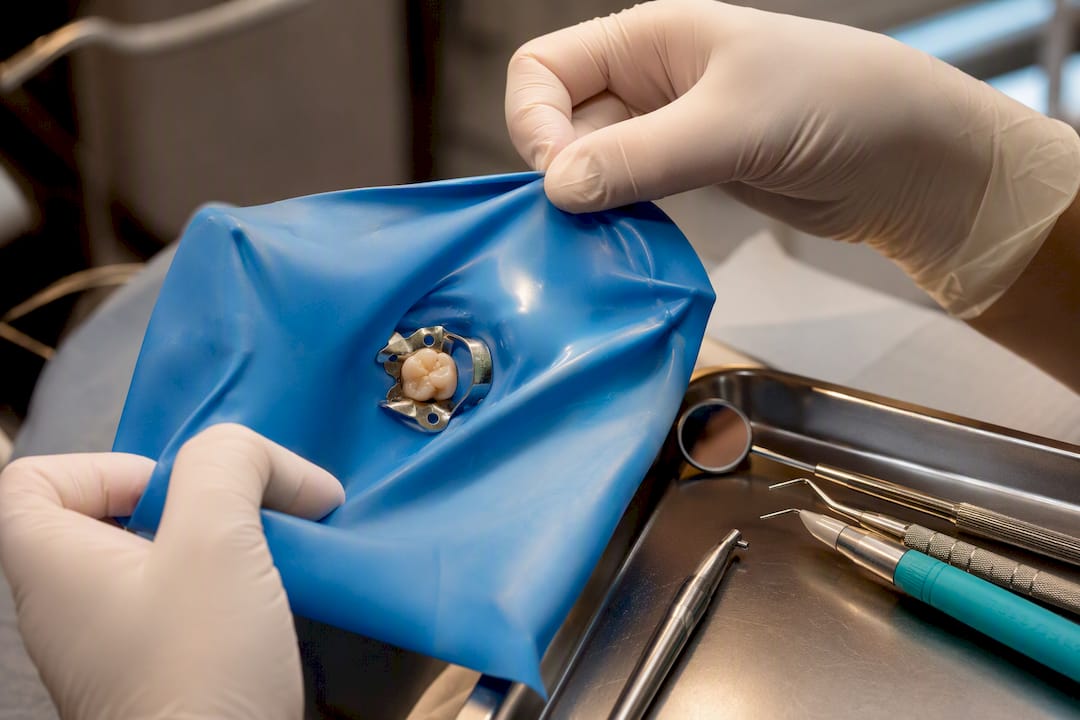
Technique matters here as much as the material itself. A systematic review of composite failure rates found annual failure rates vary widely depending on technique and patient factors, and concluded that differences between specific composite products played a minor role compared to placement technique and patient factors like hygiene and bruxism. Isolation during placement, meaning keeping the tooth completely dry with a rubber dam, has an outsized effect on how well the bond holds up over years.
Gold and ceramic restorations (onlays, inlays, and cast fillings) sit at the top end of the durability scale, often lasting 15 to 30 years or longer. Dentists typically reserve these for larger restorations where a standard filling would leave too little tooth structure, or for patients who grind their teeth and need something that resists wear.
Glass ionomer and resin-modified glass ionomer (RMGI) fillings wear out fastest, often within a few years. They release fluoride and bond chemically to tooth structure, which makes them useful for pediatric teeth, root surfaces, and high-caries-risk patients, but nobody should expect them to last as long as composite or amalgam.
Quick comparison of what each material trades off:
- Amalgam: longest track record, strongest under chewing force, least cosmetic.
- Composite: natural appearance, moderate durability, highly technique-sensitive.
- Gold/ceramic: best longevity, highest cost, used for larger or high-stress restorations.
- Glass ionomer: shortest lifespan, best for temporary or pediatric situations.
Why Fillings Fail: The Main Causes and Risk Factors
Fillings rarely fail because the material simply “wears out” the way a tire does. They fail for specific, identifiable reasons.
Secondary caries, new decay forming at the edge of an existing filling, is the leading cause of failure across nearly every material type. A review of what drives restoration longevity found that secondary caries and fractures account for a large share of restoration failures, with high caries risk and grinding habits repeatedly showing up as major contributors. Bacteria find a microscopic gap at the filling margin, decay creeps underneath, and by the time it’s visible on an X-ray, it’s often larger than it looks.
Other common failure patterns include:
- Fracture of the filling or the surrounding tooth under biting force.
- Marginal breakdown, where the seal between filling and tooth degrades over time.
- Loss of retention, when the filling simply detaches.
- Wear from grinding or clenching (bruxism).
Patient-level risk factors compound these mechanical problems. High sugar intake, dry mouth from medications, inconsistent brushing, and untreated grinding all shorten a filling’s working life regardless of what it’s made of. Tooth-level factors matter too. Molars carry more chewing load than front teeth, and restorations covering more surfaces fail earlier on average.
How Dentists Decide to Repair or Replace a Filling
A filling’s age alone doesn’t determine whether it needs work. Clinical guidance from the Journal of the American Dental Association is explicit that replacing a restoration solely because of its age is not recommended, since it sacrifices healthy tooth structure unnecessarily.
Here’s roughly how that evaluation happens during a checkup:
- Visual inspection for staining, cracks, or gaps at the margin.
- Explorer probe to feel for softness, ledges, or catch points along the edge.
- Bite test to check for sensitivity that might signal a crack.
- Radiographs to spot decay underneath the filling that isn’t visible to the eye.
Clear signs that a filling needs attention include visible decay at the margin, a cracked or chipped edge, pain when biting, or new shadows on an X-ray. When the defect is small and localized, many dentists will repair it with a bit of flowable composite rather than removing the entire filling, a conservative approach that preserves far more of your natural tooth. Full restorative work only becomes necessary when decay or fracture extends beyond what a localized repair can fix.
Pro Tip: At your next checkup, ask your dentist to show you the X-ray of any filling they’re concerned about. Seeing the shadow yourself makes it much easier to understand why repair or replacement is being recommended.
How to Extend the Life of a Filling
Fillings don’t fail on a fixed schedule. What you do daily has a measurable effect on how long they last.
Brushing twice daily with fluoride toothpaste and flossing to clean between teeth reduces the bacterial buildup that causes secondary decay at filling margins. Interdental brushes or water flossers help reach spots a regular brush misses, particularly around back teeth with multi-surface restorations.
Diet plays a bigger role than most people expect. Frequent snacking on sugary or acidic foods keeps your mouth in an acidic state for hours longer than the same amount of sugar eaten in one sitting. Spacing out sugary drinks and snacks, rather than sipping soda all afternoon, genuinely protects filling margins.
On the professional side:
- Keep to your recommended recall interval so small problems get caught early.
- Ask about topical fluoride treatments if you’re at elevated caries risk.
- Consider sealants on unrestored molars to prevent new decay nearby.
- Get fitted for a nightguard if you grind or clench, since bruxism is one of the fastest ways to crack a filling.
Dry mouth, whether from medication or a medical condition, also raises decay risk around existing restorations. Mention it to your dentist, since it can change how often you should be seen.
Pro Tip: If you wake up with a sore jaw or notice your fillings feel “high” some mornings, that’s a strong sign of nighttime grinding, even if you’ve never been told you have bruxism.
What Happens If a Filling Needs to Be Replaced
Replacement is usually a straightforward, single-visit procedure, though what replaces the old filling depends on how much healthy tooth remains.
- Local anesthesia numbs the area.
- The old filling and any decayed tissue are removed.
- The dentist evaluates remaining tooth structure and preps the cavity.
- A new filling, onlay, or crown is placed and shaped to your bite.
When a tooth has lost significant structure across multiple replacements, a crown or onlay often replaces the filling entirely, since a large filling in a heavily worked tooth is prone to fracture. If decay has reached the nerve, root canal treatment may be needed before any new restoration goes in. Costs vary widely depending on material and whether insurance covers restorative work, so it’s worth asking for an estimate before treatment. Mild sensitivity for a few days after replacement is normal; pain that worsens or persists beyond a week or two is a signal to call your dentist.
Repair First When Possible: A Clinical Rationale
Evidence supports a conservative approach: when a defect is small and localized, repairing it preserves tooth structure far better than removing and replacing the entire restoration, a principle backed by ADA and JADA guidance. Removing more tooth than necessary weakens it long-term, even when the new filling looks perfect on day one.
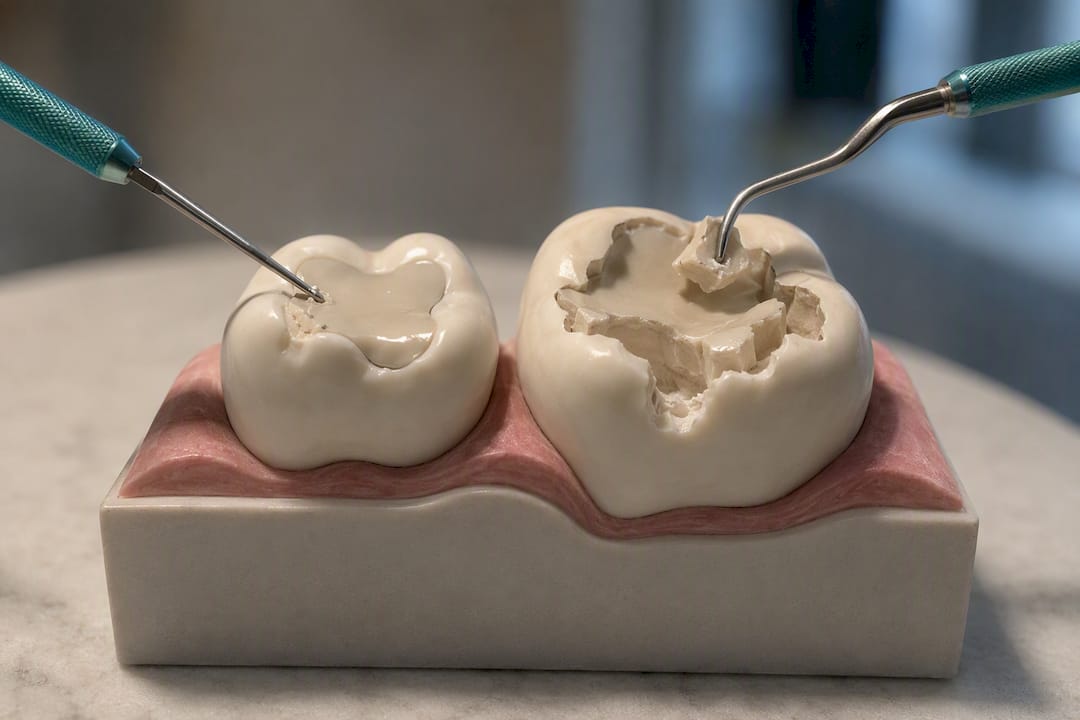
At South Littleton Family Dental, this shows up in how appointments are actually run. Same-day evaluations mean a cracked margin or new sensitivity doesn’t sit unaddressed for weeks, and treatment plans are built around what an individual tooth actually needs rather than a one-size-fits-all protocol…
Our Take: Don’t Wait for Pain to Get a Filling Checked
The biggest misconception about filling failure is that it announces itself. It usually doesn’t. Secondary decay grows quietly under a margin for months before a patient feels anything, which is exactly why the explorer probe and radiograph matter more than how a filling looks or feels day to day.
What we’d push back on is the instinct to replace a filling just because it’s old. A 12-year-old amalgam that’s still sealed tight and shows nothing on an X-ray doesn’t need to come out. Pulling sound restorations removes healthy tooth structure for no clinical benefit, and the evidence backs leaving it alone. The right question isn’t “how old is this filling?” It’s “what does the exam actually show?”
If you’re due for a checkup or something feels off with an old filling, that’s worth acting on sooner rather than later.
— Admin
Fillings, Repairs, and Same-Day Care at South Littleton Family Dental
If you’re noticing sensitivity around an old filling or just haven’t had one checked in a while, South Littleton Family Dental in Littleton, CO builds every restorative visit around what your specific tooth needs, not a standard script. That means an actual exam with radiographs before anyone talks about replacement, and a preference for conservative repair when the evidence supports it.

The practice handles the full range of restorative needs, from routine general dentistry checkups that catch problems early, to full restorative dentistry when a filling has genuinely reached the end of its life. If a filling is causing pain right now, same-day emergency care means you don’t have to wait weeks for relief. Ready to get an old filling checked? Schedule an exam with South Littleton Family Dental and find out exactly where things stand.
Sources
Key research behind this guide: restoration survival data, US practice-based outcomes, failure-cause analysis, and ADA amalgam guidance.
This article is general information, not a substitute for advice from a qualified doctor. Consult a qualified healthcare professional about your own circumstances before acting on anything here.