
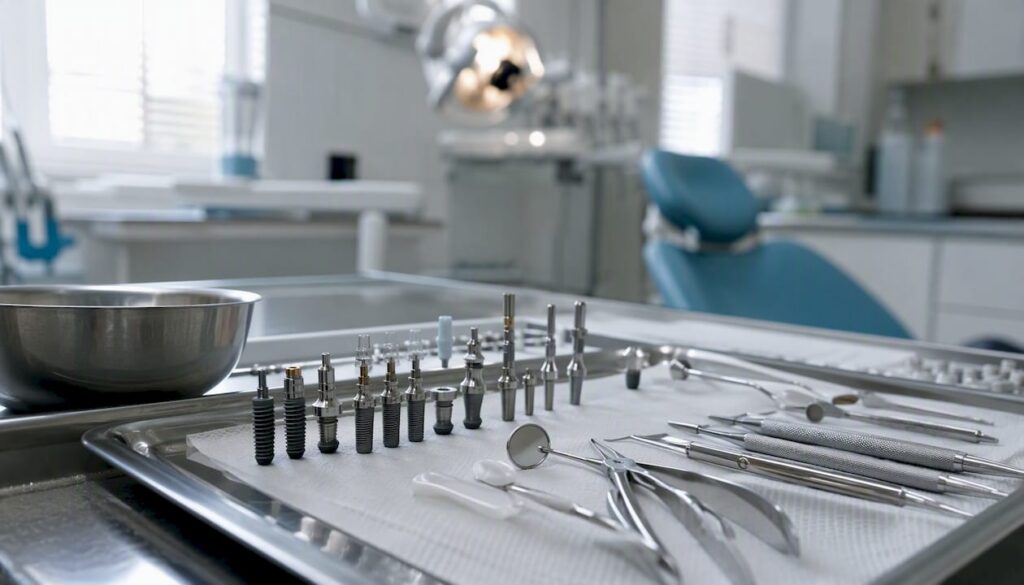
All-on-4 dental implants replace an entire arch of teeth with a fixed prosthesis anchored by just four implants, and for adults with edentulous jaws or failing dentition, they can mean walking out of surgery with provisional teeth the same day. The Nobel Biocare All-on-4 treatment concept was designed specifically as a graftless, immediate-load solution for atrophic jaws where traditional implant placement would otherwise require bone grafting first. A longitudinal study of 245 patients followed up to 10 years reported implant survival rates around 98% at five years and prosthesis survival rates near 99%, figures that put All-on-4 among the better-documented full-arch protocols in the literature.
Three things to know before you read further:
- Same-day provisional teeth are possible when implants achieve insertion torque above the recommended clinical threshold at surgery, but the final prosthesis comes months later after osseointegration.
- Fewer implants, less surgery is the core tradeoff: tilted posterior implants maximize bone contact and anterior-posterior spread without grafting in many cases, but the cantilever design creates specific biomechanical demands.
- Long-term outcomes are strong in well-selected patients, though most failures cluster in the first 12 months, and maintenance is non-negotiable for the life of the restoration.
Key Takeaways
All-on-4 dental implants offer a clinically documented, fixed full-arch solution for edentulous adults, with implant survival rates near 98% at five years in well-selected patients, but long-term success depends on careful candidacy screening, surgical precision, and lifelong maintenance.
| Point | Details |
|---|---|
| Core definition | All-on-4 uses four implants to support a full-arch fixed prosthesis, often with same-day provisional teeth when torque exceeds 35 Ncm. |
| Candidacy cue | Best candidates have adequate anterior bone, controlled systemic health, and realistic expectations about the provisional-to-final timeline. |
| Outcomes evidence | A 10-year longitudinal study reported approximately 98% implant survival at five years and approximately 99% prosthesis survival in selected mandibular cases. |
| Key question to ask | Ask your provider what their protocol is if an implant fails during integration, and confirm the definitive prosthesis cost is included in the quoted fee. |
| Southlittletonfamilydental | Offers All-on-4 candidacy evaluations in Littleton, CO, including CBCT review, individualized treatment planning, and financing discussion. |
Table of Contents
- How do all-on-4 dental implants actually work, step by step?
- Who is a good candidate for All-on-4, and who should wait?
- What are the real benefits of All-on-4, and what are the tradeoffs?
- What does the All-on-4 timeline actually look like?
- What do clinical studies say about All-on-4 risks and long-term outcomes?
- What does All-on-4 cost in the U.S., and how do you finance it?
- How does All-on-4 compare to other full-arch options?
- How do you choose the right provider for All-on-4?
- Post-operative care and maintenance for All-on-4 implants
- Complications beyond the basics: what can go wrong and how it’s managed
- How long does an All-on-4 prosthesis actually last?
- What patients actually feel, and how to prepare
- Ready to find out if All-on-4 is right for you?
- What the evidence actually tells you about All-on-4
- Sources
How do all-on-4 dental implants actually work, step by step?
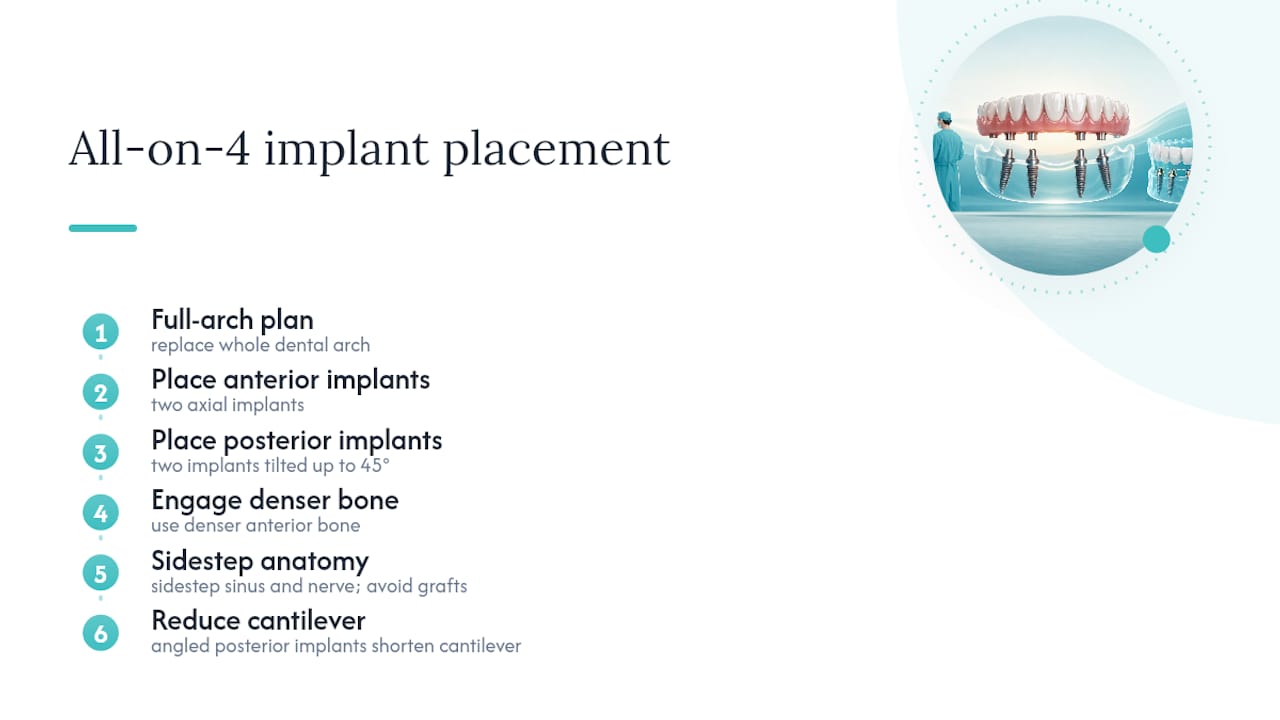
The procedure replaces a full arch using two anterior implants placed axially and two posterior implants tilted up to 45 degrees. Tilting the posterior pair lets the surgeon use longer implants in denser anterior bone, increases the anterior-posterior spread, and sidesteps the maxillary sinus or the inferior alveolar nerve without grafting in many cases. A prosthodontic review of the All-on-4 concept explains this rationale clearly: angled posterior implants reduce cantilever length while avoiding anatomic obstacles, which is the geometric logic behind the whole system.
Surgical planning
Planning starts with a cone-beam CT scan (CBCT) that maps bone density, height, and the location of critical anatomy. The surgeon and prosthodontist use that imaging to create a digital treatment plan, often with a surgical guide, and a diagnostic wax-up helps preview the final tooth position. This step determines whether any extractions, bone leveling, or a shelf preparation will be needed on surgery day.
Surgery day
- Extractions of remaining teeth (if present) are completed first.
- The surgeon levels the alveolar crest and creates the All-on-4 shelf, a flat bone platform that helps the provisional prosthesis seat passively.
- Four implants are placed: two anterior, two posterior at a tilt.
- Insertion torque is measured at each implant. The consensus clinical recommendations set the threshold at above 35 Ncm for immediate loading to proceed safely.
- A rigid provisional prosthesis, typically milled from acrylic or PMMA, is delivered the same day when that torque threshold is met.
Prosthetic workflow
- Day 0: Provisional prosthesis seated and adjusted for bite.
- Weeks 1–12: Healing and osseointegration; the provisional stays in place.
- Months 3–6: Impressions or digital scans for the definitive prosthesis.
- Final delivery: A milled titanium framework with acrylic teeth, or a monolithic zirconia bridge, is fitted and verified for passive fit using a verification jig before cementation or screw retention.
Who does what: The oral surgeon or periodontist handles implant placement and any extractions. The prosthodontist or restorative dentist designs the prosthesis, manages occlusion, and delivers both the provisional and the final restoration. A dental lab fabricates the frameworks. These roles sometimes overlap in a single specialist, but the best outcomes tend to come from a coordinated team.
Pro Tip: Ask your provider to confirm passive fit with a verification jig before the final prosthesis is fabricated. A poorly fitting framework puts stress on implants during integration and is one of the more preventable causes of early mechanical complications.
Who is a good candidate for All-on-4, and who should wait?
The typical candidate is an adult with a fully edentulous arch or dentition that is failing beyond restoration, who is in generally good systemic health. Adequate anterior bone between the mental foramina (mandible) or in the premaxilla (maxilla) is the anatomic prerequisite. You can review dental implant candidacy criteria in more detail, but the core screen comes down to bone volume, systemic health, and lifestyle factors.
Likely candidates:
- Fully edentulous upper or lower arch
- Multiple failing teeth requiring full-arch extraction
- Patients who cannot tolerate removable dentures (poor retention, gagging, bone resorption)
- Adequate anterior bone volume without requiring extensive grafting
Contraindications and risk factors to discuss with your provider:
- Uncontrolled diabetes (elevated HbA1c impairs healing and osseointegration)
- Active heavy smoking (significantly raises implant failure risk)
- Untreated periodontal disease in remaining teeth or opposing arch
- Severe bruxism or parafunction (increases mechanical stress on the provisional and final prosthesis)
- Recent head or neck radiation (compromises bone vascularity)
- Active bisphosphonate therapy or other medications affecting bone metabolism
Some of these are modifiable. Smokers who quit before surgery improve their odds. Diabetics whose blood sugar is brought under control before placement can often proceed. The point is not that these factors disqualify you automatically, but that they require honest conversation with your surgeon before committing.
Regarding bone grafting: Tilting the posterior implants and maximizing anterior-posterior spread reduces the need for sinus lifts and ridge augmentation in many atrophic cases. When anterior bone is also deficient, staged grafting followed by delayed loading may be the safer path. Bone grafting and socket preservation can restore candidacy for patients who would otherwise be excluded.
What are the real benefits of All-on-4, and what are the tradeoffs?
All-on-4 delivers a fast, fixed solution with fewer fixtures than traditional full-arch implant plans, but the biomechanics of a four-implant cantilever design create specific demands that patients need to understand before signing a consent form.
Benefits:
- Fixed teeth the same day of surgery (when insertion torque criteria are met)
- Fewer implants than traditional full-arch plans, which shortens surgical time and reduces cost
- Graftless workflow in many atrophic cases, eliminating a separate surgical stage
- Dramatically improved function and stability compared to removable dentures
- Preserved facial structure by maintaining bone stimulation
Limitations:
- Provisional acrylic prostheses fracture at a meaningful rate; clinical reports identify provisional fracture as one of the most common early complications
- Cantilever biomechanics place higher stress on posterior implants, particularly in patients with parafunction
- Hygiene is more demanding than with natural teeth; specialized tools are required for daily cleaning under the bridge
- The definitive prosthesis represents a significant additional cost beyond the implant surgery itself
- Patients with very poor bone or severe parafunction may not be suitable without additional implants
Common misconception: “All-on-4 always avoids bone grafting.” In reality, the graftless advantage applies when adequate anterior bone exists. Patients with severe maxillary atrophy may still need sinus augmentation or zygomatic implants. A second misconception: “You leave with your final zirconia bridge on day one.” The day-of prosthesis is a provisional, typically acrylic, designed to protect healing implants. The definitive restoration comes after osseointegration, usually 3–6 months later.
What does the All-on-4 timeline actually look like?
The typical pathway runs from initial consult to definitive prosthesis in roughly 6–9 months, though the surgery-to-provisional step happens in a single day.
Pre-operative phase:
- Consultation, medical history review, and CBCT imaging
- Digital treatment planning and diagnostic wax-up
- Medical clearance if needed (diabetes management, smoking cessation counseling)
- Pre-surgical impressions or digital scans for provisional fabrication
Surgery day (Day 0):
- Anesthesia or sedation administered
- Extractions and bone leveling completed
- Four implants placed and torque verified
- Provisional prosthesis seated and bite adjusted
- Post-operative instructions given; patient goes home with fixed teeth
Early healing (Weeks 1–8):
- Soft diet only: no hard, crunchy, or chewy foods
- Avoid biting directly into food with the front teeth
- Rinse with prescribed antimicrobial mouthwash; no vigorous swishing
- Attend one-week and two-week follow-up appointments for suture removal and occlusal checks
Integration period (Months 1–3):
- Gradual diet progression as directed by your provider
- Avoid heavy biting forces and grinding
- Professional hygiene visits every 3 months during this window
Definitive prosthesis phase (Months 3–6):
- Final impressions or digital scans taken
- Verification jig confirms passive fit before fabrication
- Definitive prosthesis delivered, adjusted, and documented
Ongoing maintenance: Professional hygiene recalls every 3–6 months, annual radiographic review, and periodic prosthetic maintenance checks are standard for the life of the restoration.
What do clinical studies say about All-on-4 risks and long-term outcomes?
Published data on All-on-4 is more robust than for most full-arch protocols, though the quality of evidence varies across studies. The honest picture is high survival in well-selected patients, with biological and mechanical complications that are manageable but real.
Survival data from key studies
The Patzelt systematic review is worth reading carefully: it found promising short-term results but noted that most failures cluster within the first 12 months and called for higher-quality long-term randomized studies. That context matters when a provider quotes you a survival rate without specifying the follow-up window.
Risk reduction checklist
- Patient selection: Manage diabetes to target HbA1c before surgery; counsel smokers to quit at least 8 weeks prior
- Surgical execution: Achieve above 35 Ncm insertion torque at all four implants before loading, per consensus recommendations
- Prosthetic design: Use a rigid provisional with balanced occlusion; avoid cantilever lengths beyond published biomechanical thresholds
- Hygiene: Daily cleaning under the bridge with water flossers, interdental brushes, and floss threaders
- Follow-up: Professional recalls every 3–6 months to catch peri-implant inflammation early
The AAID discussion of All-on-4 complications lists peri-implantitis, prosthesis fracture, and prosthesis bulkiness as the most common patient-reported problems. Peri-implantitis, in particular, is the biological complication most likely to threaten long-term implant survival if left unmanaged.
What does All-on-4 cost in the U.S., and how do you finance it?
All-on-4 pricing in the U.S. varies considerably based on provider experience, geographic market, materials, and what additional procedures are required. You can get a practice-specific breakdown through a dental implants cost consultation, but the ranges below reflect what patients typically encounter.
Typical U.S. cost drivers:
- Per-arch range: Full-arch All-on-4 treatment commonly runs from roughly $20,000 to $40,000 per arch, with high-cost markets and premium materials pushing toward the upper end
- Material choices: An acrylic provisional is included in most quotes; the definitive prosthesis cost depends on whether you choose a titanium framework with acrylic teeth or a monolithic zirconia bridge (zirconia typically costs more)
- Additional procedures: Extractions, CBCT imaging, sedation, bone grafting, or sinus lifts are often billed separately and can add several thousand dollars to the total
- Provider type: A dual-specialist team (oral surgeon plus prosthodontist) may bill separately; a single-provider practice may bundle fees differently
What to confirm in any written estimate:
- Lab fees: included or separate?
- Number of follow-up visits covered in the quoted fee
- Provisional prosthesis cost versus definitive prosthesis cost
- Warranty or repair policy for prosthetic fractures
- Protocol and cost if an implant fails during integration
On insurance and financing: Most dental insurance plans treat implants as elective and cover little or nothing. Medical insurance occasionally contributes when tooth loss is trauma-related. In-office financing through third-party lenders such as CareCredit or Lending Club Patient Solutions is common. Ask your provider for a detailed treatment plan before applying for financing so you know the full number.
Pro Tip: Get itemized estimates from at least two providers. The quoted “all-in” number sometimes excludes the definitive prosthesis, which can be $5,000–$15,000 additional. A lower headline price that excludes the final bridge is not actually a lower price.
How does All-on-4 compare to other full-arch options?
All-on-4 sits in the middle of a spectrum. Understanding where it fits helps you have a more productive conversation with your provider.
| Option | Best for | Same-day teeth | Bone grafting needed | Cost direction vs. All-on-4 | Maintenance |
|---|---|---|---|---|---|
| All-on-4 | Atrophic arches, graftless candidates | Yes, when torque met | Often no | Baseline | High (specialized hygiene) |
| All-on-6 / more implants | Parafunction, longer cantilever concerns, denser bone | Yes, when torque met | Sometimes | Higher | High |
| Implant-retained overdenture | Limited budget, removable preferred, less bone | No | Sometimes | Lower | Moderate (removable for cleaning) |
| Conventional denture | Lowest budget, no surgery preferred | Immediate | No | Lowest | Low (removable) |
| Staged augmentation + delayed loading | Severe bone deficiency, high-risk patients | No | Yes | Higher total | High |
When a clinician may prefer an alternative:
- Severe bruxism or heavy parafunction often favors All-on-6 or additional posterior implants to shorten cantilever length and distribute occlusal load
- Patients who want the option to remove the prosthesis for cleaning may prefer an implant-retained overdenture, which snaps onto two to four implants and is removable
- Very atrophic maxillae with insufficient anterior bone may require zygomatic implants, which anchor in the zygomatic bone rather than the alveolar ridge
- Staged augmentation and delayed loading is the conservative choice when primary stability cannot be reliably achieved, or when systemic risk factors make immediate loading inadvisable
The restorative dentistry overview at Southlittletonfamilydental covers the range of restoration options available at the practice.
How do you choose the right provider for All-on-4?
The single most important variable in All-on-4 outcomes is provider skill and team coordination. High survival rates in published studies reflect carefully selected patients treated by experienced teams with rigorous protocols. The same procedure in less experienced hands produces different results.
Provider checklist:
- Documented experience with full-arch implant cases, not just single-tooth implants
- CBCT-based digital planning capability (see advanced technology at Southlittletonfamilydental)
- Clear prosthodontic involvement in treatment planning, not just surgical placement
- Before-and-after documentation of full-arch cases
- Transparent maintenance and warranty policy for the prosthesis
- In-office lab or a trusted external lab with experience in full-arch frameworks
Questions to ask at your consultation:
- How many All-on-4 cases have you placed, and can I see representative before-and-after documentation?
- Can you walk me through the CBCT-based treatment plan and show me the proposed anterior-posterior spread?
- What is your protocol if an implant fails to integrate?
- What materials do you use for the definitive prosthesis, and why?
- What does the warranty or repair policy cover for prosthetic fractures?
- Is the prosthodontist involved in planning before surgery, or only after implants are placed?
At Southlittletonfamilydental, All-on-4 consultations include CBCT review, individualized treatment planning, a cost estimate, and a financing discussion so patients understand the full picture before committing to any procedure.
Post-operative care and maintenance for All-on-4 implants
The provisional prosthesis is fixed, but it is not indestructible, and the habits you build in the first six months set the trajectory for long-term success.
Immediate post-operative period (Days 1–7):
- Eat only soft foods: yogurt, scrambled eggs, mashed potatoes, smoothies
- Sleep with your head elevated to reduce swelling
- Apply ice packs in 20-minute intervals for the first 48 hours
- Take prescribed antibiotics and anti-inflammatories as directed; do not skip doses
- Avoid alcohol, smoking, and straws for at least two weeks
Ongoing daily hygiene (for life):
- Use a water flosser daily to flush debris from under the bridge
- Clean under the prosthesis with interdental brushes or a floss threader with unwaxed tape floss
- Brush the prosthesis itself twice daily with a soft-bristle brush and non-abrasive toothpaste
- Avoid abrasive whitening toothpastes, which scratch acrylic and zirconia surfaces
Professional maintenance schedule:
- Every 3 months during the first year
- Every 6 months thereafter for most patients (more frequently if peri-implant inflammation is detected)
- Annual radiographic bone level assessment
- Periodic prosthetic maintenance: screw torque checks, occlusal verification, and prosthesis polishing
Patients with bruxism should wear a night guard over the prosthesis to reduce nocturnal loading. This is one of the more commonly skipped recommendations, and one of the more consequential ones for long-term prosthesis integrity.
Complications beyond the basics: what can go wrong and how it’s managed
The AAID’s clinical discussion identifies three categories of problems that show up repeatedly in All-on-4 patients: biological complications, mechanical/prosthetic failures, and patient-reported functional issues.
Peri-implantitis is the biological complication with the highest long-term stakes. It is an inflammatory condition around the implant that causes progressive bone loss, similar to periodontitis around natural teeth. Early signs include bleeding on probing, suppuration, and radiographic bone loss. Management depends on severity: non-surgical debridement and antimicrobial therapy for early cases, surgical intervention for advanced bone loss. Untreated peri-implantitis is the leading cause of late implant failure.
Provisional prosthesis fracture is the most common early mechanical complication, as documented in clinical reports on prosthetic complications. Acrylic is inherently brittle under occlusal load, and patients who bite into hard foods or grind at night during healing are at highest risk. A fractured provisional requires emergency repair to prevent unprotected loading of integrating implants. This is why dietary compliance during the healing phase is not optional.
Screw loosening occurs when the screws retaining the prosthesis to the implant abutments lose torque over time. It presents as a clicking or rocking sensation in the prosthesis. The fix is straightforward: retighten or replace the screw. Ignoring it allows micro-movement that can damage the implant-abutment interface.
Prosthesis bulkiness is a patient-reported complaint, particularly in the maxilla, where the prosthesis may feel thick against the palate or affect speech initially. Most patients adapt within weeks, but this is worth discussing with your prosthodontist during planning, since prosthesis contour can be modified to some degree.
Nerve-related symptoms such as altered sensation in the lip or chin are rare but possible, particularly in mandibular cases where the inferior alveolar nerve is nearby. Most cases resolve within weeks to months as post-surgical inflammation subsides.
How long does an All-on-4 prosthesis actually last?
The implants themselves, when they integrate successfully, can last decades with proper maintenance. The prosthesis is a different story, and this distinction matters for long-term budgeting.
Implant longevity: The 10-year longitudinal data showing approximately 98% implant survival at five years is the most cited benchmark. Implants that survive the first year and are maintained with regular hygiene and professional recalls have a strong track record.
Prosthesis replacement cycle:
- Acrylic/hybrid prostheses (titanium framework with acrylic teeth): acrylic teeth wear and chip over time. Most providers plan for prosthesis replacement or significant refurbishment every 10–15 years, though individual wear varies considerably based on occlusal habits and hygiene.
- Monolithic zirconia prostheses: more wear-resistant than acrylic, but zirconia is brittle under impact and cannot be repaired chairside if it fractures. A fractured zirconia bridge typically requires full replacement. Some clinicians caution that zirconia full-arch bridges, particularly those fabricated in dental tourism settings with aggressive cantilever lengths, have generated a concentration of retreatment cases internationally.
- Screw access channels and abutments may need periodic replacement regardless of prosthesis material.
The practical implication: budget for prosthesis maintenance and eventual replacement as part of the total cost of All-on-4 ownership, not just the initial surgery. A prosthesis that costs $8,000–$15,000 to fabricate and lasts 12–15 years represents a real ongoing expense.
What patients actually feel, and how to prepare
Anxiety before full-arch implant surgery is normal, and most patients report that the anticipation is harder than the procedure itself. Sedation options, including IV sedation and general anesthesia, are available at many practices and make surgery day far more manageable than patients expect.
The first week is the most uncomfortable: swelling peaks around days 2–3 and then steadily improves. Most patients return to desk work within a few days. The provisional teeth feel strange at first, and speech may be slightly altered for a week or two as the tongue adapts to the new prosthesis contour.
A few practical things to do before surgery: arrange for someone to drive you home and stay with you the first night, prepare soft foods in advance, fill prescriptions before surgery day, and bring a list of your current medications to the appointment. The practice team at Southlittletonfamilydental walks patients through pre-surgical preparation at the consultation so nothing is a surprise on the day.
Ready to find out if All-on-4 is right for you?
Fixed teeth in a day sounds like a promise, but the real value of All-on-4 is what happens after: years of eating, speaking, and smiling without a removable appliance. Getting there starts with a consult that actually tells you the truth about your bone, your health, and your options.
Southlittletonfamilydental in Littleton, CO evaluates All-on-4 candidacy with CBCT imaging, individualized treatment planning, and a transparent cost estimate that covers both the surgical and prosthetic phases. The team walks you through financing options at the same appointment so you leave with a clear picture of what treatment involves and what it costs. No vague ranges, no surprises after you’ve committed. Schedule your consultation at Southlittletonfamilydental and find out whether All-on-4 is the right path for your situation.
What the evidence actually tells you about All-on-4
The survival numbers are real, and they are genuinely good. But they come from studies of carefully selected patients treated by experienced teams following rigorous protocols. The gap between those conditions and a rushed consult at a high-volume discount provider is where most All-on-4 regrets originate.
The procedure’s genius is also its constraint: four implants supporting a full arch is biomechanically elegant when everything goes right, and demanding when something doesn’t. Provisional fractures, peri-implantitis, and cantilever failures are not rare edge cases. They are documented, predictable risks that good providers plan around and that patients need to understand before they sign.
The patients who do best are not necessarily the ones with the best bone. They are the ones who asked the right questions, chose a team with documented full-arch experience, followed the soft-diet protocol during healing, and showed up for every maintenance appointment. That pattern holds across the literature and across clinical experience. The implants are the easy part. The discipline around them is what determines whether the outcome at year ten looks like the outcome at year one.
This article is general information, not a substitute for advice from a qualified doctor. Consult a qualified healthcare professional about your own circumstances before acting on anything here.
Sources
These are the primary clinical studies, consensus reports, and manufacturer documentation used to build this guide.
- Consensus statements and clinical recommendations on All‑On‑4 standard treatment
- Longitudinal study of All‑on‑4 immediate‑function implants with up to 10 years follow‑up
- Prosthodontic perspective to the All‑On‑4® concept for dental implants
- Clinical reports on prosthetic complications with All‑on‑4