
Most black triangles between your teeth are treatable, but the right fix depends entirely on why they showed up. A dentist first checks whether your gums are healthy or receding, then chooses between conservative composite bonding, orthodontic movement, or soft-tissue treatments like hyaluronic acid. Before any cosmetic work, rule out active gum disease.
TL;DR:
- A bone crest-to-contact point distance of 5 mm or less predicts full papilla fill, while exceeding 7 mm increases the likelihood of black triangles.
- Addressing gum recession or bone loss takes priority, as untreated health issues can worsen with cosmetic procedures.
- Conservative options like composite bonding and hyaluronic acid injections are effective for small, healthy gaps, with results lasting several years or months.
- Orthodontic movement or minor reshaping may resolve shape-related gaps, but bone loss requires grafting or surgical intervention with unpredictable outcomes.
- Proper diagnosis involves measuring bone levels, evaluating gum health, and assessing tooth shape before choosing a treatment approach.
Table of Contents
- What Is a Black Triangle Between Your Teeth?
- What Causes Black Triangles to Form?
- Are Black Triangles a Health Issue, or Just Cosmetic?
- Which Treatment Actually Closes a Black Triangle?
- What Should You Ask Before Choosing a Treatment?
- How Can You Prevent Black Triangles From Getting Worse?
- How Does a Dental Practice Evaluate and Treat Black Triangles?
- What’s the Smartest Way to Approach a Black Triangle Fix?
- Ready to Get Your Black Triangle Evaluated?
- Sources
What Is a Black Triangle Between Your Teeth?
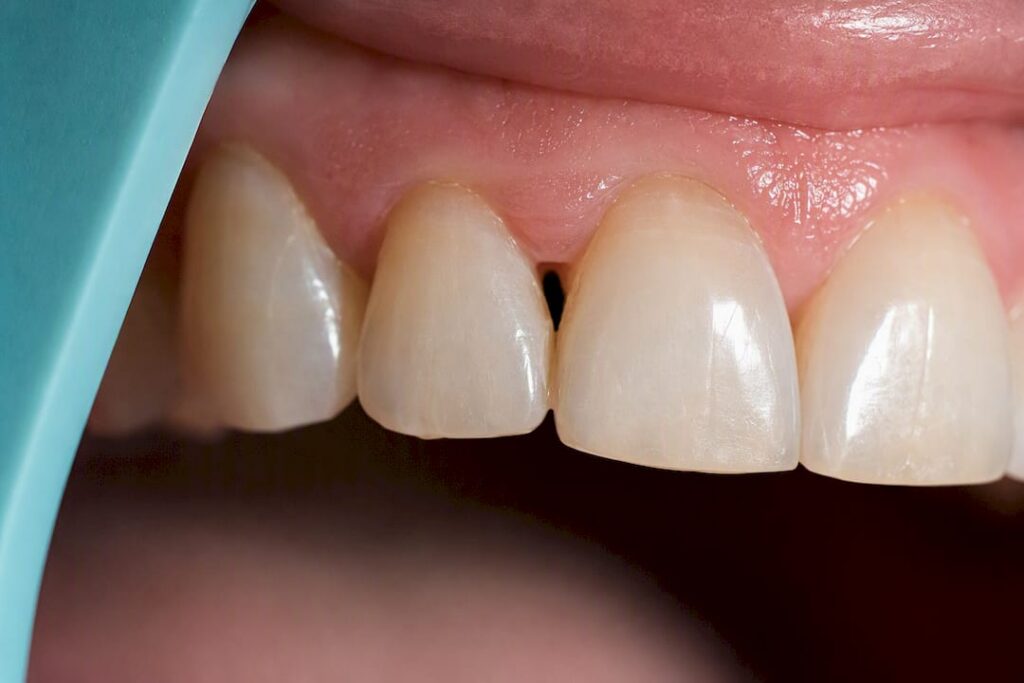
A black triangle, known clinically as an open gingival embrasure, is the small triangular gap that opens up near the gumline where two teeth meet. The dark color isn’t a stain or a hole. It’s shadow, the space behind the contact point where gum tissue used to fill in but no longer does.
Normally, a wedge of gum tissue called the interdental papilla fills that space snugly. When the papilla shrinks or never fully develops, light passes through the gap and reads as a dark triangle against your teeth.
These gaps show up most often between the upper front teeth, especially the two front incisors, though they can appear anywhere teeth meet at an angle. A Colgate review notes a large share of adults show some degree of open embrasure, making it one of the more common cosmetic complaints dentists hear about.
What you’ll typically notice:
- A dark, wedge-shaped gap right at the base of two adjacent teeth
- More visible in photos or under bright lighting than in a mirror at arm’s length
- Sometimes accompanied by food catching in the same spot
- Often symmetrical in cases tied to tooth shape rather than injury or disease
What Causes Black Triangles to Form?
The gap itself is simple. What’s underneath it varies, and that’s what determines your treatment.
Gum recession and bone loss is the most clinically significant cause. There’s a well-established relationship between the bone crest below your gum and the contact point where two teeth touch. Periodontal researcher Dennis Tarnow found that when the distance from bone to contact point is 5.0 mm or less, the papilla almost always fills the space completely. Push that distance to 7.0 mm or beyond, and the odds of an open embrasure rise sharply. This is often called the Tarnow 5 mm rule, and it’s the single most useful benchmark a dentist can measure at a consult.
Orthodontic movement can expose triangles that were always going to be there. As braces or aligners shift crowded teeth into straighter positions, the contact point between two teeth often moves toward the biting edge. The papilla, which hadn’t needed to stretch before, suddenly can’t keep up. This doesn’t mean the orthodontic treatment failed; it usually means the anatomy was hiding a deficiency the crowding had masked.
Tooth shape plays a bigger role than most people realize. Teeth with a triangular crown, narrower near the gumline and wider at the biting edge, leave a larger embrasure space by design. Square-shaped teeth, with more surface area near the gum, tend to close that space naturally.
Aggressive brushing and oversized interdental tools injure the papilla directly, especially in people with a thin gum tissue biotype that’s more prone to recession in the first place.
Other contributors include:
- Natural aging, which reduces papilla volume over time
- Prior crowns, fillings, or restorations that changed the original contact shape
- Root angulation issues that widen the space between roots
- Gaps that develop next to dental implants, where papilla support is harder to maintain long term
Are Black Triangles a Health Issue, or Just Cosmetic?
Black triangles start as an appearance problem, but they don’t always stay that way. The open space is an efficient trap for plaque and food debris, and it’s harder to clean than a flat gumline. Left unaddressed, that trapped debris can contribute to root caries and, in some cases, worsen the very periodontal disease that created the gap.
Clinicians treating these cases consistently point out that a black triangle isn’t merely cosmetic. The first management step should always be assessing the health of the gum and bone around it, according to a review on managing black triangles, before anyone touches an aesthetic fix.
Certain signs mean you should get evaluated promptly rather than waiting for your next routine cleaning:
- Bleeding gums when you brush or floss near the gap
- Any looseness or mobility in the affected teeth
- A gap that’s visibly widening over a few months
- Pain, swelling, or pus near the gumline
- A sudden change after an injury or dental work
A dental exam for a black triangle typically includes periodontal probing to measure pocket depth, X-rays to check bone level, and a visual assessment of tissue color and thickness. If you notice sudden pain or swelling rather than a gradual change, that’s a same-day matter, not a wait-and-see one, and worth an emergency dental visit rather than delaying.
Which Treatment Actually Closes a Black Triangle?
There’s no single fix that works for every gap, and picking the wrong one wastes time and money. Here’s how the major options stack up against each other.
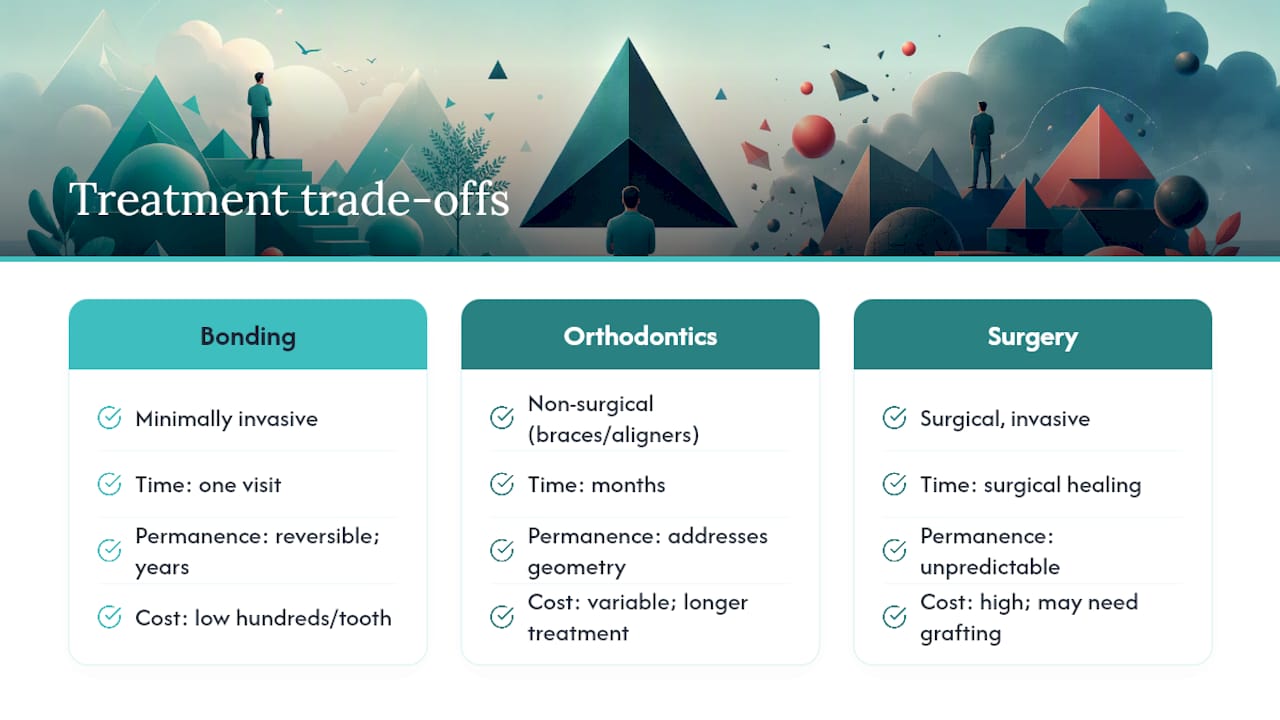
1. Composite bonding (including injection-molded techniques like Bioclear). This is usually the first option a dentist reaches for when gum health is intact and the gap is caused by tooth shape or a minor recession. A dentist reshapes the tooth’s contour with tooth-colored resin, closing the triangle without crowns or surgery. Injection-molded matrix techniques in particular reduce air bubbles and produce a smoother, more seamless margin than older hand-sculpted composite methods, according to a review of conservative treatment approaches. It’s reversible, usually done in one visit, and tends to improve hygiene by eliminating the food trap. Expect a cost in the low hundreds of dollars per tooth and results that can last several years with normal wear.
2. Porcelain veneers or crowns. More invasive and pricier than bonding, veneers make sense when a tooth already needs restorative work for other reasons, like a large filling or a cracked edge, or when the patient wants a broader smile makeover alongside the fix. Expect a higher price point and more tooth preparation.
3. Orthodontics and interproximal reduction (IPR). If your triangular tooth shape is the real problem, moving teeth with braces or aligners, sometimes combined with slight reshaping of the tooth’s sides, can shift the contact point apically and shrink the gap. This route takes months, not days, but it addresses the geometry directly rather than covering it.
4. Hyaluronic acid injections, i-PRF, and photobiomodulation. These minimally invasive, non-surgical options add volume back to the gum tissue itself. Clinical reports on class I and II cases (smaller to moderate gaps) show promising, often significant short-to-medium-term improvement in papilla height, per a narrative review of these procedures. They’re appealing because they’re reversible and repeatable, making them a reasonable way to test whether soft-tissue treatment helps before committing to something permanent. The trade-off is that results tend to fade and often need repeat treatment.
5. Surgical grafting and papilla reconstruction. When real bone loss is driving the gap, grafting is sometimes the only route to rebuilding lost support. Results here are the least predictable of any option on this list. Multiple clinical reviews note that full papilla reconstruction is genuinely unreliable once bone has receded, which is why most dentists reserve surgery for cases where non-surgical options clearly won’t reach far enough. If bone loss is significant, ask about bone grafting options directly.
6. Gingival veneers or removable masks. These pink, gum-colored prosthetics sit over the gap and hide it without any procedure at all. They’re a reasonable stopgap for someone not ready for a permanent commitment, financially or otherwise.
As a rough mental map: if the cause is tooth shape, look at bonding or IPR first. If it’s mild recession with healthy bone, hyaluronic acid is worth trying before anything permanent. If bone loss is confirmed, grafting or a combination approach becomes the realistic conversation.
Pro Tip: Ask your dentist to measure the distance from your bone crest to the contact point before agreeing to any cosmetic fix. That single number, tied to the Tarnow benchmark, predicts how likely a treatment is to hold long term.
What Should You Ask Before Choosing a Treatment?
A good consult follows a predictable sequence, and knowing it helps you tell a thorough exam from a rushed sales pitch.
- Periodontal health check. Probing depths and gum bleeding tell the dentist whether disease is active before anyone talks about aesthetics.
- Bone crest to contact point measurement. This is the Tarnow distance, and it’s the number that predicts whether a soft-tissue approach can realistically work.
- Tooth shape assessment. Triangular versus square crown shape changes which restorative option makes sense.
- Bite and occlusion review. How your teeth meet affects whether bonding or orthodontic movement will hold up.
Bring these questions to your appointment:
- What’s actually causing my black triangle, specifically?
- What are my realistic alternatives, from least to most invasive?
- How long will this result last, and what maintenance does it need?
- What’s the ballpark cost and timeline for each option?
On cost and timeline: bonding runs from one visit and a few hundred dollars per tooth; orthodontic approaches take months and cost more depending on the extent of movement needed; hyaluronic acid sessions are typically priced per visit with repeat treatments expected; grafting is a surgical fee with a longer healing window.
Pro Tip: If a dentist recommends veneers or surgery before checking your periodontal health and bone levels, get a second opinion. Irreversible cosmetic work should never come before a diagnosis.
Watch for red flags: a provider who skips the periodontal exam entirely, or who leads with the most expensive option before explaining why conservative choices won’t work for your case.
How Can You Prevent Black Triangles From Getting Worse?
Protecting the papilla you still have is far easier than rebuilding one you’ve lost.
Brush with a soft-bristled brush at a 45-degree angle to the gumline, using short, gentle strokes rather than aggressive back-and-forth scrubbing. Pressure, not brush choice, is usually what damages the tissue.
For cleaning between teeth, match the interdental brush size to the actual gap. Forcing an oversized brush into a small space does more harm than skipping it. Soft picks or well-fitted floss work better for tight contacts.
- Schedule professional cleanings on a regular schedule to catch early gum recession
- Ask about a periodontal screening if you notice any bleeding, even occasional
- If you smoke, know that it’s one of the strongest accelerators of gum recession
- Manage diabetes carefully, since poor blood sugar control worsens periodontal healing
Pro Tip: If your current interdental brush slides in without resistance, it’s too small; if it feels like you’re wedging it in, it’s too big. The right size glides with light contact on both sides.
Routine general dentistry visits catch the early signs of recession long before a visible triangle forms, which is the cheapest and least invasive point to intervene.
How Does a Dental Practice Evaluate and Treat Black Triangles?
At South Littleton Family Dental, every black triangle case starts with a periodontal exam, not a cosmetic consultation. Probing depths, radiographs, and a visual check of tissue biotype come first, because treating the shadow without checking the gum underneath it just delays the real problem.
From there, treatment planning is individualized. A patient with a healthy, thin gap gets a different recommendation than one with early bone loss. South Littleton Family Dental’s advanced diagnostic technology supports that precision, and same-day scheduling means a sudden change in your gumline doesn’t have to wait weeks for an answer. Conservative bonding, restorative work, and periodontal referrals are all part of the same coordinated plan rather than separate, disconnected fixes.
What’s the Smartest Way to Approach a Black Triangle Fix?
The advice you’ll find online often treats black triangles as a single problem with a single best answer, usually whichever treatment the article’s author happens to favor. That’s backwards. The cause determines the fix, and skipping the diagnostic step is where most people go wrong, either by paying for veneers that mask a bone problem they’ll eventually need to address anyway, or by writing off a simple tooth-shape gap as something that needs surgery.
The Tarnow measurement deserves more attention than it gets in casual conversations about this topic. It’s the closest thing dentistry has to a predictive test for whether a conservative approach will actually hold. If your dentist isn’t mentioning bone crest distance, ask about it directly.
What actually matters first isn’t picking a treatment. It’s getting an honest read on whether your gums are healthy. Everything else follows from that answer, and rushing past it is the single most common mistake in this whole process.
— Admin
Ready to Get Your Black Triangle Evaluated?
If you’re dealing with a black triangle, South Littleton Family Dental in Littleton, CO offers exactly the kind of stepwise evaluation this article describes: a periodontal check first, then a tailored plan that might include conservative bonding, restorative work, or a referral for grafting if bone loss is involved. Unlike jumping straight into a cosmetic fix, you’ll know what’s actually happening beneath the gumline before spending money on a solution that might not hold.

New patients can start with the cleaning, exam, and X-ray special, which covers the exact diagnostics needed to measure bone levels and assess your papilla health before any cosmetic conversation happens. If you’re noticing sudden changes, swelling, or pain around a gap rather than a gradual one, same-day emergency care is available. Book your assessment through the general dentistry page and get a clear answer on what’s actually causing your black triangle.
Sources
- What Is A Dental Black Triangle? Causes And Treatments | Colgate
- Conservative Treatment to Close Black Triangles | Inside Dentistry
- Narrative review on non-surgical procedures for papilla reconstruction (HA, i-PRF, photobiomodulation)
- Multidisciplinary Consideration for Managing Gingival Black Triangles in Aesthetic Dentistry: A Review
This article is general information, not a substitute for advice from a qualified doctor. Consult a qualified healthcare professional about your own circumstances before acting on anything here.