
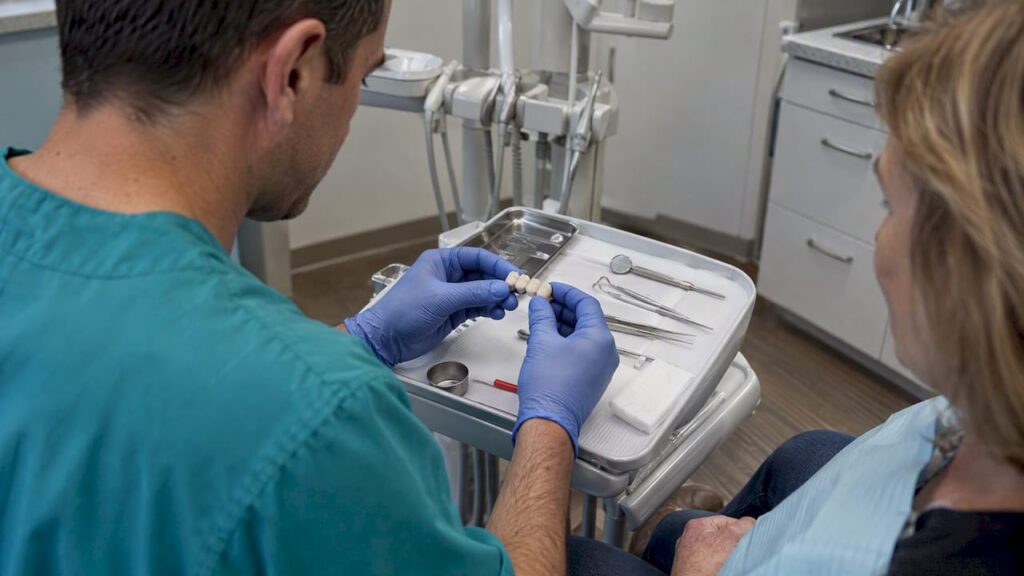
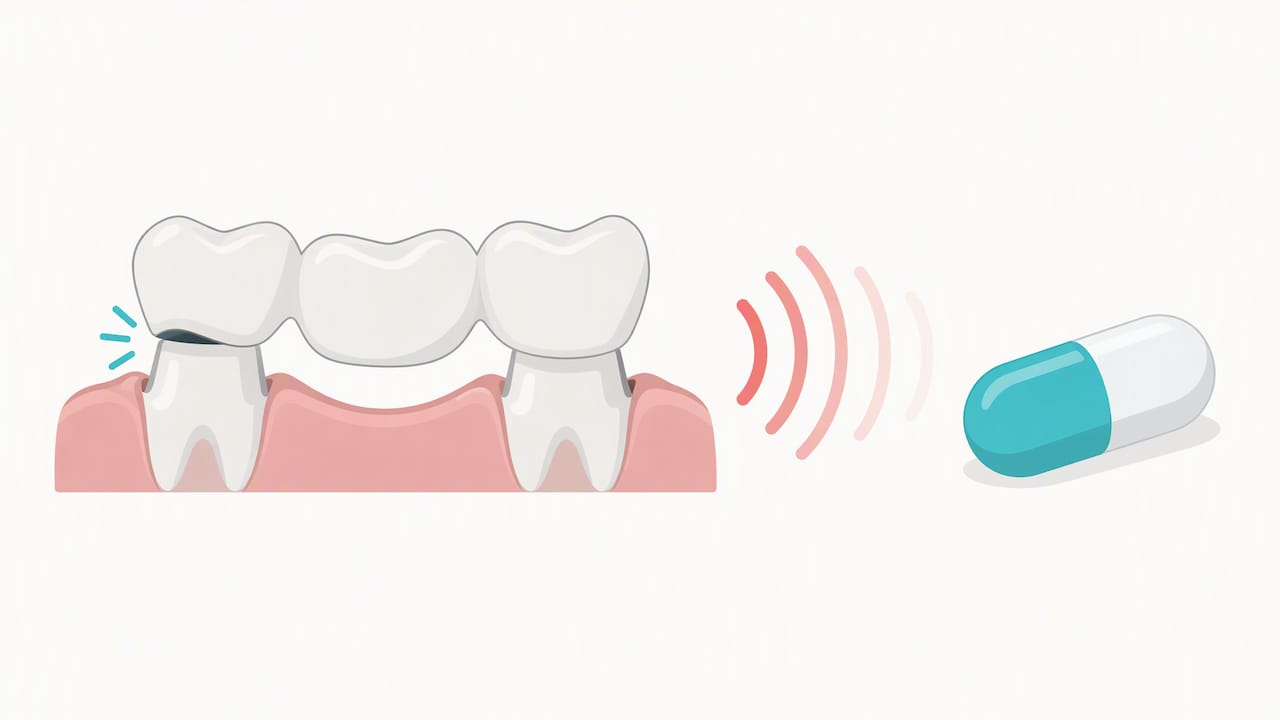
New pain or looseness in a bridge most often points to decay under a supporting tooth, failed cement, gum disease, or a fracture. Don’t use household glue or try to reseat it yourself; call a dentist, and seek immediate emergency care for trouble breathing or swallowing, or for severe swelling or fever. Contact a dentist promptly about severe pain. Bridges typically last 5 to 15 years.
TL;DR:
- Bridge movement, biting pain, trapped food, or a changed bite warrants a prompt dental visit, since early cement or decay problems are easier to treat.
- Secondary decay affected 18.4% of patients with poor oral hygiene, compared with 4% of those with good hygiene, making daily cleaning beneath the bridge essential.
- Never use household glue or force a loose bridge into place; trouble breathing or swallowing, severe swelling, or fever requires immediate emergency care.
- A dentist may recement a bridge only when it is intact and its supporting teeth remain healthy; extensive decay or fractures usually require replacement.
Table of Contents
- How can you tell if your bridge is failing?
- What causes dental bridge problems?
- What should you do right now?
- What will your dentist check and recommend?
- How can you prevent future bridge problems?
- Which red flags need same-day care?
- How do we handle bridge problems at our practice?
- Where can you get help with a bridge problem in Littleton?
- FAQ
- Sources
How can you tell if your bridge is failing?
Bridge trouble rarely arrives all at once. It usually shows up as a small change you notice while chewing, brushing, or breathing out. Here is what each sign tends to mean:
- Looseness or movement: the bridge may have lost its grip on a supporting tooth, often from cement failure.
- Pain when biting: a cracked supporting tooth, an inflamed tooth nerve, or a fracture in the bridge itself.
- Food trapped underneath, bad breath, or a bad taste: often decay beneath the bridge or a gap along its edge.
- Bleeding, swelling, or tender gums: the gum tissue and bone around a supporting tooth may be involved.
- A change in how your teeth meet: a shifted bridge or a problem with the tooth underneath.
You can do a quick, safe self-check. Look in a mirror for chips, dark lines at the gumline, or red, puffy gums. Then bite down gently on soft food, never hard food, and note whether the bridge shifts or hurts. Movement, a new gap, or pain that lingers means you should book a visit soon, because small cement or decay problems are much easier to fix early.
What causes dental bridge problems?
Most failures trace back to the natural teeth holding the bridge, not the bridge material. Those teeth can still decay and develop gum disease, and when they weaken, the whole restoration is at risk.
Secondary caries, meaning new decay at the edge of the restoration, is a leading culprit, and hygiene matters a lot. One long-term clinical evaluation found:
Secondary caries appeared in 18.4% of patients with poor oral hygiene versus 4% of those with good hygiene. Cleaning under and around your bridge is the biggest factor you control.
Other common mechanisms include:
- Loss of retention: the cement seal breaks down and the bridge debonds. The same evaluation reported this in roughly 16% of cases in some longitudinal studies.
- Fractures and chipping: stress concentrates at the connectors and the replacement tooth.
- Gum disease and recession: shrinking support around an abutment lets the tooth loosen and exposes root surfaces to decay.
- Bite problems: uneven contact, or grinding and clenching, overloads one part of the bridge.
A systematic review of fixed partial dentures followed patients for at least five years. It reported a 10-year survival of about 81.8% for cantilever designs, and it named loss of retention (16.1%) and loss of pulp vitality (32.6%) as frequent complications. Technical failures and biological ones both happen, which is why regular checkups matter.
What should you do right now?
Your goal is to stay comfortable and protect the area until a dentist can see you.
- Take an over-the-counter NSAID such as ibuprofen if it is safe for you. Current acute dental pain guidance lists NSAIDs, alone or with acetaminophen, as first-line temporary relief.
- Hold a cold compress against your cheek for swelling, 10 to 15 minutes at a time.
- Rinse gently with warm salt water after meals.
- Chew on the other side and stick to soft foods.
- If food is trapped, try a floss threader or small interdental brush only if it doesn’t hurt.
- Call a dental office and describe your symptoms and when the bridge was placed.
Never apply drugstore glue or try to bond a loose bridge back on. Cleveland Clinic warns that these products can contain chemicals harmful to oral tissues and can bond incorrectly, making professional removal harder or causing permanent damage. Don’t force any removable piece into place either.
Pro Tip: Medicine masks pain but doesn’t treat its cause, so book your visit even if the ache fades.
For another practical walk-through, see this partner guide to immediate steps.
What will your dentist check and recommend?
Expect a straightforward visit. We start with your history, then check how your teeth meet, tap on the supporting teeth, and examine the margins and gums. X-rays show decay beneath the bridge and any trouble at the roots.
What happens next depends on what we find:
- Recementing: if the bridge is intact and the teeth under it are healthy, it can sometimes be cleaned and bonded back.
- Repairs: small chips may be smoothed or built up.
- Root canal therapy: if a supporting tooth is infected but still restorable, root canal treatment can save it.
- Replacement: extensive decay, severe gum damage, or an irreparable fracture usually means a new bridge. Removal is not always gentle. Cleveland Clinic notes that taking out a bridge for decay or long-standing problems often breaks it.
- Alternatives: options include an implant-supported bridge or a removable partial denture. Implants avoid grinding down neighboring teeth and often outlast tooth-supported bridges.
If infection is present, antibiotics and pain medicine can be interim measures. StatPearls explains that definitive care usually means drainage, a root canal, or extraction, not antibiotics alone. Our page on restorative dentistry covers the repair and replacement options in more detail.
How can you prevent future bridge problems?
Prevention comes down to cleaning where a toothbrush can’t reach and keeping your checkups. A toothbrush can’t reliably clean under the replacement tooth or along the margins, so the ADA recommends daily interdental cleaning with floss threaders, interdental brushes, or a water flosser. The ADA also notes that choosing the tool that suits you and using it consistently is what makes it work.
A simple routine:
- Brush twice a day with a soft-bristled brush and a nonabrasive toothpaste.
- Clean under the bridge once daily with your chosen tool.
- Limit sticky and chewy foods that can pull at cement.
- Never use your teeth to open packages or tear tape.
- Tell us if you clench or grind; a night guard can protect the bridge.
- Keep your cleanings and exams on schedule so we can check the margins and cement while problems are small.
Pro Tip: Keep your interdental tool next to your toothbrush so the habit is hard to skip.
Our article on bridge lifespan goes deeper on extending the life of yours, and routine recall visits are part of our general dentistry care.
Which red flags need same-day care?
Some bridge problems can’t wait. Get urgent care if you notice any of these:
- Severe pain that medicine doesn’t control
- Swelling in your face, jaw, or neck
- Fever
- Trouble breathing or swallowing
- Redness that is spreading
- Difficulty opening your mouth
A tooth infection can spread into the spaces of the face and sometimes threaten the airway. StatPearls describes how quickly these infections can escalate, with severe swelling, fever, and difficulty swallowing as warning signs. Clinicians treating odontogenic infections, as the management update outlines, assess severity first and often need surgical source control, with antibiotics as an adjunct. If you have trouble breathing or swallowing, seek immediate emergency care.
How do we handle bridge problems at our practice?
When you come to us with a bridge problem, we offer same-day emergency exams and restorative dentistry, so you aren’t left waiting with a loose or painful restoration. Our workflow is simple: we listen to your symptoms, examine the bridge and the teeth under it, take images, and stabilize the area so you’re comfortable. Then we plan the definitive fix with you, whether that’s a repair, recementing, or a replacement.
We build individualized care plans and talk through your options and costs openly, so you know what to expect before we begin.
— Admin
Where can you get help with a bridge problem in Littleton?

If your bridge hurts, feels loose, or traps food, we can see you. Our relevant services include:
- Emergency dentistry for same-day exams
- Restorative dentistry, including crowns and bridges
- Root canal therapy for infected supporting teeth
- Dental implants as a long-term replacement option
Call our Littleton office and have your symptoms and the date your bridge was placed ready. We’ll take care of the rest with compassionate, personalized care.
This article is general information, not a substitute for advice from a qualified doctor. Consult a qualified healthcare professional about your own circumstances before acting on anything here.
FAQ
How can you tell if a dental bridge is bad?
A failing bridge often feels loose, hurts when you bite, traps food, or causes bad breath and bleeding gums. These signs usually mean decay or gum disease around a supporting tooth, or a failed cement seal. See a dentist promptly, since secondary caries and loss of retention are common complications.
What is the average lifespan of a dental bridge?
Bridges typically last 5 to 15 years. How long yours lasts depends on your oral health, daily cleaning under the bridge, and the condition of the supporting teeth.
Can a dental bridge be removed and not replaced?
Yes, a bridge can be removed without replacing it, but the gap is usually better filled. Missing teeth can let neighboring teeth drift and change your bite. Options such as a new bridge or an implant restore chewing and keep teeth in place.
Why do dental bridges sometimes need to be replaced?
Replacement is usually needed when decay, gum damage, or a fracture can’t be repaired. Because removal can break an older bridge, a new prosthesis is often the practical result, as Cleveland Clinic explains.
Sources
- Dental Bridges: Types & Who Needs Them
- Secondary caries in fixed dental prostheses: Long‐term clinical evaluation – PMC
- A systematic review of the survival and complication rates of fixed partial dentures (FPDs) after an observation period of at least 5 years
- Ada