
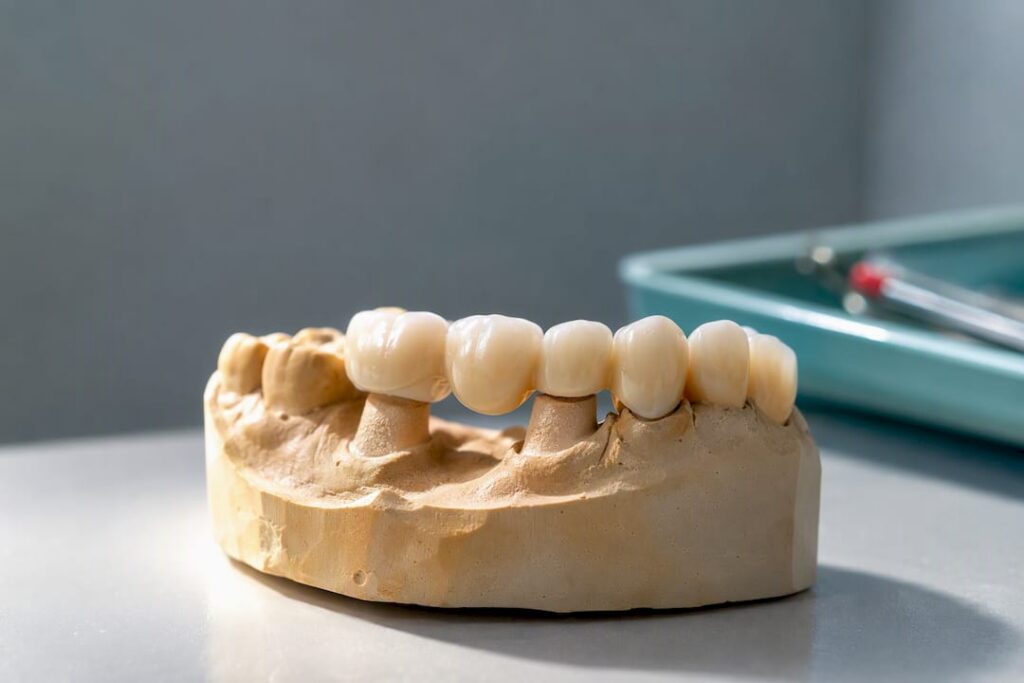
A dental bridge typically lasts several years, and it’s common for a well-maintained one to last over a decade. Implant-supported bridges tend to run longer than tooth-supported ones. The single biggest factor is the health of the abutment teeth holding it in place, followed closely by your daily hygiene habits and the bridge’s material and span. Routine dental visits and consistent home care push outcomes toward the high end of that range.
TL;DR:
- The survival rate of tooth-supported bridges remains around 93.8% at 5 years and 89.2% at 10 years, with implant-supported bridges often lasting longer.
- Biological complications like decay and gum disease of the abutment teeth account for over two-thirds of failures, making ongoing dental care critical.
- Longer-span or poorly fitting bridges, and those on compromised abutments, are more prone to failure or fracture over time.
- Proper daily hygiene, including interdental cleaning and regular checkups, can significantly extend a bridge’s lifespan.
- Replacing a bridge is usually necessary after 5 to 15 years if recurrent decay, broken abutments, or repeated repairs occur.
Table of Contents
- What Do Long-Term Studies Say About Bridge Survival Rates?
- How Do Bridge Types Compare on Durability?
- What Factors Actually Determine How Long Your Bridge Lasts?
- Why Do Dental Bridges Actually Fail?
- What Daily Care Actually Extends a Bridge’s Life?
- When Should You Replace a Dental Bridge Instead of Repairing It?
- Why Bridge Longevity Comes Down to the Teeth You Can’t See
- Get Your Bridge Checked at South Littleton Family Dental
- Sources
- FAQ
What Do Long-Term Studies Say About Bridge Survival Rates?
Survival numbers drop the further out you look, and the pattern is consistent across the research. A systematic review of fixed partial dentures found roughly 93.8% survival at 5 years for conventional tooth-supported bridges, falling to about 89.2% at 10 years. A separate meta-analysis of fixed partial denture survival put the numbers at 92% at 10 years and 75% at 15 years when “survival” means the bridge is still in the mouth.
That gap between studies comes down to definitions, not disagreement.
- Survival usually means the bridge is still physically present in the mouth, even if it needed a repair along the way.
- Success is a stricter bar: no complications, no repairs, no intervention at all.
A bridge with a decade under its belt has better odds than most people assume. Roughly 9 in 10 tooth-supported bridges are still functioning at the 10-year mark, according to pooled data in the survival meta-analysis.
Implant-supported bridges often post comparable or better numbers at equivalent time points, mainly because they don’t depend on the health of a natural tooth root. Looking past 15 years, long-term cohort data tracking restorations for up to 36 years shows survival diverging sharply by restoration type.
How Do Bridge Types Compare on Durability?
Not every bridge is built the same way, and the differences show up directly in how long each one lasts.
- Fixed tooth-supported bridges anchor to your natural teeth on either side of the gap. They’re the most common option and, per the research above, hold up well through the first decade, with risk climbing as abutment teeth age or develop new decay.
- Implant-supported bridges anchor to titanium posts instead of natural teeth, which sidesteps the risk of an abutment tooth failing underneath the crown. Complications look different here, mostly centered on the implant site itself rather than tooth decay, and lifespans often run longer.
- Removable bridges (partial dentures) come out for cleaning and typically need replacement sooner, often within 5 to 8 years, due to wear on the clasps and changes in gum tissue over time.
Material matters too. Zirconia and porcelain fused to metal tend to resist fracture better than older all-porcelain designs, particularly on back teeth that absorb heavier bite force.
What Factors Actually Determine How Long Your Bridge Lasts?
Some of what drives longevity is in your hands. Some of it isn’t. Here’s the breakdown that matters most:
- Abutment tooth health. If the teeth anchoring the bridge develop decay or gum disease, the whole structure is at risk regardless of how well the bridge itself was made.
- Oral hygiene habits. Plaque builds up under a bridge just like anywhere else, and it’s harder to reach.
- Smoking status. Smoking slows healing and worsens gum disease risk, both of which shorten a bridge’s functional life.
- Bruxism (teeth grinding). Constant grinding puts abnormal stress on the bridge and its anchor teeth, raising fracture risk.
- Bridge span and design. Longer-span bridges carry a higher risk of technical failure than shorter ones, since more leverage means more stress on the abutments.
- Quality of the original fit. How precisely the crown margins were prepared and cemented affects how well decay and bacteria stay out.
Pro Tip: If you grind your teeth at night, ask your dentist about a nightguard before you get a bridge, not after it chips. Protecting the investment starts on day one.
Why Do Dental Bridges Actually Fail?
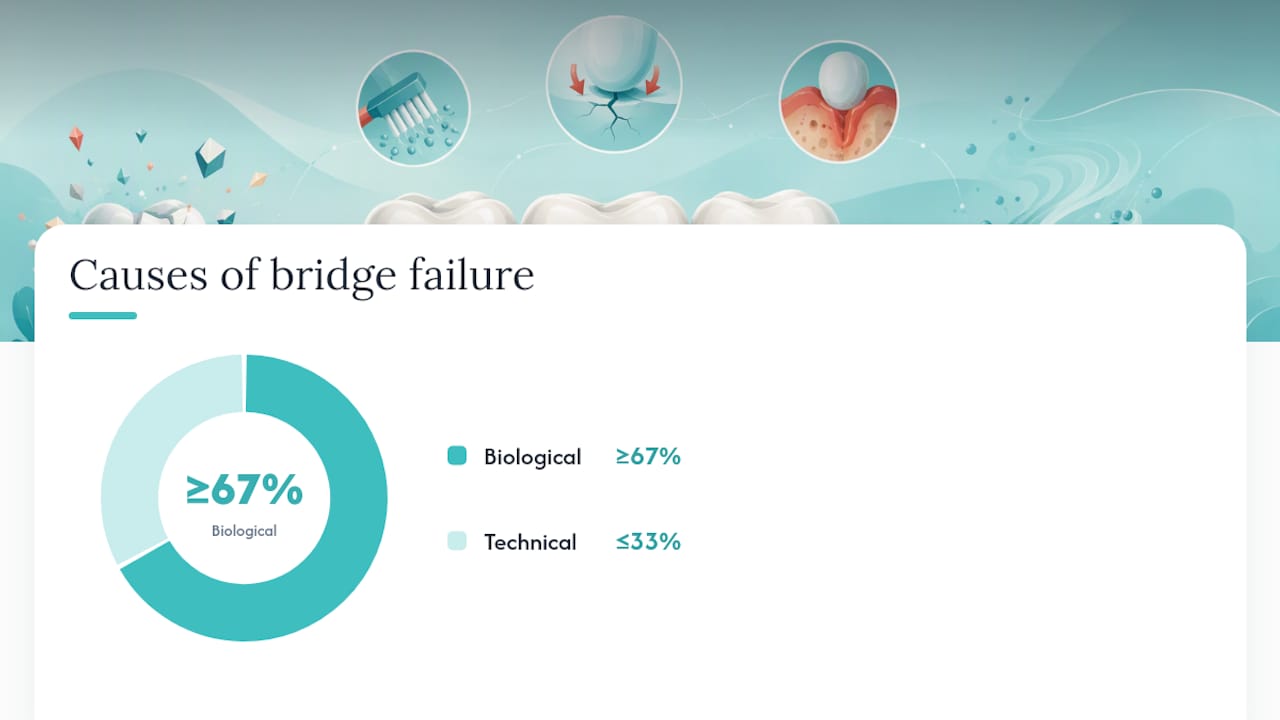
Biological problems, not broken porcelain, are the real threat. Long-term cohort data shows biological complications, mainly decay and periodontitis around the abutment teeth, account for more than two-thirds of all fixed dental prosthesis failures. That single fact reframes how most people should think about protecting a bridge: it’s less about the crown chipping and more about what’s happening to the teeth underneath it.
Technical failures still happen, just less often and on a different timeline:
- Loss of retention (the cement bond weakens) often shows up within the first few years.
- Chipping or fracture of the porcelain tends to surface later, especially under heavy bite forces.
- Connector fractures are more common on longer-span bridges.
Watch for these warning signs and call your dentist promptly if you notice them: persistent pain near the bridge, any looseness or movement, ongoing sensitivity to hot or cold, or a bad taste or odor that won’t go away. That last one often signals decay working its way in underneath.
What Daily Care Actually Extends a Bridge’s Life?
The routine that protects a bridge isn’t complicated, but it does need to be consistent, and it looks a little different than caring for a natural tooth.
- Brush at the gumline where the bridge meets your gums, angling bristles slightly under the edge to disrupt plaque before it hardens.
- Clean under the bridge daily using a floss threader, a superfloss designed for bridges, an interdental brush, or a water flosser. The ADA recommends picking whichever tool you’ll actually use every day, since consistency matters more than which tool wins on paper.
- Keep every checkup, typically every six months, so your dentist can catch decay at the margins before it spreads.
- Get bite-wing X-rays as recommended, since decay under a crown margin often doesn’t show up on a visual exam alone.
- Address grinding and hard-food habits proactively rather than after a chip appears.
Pro Tip: Ask your hygienist to show you exactly how to angle a floss threader or water flosser under your specific bridge. Everyone’s anatomy is different, and five minutes of coaching beats months of guessing.
Consistent interdental cleaning correlates with lower rates of periodontitis, which directly protects the abutment teeth doing the structural work. If you smoke, quitting is one of the highest-leverage changes you can make; it slows healing and worsens the gum disease that drives most failures. Sugar-free gum between meals can help too, as a minor supplement to brushing, not a replacement for it.
If a bridge develops a small chip or a loose margin, ask about repair first. Replacement becomes the better conversation when problems repeat or when the abutment tooth itself is compromised, a distinction worth understanding before you’re sitting in the chair. For comparison, fillings on natural teeth last 11 to 16 years or more under similar care, which gives you a sense of how much abutment tooth condition alone can extend or shorten a bridge’s working life.
When Should You Replace a Dental Bridge Instead of Repairing It?
A few signs point clearly toward replacement rather than another patch job:
- Recurrent decay at the same margin, even after a filling or repair
- An abutment tooth that’s fractured, abscessed, or structurally failing
- Persistent pain or a bite that feels increasingly off
- A pattern of repeated repairs within a short span, since frequent fixes usually signal a bigger underlying issue
When repairs start piling up, ask your dentist directly: Is this abutment tooth still a viable anchor? Would an implant-supported option hold up better long-term? What’s the realistic timeline before this bridge needs full replacement? Those three questions turn a vague worry into a concrete plan.
Why Bridge Longevity Comes Down to the Teeth You Can’t See
Most patients worry about the wrong thing. They ask whether the porcelain will chip, when the real risk sits quietly under the gumline: the abutment teeth. The data backs this up consistently. Biological failure outpaces mechanical failure by a wide margin, yet most marketing and most patient anxiety focuses on material strength.
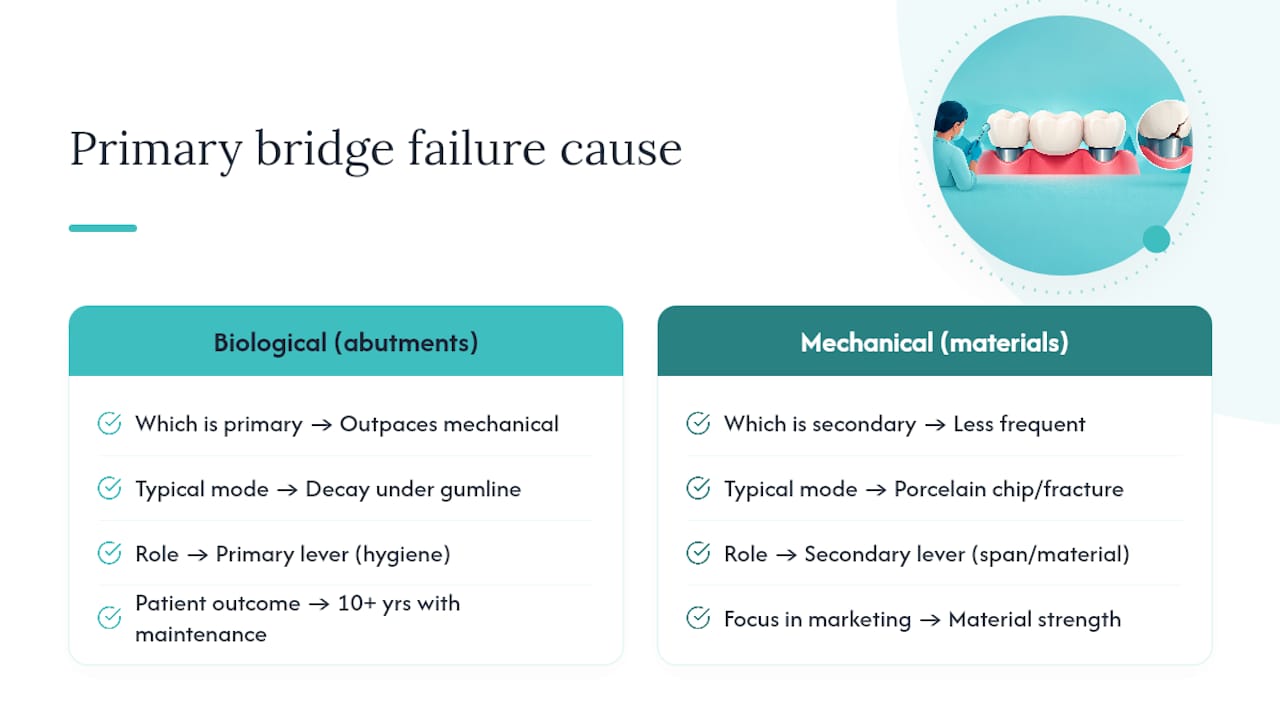
That’s backwards. A zirconia bridge on a decaying abutment tooth is still a bridge on borrowed time, no matter how strong the crown itself is.
The uncomfortable truth is that bridge longevity is mostly a hygiene story wearing a materials-science costume. Span length and material choice matter, but they’re secondary levers. The primary lever is whether you and your dentist are keeping the supporting teeth healthy year after year. Patients who treat a bridge as “installed and done” tend to be the ones back in the chair at year six or seven. Patients who treat it as an ongoing maintenance relationship, showing up for checkups and actually using the interdental tools they were shown, are the ones still smiling with the same bridge past the 10-year mark.
— Admin
Get Your Bridge Checked at South Littleton Family Dental
South Littleton Family Dental gives you a straightforward path when it’s time to find out whether your bridge just needs monitoring, a repair, or a full replacement conversation, without the guesswork of trying to self-diagnose a margin issue at home.

We build individualized care plans around what’s actually happening with your abutment teeth and bite, using imaging and exams to catch problems while they’re still small and cheap to fix. If a repair won’t cut it anymore, our restorative dentistry team walks you through options including dental implants as a longer-lasting alternative. Dealing with sudden pain or a bridge that suddenly feels loose? Our emergency dentistry service offers same-day exams; for current pricing, please check the practice’s pricing page. Schedule a bridge evaluation with our general dentistry team in Littleton, CO, and get a clear answer instead of a guess.
This article is general information, not a substitute for advice from a qualified doctor. Consult a qualified healthcare professional about your own circumstances before acting on anything here.
Sources
- Survival and complication rates of tooth- and implant-supported restorations after an observation period up to 36 years
- Meta-analysis of fixed partial denture survival: prostheses and abutments
- A systematic review of the survival and complication rates of fixed partial dentures (FPDs) after an observation period of at least 5 years
- Retrospective data on complexity and longevity of prosthetic reconstructions
FAQ
Can Dental Bridges Last 20 Years?
Some do, particularly implant-supported bridges with excellent home care and regular checkups, but long-term survival beyond 15 years varies widely and is less common. Long-term cohort data shows survival rates diverge widely by restoration type well past the 15-year mark, so ask your dentist for a realistic estimate based on your specific case.
Can Teeth Decay Under a Bridge?
Yes, and it’s the leading cause of bridge failure. Decay tends to start at the margin where the crown meets the natural tooth, which is why daily interdental cleaning and regular bite-wing X-rays matter more than most patients realize.
What Is the Downside of Having a Dental Bridge?
The main downside is that a fixed bridge relies on the abutment teeth staying healthy, and cleaning underneath the false tooth takes more effort than brushing a natural tooth. Compared to implants, a bridge also places extra chewing load on the neighboring teeth, which can shorten their working life over time.
How Often Do You Have to Replace a Dental Bridge?
Most bridges last somewhere between 5 and 15 years before replacement becomes necessary, with many patients reaching a decade or more on the same bridge. The real trigger for replacement usually isn’t a calendar date. It’s recurrent decay, a failing abutment tooth, or repairs that keep piling up, all of which are worth discussing at a restorative dentistry evaluation.