
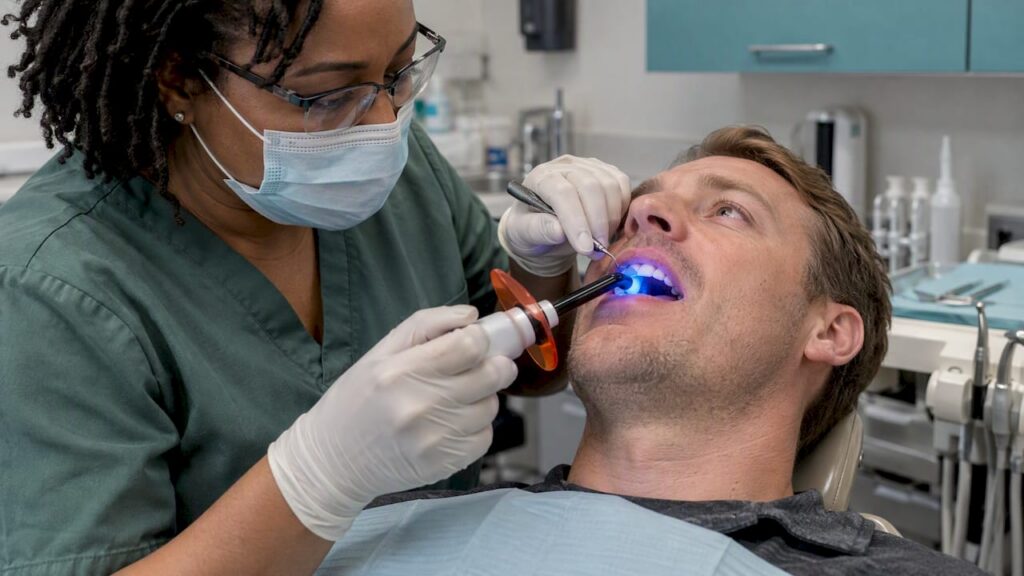
Tooth bonding typically lasts between three and 10 years before it needs a touch-up or replacement, according to Cleveland Clinic. Where you land in that range depends less on luck than on which tooth was treated, how much of it was rebuilt, and what your mouth does all day: grinding, chewing, sipping coffee. Below, we explain what moves the number, how to tell when a bonded tooth needs attention, and how to get the most years out of it.
TL;DR
- Plan on roughly 3 to 10 years for bonding. Small repairs on intact enamel can go longer; bigger rebuilds tend to sit at the shorter end.
- Habits matter most: nail biting, chewing pens, opening packages with your teeth and grinding at night are the usual culprits.
- Bonding fails in predictable ways (chips, stains, decay at the edge). Many problems can be repaired rather than redone.
- Brushing with fluoride toothpaste, flossing daily and keeping your checkups protects both the resin and the tooth underneath.
- Sharp edges, a rough spot or a bite that feels “off” are reasons to book a visit, not to wait.
Table of Contents
- What bonding is, and why it is not permanent
- How long bonding lasts: the realistic numbers
- Does bonding last less on front teeth?
- What shortens the life of bonding
- Signs your bonding needs attention
- How to make bonding last longer
- Bonding vs. veneers vs. fillings: how lifespans compare
- Our perspective: what we tell patients about bonding
- Getting your bonding checked in Littleton
- FAQ
- Sources
What bonding is, and why it is not permanent
Dental bonding is a tooth-colored composite resin that your dentist shapes onto a tooth, then hardens with a light. It is used to fix small chips, close minor gaps, cover discoloration and rebuild a tooth after a cavity is removed. It is popular because it is conservative: in most cases little or no tooth is removed, and it is often finished in a single visit.
The tradeoff is durability. Resin is strong, but it is not as hard as natural enamel or porcelain, and it is bonded in a mouth that chews, clenches and gets exposed to acid every day. That is why dentists describe bonding as a long-lasting but not permanent repair. The same material is what we use for composite fillings, so much of what is known about filling longevity applies to bonding too.
How long bonding lasts: the realistic numbers
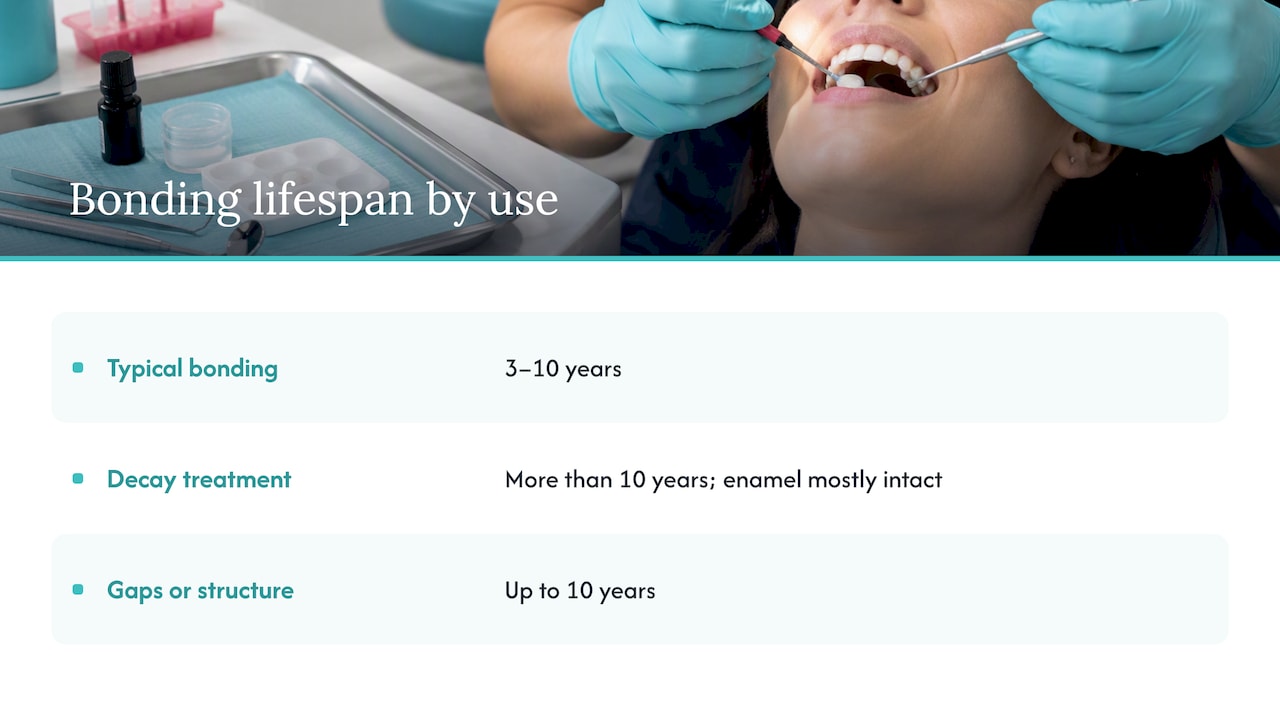
The headline figure is three to 10 years, and it appears consistently in clinical guidance. Cleveland Clinic says bonding typically lasts three to 10 years before it needs to be touched up or replaced, and ties that range to oral habits and how many teeth were treated.
Two details sharpen that range. According to WebMD’s overview of bonding, bonding used to treat decay can last more than 10 years when the enamel is mostly intact, while bonding used to fill gaps or replace more missing tooth structure may last up to 10 years. In plain terms: the more the resin has to do on its own, the shorter the likely lifespan.
Research on composite restorations in general shows how wide the spread can be. A 2022 review of composite restoration longevity found annual failure rates ranging from 0.08% to 6.3%. That gap, nearly a hundredfold, is a useful reminder that two people with the same material can have very different outcomes.
What this means in practice
| Situation | What to expect |
|---|---|
| Small repair on a tooth with mostly intact enamel | Toward the longer end, and sometimes beyond 10 years |
| Closing a gap or rebuilding a larger area | Up to about 10 years, often less |
| Habits like nail biting or grinding | Shorter, with a higher chance of chips |
| Regular checkups and good home care | Most likely to reach or pass the average |
These are ranges, not promises. Your dentist can give you a better estimate once they see the tooth, your bite and your habits.
Does bonding last less on front teeth?
People often ask about front teeth specifically, because that is where bonding is most visible. The fair answer is that front teeth do not take the heavy grinding forces that molars do, which works in bonding’s favor. But front teeth are also the ones that bite into apples, tear tape and open bottles, and a bonded edge is vulnerable to exactly that. A chipped corner on a front tooth is the most common reason bonding gets redone.
So the same three-to-10-year range applies, and the biggest swing factor is the edge: a bonded biting edge works harder than bonding on the face of the tooth. If your bonding sits on the edge, be especially careful with hard foods and habits. If a bonded front tooth does chip, our guide to a same-day chipped tooth fix in Littleton explains what repair usually involves.
What shortens the life of bonding
The research points to a handful of repeat offenders.
Habits that put force on resin
Cleveland Clinic lists biting fingernails, chewing on pens and using teeth to open packages as habits that wear bonding down. These put a sharp, concentrated load on a thin layer of resin, which is exactly what it handles worst.
Grinding and clenching
Parafunctional habits, meaning grinding and clenching beyond normal chewing, appear among the patient-level risk factors for reduced restoration durability in the composite restoration review. Many people grind without knowing, and wake with sore jaw muscles or headaches. If that sounds familiar, this guide on teeth grinding and jaw pain, and who to see can help you understand the symptoms. For your teeth specifically, WebMD recommends talking to your dentist about a mouthguard if you grind.
Decay risk and checkup frequency
The same review lists caries risk, the number of checkups per year and socioeconomic status among the patient-level factors tied to how long restorations last. It also found that secondary caries, fractures and esthetic compromise were the main reasons composite restorations failed. Secondary caries is decay that starts at the margin where resin meets tooth. It is the quiet failure: the bonding can look fine while the tooth underneath is breaking down.
How much was bonded
A tiny chip repair has a very different load from a rebuilt corner or a gap closed across two teeth. The more teeth and surface area involved, the more places the bond can be challenged. That is one reason a dentist may suggest a different option, such as a crown or veneer, when a large area is involved.
Stains
Bonding is not immune to staining. Cleveland Clinic advises limiting dark drinks and acidic foods. Stained resin does not respond to whitening the way natural enamel does, so any whitening you want is best done before the bonding color is matched. If you are planning both, ask about the sequence.
Signs your bonding needs attention
Bonding rarely fails all at once. Watch for these:
- A sharp or rough edge. Cleveland Clinic lists sharp edges on a bonded tooth as a reason to see your dentist.
- A bite that feels odd. The same source mentions a tooth that feels strange when you bite down.
- Looks you are no longer happy with. Cleveland Clinic includes concern about how your teeth look. Stained or dull resin counts.
- A visible chip or a gap at the edge. Food and bacteria collect there, which is how secondary decay begins.
- Sensitivity or pain near the bonded tooth. This can signal decay or a cracked tooth, and warrants prompt evaluation. If it is severe, our emergency dentistry team handles same-day care.
Repair or replace?
Not every flaw means starting over. In its 2018 report on posterior composite restorations, the American Dental Association’s science team framed repair as a way to increase restoration longevity, suited to localized defects such as secondary caries or a fracture, with replacement more appropriate for generalized or severe defects. That report concerns back-tooth composites, but the logic carries over: a small chip can often be patched, while widespread breakdown calls for a new restoration.
Keep in mind that a patched area may not last as long as the original work. WebMD notes that composite repairs can last anywhere from six months to many years.
How to make bonding last longer
None of this is exotic. It is the unglamorous routine that protects both resin and natural tooth.
- Brush at least twice a day with a soft toothbrush and fluoride toothpaste, and floss daily, as Cleveland Clinic recommends. Pay attention to the line where bonding meets tooth.
- Stop using your teeth as tools. Scissors exist for packages, and pens belong in hands.
- Limit dark drinks and acidic foods, or rinse with water afterward. Coffee, tea and red wine are the usual suspects for resin staining.
- Ask about a night guard if you grind or clench. A custom guard spreads the force across all your teeth.
- Keep your checkups. A dentist can spot a failing margin or early decay long before you feel anything. The review authors’ broader advice is that clinicians should treat patients comprehensively and promote a healthy lifestyle to support restoration longevity.
- Fix small problems early. A tiny chip is a quick repair. A neglected one can expose the tooth underneath.
Bonding vs. veneers vs. fillings: how lifespans compare
Bonding is not always the best long-term answer, and it is worth knowing the alternatives before you commit.
- Bonding is the least invasive and usually the fastest, and the three-to-10-year range makes it a good fit for small, contained fixes.
- Porcelain veneers cost more and involve more preparation, but they resist staining better and tend to last longer. See our breakdown of veneer lifespan and why your bite matters and the veneer timeline for porcelain versus composite.
- Fillings use the same resin to treat cavities. Our article on how long fillings last covers the evidence, and when to replace an old filling walks through the warning signs.
- Crowns are the stronger choice when a tooth has lost a lot of structure. Our crown lifespan guide explains typical expectations.
A useful rule: choose bonding when you want a conservative, reversible-feeling fix for a small area, and consider porcelain when you want the result to hold up for decades with little maintenance. If you are considering several cosmetic changes at once, how dentists stack treatments for a smile makeover shows how they are usually sequenced.
Our perspective: what we tell patients about bonding
We like bonding, and we are honest about its limits. For a small chip or a minor gap, it is one of the most conservative ways to restore a smile, and it often means a patient leaves in one visit without needle-heavy, drill-heavy work. That matters to nervous patients and to parents of kids who have had a rough day at school and a rougher fall on the playground.
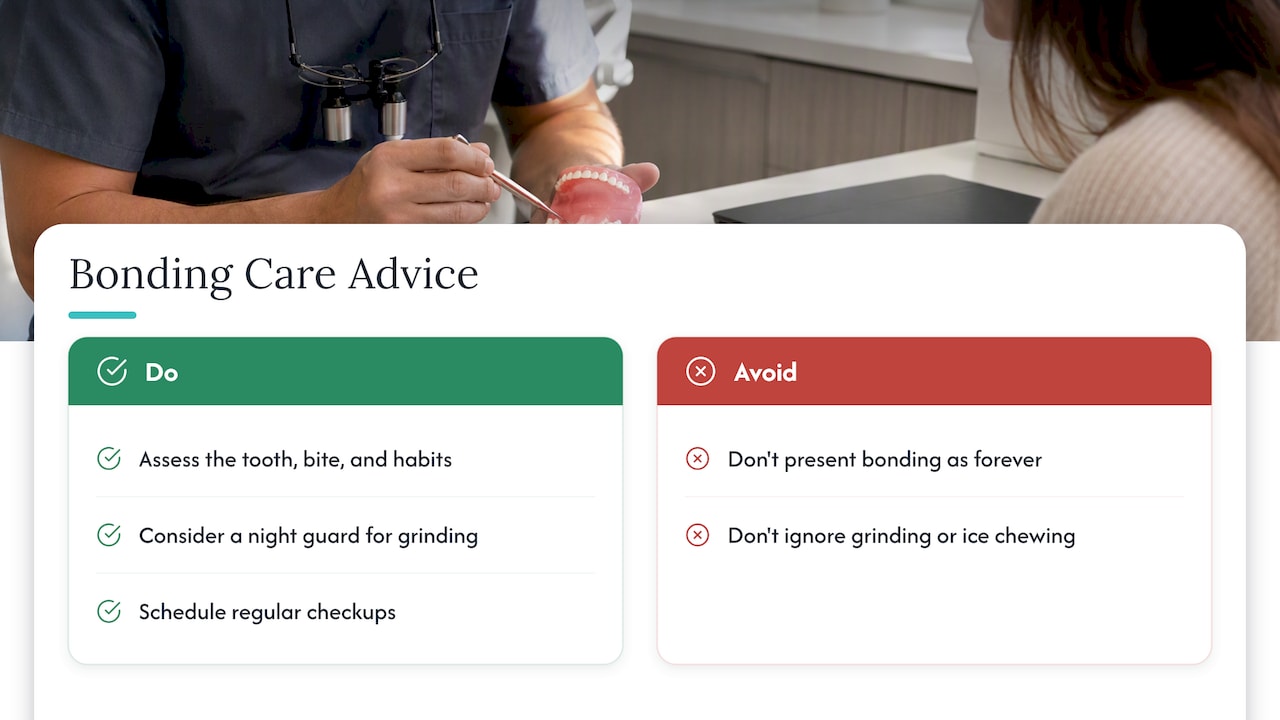
But we do not sell bonding as forever. When we plan care, we look at the tooth, the bite and the habits together, and we say plainly if a different restoration would serve you better. A person who grinds heavily or chews ice is a poor match for a thin resin edge, and we would rather talk about a night guard first than redo the same chip in two years.
Our approach is to build an individualized plan and explain it clearly: what we recommend, what it should do, what could shorten it, and what a repair might look like down the road. The best predictor of a restoration lasting is a patient who understands it and comes in for regular checkups, so that small issues stay small.
— the author
Getting your bonding checked in Littleton
If you have bonding you are unsure about, or a chip you want fixed, we can look at it and tell you whether it needs a polish, a repair or a replacement. New patients can ask about our $99 cleaning package, a good way to get a full look at your teeth and existing work. You can see the details on our new patient special page, or explore our cosmetic and restorative services.

If a bonded tooth is painful, cracked or has broken off, do not wait for a routine slot. Call us and ask about same-day emergency care.
FAQ
How long does dental bonding last?
Most bonding lasts three to 10 years, with the best results on teeth that have mostly intact enamel and patients who avoid habits like nail biting. Your own timeline depends on which tooth was treated, how much was rebuilt and how well you protect it. Regular checkups help catch wear before it becomes a failure.
Can bonding be repaired instead of replaced?
Often, yes. Localized problems such as a small chip or an early cavity at the edge are usually good candidates for repair, while widespread or severe damage points toward replacement. A repair may not last as long as the original, so your dentist will weigh the two options with you.
Does bonding stain?
Yes, resin can pick up stains from coffee, tea, red wine and other dark or acidic items over time. Rinsing with water, brushing regularly and cutting back on dark drinks slows this down. Bonding does not whiten like natural enamel, so discuss any whitening plans before the resin shade is chosen.
Is bonding or a veneer better for a chipped front tooth?
For a small chip, bonding is usually the faster, more conservative choice. A veneer may make sense for several teeth, heavier staining or a wish for a longer-lasting result. Your dentist can compare both on your specific tooth and bite.
What should I do if my bonding chips?
Save any fragment, rinse your mouth with water and call your dentist. If you have pain, bleeding or a sharp edge cutting your tongue, ask for the earliest appointment. Our chipped tooth triage guide outlines the first steps.
Sources
- What is Dental Bonding & What To Expect, Cleveland Clinic
- Longevity of composite restorations, PubMed
- Dental Bonding: Teeth Bonding Procedure, Lifespan, and Cost, WebMD
- Posterior composite restoration report, American Dental Association (2018)