
You can close a gap between teeth with braces, clear aligners, bonding, porcelain veneers, or, when a tooth is missing, an implant, bridge, or denture. The right choice depends on why the gap is there, how big it is, and whether you want to move your teeth or cover the space. This guide explains each option in plain terms, what to weigh before choosing, and what happens at a gap consultation in Littleton, CO.
TL;DR
- Gaps between teeth come from tooth position, tooth size, gum health, or a missing tooth. The cause decides the treatment.
- Braces and clear aligners move teeth. Bonding and veneers cover the space. Implants, bridges, and dentures replace a missing tooth.
- Retainers matter after orthodontic work, because some gaps tend to reopen.
- In children, a front-teeth gap is often a normal phase and may close on its own.
- A dentist should check gum health and bite before any gap is closed.
Table of Contents
- What a tooth gap is and why it happens
- How a dentist figures out the right fix
- Your options at a glance
- Moving the teeth: braces and clear aligners
- Covering the gap: bonding and veneers
- When the gap is a missing tooth
- What to weigh before you choose
- Our perspective at South Littleton Family Dental
- Get your gap checked in Littleton
- A quick word on yellow baby teeth
- What to expect at a gap consultation
- FAQ
- Sources
What a tooth gap is and why it happens
A gap between two teeth is called a diastema when it shows up between the upper front teeth. The same idea applies to spacing anywhere in the mouth. A gap is not a disease. For many people it is simply how their teeth and jaws fit together, and some people like it.
Common reasons gaps form include:
- Teeth that are small relative to the jaw. There is more room than tooth, so space is left over.
- Tooth position. Teeth that drift or tilt can open spaces.
- Gum or bone changes. Gum disease can loosen teeth and let them move, which is one reason gum health comes first.
- A missing tooth. The neighbors tend to lean into the space, and the gap can grow or shift.
- Early tooth loss in children. Untreated decay in baby teeth can lead to infections and extractions, which may shift teeth and call for orthodontic correction later.
If your child has a gap between the upper front teeth, it may not need treatment yet. A review of midline diastema describes it as often a normal developmental phase that frequently closes by itself as the permanent canines and lateral incisors come in. A dentist can tell you whether to wait or act.
How a dentist figures out the right fix
Two people with the same visible gap can need different treatment. Before recommending anything, a dentist looks at tooth position and spacing, how your bite lines up, your jaw relationship, and the health of your gums and teeth. According to the American Association of Orthodontists, the work-up may include photos, digital scans, X-rays, or impressions to pin down the cause.
That step is not paperwork. If gum disease is behind the gap, closing it cosmetically without treating the gums just hides a problem. If a missing tooth is behind it, moving teeth together may not be the best plan. Our general dentistry exam and X-rays are where this starts.
Your options at a glance
| Option | What it does | Best for | Alters the tooth? | Typical pace |
|---|---|---|---|---|
| Braces | Move teeth into new positions | Larger gaps, bite issues, several teeth involved | No | Longest, usually many months |
| Clear aligners | Move teeth with removable trays | Mild to moderate spacing | No | Months, depends on case |
| Dental bonding | Resin added to the tooth edges to fill the space | Small gaps, one or two teeth | Little to none | Often one visit |
| Porcelain veneers | Thin ceramic shells cover the front of teeth | Gaps with small, uneven, or stained teeth | Yes, some enamel removal | A few weeks, or faster in some cases |
| Implant, bridge, or denture | Replace a missing tooth | Gap from a lost tooth | Bridge: neighbors reshaped | Varies by option |
The table gives general patterns. Your own timeline and fit are set at the exam.
Moving the teeth: braces and clear aligners
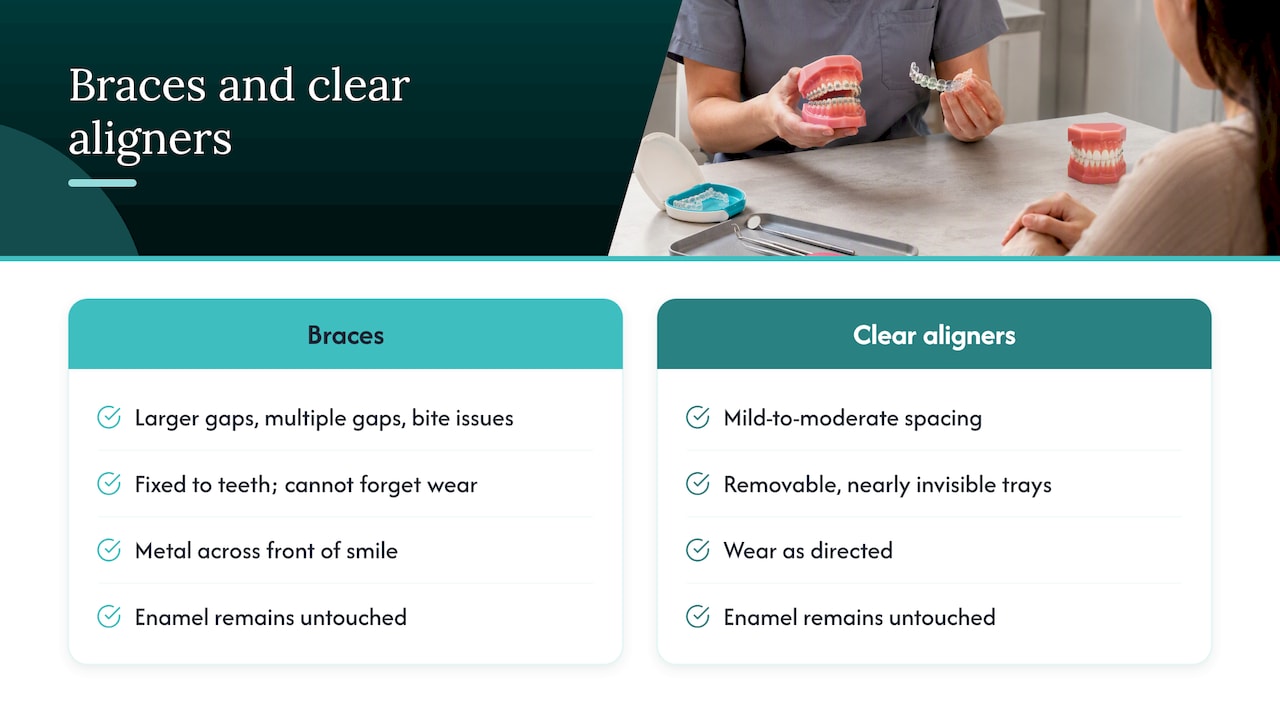
If the gap exists because teeth are out of position, moving them is the approach that treats the cause. The AAO lists braces to guide teeth into place and clear aligners for mild to moderate spacing.
Braces work for bigger spaces, multiple gaps, or cases where the bite also needs attention. They are fixed to the teeth, so you cannot forget to wear them.
Clear aligners are removable, nearly invisible trays. Many adults prefer them because they avoid metal across the front of the smile. The trade-off is discipline: they only work when you wear them as directed, and they are best suited to milder cases.
The upside of moving teeth is that your enamel stays untouched. The downside is time, and the need for a retainer afterward. If you want to know whether you are a fit, we can examine your bite and spacing and talk through whether orthodontic care makes sense, or whether another route is faster for your goals.
Covering the gap: bonding and veneers
Sometimes the gap is a size issue, not a position issue. Teeth are a bit narrow, and the space is small. Covering the gap can make more sense than moving everything. The AAO notes that care may be combined with bonding or veneers for small or uneven teeth.
Dental bonding
Bonding uses tooth-colored resin that a dentist shapes onto the edge of a tooth to widen it and fill the space. It is usually the least invasive cosmetic fix and often finishes in a single visit. It suits small gaps. Resin can chip or stain over time and may need touch-ups, so it is a good choice for modest changes rather than a permanent solution for everyone.
Porcelain veneers
Veneers are thin ceramic shells bonded to the front of the teeth. Because they are slightly wider than the natural teeth, they can close a gap while also changing color, shape, and length. That makes them a strong option when the gap comes with other things you want to change. Preparing the tooth usually involves removing a small amount of enamel, which is a one-way decision, so it deserves a careful conversation.
If you want to see what is involved, read our guide to the veneer timeline for porcelain versus composite, or the page on porcelain veneers at our office. When several treatments are combined, such as gum recontouring, whitening, and veneers, the order matters. A professional case report in ADA News describes a sequenced approach that combined soft-tissue recontouring, whitening, ceramic veneers, and direct composite restorations. We explain how that sequencing works in how dentists stack treatments for a predictable smile makeover.
A note on the “black triangle”
When teeth are moved or restored to close a space, a small dark triangle can sometimes remain near the gumline. That is a known cosmetic issue, and it is worth asking about before you start. Our page on black triangles and the questions to ask before any fix covers what to bring up with your dentist.
When the gap is a missing tooth
A space left by a lost tooth is a different problem. It affects chewing, and neighboring teeth can lean into the space. The AAO notes that tooth replacement is an option when the gap comes from a missing tooth. The three main routes are:
- Dental implant. A titanium post placed in the jaw holds a crown. It replaces the tooth without involving the neighbors. Candidacy depends on bone and gum health, so a bone graft or socket preservation may come into the plan. See our overview of dental implants and the page on who is a candidate.
- Dental bridge. A false tooth is anchored to crowns on the two neighboring teeth, which are reshaped to hold it. Bridges need careful cleaning underneath. Our guide to cleaning under a bridge shows how.
- Partial or full denture. A removable option that can replace one tooth or many. It is often the choice when several teeth are missing.
These all fall under restorative dentistry. The best fit depends on how many teeth are missing, the condition of the neighbors, your bone, and your budget. We explain each of these options at the exam so you can compare them side by side.
What to weigh before you choose
A few questions help narrow things down:
- What is causing the gap? If it is a missing tooth or gum disease, that comes first.
- How big is the gap, and how many teeth are involved? One small space points toward bonding or a few aligner trays. Several spaces often point toward braces or aligners.
- Do you want to keep all your natural enamel? Moving teeth does that. Veneers and bridges do not.
- How fast do you want results? Bonding is often the fastest. Orthodontic movement takes months.
- What will you do to maintain it? Every option needs good brushing, flossing, and regular checkups.
- Are other changes on your wish list? Color, shape, or length changes can tilt the decision toward veneers.
Retainers and relapse
If you move your teeth, plan on a retainer. The AAO notes that retainers help hold results and keep gaps from reopening, and that some spacing cases are more prone to relapse, so wear them as directed. Skipping the retainer is the most common way people end up with a gap again.
Gum health comes first
Healthy gums and bone are the foundation for any gap treatment. Bleeding, swelling, or loose teeth should be checked before cosmetic work starts. A routine cleaning and exam also show whether a gap is stable or changing.
Our perspective at South Littleton Family Dental
People often come in asking for one specific fix, usually veneers or aligners, because that is what they saw online. We start somewhere else: with why the gap is there. A gap caused by a small tooth, a gap caused by shifting, and a gap caused by a lost tooth are three different problems with three different best answers.
We lean toward the least invasive option that meets your goal. For some patients that is bonding. For others it is moving teeth first, then adding a small cosmetic touch to finish. For patients who want a bigger change, veneers can be an excellent choice, and we plan them with you carefully since they are permanent. Our care plans are individualized, and we aim to explain each step clearly, because uncertainty is a big part of dental anxiety. If you are a first-time patient or have avoided the dentist for a while, tell us. We will go at your pace.
— Admin
Get your gap checked in Littleton
If you want a straight answer on what would work for your smile, we can examine your teeth and gums, review your bite, and lay out your options in plain language. Cosmetic work, restorative replacement, and everyday preventive care are all available at our Littleton office, and we see families, so everyone can come in together. Browse our cosmetic and restorative services or contact the practice to book an exam.

Parents of younger children can also look at our children’s dentistry and new patient page for current new patient information.
A quick word on yellow baby teeth
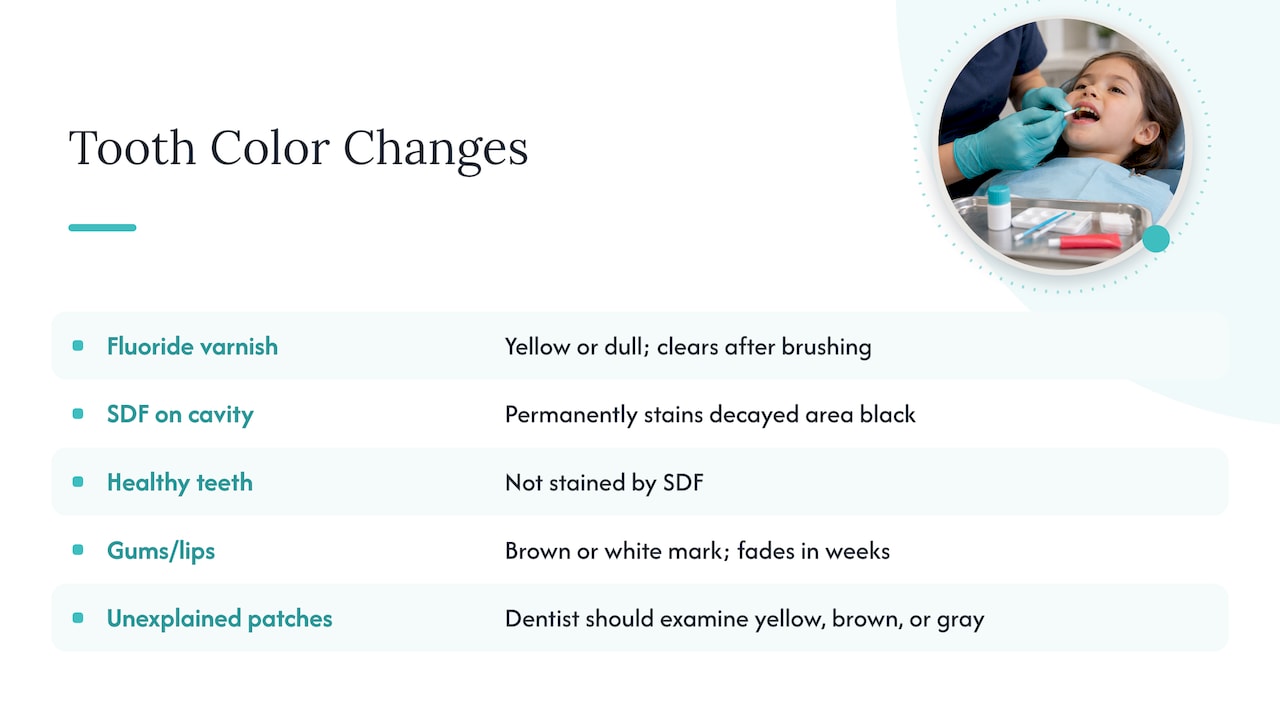
Some parents searching for gaps are really worried about color, since baby teeth can look yellow. Not every yellow look means decay. The American Academy of Pediatrics notes that some brands of professional fluoride varnish can leave teeth looking yellow or dull for a while, and this goes away after brushing.
Treatment can also change color. According to the same organization, silver diamine fluoride used on cavities permanently stains the decayed area black, without staining the healthy teeth around it. If it touches gums or lips, a brown or white mark can show up and usually fades within a few weeks.
If you see yellow, brown, or gray patches that are not explained by a recent treatment, have a dentist look. Major dental and pediatric organizations support a first dental visit on or before a child’s first birthday. A tooth that turns gray after a bump needs prompt attention too, and our page on a gray tooth after trauma explains the steps parents can take.
What to expect at a gap consultation
A typical visit follows a simple path:
- Conversation. You tell us what bothers you and what you hope for. Some people want the gap gone. Others only want it smaller.
- Exam. We check teeth, gums, and bite, and take X-rays or photos as needed.
- Diagnosis. We explain what is causing the gap, including any gum or bite issues to address first.
- Options. We walk through realistic choices, with the pros and cons of each, including how much natural tooth is kept, how long it takes, and what upkeep looks like.
- Plan. You choose, and we set out the steps. Insurance and payment details are talked through before you commit.
If you have a sudden problem, such as a broken tooth that created a new space or pain, that is a different kind of visit. Our emergency dentistry service handles same-day needs.
FAQ
Can a dentist fix a tooth gap without braces?
Often, yes. Bonding can fill small gaps, and veneers can close gaps while also changing the look of the teeth. Bridges, implants, or dentures handle gaps caused by a missing tooth. Braces or aligners are better when the root issue is tooth position or a larger space.
What is the fastest way to close a gap between front teeth?
Bonding is usually the quickest, and many cases are done in one visit. Veneers take longer because they are made to fit your teeth. Orthodontic movement takes the longest because teeth need time to shift safely.
Will the gap come back after treatment?
It can. After teeth are moved, they may drift back if you do not wear your retainer, and some spacing is more prone to this than others. Bonding and veneers cover a gap rather than move teeth, so they do not carry the same relapse risk, though they can wear or chip over time.
Is a gap between my child’s front teeth a problem?
Usually not by itself. A gap between the upper front teeth is often a normal phase that can close as the permanent teeth come in. Have your child’s dentist check it at regular visits, especially if teeth are decayed, lost early, or crowded.
Do I need to treat the gap at all?
No. A gap is a cosmetic choice unless it comes from gum disease, a missing tooth, or a bite problem. If it does not bother you and your gums are healthy, leaving it alone is a reasonable decision.
Sources
- Teeth Spacing: Causes, Concerns, and Treatment Options (American Association of Orthodontists)
- Midline diastema: A brief overview of its aetiology and management (Nature)
- Universal Simplicity Meets Comprehensive Esthetics (ADA News)
- Little Teeth: The State of Little Teeth (American Academy of Pediatric Dentistry)
- Fluoride Varnish: What Parents Need to Know (HealthyChildren.org)
- Silver Diamine Fluoride to Stop Tooth Decay (HealthyChildren.org)