
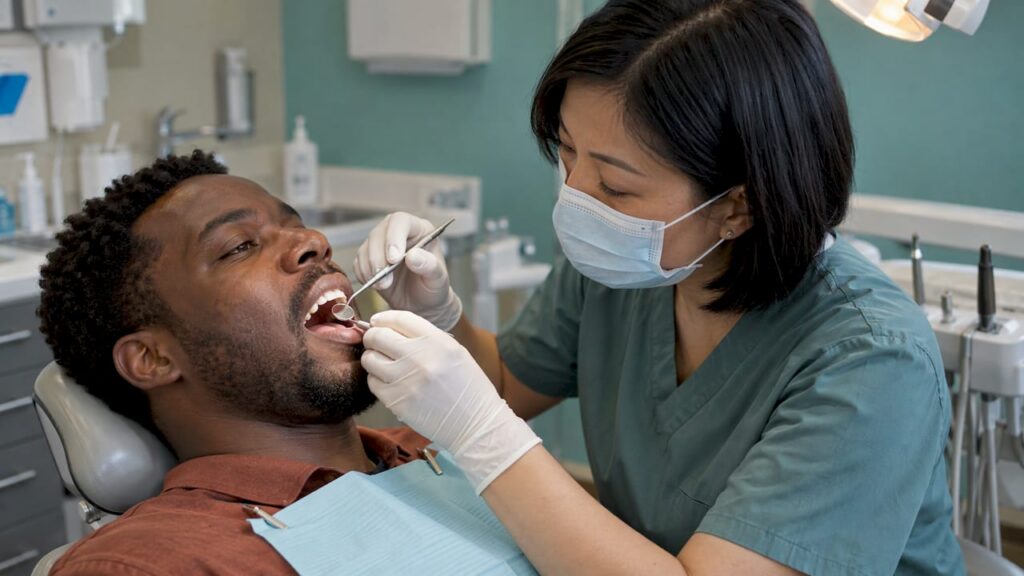
Breathing through your mouth day after day dries out your gums and teeth, and that dryness raises the risk of cavities, gum inflammation and bad breath. In growing children, long-term mouth breathing is also linked to narrower dental arches and bites that do not line up. The good news: a dentist can often spot the pattern at a routine exam, and most of the damage is easier to prevent than to repair.
TL;DR
- Mouth breathing reduces saliva and oral humidity, which leaves teeth and gums less protected against decay and gum disease.
- At night the effect is stronger, because saliva is already at its lowest during sleep.
- In children, persistent mouth breathing is associated with a narrower upper arch, crossbite and a longer facial profile.
- The root cause is usually a blocked nose (allergies, enlarged adenoids or tonsils, a deviated septum), so treating the airway matters as much as treating the teeth.
- Brush with fluoride toothpaste, floss daily, keep regular cleanings and ask your dentist or your child’s pediatrician to look at the airway.
Table of Contents
- What happens to your teeth when you breathe through your mouth
- Which teeth are affected first
- How mouth breathing affects a child’s bite and facial growth
- Why people breathe through their mouths
- Can a dentist tell if you breathe through your mouth?
- How to protect your teeth and gums
- Our perspective on mouth breathing and dental care
- Care for the whole family in Littleton
- FAQ
- Sources
What happens to your teeth when you breathe through your mouth
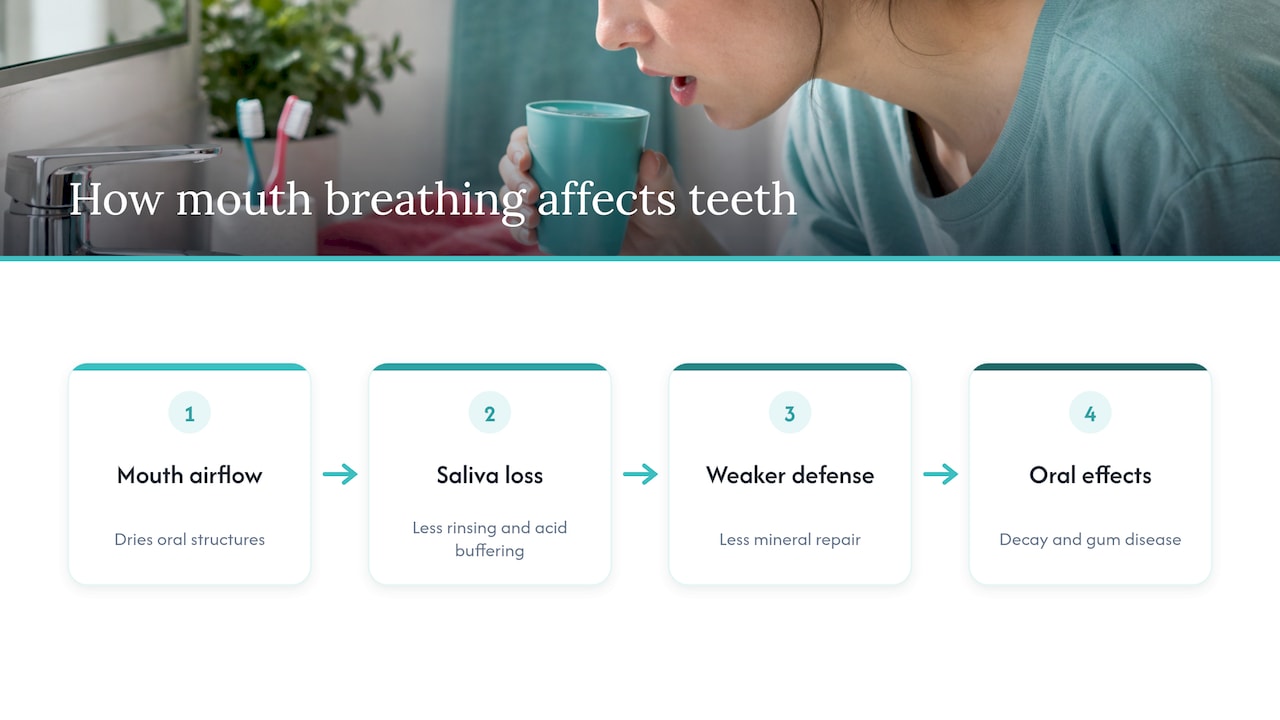
Your nose warms and humidifies air. Your mouth does not. When air moves over your tongue, gums and teeth all day or all night, the thin film of saliva that coats them evaporates.
Saliva is your mouth’s built-in defense. It rinses food and bacteria off teeth, buffers acid and carries minerals that help repair early enamel damage. The American Dental Association notes that reduced salivary flow can increase the chance of cavities, tooth demineralization, tooth sensitivity and oral infections, and can make tasting, chewing, swallowing and speaking harder.
A 2020 peer-reviewed article on airway dysfunction and dental health explains that mouth breathing dries oral structures and lowers saliva production, which increases the risk of decay and periodontal disease. A 2026 review in Frontiers in Dental Medicine adds that in oral breathers the airflow lowers humidity in the mouth and is tied to more plaque, higher levels of Streptococcus mutans (a bacterium associated with decay) and a higher risk of caries.
Harvard Health puts the everyday version simply: mouth breathing during sleep can lead to dry mouth, which promotes tooth decay and gum disease.
Cavities, gum inflammation and bad breath
Three problems show up most often in adults and children who breathe through their mouths:
- Cavities. With less saliva, plaque sits longer and acid does more work. Cavities often appear in places that are normally well protected, such as along the gumline and on the front teeth that air hits directly.
- Red, puffy gums. Constantly dried gum tissue becomes irritated and inflamed. Many people notice bleeding when they floss, especially on the upper front teeth.
- Bad breath. A dry mouth lets odor-causing bacteria thrive. If this sounds familiar, our guide to bad breath causes and when to see a dentist explains how to sort out the source.
Why night-time mouth breathing is the bigger problem
Saliva flow naturally drops during sleep. The ADA points out that dry mouth symptoms may worsen at night because salivary output is at its lowest, and mouth breathing can make that worse. The 2020 article also reports that during sleep, mouth breathing lowers the pH inside the mouth compared with normal breathing. A more acidic mouth can erode tooth surfaces, increase sensitivity to temperature and leave teeth more prone to decay.
If your teeth have started to feel sensitive to cold air or drinks and you also wake with a dry mouth, the two may be connected. Our pages on enamel erosion repair and sensitive teeth cover what a dentist can do once enamel has been affected.
Which teeth are affected first
People often ask which teeth “rot first.” There is no single answer, because decay depends on diet, brushing, fluoride exposure and saliva. In mouth breathers, the pattern tends to follow the airflow and the dryness: the front teeth and gumline, where saliva evaporates fastest, and any back teeth with deep grooves where plaque collects. That is one reason we look at the whole mouth, not just the tooth that hurts.
How mouth breathing affects a child’s bite and facial growth
In adults, mouth breathing mostly damages the soft tissue and the chemistry of the mouth. In children, whose jaws and faces are still growing, it can also influence how things develop.
Nasal breathing helps the upper airway and surrounding structures develop in balance. When a child breathes through the mouth, the tongue sits lower and the lips and cheeks apply different pressure than they should. A 2022 review in Frontiers in Public Health describes this as muscle imbalance that may lead to oral and craniofacial changes, including lower tongue pressure, compression of the upper teeth and a constricted upper dental arch.
Other research points the same way:
- A 2026 meta-analysis of 13 studies found narrower upper intercanine and intermolar widths in mouth-breathing children, along with more posterior crossbite.
- A 2021 systematic review and meta-analysis in BMC Oral Health found that in mouth-breathing children the jaws rotated backward and downward and the upper front teeth tended to tilt forward.
- A 2025 review describes oral breathing as a significant risk factor for malocclusion, with changes such as a longer lower face and protruding upper front teeth.
Cleveland Clinic summarizes what parents may see: a narrow face, a receding chin or jaw, and upper and lower teeth that do not line up.
These are associations found in groups of children, not a prediction for every child who snores during a cold. What they do show is why early attention pays off: the younger a child is when the airway problem is addressed, the more growth is still ahead.
If your toddler keeps the mouth open at rest, it is also worth reading about toddler mouth breathing and ENT care, which covers when to involve an ENT and when therapy may help.
For school-age kids, cavity prevention matters just as much. Our guide to dental sealants for kids explains how sealants protect the grooves of back teeth, which is helpful when saliva is not doing its full job.
Why people breathe through their mouths
Mouth breathing is usually a symptom, not a habit someone chose. Healthline notes that the underlying cause in most cases is an obstructed nasal airway. Cleveland Clinic lists the usual suspects: a deviated septum, enlarged turbinates, enlarged adenoids or tonsils, nasal congestion from allergies or chronic sinusitis, nasal polyps and sleep apnea.
That list matters for one reason: brushing better will not open a blocked nose. Dental care protects the teeth while the cause is found and treated by the right medical professional.
Signs to watch for
Adults and parents often notice:
- Dry mouth or a sticky mouth on waking
- Bad breath that returns quickly after brushing
- Snoring, hoarseness or drooling on the pillow
- Feeling tired all the time despite a full night in bed
- Frequent cavities or gum inflammation despite decent brushing
In children, add a lips-apart resting posture, noisy eating, restless sleep, daytime sleepiness or trouble focusing, teeth grinding and changes in how the face or bite is developing. The American Academy of Pediatric Dentistry’s Pediatric Airway Assessment form asks about exactly these things, including snoring, pauses in breathing, grinding, bedwetting and heavy sweating during sleep.
Grinding deserves its own mention. If you or your child clench or grind at night, see our article on teeth grinding at night, since disrupted sleep breathing and grinding often travel together.
Can a dentist tell if you breathe through your mouth?
Often, yes. Your dentist sees the mouth up close, and mouth breathing leaves clues. Healthline notes that a dentist may suspect it at a routine exam when a patient has bad breath, frequent cavities or gum disease, and may then refer the patient to an ear, nose and throat (ENT) specialist.
WebMD describes what a fuller evaluation can look at: lip seal, posture, dark circles under the eyes, a long face, open bite, a high and narrow palate and gingivitis, plus questions about mouth position and morning headaches.
At a general exam we look for:
- Dry, red or swollen gum tissue, particularly at the front of the mouth
- A pattern of new decay or early enamel wear
- Narrow arches, crossbite or an open bite in children
- Enlarged tonsils or other visible signs that the airway may be narrow
- Signs of grinding, such as flattened or chipped teeth
We cannot diagnose a sinus, allergy or sleep problem from the chair, and we do not pretend to. What we can do is flag the pattern, protect the teeth and point you toward the right medical professional.
How to protect your teeth and gums
While the cause is being sorted out, a few habits make a real difference. These follow the ADA’s guidance for people with dry mouth:
- Brush gently at least twice a day with fluoride toothpaste.
- Floss every day.
- Schedule dental visits at least twice a year.
- Ask your dentist whether a prescription-strength fluoride gel is right for you.
- Use a humidifier at night.
Those points come from the ADA’s dry mouth resource, which also notes that chewing sugar-free gum and saliva substitutes can ease discomfort. If you take several medications, dry mouth may have more than one cause; our article on why dry mouth starts lists what to bring to your appointment.
When to see a doctor as well as a dentist
Cleveland Clinic advises talking to a healthcare provider about symptoms like bad breath or drooling on your pillow, and asking a child’s pediatrician to check the nose and airway if the child often breathes through the mouth. Connecticut Children’s suggests parents see a doctor when a child shows snoring or noisy sleep breathing, daytime sleepiness, speech or swallowing difficulty, or changes in facial growth or dental alignment such as a long face or open bite.
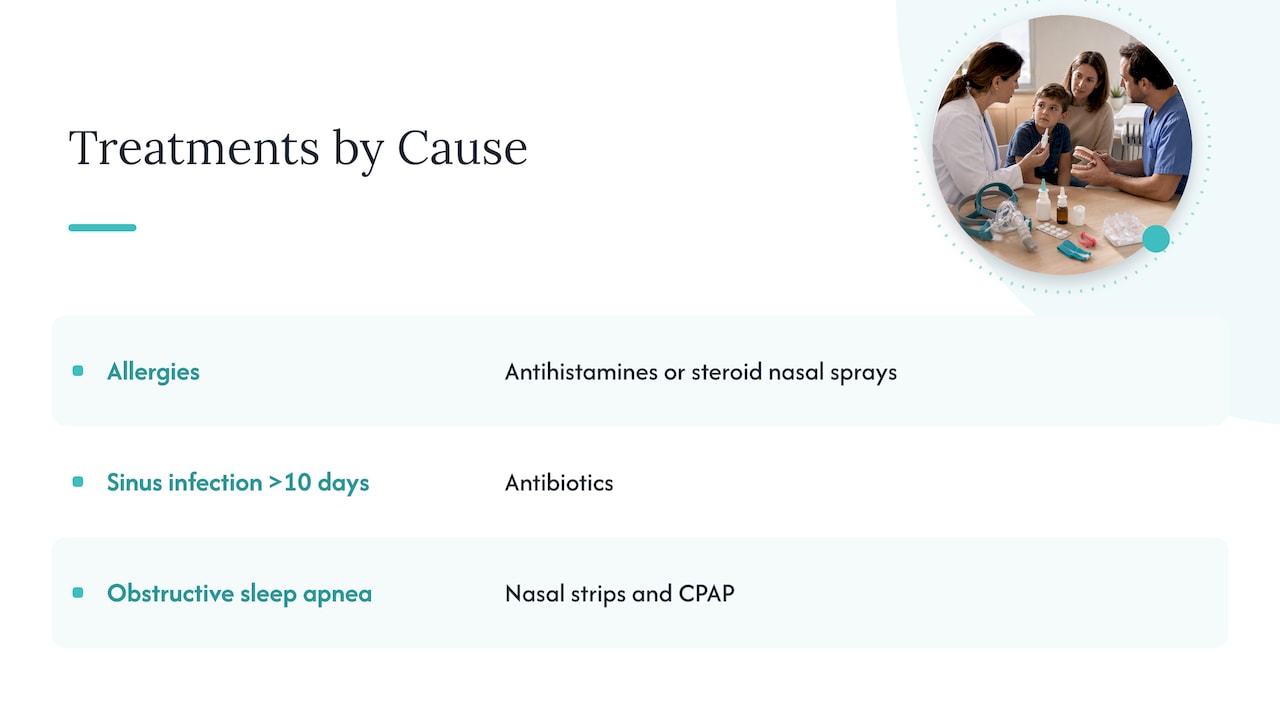
Treatment depends on the cause. Cleveland Clinic lists antihistamines or steroid nasal sprays for allergies, antibiotics for a sinus infection lasting more than 10 days, and surgeries such as adenoidectomy, septoplasty or turbinate reduction. Healthline adds nasal dilator strips and CPAP for obstructive sleep apnea. Those are decisions for your physician or an ENT, not something to try on your own, especially for a child.
Our perspective on mouth breathing and dental care
At South Littleton Family Dental, we see mouth breathing as a good example of why dental care should be personal. Two patients can brush the same way and have very different mouths, because one of them is sleeping with dry gums and the other is not.
That is why we build individualized care plans. If a cavity, red gums or a worn tooth keeps coming back, we look at the reason behind it, including how you breathe, how you sleep and how dry your mouth feels, instead of simply treating the spot in front of us.
We also know that dental visits can make people anxious, and parents worry about their children’s growth. We aim to explain what we see in plain language, show you what it means for your teeth and keep the plan clear. Preventive care is the heart of this: regular exams and cleanings help us catch early decay and gum changes while they are still simple to treat, and same-day emergency care is there when something cannot wait.
When the cause is a blocked nose or a sleep issue, we will tell you so and recommend you see your physician, your child’s pediatrician or an ENT. Our job is to keep the teeth and gums as healthy as possible while you get the airway looked after.
the author
Care for the whole family in Littleton
If you or your child has dry mouth, frequent cavities, red gums or a bite that looks like it is changing, a checkup is the simplest first step. We provide general dentistry for all ages, including exams, cleanings, x-rays, fillings and preventive care such as fluoride treatments and oral cancer screenings.

Parents can start with our children’s dentistry page. If a tooth is already causing pain, our emergency dentistry service offers same-day care. Or visit South Littleton Family Dental to request an appointment and tell us about your symptoms.
FAQ
Do mouth breathers get less oxygen?
The research gathered for this article focuses on dental and facial effects, so we will not make claims about oxygen levels. What the sources do describe are the related signs that deserve a medical check: snoring, restless sleep, feeling tired all the time and trouble focusing in children. If you notice these, talk with your physician or your child’s pediatrician.
Can mouth breathing cause cavities even if I brush well?
It can raise your risk. Less saliva means plaque stays on teeth longer and acids are neutralized more slowly. The ADA’s advice for dry mouth is fluoride toothpaste twice a day, daily flossing, dental visits at least twice a year and a humidifier at night. Tell your dentist about the dryness so the plan can be adjusted.
Can mouth breathing change my child’s teeth?
Several reviews link persistent mouth breathing in children with a narrower upper arch, crossbite and a longer facial profile. It does not happen to every child, and the cause is often a treatable nasal or airway problem. If your child snores, sleeps with the mouth open or has a bite that looks off, ask the pediatrician to check the airway and have a dentist check the bite.
Is mouth breathing at night different from during the day?
Night is usually harder on teeth. Saliva output is lowest during sleep, and mouth breathing at night can lower the pH in the mouth. Waking with a dry mouth, sore throat or morning bad breath are common clues.
When should I see a dentist about mouth breathing?
See a dentist if you have dry mouth that does not go away, new cavities, bleeding or swollen gums, or if your child’s teeth seem crowded or misaligned. A routine exam is enough to start, and your dentist can refer you onward if the airway needs attention.
Sources
- Xerostomia (Dry Mouth), American Dental Association
- Impact of airway dysfunction on dental health, PMC
- Oral breathing and its dental and cognitive effects, Frontiers in Dental Medicine
- Does breathing through my mouth affect my dental health? Harvard Health
- The impact of mouth breathing on dentofacial development, Frontiers in Public Health
- Dental arch dimension and palatal morphology in children, PMC
- Effects of mouth breathing on facial skeletal development, BMC Oral Health
- Oral Breathing Effects on Malocclusions, PMC
- Mouth Breathing: Symptoms, Complications & Treatment, Cleveland Clinic
- Mouth Breathing: Symptoms, Complications, and Treatments, Healthline
- Mouth Breathing: Causes, Effects, Treatment and Prevention, WebMD
- Pediatric Airway Assessment, American Academy of Pediatric Dentistry
- Mouth Breathing in Kids: When to Worry, Connecticut Children’s