
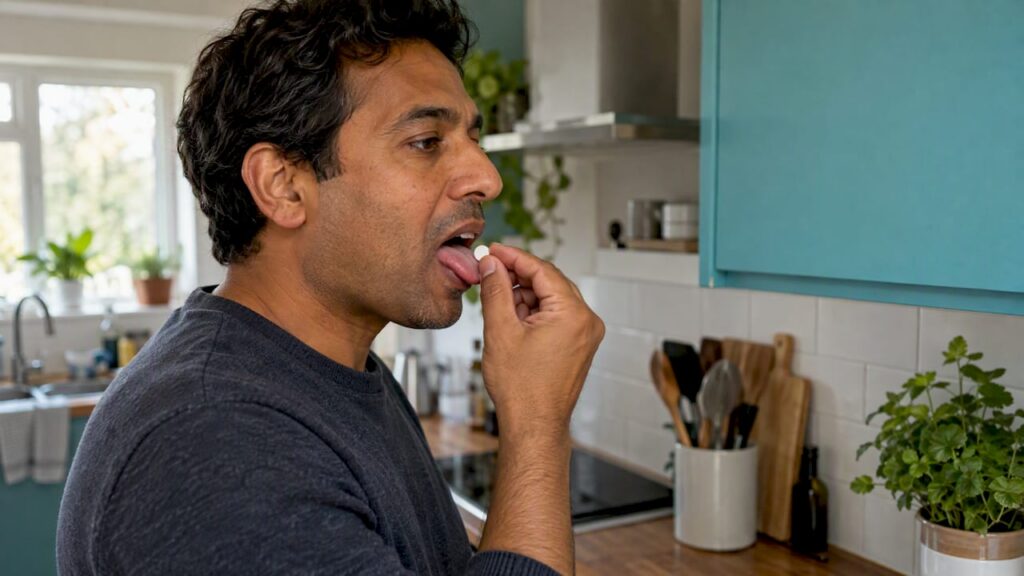
Oral probiotics are live bacteria meant to settle in your mouth and crowd out the species that cause cavities, gum inflammation and bad breath. The research shows modest benefits for certain strains, mostly for bad breath and for the bacteria linked to cavities. It does not show that a probiotic can replace brushing, flossing or a professional cleaning. Xylitol gum has a longer record and clearer guidance behind it. Below, we sort what the studies support from what the labels promise, and how to use both safely.
TL;DR
- Oral probiotics show modest, strain-specific benefits. The best-supported are short-term bad breath relief and lower counts of cavity-linked bacteria.
- Evidence for gum health is mixed. Studies differ in strains, doses and length, so results are hard to compare.
- Xylitol gum is a useful add-on to brushing. Choose sucrose-free gum and chew it for 10 to 20 minutes after meals.
- Persistent bad breath, bleeding gums or tooth pain need an exam. A supplement cannot diagnose or treat the cause.
- Too much xylitol can upset your stomach, and it is toxic to dogs, so keep it out of reach of pets.
Table of Contents
- What oral probiotics are, and how they differ from the ones you swallow
- Do oral probiotics really work?
- Oral probiotics for bad breath
- Probiotics for gum health
- Xylitol gum: benefits and what the studies show
- The best gum for your teeth
- Safe use: side effects and cautions
- A perspective from our dental team
- Build a routine that works
- See us for a checkup in Littleton
- FAQ
- Sources
What oral probiotics are, and how they differ from the ones you swallow
A general probiotic is a live microorganism you take for your gut. Cleveland Clinic describes probiotics as live bacteria and yeasts that can be taken as supplements or used as topical products. An oral probiotic is the same idea aimed at the mouth. It usually comes as a lozenge, chewable tablet, lozenge-style mint or dissolving powder. The idea is that the bacteria sit on your teeth, tongue and gums for a while instead of passing straight through you.
The mouth hosts hundreds of bacterial species. Most are harmless. Trouble starts when acid-producing species such as Streptococcus mutans dominate (cavities), or when bacteria that produce sulfur gases collect on the back of the tongue (bad breath). Oral probiotics try to shift that balance.
One point matters when you shop. A 2024 critical evaluation points out that many species in oral probiotic products are included because they have a history of safe use as food starters, not because they have been shown to work in the mouth. The same review notes that benefits are strain-specific, and that some Streptococcus strains have documented effects against bacteria involved in gingivitis, periodontitis and cavities. So “contains probiotics” tells you very little. The exact strain is what counts.
Do oral probiotics really work?
Sometimes, modestly, and only for specific strains. A 2026 umbrella review of meta-analyses in Frontiers in Oral Health found that probiotic supplementation is associated with modest reductions in S. mutans counts and improved bad breath measures. Common strains in these studies were Lactobacillus, Bifidobacterium and S. salivarius. The same authors caution that the studies vary a lot, often measure surrogate outcomes (bacterial counts rather than actual cavities), and are of moderate quality, which limits how confident anyone can be.
In plain terms:
- A lower bacterial count is a good sign, but it is not the same as fewer fillings.
- Results from one strain do not carry over to another brand’s product.
- Most trials are short, so we know little about what happens after months or years.
That is a reasonable summary of where the field stands: promising, not settled. It is a good reason to treat probiotics as a supporting player in a routine built on brushing twice a day, cleaning between your teeth and regular dental visits.
Oral probiotics for bad breath
Bad breath is where the evidence is strongest, and it is also the reason most people search for this topic. A 2022 meta-analysis found that Lactobacillus salivarius, Lactobacillus reuteri, Streptococcus salivarius and Weissella cibaria may relieve halitosis in the short term, four weeks or less, by reducing volatile sulfur compounds. The authors also flagged limited data, risk of bias and differences between studies, which lowers the reliability of the findings.
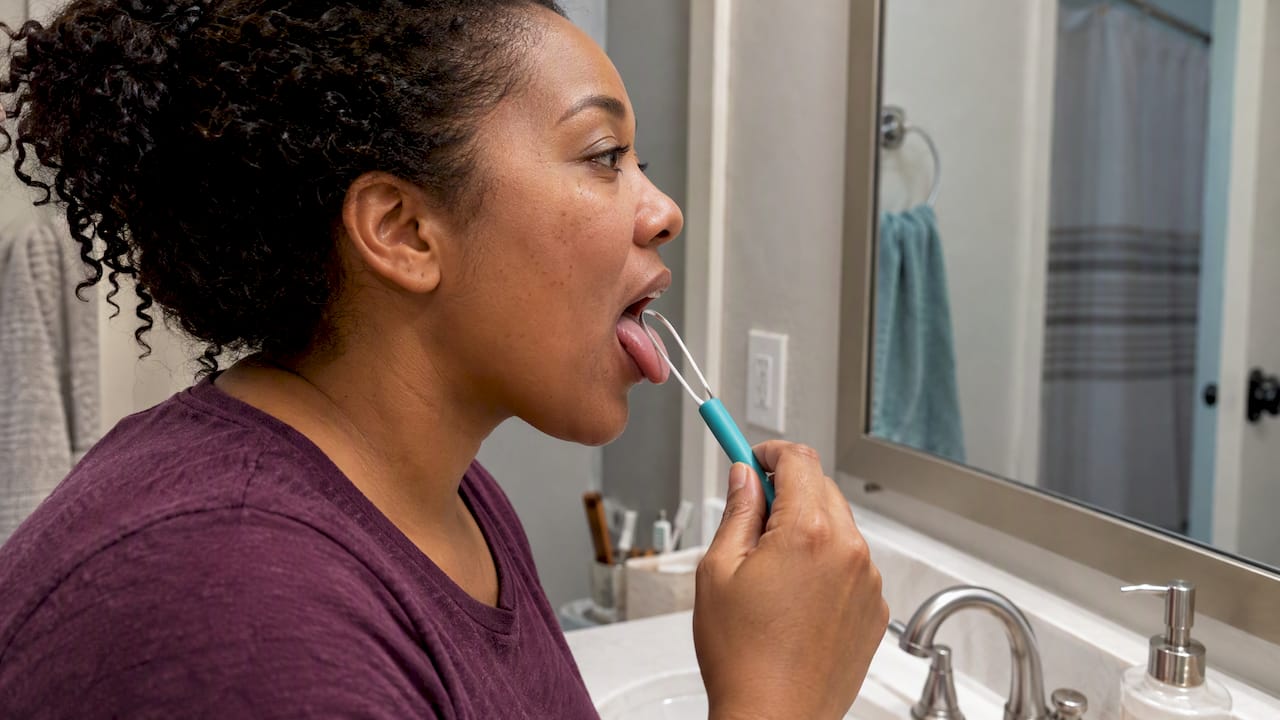
A double-blind trial summarized in a 2023 narrative review found that a tablet containing L. salivarius and xylitol significantly lowered sulfur compound levels compared with placebo. A 2024 systematic review adds a practical tip: combining probiotics with tongue scraping may help keep those reductions going.
What this means for your routine
If your breath is the issue, a probiotic lozenge is a reasonable thing to try alongside the basics:
- Brush twice a day and clean between your teeth daily.
- Scrape or brush your tongue, especially the back third.
- Drink water through the day, since a dry mouth makes odor worse.
- Try a probiotic lozenge with a studied strain for a few weeks and see whether it helps.
The key word in the research is “short term.” If your breath returns when you stop, or never improves, the cause is probably something a lozenge cannot reach: gum disease, a cavity, a cracked filling, a tooth infection, dry mouth from a medication, or a sinus or stomach issue. Our guide to bad breath causes and when to see a dentist walks through how to tell them apart.
Probiotics for gum health
Here the picture is less tidy. Some trials report fewer periodontal pathogens after probiotic use, but a 2024 review found the results conflicting, with study design, sample size, delivery route, frequency and duration making comparisons hard. Another review noted that research can’t be generalized because studies use very different bacterial strains.
One encouraging pattern: a 2021 systematic review reported that combinations of probiotic bacteria often showed higher clinical efficacy than single agents for gingivitis and periodontitis. That points toward multi-strain products, but it is not a recommendation for any specific one.
What that means for you: if your gums bleed, look puffy or are receding, a probiotic is not the first step. Gum inflammation responds best to removing the plaque and tartar that feed it, which takes a professional cleaning and an exam to measure how deep any pockets are. Once that is done, a probiotic may be one more tool for keeping bacteria in balance. Our general dentistry team can check your gums and tell you where you stand.
Xylitol gum: benefits and what the studies show
Xylitol is a sugar alcohol that bacteria in your mouth cannot turn into acid. Chewing gum also stimulates saliva, which helps wash away food and buffer acids. The American Academy of Pediatric Dentistry notes that xylitol reduces plaque formation, inhibits enamel demineralization by lowering acid production, and directly inhibits S. mutans.
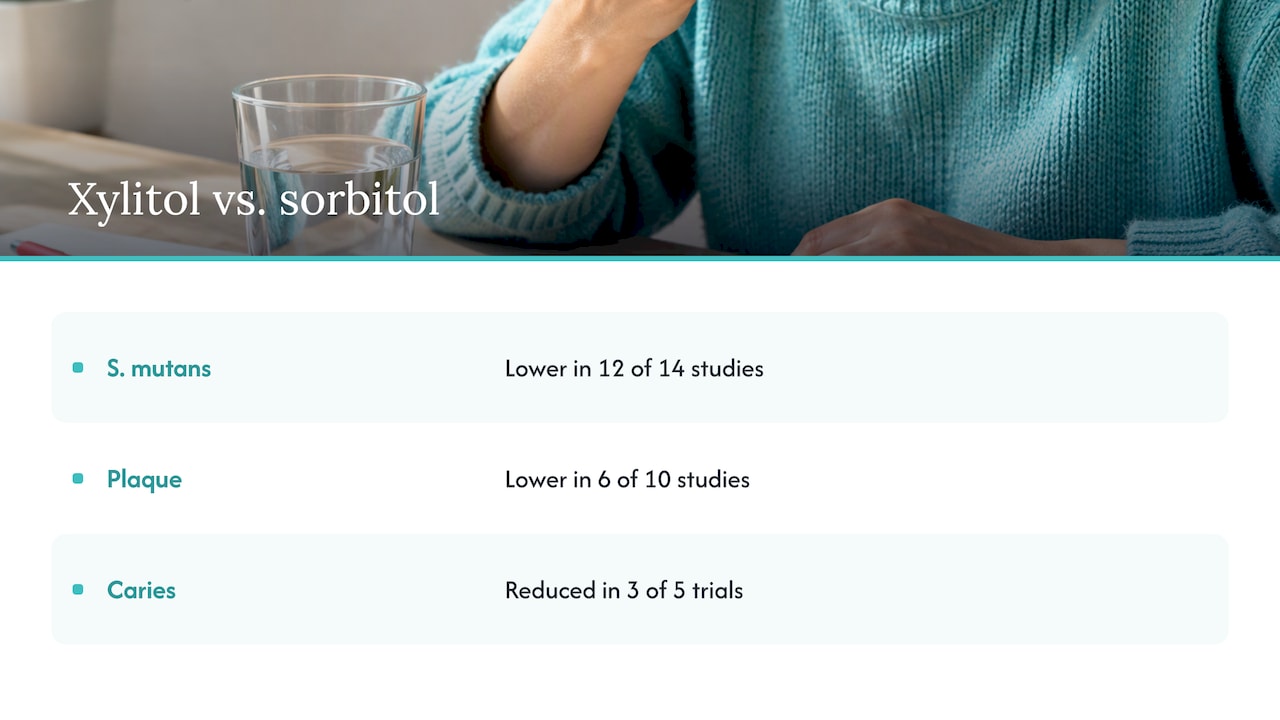
A 2025 systematic review in BMC Oral Health looked at chewing xylitol gum against sorbitol gum. Xylitol significantly reduced S. mutans counts in 12 of 14 studies, plaque in 6 of 10, and caries in 3 of 5 trials. The authors suggest xylitol gum as an adjunct to toothbrushing for children and adults.
Does xylitol prevent cavities?
It helps lower risk, but the science does not call it a guarantee. A 2022 meta-analysis concluded that xylitol products significantly prevented caries compared with non-xylitol controls. A 2024 review reached a more cautious verdict: the preventive effect cannot be confirmed, and standardized protocols are needed. The 2025 review authors add that the cost-benefit may be best for people at high risk of cavities.
So the honest answer: xylitol gum is a sensible add-on, especially if you get frequent cavities, have dry mouth, or can’t brush after lunch. It is not a substitute for fluoride toothpaste.
The best gum for your teeth
The American Dental Association guidance, as summarized by Guideline Central, says that sucrose-free gum with xylitol alone or a mix of polyols, chewed for 10 to 20 minutes after meals, may reduce new cavities on the crown of adult teeth. Use this checklist at the store:
| What to check | What to look for |
|---|---|
| Sweetener | Sugar-free, with xylitol listed first or high on the list |
| Timing | After meals and snacks, for 10 to 20 minutes |
| Frequency | A few times a day, as the study doses suggest |
| Alternatives | Mints and lozenges with xylitol if gum bothers your jaw |
One trial summarized by the AAPD found that people chewing 100% xylitol gum five times a day had significantly lower plaque scores than at baseline. That is a heavy schedule, and it shows why gum with only a trace of xylitol is unlikely to do much.
If you have jaw pain, a clicking joint or TMJ problems, ask your dentist before adding lots of chewing. Gum is not for everyone.
Safe use: side effects and cautions
- Stomach upset. The AAPD reports abdominal distress and osmotic diarrhea in patients consuming 3 to 60 grams of xylitol per day. Start with a piece or two a day and build up.
- Young children. Gum is a choking risk for small children. Ask a pediatric dentist before using xylitol products with a child.
- Pets. Xylitol is poisonous to dogs. Store gum and mints where pets cannot reach them, and call your veterinarian right away if a dog eats some.
- Probiotic products. If you have a weakened immune system or a serious medical condition, ask your physician before taking any live-bacteria supplement.
- Pregnancy and medications. Check with your doctor or dentist first.
The mouth also connects to the rest of the body, which is why dentists look at more than teeth. If you’re curious about that wider picture, this piece on the mouth and body connection is a good place to continue.
A perspective from our dental team
We see the same pattern in the chair. A patient arrives with a new probiotic, a new gum or a new mouthwash, hoping one product will fix a problem that has been building for years. The products can help. They help most when we know what is actually going on.
Our approach is built on individualized care plans. Bad breath might come from the tongue, a failing filling, gum pockets or a dry mouth. Each has a different fix, and we use modern diagnostic tools to show you what we see, so the plan is clear and specific to you. That is how we try to make visits less stressful, too.
If you want to try a probiotic lozenge or xylitol gum, we are happy to talk it through. We would rather you do it on top of a solid foundation: regular exams, professional cleanings, and same-day care when something hurts. Preventive care for the whole family is what we do every day in Littleton.
the author
Build a routine that works
Here is a simple order of priorities, from most to least proven:
- Fluoride toothpaste twice a day and daily cleaning between teeth.
- Regular exams and cleanings. Our guide on how often you need a dental checkup helps you set the right interval for your risk level.
- Sealants for deep grooves in back teeth. See sealants for adults if you have cavity-prone molars.
- Xylitol gum after meals as an extra layer.
- A probiotic lozenge with a studied strain, mainly if bad breath is your concern.
Track how you feel for four to six weeks. If your breath improves and your gums stay healthy, keep going. If not, book an exam rather than adding more products.
See us for a checkup in Littleton
Probiotics and gum can support a healthy mouth, but they can’t find a cavity or measure gum pockets. We offer exams, cleanings, x-rays and preventive care for children and adults, along with same-day emergency visits when pain can’t wait.

If you have lingering bad breath, bleeding gums or a sore tooth, start with general dentistry at South Littleton Family Dental. If it hurts right now, see our emergency dentistry page.
FAQ
Do oral probiotics really work?
For certain strains, they appear to work modestly. Reviews link them to lower cavity-causing bacteria counts and short-term bad breath relief, but study quality and differences between trials limit certainty. They work best alongside brushing, flossing and dental visits.
Can oral probiotics get rid of bad breath for good?
Not reliably. The studies showing benefit mostly cover four weeks or less, and the effect may fade when you stop. Lasting bad breath usually has a cause, such as gum disease, a cavity or dry mouth, that a dentist should find and treat.
Does xylitol prevent cavities?
It can lower your risk, but the evidence is mixed. Some meta-analyses found significant prevention and others could not confirm it, so treat xylitol gum as a supplement to fluoride toothpaste, not a replacement.
What is the best gum for your teeth?
Choose sugar-free gum sweetened with xylitol alone or with other polyols. ADA-based guidance suggests chewing for 10 to 20 minutes after meals. Avoid gum with sugar, and skip gum if it aggravates jaw pain.
Are oral probiotics different from regular probiotics?
Yes, in where they are meant to act. Oral probiotics are lozenges or chewables designed to colonize the mouth, while regular probiotics are aimed at the gut. Strains that help one area do not always help the other.
Sources
- Probiotics: What They Are, Benefits & Side Effects, Cleveland Clinic
- Probiotics for oral health: a critical evaluation, PMC
- The effects of probiotics intervention on oral health, Frontiers in Oral Health
- Efficacy of probiotics in the management of halitosis, PMC
- Causes and Management of Halitosis: A Narrative Review, PMC
- The Influence of Probiotics in Halitosis and Cariogenic Bacteria, MDPI
- Effect of Probiotic Supplements on the Oral Microbiota, PMC
- Probiotics in Oral Health and Disease: A Systematic Review, MDPI
- Policy on the Use of Xylitol in Caries Prevention, AAPD
- Specific effects of xylitol chewing gum on mutans streptococci, BMC Oral Health
- Meta-analysis on the Effectiveness of Xylitol in Caries Prevention, PMC
- Is xylitol effective in the prevention of dental caries?, PMC
- ADA Non-Fluoride Caries Preventive Agents guideline, Guideline Central
- The Pelvic Floor–Oral Health Connection