
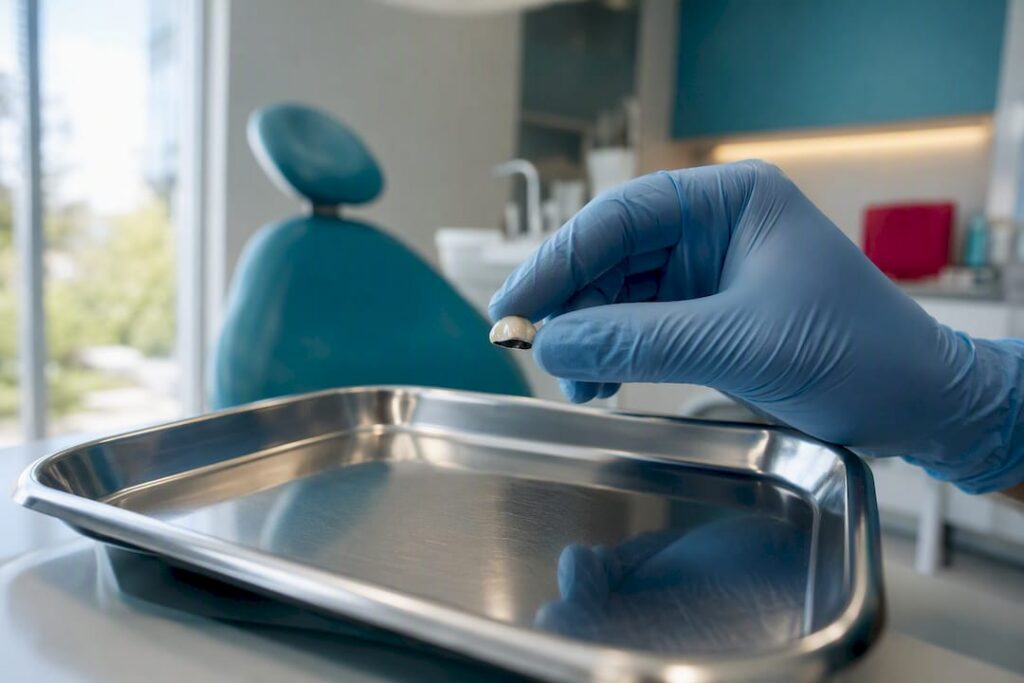
Retrieve the crown, rinse it off, and set it somewhere safe. Avoid chewing on that side of your mouth. Call your dentist and aim to get seen promptly within a couple of days, unless you have severe pain, swelling, or bleeding that won’t stop, in which case you need care today. If you’re desperate to cover the tooth in the meantime, an over-the-counter dental cement kit works for a short stretch. Never reach for super glue or any household adhesive.
TL;DR:
- Crowns that fall off should be located, inspected for damage, and stored properly to facilitate potential re-cementing by a dentist.
- Temporary fixes like dental cement kits or denture adhesives can help, but household glues or epoxies must never be used.
- Avoid chewing on the affected side, and stick to soft foods while managing discomfort with over-the-counter pain medication.
- Seek dental care within 24 to 48 hours unless experiencing severe pain, swelling, bleeding, or signs of infection, which require immediate attention.
- During the dental visit, the tooth and crown will be examined, X-rayed if necessary, and treatment options discussed based on the condition.
Table of Contents
- Crown Fell Off? Here’s What to Do in the First Few Minutes
- Protecting the Tooth: Safe Temporary Fixes You Can Try at Home
- Eating, Pain, and Hygiene While You Wait
- Is a Missing Crown a Dental Emergency? Warning Signs to Watch
- What Happens at the Dental Visit
- Why Crowns Fall Off in the First Place
- How Long Can You Wait Before Seeing a Dentist?
- How We Handle Lost Crowns at South Littleton Family Dental
- Same-Day Emergency Care When Your Crown Won’t Wait
- Sources
Crown Fell Off? Here’s What to Do in the First Few Minutes
Don’t panic, and don’t spit reflexively if the crown is still in your mouth. Most people either feel it come loose while eating something chewy or notice a gap with their tongue a few hours later. Either way, the next few minutes matter more than people think.
Here’s the order of operations:
- Find it. Check your mouth first, then look at whatever you were eating or the sink if you were brushing. If you think you swallowed it, don’t try to induce vomiting. Call your dentist or a doctor for advice. Crowns are small and typically pass without incident, but it’s worth a call to be safe.
- Inspect the crown. Look for cracks, chips, or missing chunks. A crown that’s cracked or crumbling at the edges usually can’t just be popped back on, no matter how good your temporary fix is.
- Inspect the tooth. Run your tongue over it gently. Sharp edges or a rough, dark patch of exposed dentin are both signs you’ll want to mention to your dentist.
- Rinse and dry. Rinse the crown under plain water. Don’t scrub it with anything abrasive. If you’re planning to try a temporary reseat, dry it carefully first.
- Store it properly. Keep the crown in a clean, labeled container. If it still has old cement clinging to the inside, keep that surface slightly moist rather than letting it dry out completely, since that residue helps your dentist see exactly how it was seated.
The MouthHealthy patient guidance from the American Dental Association is blunt about this: keep the crown, use approved temporary materials if you need to, and get to your dentist. Many crowns that arrive intact and clean can often be re-cemented.
Protecting the Tooth: Safe Temporary Fixes You Can Try at Home
Once the crown is off, the tooth underneath is exposed to temperature, pressure, and bacteria in a way it hasn’t been in years. You have a few legitimate options for buying yourself time.
- Dental cement kits from the pharmacy are built for exactly this. Follow the package directions closely, apply a thin layer inside the crown, and seat it gently. These are a short-term bridge, not a long-term fix.
- Denture adhesive can work in a pinch to help a crown sit in place, though it’s not designed for this and won’t hold well under any real bite pressure.
- Dental wax or sugar-free gum pressed gently over an exposed tooth can blunt sharp edges as a last resort if you have nothing else on hand.
- Never use super glue, epoxy, or any household adhesive. These products aren’t formulated for the mouth, and clinical guidance from practices treating this exact scenario is consistent that household adhesives can complicate dental treatment rather than fix anything.
Pro Tip: If the crown won’t stay seated even with cement, don’t force it. A loose crown that keeps popping back off can slip and become a choking hazard. Store it and wait for your dentist instead.
Eating, Pain, and Hygiene While You Wait
Your exposed tooth is sensitive to almost everything right now, so treat this like a temporary injury. Stick to soft, room-temperature foods and skip anything hard, crunchy, sticky, or extreme in temperature. Chewing on the affected side is one of the fastest ways to worsen the exposure or crack whatever tooth structure is left.

For pain, over-the-counter acetaminophen or NSAIDs like ibuprofen usually manage the discomfort. Follow the dosing on the package and check with your doctor if you have kidney issues, stomach problems, or take blood thinners. Clinical guidance on dental emergencies generally reserves antibiotics for cases with systemic infection or spreading swelling, not routine pain, so don’t expect or push for one unless something looks infected.
Keep brushing, but be gentle around the exposed area. Floss carefully rather than skipping it. Only use a chlorhexidine rinse if your dentist specifically recommends it.
Is a Missing Crown a Dental Emergency? Warning Signs to Watch
Most crown losses aren’t emergencies, but some are. The difference usually comes down to pain intensity and whether you’re seeing signs of infection.
Call your dentist immediately, or head to an emergency room if it’s after hours and severe, if you notice:
- Severe pain that over-the-counter medication doesn’t touch
- Swelling that’s spreading toward your jaw, neck, or eye
- Fever alongside tooth pain
- Bleeding that won’t stop after gentle pressure
- A bad taste or pus near the exposed tooth
A lost crown by itself usually isn’t life-threatening, but it needs prompt attention, ideally within 24 to 48 hours, because pain, uncontrolled bleeding, or spreading infection can escalate quickly and shouldn’t wait for a routine opening.
If your regular dentist’s office is closed and you’re dealing with genuine swelling or fever, an ER can stabilize acute infection risk, but you’ll still need a dentist for the actual repair. If you’re weighing that decision, our emergency dental pain guidance walks through how to tell the difference.
What Happens at the Dental Visit
Your dentist isn’t just going to glue the crown back and send you off. There’s a short exam first that determines everything else.
- Visual inspection of the tooth and the crown itself, checking for decay, cracks, or wear at the margins.
- Probing the margins, the edge where the crown meets your natural tooth, since that’s where cement breaks down and bacteria sneak in first.
- Bite check to confirm the crown seats correctly against your opposing teeth.
- A periapical X-ray to see beneath the gumline and check the tooth’s root and any surrounding bone.
From there, treatment depends on what they find. If the tooth is healthy and the crown is intact, re-cementing it the same day is common. If there’s decay under the crown, they’ll remove it, clean out the decay, and either recement or remake the crown entirely. If the decay reached the nerve, you’re likely looking at root canal therapy before a new crown goes on. In the worst cases, where the tooth structure is too compromised to support anything, extraction and eventual implant discussion become the realistic path, something our restorative dentistry team can walk you through.
Why Crowns Fall Off in the First Place
Crowns don’t just pop off randomly. Something usually triggered it, and knowing the cause helps prevent the next one.
- Cement breakdown happens gradually over years as the bonding agent wears thin, especially at the margins where saliva and bacteria have constant access.
- Recurrent decay under the crown eats away at the tooth structure holding it in place.
- Tooth fracture beneath the crown, often from an old filling or root canal that weakened the tooth over time.
- Bruxism, or nighttime grinding, puts repeated stress on crowns that they weren’t built to absorb long-term.
- Crown age and material matter too. Older crowns or ones with a material mismatch to the surrounding tooth lose retention faster.
Pro Tip: If this is your second or third crown to fall off in the same area, tell your dentist directly. Repeated failures usually point to grinding, insufficient tooth structure, or a bite problem that a single recementing won’t fix.
How Long Can You Wait Before Seeing a Dentist?
Aim for 24 to 48 hours. That’s the general window clinical guidance supports for a crown loss without severe symptoms, and it’s realistic for most people’s schedules.
- If you have pain or swelling, don’t wait. Get seen the same day.
- The longer the tooth sits exposed, the more it’s at risk for fracture or deeper decay that could turn a simple recementing into a root canal.
- If you genuinely can’t get in within that window, keep using temporary cement, avoid chewing on that side, and maintain your normal hygiene routine without aggravating the area.
How We Handle Lost Crowns at South Littleton Family Dental
When a patient calls about a crown that fell off, we ask them to bring the crown itself, a quick rundown of symptoms, and their insurance information so we can move fast. Many crowns that come in intact, with no decay underneath, get re-cemented that same visit. When there’s more going on, decay, a crack, or bite wear, we walk through it clearly before deciding on repair, a remake, or root canal therapy.
— Admin
Same-Day Emergency Care When Your Crown Won’t Wait
South Littleton Family Dental treats a lost crown as exactly what it is: a same-day priority, not a “get to it next week” problem. We reserve emergency slots specifically for situations like this, and our emergency dentistry exam runs $49, which covers the visual inspection, X-ray, and a clear plan before you leave.

When you call, bring the crown itself if you have it, a quick list of your symptoms, any medications you’re taking, and your insurance card. If you’re already a bit anxious about the visit, our team is used to walking first-time emergency patients through every step before touching anything. Book your exam through our Littleton, CO office today, or call ahead to see if we can fit you in this afternoon.
Sources
- Lost crown or filling — is it a dental emergency? — 911 Dentist
- What to do when your crown falls out — Healthline
- Dental emergencies — MouthHealthy (American Dental Association patient site)
- Overview of dental emergencies — MSD Manuals (Professional)
This article is general information, not a substitute for advice from a qualified doctor. Consult a qualified healthcare professional about your own circumstances before acting on anything here.