
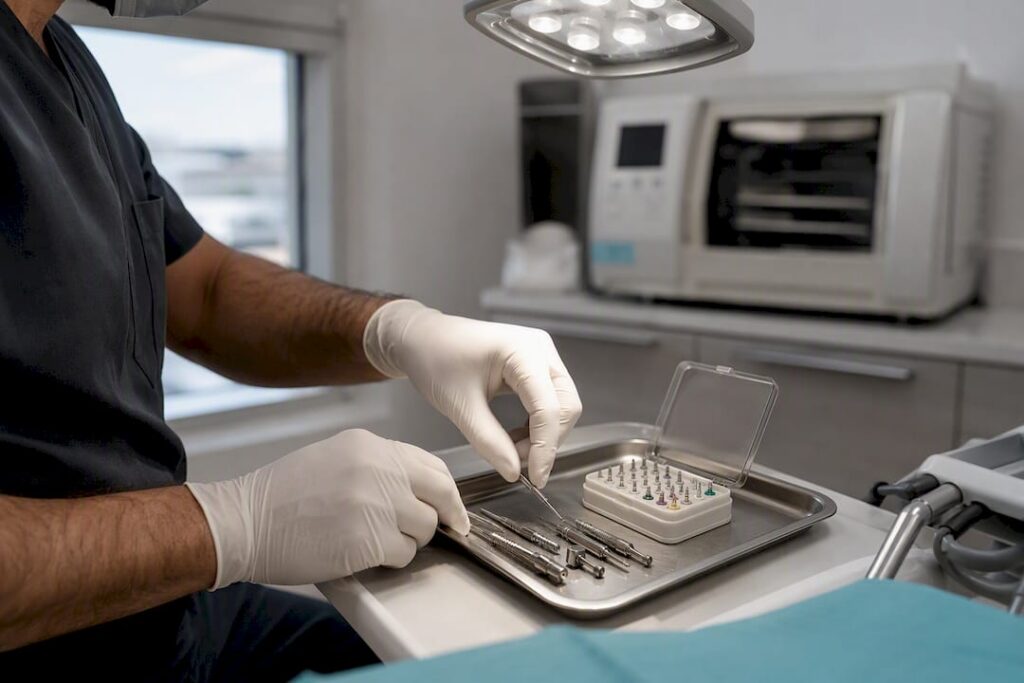
Yes, same-day dental implants are real, and many patients do walk out with a functioning temporary tooth the same afternoon. That verdict comes with conditions. The implant still needs an osseointegration window of several months before it’s ready for a permanent crown, and the International Team for Implantology classifies immediate loading as a complex, case-selected procedure, not a routine one.
That means your candidacy, not your calendar, decides whether this works for you. Before you get excited or discouraged, here’s what determines the answer:
- Whether you have adequate bone volume and an intact socket wall
- Whether any infection is present at the implant site
- Whether systemic conditions like diabetes are well controlled
- Whether you smoke, and whether you can stop for the healing period
If those boxes check out, the next step is a consult with CBCT imaging, which lets a clinician actually see your bone before promising you anything.
Key Takeaways
Same-day dental implants work best as a case-selected procedure where anatomy, health, and intraoperative stability all align, not as a guaranteed outcome for every missing tooth.
| Point | Details |
|---|---|
| Verdict on same-day implants | Many patients qualify for a same-day temporary, but strict case selection and clinician training decide eligibility. |
| Osseointegration takes months | Final restorations typically wait three to six months while the implant fuses to bone. |
| Stability testing is the gatekeeper | Insertion torque of roughly 25 to 40 Ncm or higher determines whether loading proceeds the same day. |
| Provisional isn’t final function | Temporaries avoid heavy biting contact; full chewing function returns after the permanent crown is placed. |
| Southlittletonfamilydental offers CBCT-guided consults | Candidacy assessment, cost overview, and a staged backup plan are part of every implant consult. |
Table of Contents
- What Same-Day Dental Implants Actually Mean
- Who Qualifies for Immediate Implant Placement?
- What Happens During a Same-Day Implant Appointment?
- What Are the Real Benefits, and What Are the Limits?
- Risks, Complications, and When Staging Makes More Sense
- Recovery Timeline and Long-Term Maintenance
- How Do You Choose a Qualified Provider?
- What Does the Long-Term Evidence Actually Show?
- Considering Same-Day Implants? Here’s What a Consult Covers
- Frequently Asked Questions
- Sources
What Same-Day Dental Implants Actually Mean
“Same-day dental implants” is patient shorthand for a few distinct clinical protocols, and the differences matter more than the marketing suggests. The industry terms are immediate placement, immediate loading, and full-arch immediate restoration.
- Immediate placement means the implant goes into the socket right after a tooth is extracted, often in one visit.
- Immediate loading (frequently branded “Teeth in a Day”) means a provisional crown or bridge is attached to that implant the same day, rather than waiting months.
- Full-arch immediate solutions, commonly marketed as All-on-4, use four to six strategically angled implants to support a full temporary arch the day of surgery.
Single-tooth immediate cases usually target front teeth where esthetics matter most. All-on-4 style approaches target patients missing most or all of their teeth in an arch. In nearly every case, what you leave with that day is a provisional restoration, not the final crown or bridge. The final piece comes later, once the bone has fully fused to the implant.
Who Qualifies for Immediate Implant Placement?
Candidacy hinges on anatomy first, health second, and behavior third. Clinicians look at sufficient bone volume and quality, intact socket walls, and the primary stability they can measure the moment the implant goes in. A facial bone wall of at least 1 millimeter is often required for esthetic-zone cases, since anything thinner raises the risk of visible recession later.
Medical and behavioral screening matters just as much:
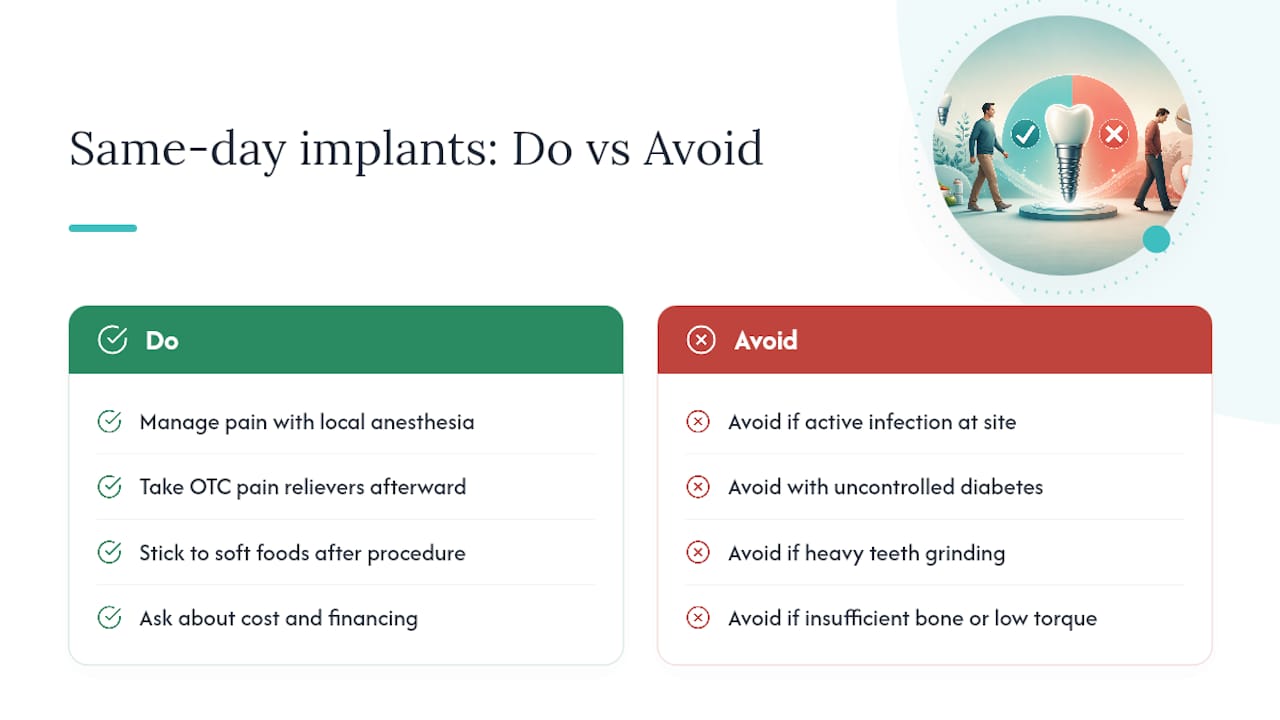
- No active infection at or near the surgical site
- Controlled systemic health, such as diabetes with HbA1c generally kept below 7.5%
- Non-smoking status, or a genuine willingness to stop for the healing window
Certain situations tend to rule out same-day loading outright: heavy bruxism (nighttime grinding puts destructive force on a healing implant), bone loss severe enough to require staged grafting first, or systemic disease that isn’t under control. Your dentist isn’t being overly cautious by asking about these. They’re avoiding a failure that costs you more time in the long run.
Pro Tip: Ask your surgeon about insertion torque and ISQ (implant stability quotient) before your appointment. These are the numbers measured in the operating chair that decide, in real time, whether same-day loading proceeds. Many protocols require insertion torque in a range considered sufficient for immediate loading before a provisional gets attached. If the number comes in low, a good surgeon converts to a staged approach on the spot rather than gambling on your new implant.
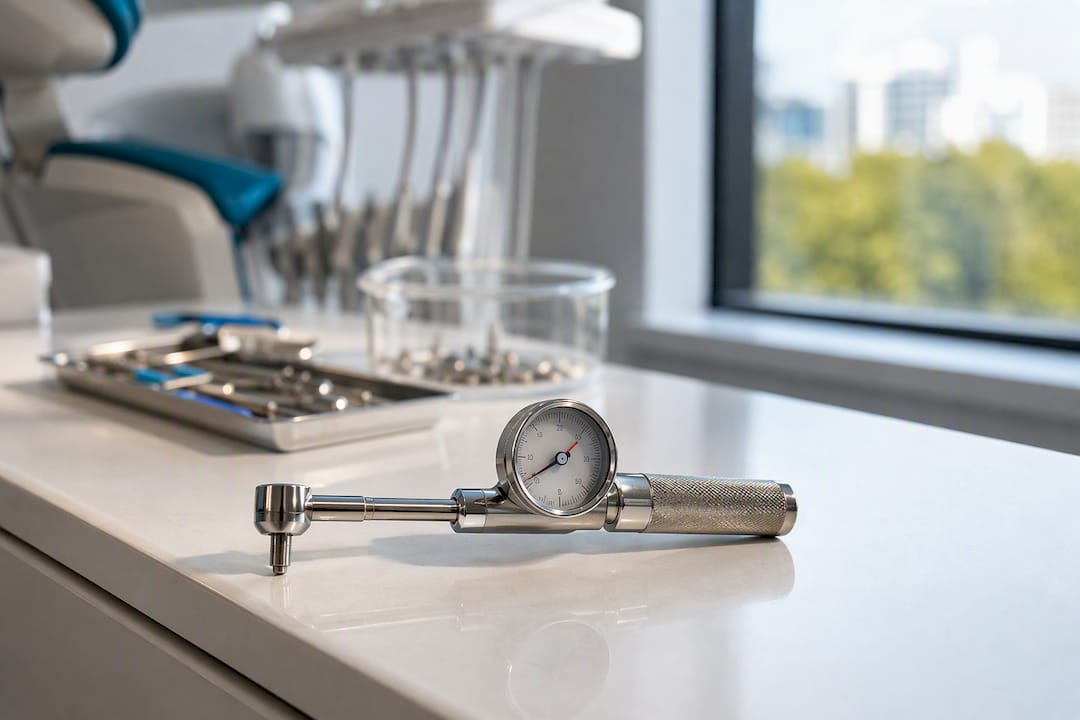
For a fuller rundown of how dental implant candidacy gets evaluated, a consult will walk through your specific bone and health picture.
What Happens During a Same-Day Implant Appointment?
Most of the real work happens before you ever sit in the chair.
- Pre-op planning. A consultation, medical history review, and CBCT scan let the team map your bone in 3D and plan implant position digitally, sometimes with a provisional crown fabricated in advance.
- Anesthesia. Local anesthesia covers most single-tooth cases; full-arch cases often add IV sedation for comfort during a longer procedure.
- Extraction, if needed. Damaged teeth are removed as atraumatically as possible to preserve the surrounding bone.
- Implant placement. The implant goes in using guided surgical templates or a freehand technique, depending on the case’s complexity.
- Stability testing. The surgeon measures insertion torque and ISQ immediately. This is the go/no-go moment for same-day loading.
- Provisional attachment. If stability is adequate, a temporary crown or bridge is placed, deliberately kept out of full biting contact.
A typical single-tooth appointment runs one to two hours; full-arch procedures often take half a day. Surgeons change course mid-procedure when stability readings come in low, when they find unexpected infection, or when the socket walls are more damaged than the CBCT predicted. That flexibility is a sign of good judgment, not a failed plan. The step-by-step implant process page covers what a typical visit looks like locally.
What Are the Real Benefits, and What Are the Limits?
The appeal is obvious: you don’t leave the office with a gap in your smile, and you avoid the older two-surgery timeline that used to stretch treatment out for the better part of a year. For a front tooth, that same-day continuity carries real psychological weight. Nobody wants to show up to work or a family event missing a visible tooth.
- Immediate aesthetics with no gap in your smile
- Fewer total surgical visits compared to staged protocols
- Reduced social and psychological disruption during treatment
But the provisional you leave with is not built for a steak dinner that night. It’s designed to avoid direct occlusal contact with opposing teeth, which protects the healing implant while it fuses to bone. Full chewing function typically waits weeks, and the final, full-strength restoration doesn’t arrive until osseointegration is confirmed months later. Same-day gets you a tooth. It doesn’t get you a finished job.
Risks, Complications, and When Staging Makes More Sense
Immediate loading isn’t risk-free, and pretending otherwise does patients a disservice. Complications run from mildly annoying to genuinely costly:
- Prosthetic issues like a chipped or loosened provisional, which show up fairly often even in successful long-term cases
- Biological complications including infection or marginal bone loss around the implant
- A statistically higher short-term failure risk in some subgroups, particularly single-tooth immediate loading, compared with conventional staged protocols
The reassuring part: overall survival rates stay high for both approaches when cases are properly selected, and a long-term randomized trial following patients for 12 years found comparable clinical and radiographic outcomes between immediate and delayed loading in well-chosen cases.
Certain red flags push a surgeon toward staging instead: inadequate insertion torque, active infection, a thin facial bone wall in an esthetic zone, or heavy bruxism. If grafting is needed first, socket preservation becomes the more predictable path, even if it takes longer.
Recovery Timeline and Long-Term Maintenance
The first few days set the tone for everything after. Stick to soft foods, avoid biting directly on the provisional, keep the surgical site clean per your dentist’s instructions, and if you smoke, this is the window to stop. Even a single cigarette can measurably slow healing at the implant site.
Full osseointegration generally takes three to six months, confirmed through follow-up radiographs and stability testing before the final crown ever gets attached. Skipping that confirmation step to rush the permanent restoration is how avoidable failures happen. For aftercare guidance in the days right after oral surgery, following a written recovery checklist reduces the odds of a setback.
Once the final restoration is in place, the job isn’t over. Recall visits and prosthetic maintenance are a normal part of long-term implant ownership. Check the implant FAQs for common questions about what maintenance actually involves.
How Do You Choose a Qualified Provider?
Not every dentist who offers implants offers same-day protocols responsibly, and that gap is where bad outcomes happen. At your consult, ask directly:
- How many same-day implant cases has this clinician performed, and what were the outcomes?
- What percentage of consult patients actually qualify for immediate loading versus staged treatment?
- Is a prosthodontist or restorative specialist involved in planning the final crown?
- What’s the contingency plan if stability testing comes back low the day of surgery?
Look for a team that includes an oral surgeon or periodontist working alongside restorative training, ideally with a prosthodontist involved in the final piece. On the technology side, CBCT-based planning, guided surgical templates, and a prefabricated provisional workflow are signs the practice takes case selection seriously rather than promising same-day results to everyone who walks in. A written aftercare plan and recall schedule should be part of that conversation too, not an afterthought. The advanced technology used during planning is worth asking about directly.
What Does the Long-Term Evidence Actually Show?
Consensus guidance from the ITI is consistent on one point: immediate protocols work, but they demand advanced surgical and restorative skill, and they shouldn’t be treated as a default option for every patient.
Bottom line from the research: a 12-year randomized follow-up found immediate and delayed loading produced comparable long-term clinical and radiographic outcomes in well-selected patients, even though prosthetic complications required ongoing repair over that period. Meanwhile, insertion torque in the 25 to 40 Ncm range remains the intraoperative threshold surgeons use to decide, case by case, whether same-day loading is safe to proceed.
That combination, comparable long-term survival paired with a real short-term risk in poorly selected cases, is exactly why case selection matters more than enthusiasm.
When Do Same-Day Implants Make the Most Sense?
Same-day loading earns its place when the anatomy supports strong primary stability, the esthetic goal is real, and the patient will actually follow strict aftercare. It’s a clinical decision, not a marketing promise, and a proper consult should always come before the calendar does.
Considering Same-Day Implants? Here’s What a Consult Covers
If you’re weighing whether same-day treatment fits your situation, the fastest way to know is a real evaluation, not a guess based on what you’ve read online. Southlittletonfamilydental gives you that answer in one visit, using the same CBCT-based planning and candidacy assessment described above, so you leave the appointment knowing exactly where you stand instead of waiting weeks for a second opinion.

A consult typically includes CBCT imaging to map your bone, a candidacy assessment against the criteria covered here, and a straightforward cost overview with financing options discussed up front. If your case isn’t a fit for immediate loading, the plan simply shifts to a staged approach with grafting where needed. Nobody gets pushed toward same-day treatment that isn’t right for their anatomy. Start with a consult through South Littleton Family Dental’s restorative dentistry team, or review implant cost and payment options before you book.
Frequently Asked Questions
Is same-day tooth replacement painful?
Most patients manage discomfort with local anesthesia and standard over-the-counter pain relievers afterward; full-arch cases involving IV sedation feel less during the procedure but may involve more soreness during the first few days of recovery.
Can I eat normally the day after getting an instant dental implant?
No. Stick to soft foods and avoid biting directly on the new provisional for at least a few weeks, since the temporary is deliberately kept out of full occlusal contact while the implant heals.
How much does same-day implant cost compare to traditional staged implants?
Same-day cost depends heavily on complexity, whether extraction and grafting are needed, and how many implants are involved; a consult with cost and financing details gives a far more accurate figure than any general estimate.
What disqualifies someone from an immediate implant procedure?
Active infection at the site, uncontrolled diabetes or other systemic disease, heavy teeth grinding, insufficient bone volume, and low insertion torque measured during surgery are the most common reasons a clinician converts to a staged approach.
Are same-day dental implants considered an emergency dental implant option?
They can address urgent esthetic needs following a lost front tooth, but same-day loading still requires a proper candidacy workup. True dental emergencies are evaluated and stabilized first, with implant planning following once infection or trauma is under control.
This article is general information, not a substitute for advice from a qualified doctor. Consult a qualified healthcare professional about your own circumstances before acting on anything here.
Sources
- Immediate placement and immediate loading criteria (PMC5965071)
- Implant placement and loading protocols — ITI consensus
- Immediate function and provisional restoration guidance (NBK409613)
- 12-year RCT long-term follow-up of immediate vs delayed loading (PubMed 41525213)