
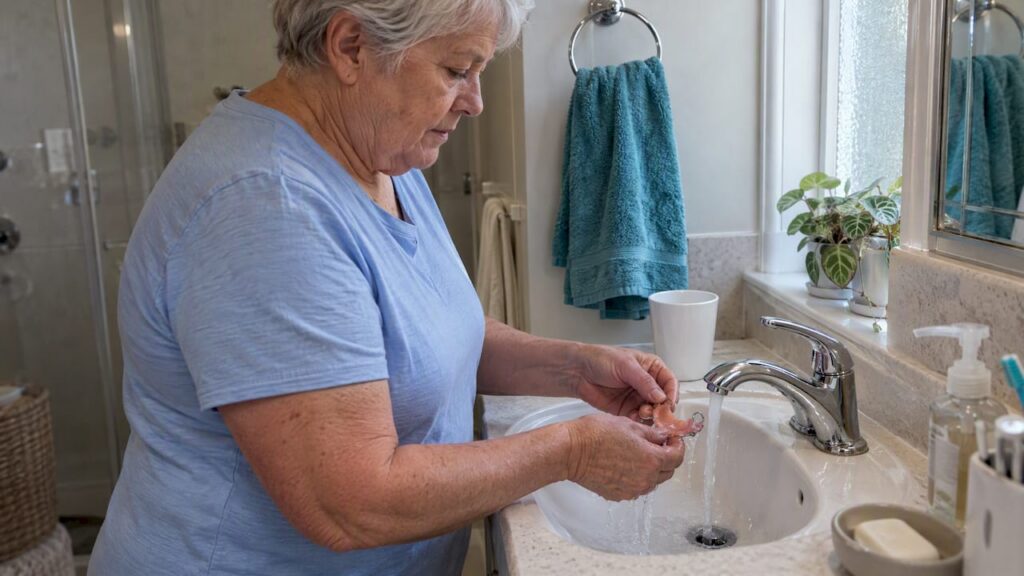
Brush your partial denture daily with a soft brush and nonabrasive cleanser, soak it in a dentist-approved solution overnight, and remove it for at least four hours out of every 24. Never use hot water, abrasive toothpaste, or bleach on metal clasps, since those can warp or corrode the framework. See your dentist promptly for persistent soreness, a loose fit, or any crack or break.
TL;DR:
- A clinical trial found lower Candida and bacterial counts when patients brushed daily and used a denture cleanser, rather than cleaning intermittently or rinsing with saline.
- Choose cleaners for the appliance materials: bleach can corrode metal and damage soft relines, while daily effervescent tablets may roughen some liners.
- Remove the partial for at least four hours daily, preferably overnight, and store it in room temperature water or a solution your dentist recommends.
- Brush and floss the natural teeth that support the partial each day, especially around clasps, and clean your gums, tongue, and cheeks before reinserting it.
- Remove the partial and contact your dentist for a persistent sore, loose fit, crack, or missing tooth; do not bend clasps or glue breaks yourself.
Table of Contents
- Daily cleaning routine for partial dentures: morning and evening step-by-step
- Soaking and storage: why, when, and how to soak safely
- Cleaning products and methods: evidence, pros and cons, and material compatibility
- Care for gums and remaining natural teeth that support the partial
- What not to do and troubleshooting: quick fixes and when to stop wearing the partial
- When to see the dentist: adjustments, repairs, and routine checks
- South Littleton Family Dental perspective and practical patient supports
- Restore comfort with a same-day denture adjustment or exam
- FAQ
- Sources
Daily cleaning routine for partial dentures: morning and evening step-by-step
A partial denture collects plaque and food debris just like natural teeth, so it needs its own cleaning routine twice a day, separate from the care you give your remaining teeth and gums.
- Rinse the partial under running water after every meal to clear loose food particles before they stick.
- Remove the appliance and brush it with a soft-bristled denture brush and a nonabsorbent, nonabrasive cleanser, reaching the clasps and the inner surface that touches your gums.
- Clean your remaining natural teeth with regular toothpaste and floss, and brush your tongue, cheeks, and gums before putting the partial back in.
- Soak the partial once daily in a chemical cleanser to reach the microscopic grooves a brush cannot, since combining brushing with a daily soak controls biofilm far better than either step alone, according to a clinical trial on denture cleansing methods.
- Rinse thoroughly before reinserting, since leftover cleanser can irritate soft tissue.
If dexterity or memory issues make this routine hard to manage alone, a caregiver can brush the mucosa with a soft cloth and clean the prosthesis with soap and a brush or an ADA-accepted cleanser, always with the device out of the mouth to avoid choking risk.
Soaking and storage: why, when, and how to soak safely
Taking your partial out overnight gives your gums and the ridge beneath the appliance a chance to recover from constant pressure, and it lowers the risk of swallowing or inhaling the device while you sleep. Most clinical guidance points to removing the partial for a minimum of about four hours in every 24-hour stretch, with overnight being the simplest way to meet that window, as explained in detail by dental benefits and coverage for employee wellness.
- Soak acrylic components in an effervescent or peroxide-based cleaner made for dentures.
- Avoid bleach near metal clasps or frameworks, since it can corrode the metal over time.
- Store the partial in room-temperature water or a dentist-recommended soak, never in hot water, which can warp acrylic.
- Change the soaking solution regularly rather than reusing old liquid.
- Rinse the partial under running water before placing it back in your mouth.
If your partial has a soft reline, ask your dentist before using daily effervescent tablets, since repeated exposure can harden or roughen some lining materials.
Cleaning products and methods: evidence, pros and cons, and material compatibility
Not every cleaning method suits every partial. The right choice depends on what your framework and base are made of.
- Effervescent tablets: convenient and generally safe for metal, though some formulas can affect soft liners with daily use.
- Peroxide or oxygen-based cleaners: effective against bacteria and fungus, with good overall material compatibility for acrylic and metal.
- Soap and soft brush: gentle and low-risk, though it relies entirely on mechanical scrubbing rather than chemical disinfection.
- Ultrasonic cleaning: an add-on tool that, when used alongside brushing, reduced biofilm coverage on metal-framework partials more than brushing alone in a randomized trial.
Daily cleanser plus brushing cuts microbial load. In a 2022 randomized controlled trial, patients who brushed and used a denture cleanser daily showed notably lower Candida and bacterial counts than those who cleaned intermittently or relied on saline rinses alone. That gap matters because Candida buildup on a partial is a leading driver of denture-related sore spots and gum inflammation.
Bleach-based cleaners carry the strongest antimicrobial punch, but they can corrode metal frameworks and degrade soft relines, while effervescent cleaners are generally safe for metal but may degrade some reline materials over time, according to a review of denture hygiene methods. Ask your dentist which product matches the specific metals and liners in your partial before settling on a routine.
Care for gums and remaining natural teeth that support the partial
A partial denture rests on your own teeth and gums, so neglecting them puts the whole appliance at risk.
- Brush your gums, tongue, and cheeks daily before inserting the partial to stimulate circulation and clear plaque from soft tissue.
- Brush and floss the abutment teeth, the natural teeth the partial clips onto, every day, since these teeth carry extra chewing load and are more exposed to decay around the clasps.
- Know that poor denture hygiene and poor natural-tooth hygiene tend to go together, and both raise the risk of gum disease and cavities around the teeth supporting the partial, according to a review of denture cleanliness.
- Ask your dentist about high-fluoride toothpaste or a short course of chlorhexidine rinse if your abutment teeth are at higher risk for decay. A 12-week randomized trial found that a multi-step routine combining fluoride toothpaste, a fluoride rinse, and an antibacterial denture cleanser foam significantly improved gum health and denture cleanliness compared with standard care.
What not to do and troubleshooting: quick fixes and when to stop wearing the partial
A few habits cause more harm than the problem they’re meant to solve.
- Never soak or rinse the partial in hot water, since heat can warp the acrylic base permanently.
- Skip abrasive toothpaste and household bleach on metal clasps or frameworks, both of which scratch or corrode the surface.
- Don’t try to bend a loose clasp, reline the base, or glue a crack yourself; home fixes often damage the teeth or tissue underneath and complicate the professional repair.
- If the partial causes a sore that won’t heal, feels loose, or has a visible crack or missing tooth, take it out and call your dentist; for a minor pressure spot, a same-day adjustment is usually enough.
- Stick to removing the partial overnight and aim for at least four hours out of the mouth every 24 hours to let your tissue rest.
When to see the dentist: adjustments, repairs, and routine checks
Your mouth changes shape gradually, even after a partial is fitted, so watch for signs the appliance no longer matches your bite.
- Persistent pain, a new sore spot, or a partial that feels loose or shifts while chewing.
- A broken clasp, a visible crack in the base, or a missing tooth on the appliance itself.
- Difficulty biting evenly, which can signal the fit has changed as your gums and bone remodel.
Bring the partial itself to the appointment along with a clear description of when the problem started. Your dentist will check the fit, your bite, and the clasps, and many pressure-spot or clasp issues can be handled the same day, while a reline or a more involved repair may need a short lab turnaround.
South Littleton Family Dental perspective and practical patient supports
Patients most often miss the four-hour daily removal window, assuming nightly soaking alone is enough. We built our care model around same-day adjustments precisely because small fit issues, caught early, prevent bigger repairs later. Our individualized care plans emphasize that a checkup doesn’t have to wait until pain forces the issue, and caregivers are welcome to join appointments to learn hands-on cleaning techniques for a family member.
— Admin
Restore comfort with a same-day denture adjustment or exam
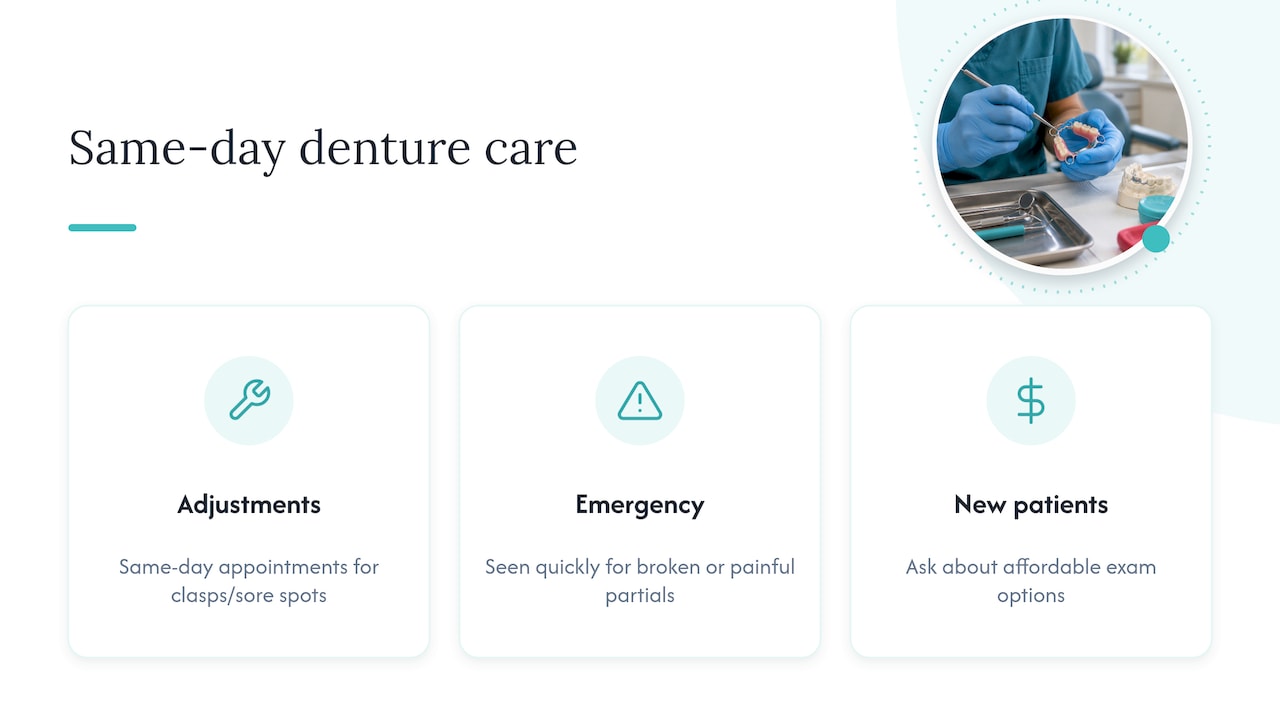
A loose clasp or a sore spot shouldn’t wait weeks for relief. We handle partial denture adjustments, relines, and repairs with same-day appointments, and our restorative dentistry services cover everything from a quick fix to a full reline.

If your partial is broken or causing pain right now, our emergency dentistry team can get you seen quickly, and new patients can also ask about our affordable exam options when booking.
This article is general information, not a substitute for advice from a qualified doctor. Consult a qualified healthcare professional about your own circumstances before acting on anything here.
FAQ
What not to do with a partial denture?
Avoid hot water, abrasive toothpaste, and household bleach near metal clasps, since all three can warp acrylic or corrode the framework. Never attempt to bend a clasp, reline the base, or glue a crack yourself, as these fixes often damage the appliance or the tissue beneath it.
How many hours a day should I wear my partial dentures?
Most dental guidance recommends removing your partial for at least four hours out of every 24, with overnight removal being the simplest way to reach that target. This rest period lets your gums and the supporting ridge recover from constant pressure.
What is the best thing to clean partials with?
A soft denture brush with a nonabrasive cleanser, combined with a daily soak in an effervescent or peroxide-based denture cleaner, offers the strongest evidence-backed combination for reducing plaque and Candida buildup, per a clinical trial on cleaning methods. Ask your dentist which product is safe for your specific metal and acrylic components.
Should I leave my partial denture in water overnight?
Yes, storing the partial in room-temperature water or a dentist-approved soaking solution overnight keeps the acrylic from drying out and cracking. Avoid hot water, since heat can warp the base, and rinse the appliance before putting it back in your mouth.
Sources
- Effectiveness of denture cleansing methods (RCT)
- Multi-step oral hygiene intervention for RPD wearers (RCT)
- Ultrasonic denture hygiene interventions (trial)