

Severe throbbing pain that worsens around day 2 or 3 after an extraction, an empty-looking socket with visible bone, and a persistent bad taste or odor are the three signs that point to dry socket. If your pain is getting worse instead of better and you notice any of these, call your dentist today rather than waiting it out.
TL;DR:
- Dry socket most commonly develops between days 2 and 3 after extraction, with severe, radiating pain that worsens rather than improves.
- An empty-looking socket with visible bone, coupled with a foul taste or bad breath, strongly indicates dry socket.
- Pain that resists over-the-counter medication or worsens after initial improvement suggests the need for immediate dental evaluation.
- Symptoms after day 5 or beyond are unlikely to be dry socket and may indicate other complications, requiring different treatment.
- Prompt same-day dental care involving socket cleaning and medicated dressing can significantly shorten recovery time.
Table of Contents
- Dry Socket Symptoms: The Complete Checklist
- Dry Socket Timeline: When Symptoms Typically Appear
- Dry Socket vs. Normal Healing: A Direct Comparison
- When to Contact a Dentist: Warning Signs That Need Same-Day Attention
- What Happens at the Dental Visit
- South Littleton Family Dental’s Approach to Suspected Dry Socket
- Sources
- FAQ
Dry Socket Symptoms: The Complete Checklist
Dry socket, known clinically as alveolar osteitis, has a fairly specific symptom profile once you know what to look for. It doesn’t feel like ordinary extraction soreness, and it usually doesn’t look like a healing socket either.
The pain is the giveaway. It’s typically severe and throbbing, and it tends to intensify one to three days after the extraction rather than fade the way normal post-surgical pain does, according to Mayo Clinic. Many patients describe it as sharper and more constant than the ache they felt right after the procedure. It also radiates. Pain can travel from the socket to your ear, temple, eye, or neck on the same side, per Cleveland Clinic, which throws people off because it doesn’t feel like it’s coming from their mouth at all.
Look at the socket itself if you can do so without touching it. A healthy healing socket has a dark, slightly gelatinous clot sitting in it. Dry socket looks different: the clot is missing or has broken down, leaving what looks like an empty hole, sometimes with a visible whitish or grayish bone underneath, according to Cleveland Clinic.
Then there’s the smell and taste. A foul taste in your mouth or bad breath coming specifically from the extraction site is common, and it’s often one of the first things people notice before the pain fully ramps up.
Other signs worth flagging:
- A low-grade fever alongside the pain and empty socket
- Swelling that’s increasing rather than settling
- Pain that doesn’t respond to over-the-counter pain relievers or even prescribed medication
Not every case looks identical. Some milder cases produce moderate discomfort rather than agony, and a few very mild presentations improve with minimal intervention. But persistent, worsening pain is what usually drives people back into the dental chair, and for good reason.
Dry Socket Timeline: When Symptoms Typically Appear
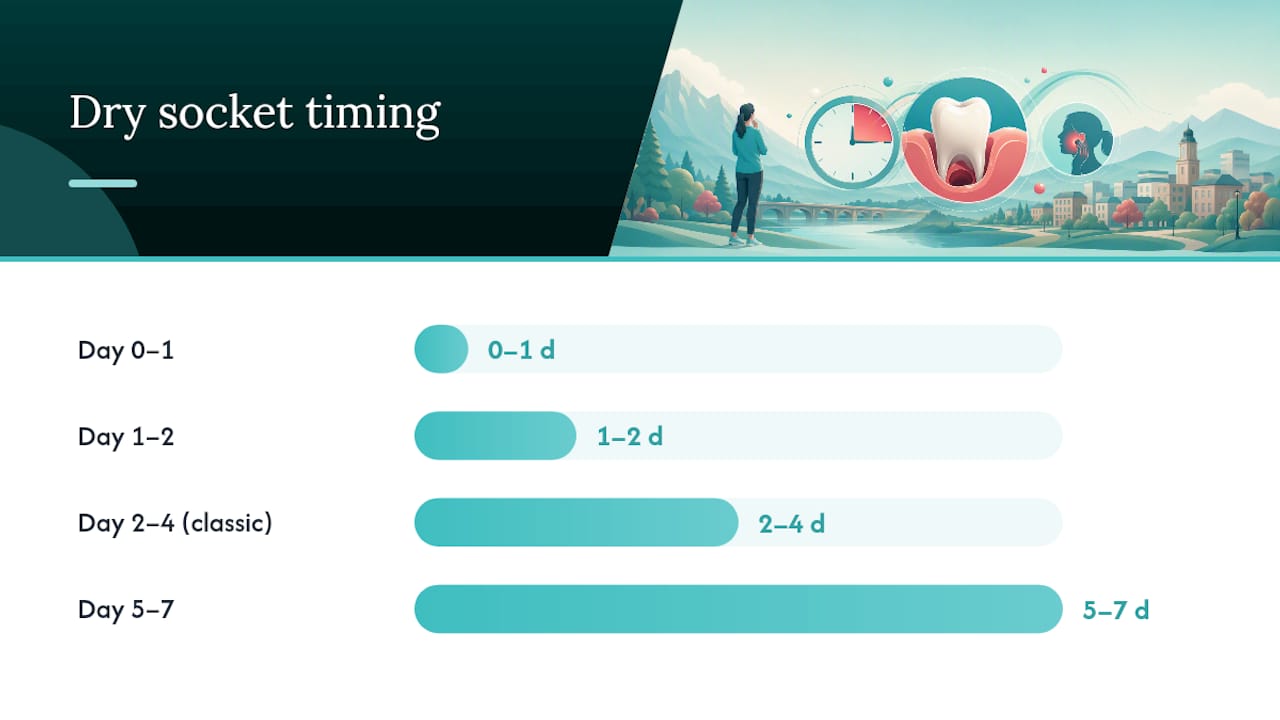
Dry socket has a fairly predictable window. It most commonly shows up one to three days after extraction, with day two or three being the classic turning point, per Mayo Clinic. If you’re past day five or six with no new pain, dry socket becomes far less likely.
Here’s roughly what to expect across the first week:
- Day 0 to 1: Normal soreness, some swelling, manageable with prescribed or OTC pain relief.
- Day 1 to 2: Pain should be leveling off or starting to improve. If it’s climbing instead, pay attention.
- Day 2 to 4: The classic dry socket window. Sharp, radiating pain and an empty-looking socket point strongly toward it.
- Day 5 to 7: Normal healing continues to improve steadily. Dry socket, if untreated, tends to stay severe or worsen.
One thing trips people up: normal healing tissue can look pale, whitish, or slightly odd as granulation tissue forms, and that’s not automatically a red flag. The distinguishing factor is pain, not appearance alone. If tissue looks unusual but pain is mild and improving, it’s probably just healing normally.
If you want to check the socket, a gentle look in a mirror or a quick photo works fine. Don’t probe it with a finger, tongue, or cotton swab. Clinicians warn that poking around can dislodge whatever clot remains or push debris into the socket, which can make things worse.
Dry Socket vs. Normal Healing: A Direct Comparison
The clearest way to tell the two apart is to track your pain’s direction over time, not just its intensity on any single day.
- Pain trajectory: Normal healing pain peaks early and declines steadily after the first 24 to 48 hours. Dry socket pain often does the opposite, intensifying between days 1 and 3.
- Response to medication: Regular post-extraction pain responds reasonably well to prescribed or OTC pain relievers. Dry socket pain frequently resists standard pain medication, a pattern noted in clinical reviews of alveolar osteitis.
- Visual appearance: A stable, dark clot sitting in the socket signals normal healing. A missing clot or visibly exposed bone signals a problem.
- Timing: Pain that was improving and suddenly gets worse around day 2 or 3 is far more suspicious than pain that’s simply lingering from day one.
If your pain is climbing instead of falling, doesn’t budge with medication you’d normally take, and the socket looks empty rather than clotted, that combination is your signal to call your dentist rather than wait another day.
When to Contact a Dentist: Warning Signs That Need Same-Day Attention
Some symptoms mean you shouldn’t wait for a routine appointment. Contact your dentist promptly if worsening pain, an empty socket, or a persistent bad taste shows up. Certain signs justify calling the same day:
- Severe, uncontrolled pain that isn’t responding to medication
- Pain spreading to the ear or temple accompanied by new or increasing swelling
- A fever at or above 101°F, which is more suggestive of a secondary infection than uncomplicated dry socket
- Swelling that’s spreading across the face rather than staying localized
- Trouble breathing or swallowing
- Bleeding that won’t stop with steady pressure
Breathing or swallowing difficulty and rapidly spreading facial swelling belong in an emergency room, not a dental office waiting room. For everything else on that list, same-day dental care is the right call.
Pro Tip: Getting evaluated within a day or two of symptoms starting typically shortens how long you’re in pain, since a medicated dressing often relieves discomfort faster than waiting for the socket to heal on its own.
What Happens at the Dental Visit
Diagnosis is mostly clinical, not high-tech. Your dentist will ask about when the pain started and how it’s behaved, then visually inspect the socket for a missing or broken-down clot, according to Mayo Clinic. An X-ray isn’t routine for diagnosis. It’s used selectively to rule out retained root fragments or a deeper infection if something doesn’t add up.
Treatment centers on managing pain and cleaning the site, including:
- Gently irrigating the socket to clear out debris and food particles
- Packing it with a medicated dressing that provides fast, targeted pain relief
- A short course of prescription pain medication if needed
- Home instructions: warm salt water rinses, and avoiding straws, smoking, or spitting that create suction
Most patients feel meaningfully better within a few days of treatment, with full comfort returning over one to two weeks as the socket finishes healing.
South Littleton Family Dental’s Approach to Suspected Dry Socket
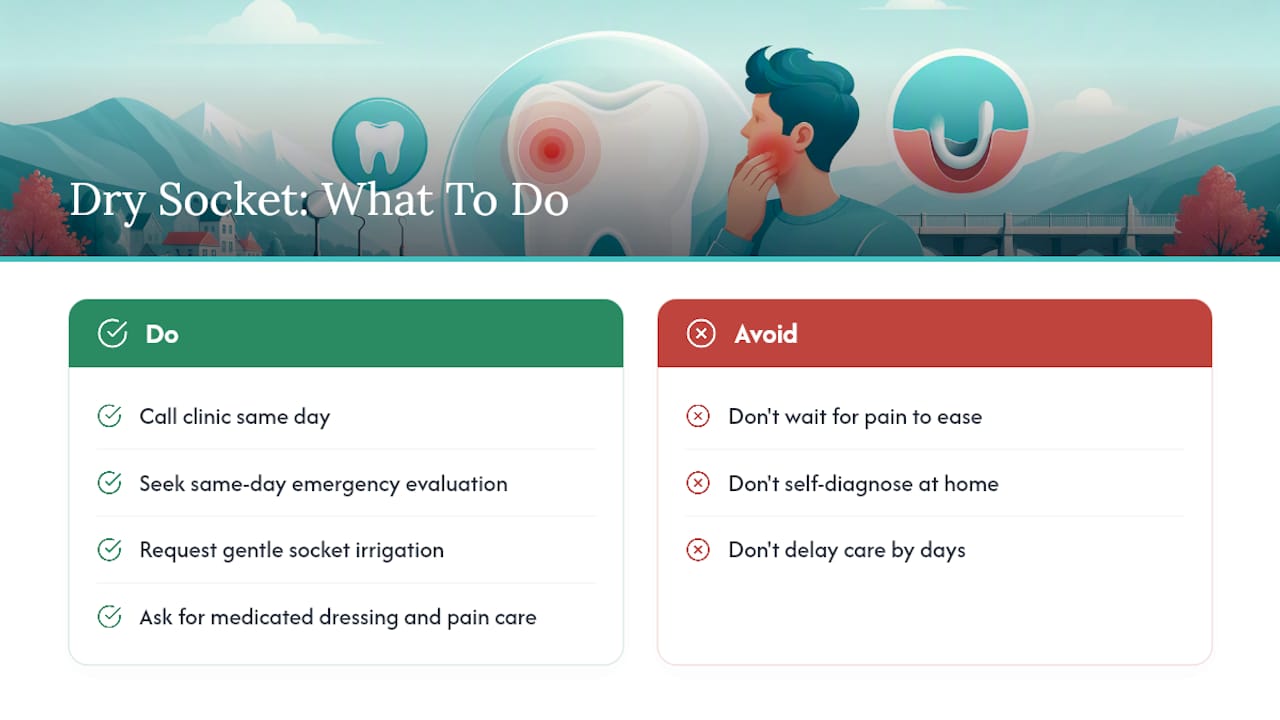
We treat suspected dry socket as a same-day priority, not a wait-and-see problem. If your pain is climbing instead of easing, same-day emergency evaluation gets you seen fast rather than stuck guessing at home.
Our care includes gentle socket irrigation, medicated dressing, and pain management tailored to how you’re actually feeling, not a one-size script. For patients whose extraction site needs extra support afterward, we also offer socket preservation and bone grafting when it’s clinically appropriate. If something feels off after an extraction, call us. It’s easier to rule dry socket out early than to manage it after it’s had days to worsen.
— Admin
Sources
- Dry socket – Symptoms and causes – Mayo Clinic
- Dry Socket: Symptoms, Causes & Treatment – Cleveland Clinic
This article is general information, not a substitute for advice from a qualified doctor. Consult a qualified healthcare professional about your own circumstances before acting on anything here.
FAQ
How can you tell if a dry socket is forming?
Watch for pain that starts improving and then suddenly worsens around day 2 or 3, especially paired with an empty-looking socket or a foul taste. That combination, rather than pain alone, is the clearest early signal.
Will a dry socket heal on its own?
Very mild cases with minimal pain sometimes improve without active treatment, but persistent or severe pain typically needs a dentist to clean and pack the socket for real relief. Waiting it out when pain is intensifying usually just prolongs the discomfort.
What are the riskiest days for dry socket?
Days 2 through 4 after extraction carry the highest risk, since dry socket most commonly develops within 1 to 3 days post-extraction. Symptoms appearing after day 5 are less likely to be dry socket.
How is dry socket pain different from normal healing pain?
Normal pain declines steadily after the first 24 to 48 hours and responds to standard pain medication. Dry socket pain tends to intensify during days 1 through 3 and often resists over-the-counter or prescribed relief.
Should I check my own socket for signs of dry socket?
A brief look in the mirror or a photo is fine, but avoid touching or probing the area with your finger or a cotton swab, since that can dislodge remaining clot tissue and worsen irritation.