
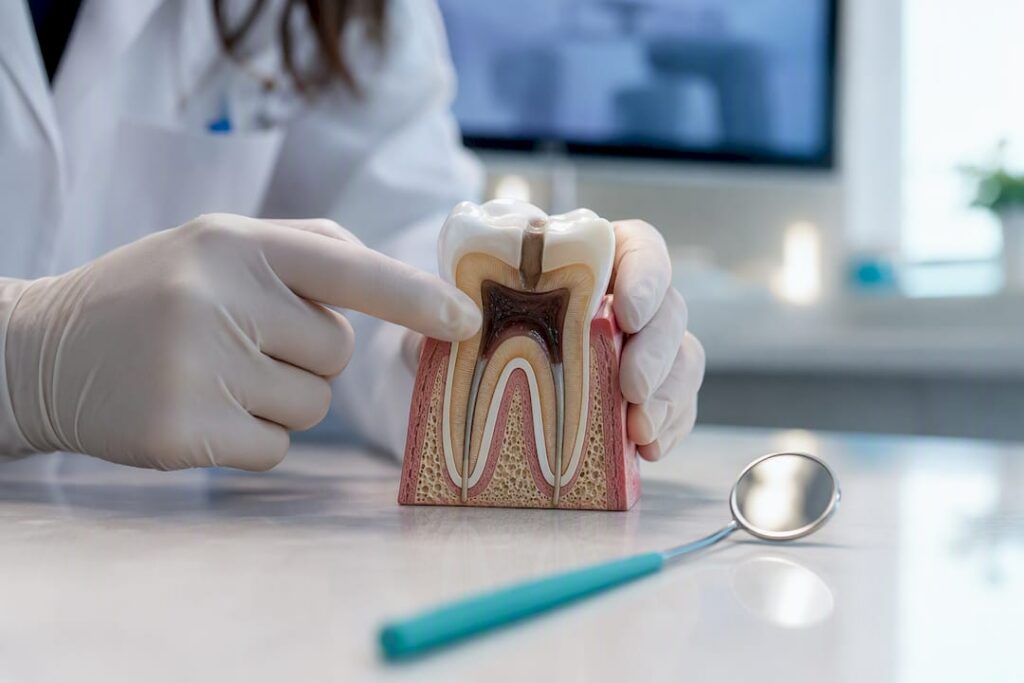
Internal (intracoronal) bleaching is a conservative, often effective way to lighten a tooth that has darkened after root canal therapy, when the root filling is stable and the tooth is otherwise healthy. Success rates in the research range widely, from 45% to more than 90% at five years, and the main trade-off is a small but real risk of external cervical root resorption tied to certain peroxide protocols. The right next step is a clinical exam, an honest look at your root canal history, and a technique chosen to match your specific stain.
TL;DR:
- Internal bleaching is most effective for teeth with intrinsic stains caused by trauma or blood pigments, with success rates varying from 45% to over 90% over five years.
- Proper case selection requires confirmation of a well-sealed root filling, absence of active infection, and enough remaining structure before proceeding.
- The safest agents are sodium perborate mixed with water and avoiding heat activation or high concentrations of peroxide to minimize the risk of external cervical root resorption.
- Success heavily depends on thorough cleaning of the pulp chamber, an effective intraorifice barrier, and delayed placement of the final restoration to ensure color stability.
- In cases of unresponsive stains, excessive tooth structure loss, or prior treatment failure, crowns or veneers may be more predictable and appropriate than repeat bleaching.
Table of Contents
- What Internal Tooth Bleaching Actually Does
- Are You a Good Candidate for Internal Bleaching?
- Walking Bleach, Inside-Outside, or In-Office: Which Technique Fits?
- What Happens in the Dental Chair, Step by Step
- Which Bleaching Agents Are Actually Used, and Why It Matters
- The Real Risks: Root Resorption and Weaker Bonds
- How Long Does It Last, and What Makes It Fail?
- What to Ask Before You Say Yes to Treatment
- Bleaching vs. Crowns: A Clinical Trade-Off Worth Understanding
- Getting Evaluated for Internal Bleaching at South Littleton Family Dental
- Sources
- FAQ
What Internal Tooth Bleaching Actually Does
Internal bleaching, also called intracoronal bleaching, treats discoloration from the inside of the tooth rather than the outside. That distinction matters because a root-canal tooth often darkens from within, as blood breakdown products and old filling materials seep into the dentin itself. Whitening strips or in-office external whitening can’t reach that deep, so an external whitening treatment applied to the enamel surface won’t budge it.
The technique works by placing an oxidizing agent, usually a peroxide compound, directly inside the pulp chamber. From there it penetrates the dentinal tubules and breaks down the pigmented molecules causing the stain.
A few points explain why dentists reach for this method specifically:
- It targets intrinsic (dentin-level) chromogens that external whitening physically cannot access.
- It’s reversible and minimally invasive compared to covering the tooth with a crown or veneer.
- It preserves natural tooth structure, which matters most in a front tooth where a crown means cutting away healthy enamel.
- It costs less upfront than restorative alternatives, though outcomes vary by staining cause.
Are You a Good Candidate for Internal Bleaching?
The best candidates have a single darkened, root-filled tooth with intrinsic staining traced to old blood pigments or degraded pulp tissue from trauma or infection. If the root canal itself was done well and the discoloration is isolated, internal bleaching tends to respond predictably.
Not every dark tooth qualifies, though. Staining caused by metallic materials (like old amalgam or certain root canal sealers), unresolved infection at the root tip, or heavily calcified dentin tends to resist bleaching or relapse quickly. Color prognosis actually depends heavily on the origin of the stain: trauma and hemorrhage-related discoloration responds more predictably than staining from metallic compounds.
Before anyone touches your tooth with peroxide, a dentist should confirm a few things:
- Radiographs showing a well-sealed, adequate root filling with no active infection.
- Enough remaining tooth structure to support the seal and eventual restoration.
- No signs of a fracture or crack that bleaching could worsen.
- A clear diagnosis of what’s actually causing the discoloration.
Walking Bleach, Inside-Outside, or In-Office: Which Technique Fits?
Three main approaches dominate clinical practice, and each suits a different situation.
-
Walking bleach. The dentist seals a bleaching agent, typically sodium perborate mixed with water, inside the pulp chamber and covers it with a temporary filling. The paste sits and works between appointments, often over one to three visits spaced a week or two apart. Patient burden is low since there’s nothing to manage at home.
-
Inside-outside bleaching. This combines an internal application with a take-home whitening tray worn over the tooth, giving both angles at once. It can speed up results, but it demands real patient compliance, and leaving the internal access cavity unsealed between wears risks bacterial contamination. Dentists usually reserve it for motivated patients they can monitor closely.
-
In-office internal bleaching. A concentrated peroxide gel goes directly into the isolated pulp chamber for a single, faster session. It gets results quicker, but higher concentrations carry a different safety profile and demand tighter control over isolation and barrier placement.
Which one your dentist recommends usually comes down to how severe the stain is, how much time you’re willing to invest, and how conservative your provider wants to be with peroxide strength.
What Happens in the Dental Chair, Step by Step
Here’s what a well-run internal bleaching appointment actually involves:
- Diagnostic review. Radiographs confirm the root filling is adequate and there’s no active infection. If there’s a problem here, it gets fixed before any bleaching starts.
- Isolation. A rubber dam isolates the tooth completely, keeping bleaching agents away from gums and soft tissue.
- Pulp chamber cleanup. The dentist removes old restorative material and any remaining pulp tissue, especially from the pulp horns, since leftover tissue is one of the most common causes of treatment failure or fast relapse.
- Intraorifice barrier placement. A barrier, usually glass ionomer, MTA, or composite, gets placed over the root filling to physically block peroxide from ever reaching the root and periodontal tissues below.
- Bleaching agent placement. Sodium perborate mixed with water in roughly a 2 gram to 1 milliliter ratio is a commonly used formula, sealed with a temporary filling.
- Follow-up and repeat sessions. Most cases need one to three visits over one to three weeks before the color stabilizes.
- Delayed final restoration. The tooth gets its permanent filling only after color has held steady for a couple of weeks.
Pro Tip: Ask your dentist to show you the pre-treatment radiograph and explain where the intraorifice barrier will sit. If they can’t describe that step clearly, that’s worth a second opinion.
Which Bleaching Agents Are Actually Used, and Why It Matters
Three agents dominate internal bleaching: sodium perborate, hydrogen peroxide, and carbamide peroxide. Each releases active oxygen that breaks down stain molecules, but they differ sharply in strength and risk.
- Sodium perborate mixed with water is widely considered the safer intracoronal choice. It releases active oxygen more slowly than pure hydrogen peroxide.
- Hydrogen peroxide works faster and at higher concentrations but has been more closely tied to complications when combined with heat.
- Carbamide peroxide breaks down into hydrogen peroxide gradually, giving a gentler, slower-release option often used in inside-outside protocols.
A commonly cited mixing ratio for sodium perborate and water, 2 grams to 1 milliliter, releases an estimated 10.4% hydrogen peroxide equivalent under test conditions, which is a meaningfully lower effective concentration than straight high-strength peroxide gels.
Regulatory and clinical guidance generally favors avoiding heat activation with high-concentration peroxide altogether, since that combination shows up repeatedly in resorption case reports.
The Real Risks: Root Resorption and Weaker Bonds
External cervical root resorption is the complication that gets the most attention, and for good reason. It’s the process where the root structure near the gumline gradually breaks down, sometimes without symptoms until it’s advanced.
Reviewed literature places the incidence of cervical resorption at under 4% when clinicians follow safer protocols, meaning conservative agents, proper barriers, and no heat activation.
Beyond resorption, two other issues come up regularly:
- Reduced bond strength. Bleaching temporarily weakens the bond between tooth structure and resin restorations, which is exactly why dentists wait before placing a final filling.
- Sensitivity and soft-tissue irritation. Usually mild and temporary, tied to peroxide contact with gums during placement.
Dentists reduce these risks the same way every time: a solid intraorifice barrier, complete rubber-dam isolation, conservative agent selection, and a radiographic follow-up schedule that catches resorption early if it’s going to happen.
How Long Does It Last, and What Makes It Fail?
Outcomes vary more than most patients expect. Reported success rates across studies range from 45% to 100%, largely because “success” gets measured differently depending on the study and the follow-up window.
| Metric | Reported Result |
|---|---|
| Overall 5-year success rate (walking bleach) | 79% |
| Success in single-access, ideal cases | Up to 91% |
| Success range across studies | 45% to 100% |
| Reported cervical resorption incidence | Under 4% |
The strongest predictor of a lasting result isn’t the bleaching agent, it’s the quality of the cleanup and the seal that follows. Follow-up quality, meaning a timely, durable final restoration, is a major determinant of long-term color stability. Relapse usually traces back to one of three things: an incomplete pulp chamber cleaning that left staining pigment behind, a seal that eventually leaked, or a nearby restoration that stained independently of the bleached tooth itself.
What to Ask Before You Say Yes to Treatment
A short conversation before treatment tells you almost everything about whether you’re getting careful care.
Ask to see the radiograph and have the dentist point out the root filling quality. Ask what material they’ll use for the intraorifice barrier and why. Ask which bleaching agent they’re planning, how many visits they expect, and when they’ll take a follow-up X-ray.
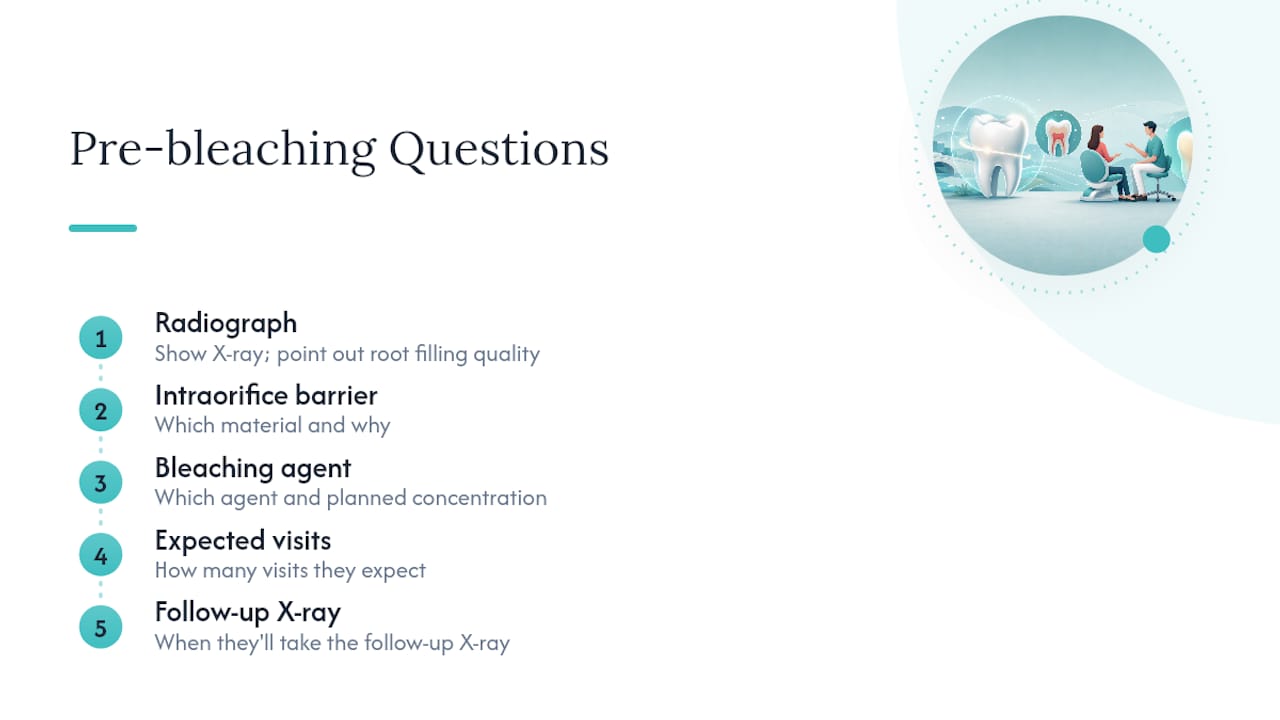
Good answers sound specific: “We’ll place a glass ionomer barrier over your root filling, use sodium perborate mixed with water, and check color stability at two weeks before we bond your final filling.” Vague answers, or a plan that skips radiographs, skips a barrier, or reaches straight for high-concentration peroxide with heat, are worth questioning further.
Pro Tip: If a provider can’t explain why they chose a specific agent and concentration for your case, ask them to walk you through the alternative and why they ruled it out. A confident answer usually reveals real experience with the restorative dentistry side of these cases too.
Bleaching vs. Crowns: A Clinical Trade-Off Worth Understanding
Internal bleaching wins on conservatism. It costs less, keeps your natural tooth intact, and works well when the discoloration traces to trauma or blood pigment rather than metal or calcified dentin. That’s the case where it earns its reputation.
Crowns and veneers make more sense once too much tooth structure is already gone, or once bleaching has been tried and the stain simply won’t respond. Restorative work is more predictable in those cases, at a higher cost and with more permanent tooth reduction.
The honest answer isn’t “always bleach first” or “always restore.” It depends on how much structure remains and what’s actually causing the color change.
— Admin
Getting Evaluated for Internal Bleaching at South Littleton Family Dental
If your root canal tooth has darkened and you’re not sure whether bleaching or a restoration is the right call, that’s exactly the kind of judgment call worth getting in a chair for. South Littleton Family Dental evaluates each case individually rather than defaulting to whichever option is easiest to schedule.
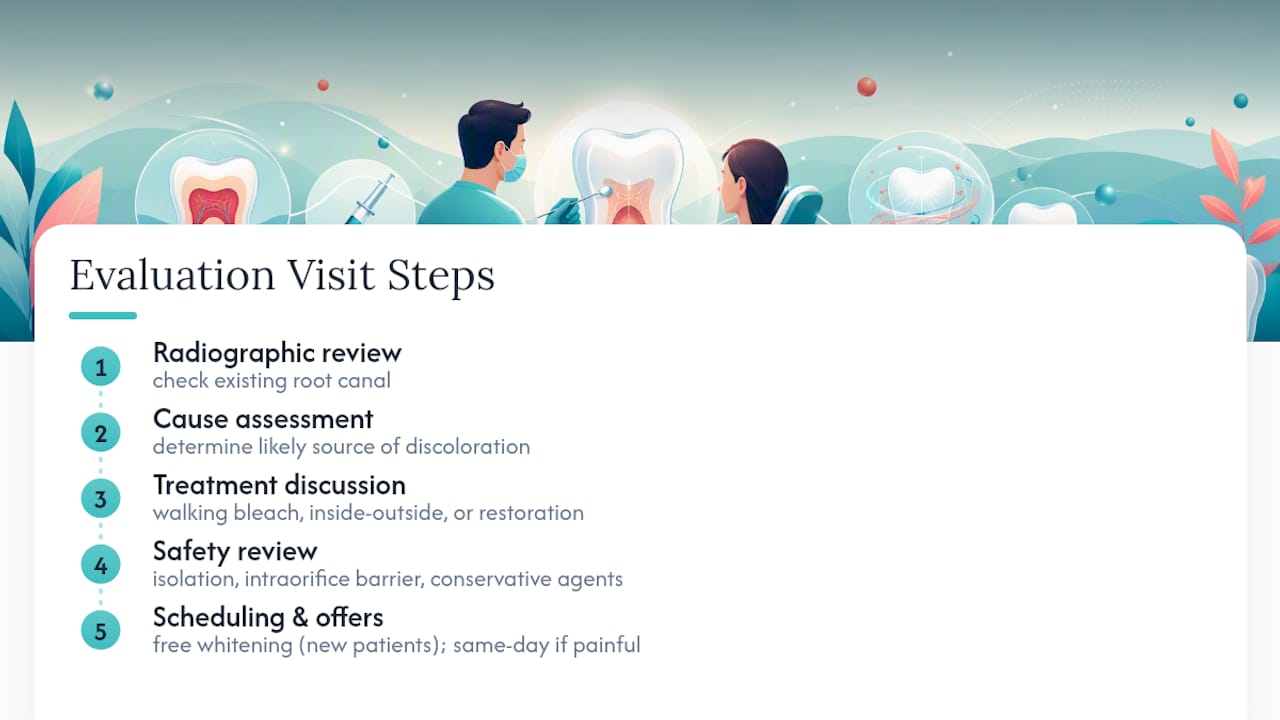
A first visit typically includes a radiographic review of your existing root canal, an assessment of the discoloration’s likely cause, and a discussion of whether walking bleach, inside-outside bleaching, or a restorative approach fits your tooth best. The practice follows the same safety principles covered above, meaning proper isolation, an intraorifice barrier, and conservative agent selection, rather than rushing straight to the fastest option.
New patients can also take advantage of the practice’s free teeth whitening offer to get started, and same-day scheduling is available for anyone dealing with discomfort alongside discoloration. If you’re ready to find out whether your tooth is a good candidate, schedule an evaluation and get a straight answer instead of guessing from a search bar.
Sources
This guide draws on StatPearls’ clinical overview of internal tooth whitening for technique descriptions, contraindications, and safety guidance; a five-year clinical follow-up study reporting long-term success rates for the walking bleach method; and a peer-reviewed review of intracoronal bleaching agents and protocols covering mixing ratios and safer-agent recommendations.
This article is general information, not a substitute for advice from a qualified doctor. Consult a qualified healthcare professional about your own circumstances before acting on anything here.
- Internal Tooth Whitening – StatPearls – NCBI Bookshelf
- Intracoronal tooth bleaching – A review and treatment guidelines (Wiley/Adj Dent Journal)
- Study on bleaching effects on bonding (PubMed record)
FAQ
Does internal bleaching of a tooth actually work?
Yes, for most nonvital teeth with intrinsic staining from trauma or old blood pigment, internal bleaching lightens the tooth effectively, with success rates reported between 45% and 100% depending on the cause of discoloration and technique used.
How long does internal tooth bleaching last?
Results tend to hold well for years when the seal and pulp chamber cleaning were done properly. A five-year follow-up found a 79% overall success rate, rising to 91% in ideal single-access cases.
Does internal bleaching a tooth hurt?
The procedure itself is generally painless since the tooth is already nonvital and numbing isn’t typically needed for the bleaching step, though some patients notice mild sensitivity or gum irritation if peroxide contacts soft tissue.
What are the disadvantages of internal bleaching?
The main risks are a small chance of external cervical root resorption, reported at under 4% with safer protocols, and a temporary drop in bond strength that requires delaying the final restoration until the tooth stabilizes.
Can South Littleton Family Dental treat a tooth that’s already failed a previous bleaching attempt?
Yes, an evaluation with radiographs can identify why a prior attempt relapsed, whether from residual pulp tissue, a failed seal, or an unresponsive stain source, and determine whether a repeat bleaching attempt or a restorative option makes more sense.