
Yes, you can use a health savings account for dental care. The IRS treats amounts paid to a dentist for the diagnosis, treatment or prevention of disease as qualified medical expenses, so exams, cleanings, X-rays, fillings, extractions, root canals and crowns generally qualify. Treatments done purely to improve appearance, such as teeth whitening, generally do not. Dental implants sit in between, and the reason for the implant decides the answer.
This guide walks through each category, explains the implant question, and shows how to pay and keep records so your HSA money stays tax-free.
TL;DR
- Dental care that treats or prevents disease is HSA eligible: exams, cleanings, X-rays, fillings, crowns, extractions, root canals, dentures and bridges.
- Cosmetic-only work, including teeth whitening, does not qualify. Veneers need a medical reason to count.
- Implants are generally eligible when they replace missing teeth or treat dental disease, not when they are purely cosmetic.
- You can spend HSA funds on your spouse’s and dependents’ dental care too, and you should keep itemized receipts.
- Using HSA money on a non-qualified expense means income tax plus a 20% penalty on that amount.
Table of Contents
- The rule that decides every dental question
- Dental treatments that are generally HSA eligible
- Can you use an HSA for dental implants?
- Cosmetic dentistry: what is and isn’t eligible
- How to pay with your HSA
- What happens if you pay for a non-qualified expense
- Contribution limits: how much can go toward dental care?
- Our perspective
- See a dentist who plans around your budget
- Special situations to check
- FAQ
- Sources
The rule that decides every dental question
HSA dental eligibility comes from one test. Funds can be withdrawn tax-free for unreimbursed qualified medical expenses of the account holder, a spouse or dependents, and those expenses are defined by section 213(d) of the tax code and explained in IRS Publication 502. In plain terms, the care has to be aimed at diagnosing, curing, easing, treating or preventing disease, or at affecting a structure or function of the body. The IRS adds that an expense that is merely beneficial to general health does not qualify.
Publication 502 is the main reference, though it does not capture every HSA-specific rule, for example the ones about over-the-counter medications. For dental work, though, the test is straightforward: ask what the treatment is for.
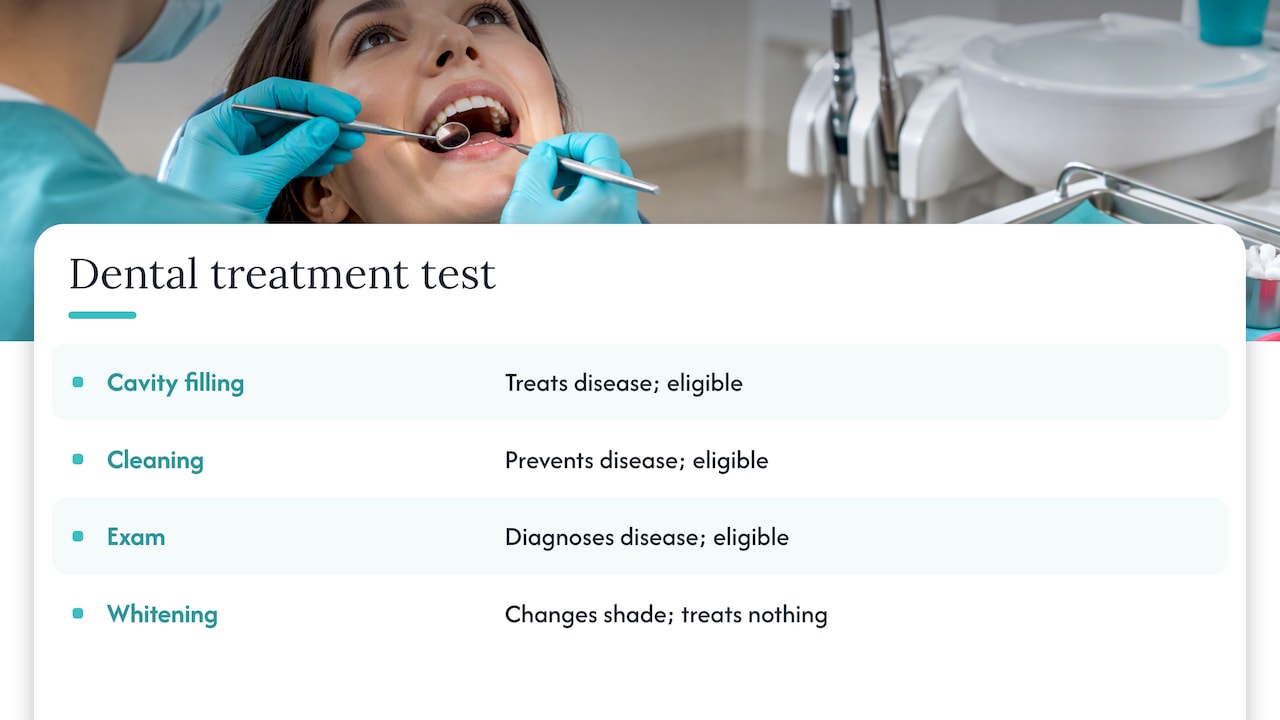
A filling for a cavity treats disease. A cleaning prevents it. An exam diagnoses it. All three pass. A whitening session that changes shade but treats nothing fails.
Dental treatments that are generally HSA eligible
The IRS says a dental exam is eligible because it diagnoses whether a disease or illness is present. Beyond that, benefit administrators publish similar lists. Routine care such as cleanings, X-rays, fillings, extractions and root canals is typically eligible, and so are restorative procedures like crowns, bridges and dentures when they serve a medical purpose such as restoring tooth function.
Here is how that maps to common services:
| Treatment | Usually HSA eligible? | Why |
|---|---|---|
| Exam and X-rays | Yes | Diagnoses disease |
| Routine cleaning | Yes | Prevents gum disease and decay |
| Fluoride treatment, sealants | Yes | Prevents decay |
| Oral cancer screening | Yes | Diagnoses disease |
| Fillings (composite or amalgam) | Yes | Treats decay |
| Crowns | Yes, when restoring a damaged tooth | Restores function |
| Root canal therapy | Yes | Treats infection of the tooth |
| Extractions, oral surgery | Yes | Treats disease or damage |
| Bridges, dentures, partials | Yes | Replace missing teeth |
| Braces and aligners for orthodontic need | Typically yes | Orthodontic expenses are usually payable from an HSA |
| Teeth whitening | No | Cosmetic |
| Toothpaste, floss, mouthwash | No | General use |
One more item worth knowing: some plan administrators list night guards used to prevent teeth grinding as eligible. Artificial teeth also appear among the dental treatments discussed in IRS Publication 502.
Everyday oral care products are different. Toothbrushes, toothpaste, floss and mouthwash are classed as general use and are not eligible.
Emergency dental care
A cracked tooth, a knocked-out tooth, an abscess and severe tooth pain are all disease or injury, so emergency exams, X-rays, extractions, temporary and permanent restorations and root canals follow the same rules as any other treatment. If you have an emergency, the care is eligible and your HSA card works at the front desk the same way it does for a routine visit. Our emergency dentistry page explains how same-day visits work in Littleton.
Children and family members
You are not limited to your own care. HSA funds can pay eligible dental expenses for the account holder, a spouse and dependents. That makes the account a practical way to cover a family’s checkups, sealants, fluoride and the occasional filling in one place. One condition: the person must be your spouse or tax dependent, and the expense must be incurred after your HSA was set up.
Can you use an HSA for dental implants?
Often yes, and this is the question that trips people up most. An implant replaces a missing tooth, and replacing teeth is dental treatment. Benefit guides state that implants are eligible when they treat dental disease, replace teeth lost to an accident, or help prevent bone loss, and that they likely will not qualify when the reason is cosmetic. Another administrator gives the same rule: reimbursable when used to treat dental disease and not primarily for appearance.
In practice, a few things make an implant easier to support as a medical expense:
- A clinical reason in your chart. A tooth lost to decay, infection, fracture or gum disease is a documented dental problem.
- Related procedures. An extraction, bone grafting, socket preservation and the implant post, abutment and crown are all part of replacing the tooth. Each should appear as its own line on your itemized statement.
- Itemized billing. Separate lines for each step let you reimburse yourself accurately.
If you are comparing options, our pages on the dental implants process, candidacy and cost cover what to expect. Because implant treatment usually stretches over several months, remember that you can pay each stage as it happens, and the HSA has to have been open before the date of each service.
Cosmetic dentistry: what is and isn’t eligible
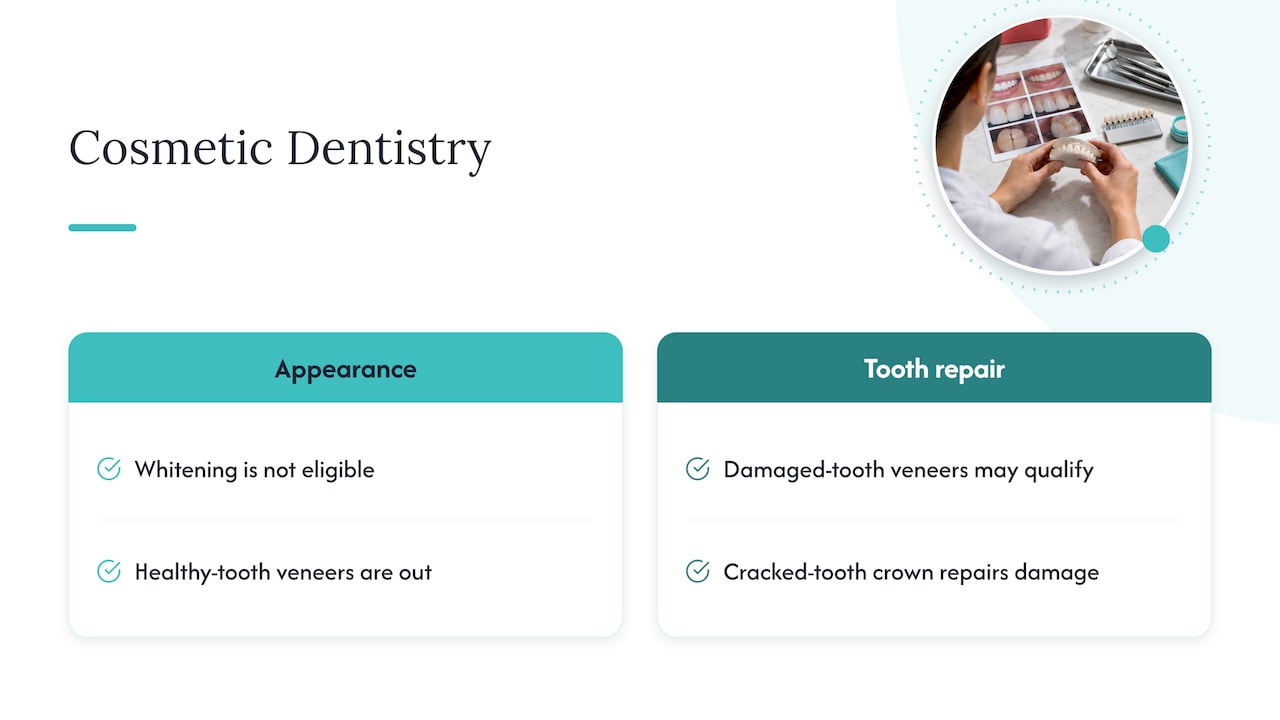
The IRS is explicit on one point. Publication 502 says you can’t include amounts paid to whiten teeth in medical expenses. Professional whitening, including in-office systems, is therefore not a qualified expense, and paying for it with HSA funds would be a non-qualified withdrawal.
Veneers are less black and white. One major health plan’s guidance says veneers are not covered when purely cosmetic and that a medical diagnosis is needed if there is concern a procedure could be considered cosmetic. So veneers placed to change the look of healthy teeth are out. Veneers that repair a tooth damaged by fracture, wear or decay may be a different matter, and that is a conversation to have with your dentist and your plan administrator, ideally before treatment.
A useful rule of thumb: if the honest answer to “why am I doing this?” is “to look better,” plan to pay with other money. If it is “to fix a problem with my tooth,” the HSA is likely a fit. Many smile makeovers combine both kinds of work, such as a crown on a cracked tooth and whitening for the rest. Our guide to how dentists stack treatments in a smile makeover explains the sequence, and we can itemize the restorative and cosmetic steps separately so you can pay each with the right funds.
How to pay with your HSA
There are two routes, and both are fine.
- Pay at the office with your HSA debit card or another HSA payment method. The money goes straight to the provider.
- Pay with another card and reimburse yourself later. You can move money from the HSA to your own bank account for a qualified, unreimbursed expense. Publication 969 allows this as long as the HSA existed when the expense was incurred.
If you have dental insurance, the HSA covers what insurance does not: deductibles, copays, coinsurance and anything above the plan’s annual maximum. Pay the patient portion after insurance has processed the claim so you reimburse only what you actually owe.
Records to keep
The IRS does not ask you to send receipts with your return, but you are responsible for showing that withdrawals paid qualified expenses. Publication 969 says you need records sufficient to show the distributions were used for qualified medical expenses. Keep:
- The itemized receipt or statement, not just the card slip
- Date of service, provider name and patient name
- A description of the treatment and the amount paid
- Insurance explanation of benefits showing what was reimbursed or adjusted
- Proof your HSA was open before the service date
Also avoid double dipping. An expense paid or reimbursed by an HSA cannot also be claimed as a medical-expense deduction on your federal income-tax return.
What happens if you pay for a non-qualified expense
If HSA money goes to something that does not qualify, that amount is included in your gross income for the year and is generally subject to an additional 20% tax. On a $1,000 whitening session paid from the HSA, that would mean the $1,000 is taxed as income and a further $200 penalty applies. For a treatment in a gray area, such as veneers or an implant, ask for a written statement of the clinical reason before paying, and check with your HSA administrator or a tax professional if the answer is unclear.
Contribution limits: how much can go toward dental care?
The account is only useful if it is funded. For 2026, annual contributions are capped at $4,400 for self-only coverage and $8,750 for family coverage. Those limits change yearly, so check the IRS for the current figures when you plan. Because HSA balances roll over, you can build up funds in a year with light dental needs and use them for a larger treatment, like a crown or implant, later.
Our perspective
We see the same pattern at the front desk every month. Patients put off a filling or a crown because the bill feels large, then arrive with pain and a bigger problem. An HSA changes that math, because you are paying with pre-tax dollars you set aside for exactly this.
Our approach is to make the paperwork as clear as the treatment plan. We build individualized care plans, explain each step in plain language, and can provide itemized statements that separate preventive, restorative and cosmetic work. That makes it easier for you to pay with your HSA where it applies and use other funds where it does not.
We also think prevention is the best use of any health account. Regular exams, cleanings and X-rays are eligible, and they are how we find a small cavity before it needs a root canal. Same-day emergency care and a calm, family-friendly office mean you do not have to wait or dread the visit.
the author
See a dentist who plans around your budget
If you live in or near Littleton, Colorado, we can walk you through a treatment plan and an itemized estimate before you commit, so you know which parts are likely HSA eligible. We offer general care for all ages, restorative treatment including crowns, bridges, dentures and implants, and same-day emergency visits.

Start with general dentistry for exams and cleanings, explore restorative dentistry, or visit South Littleton Family Dental to book. Ask the front desk to note that you will pay with an HSA.
Special situations to check
Medicare and seniors. If you are on Medicare, dental coverage is limited, and HSA rules also change once you enroll, because you can no longer contribute. You can still spend existing HSA funds on qualified dental care. Our guide on Medicare dental coverage explains what is covered and how to claim.
Dentures and bridges. These replace missing teeth and are generally treated as eligible. Partial dentures, adjustments and relines are usually grouped with them, but always check that the statement describes the service.
Payment plans. If you finance treatment, the HSA can reimburse you as you pay each installment, as long as the service was provided after the account was opened. Keep each payment record along with the original treatment plan.
Employer rules. Your HSA is yours, but the card or portal your plan administrator provides may flag some purchases for documentation. Having your itemized statement ready speeds that up.
FAQ
Is a routine dental cleaning HSA eligible?
Yes. Cleanings help prevent disease, so they qualify as medical care under IRS rules. Exams, X-rays, fluoride treatments and sealants also qualify. If dental insurance pays part of the cost, use the HSA only for the portion you owe.
Can I use my HSA for dental implants?
Often, yes. Implants generally qualify when they replace teeth lost to disease or injury or help prevent bone loss, and generally do not when done only for looks. Ask your dentist to document the clinical reason and to itemize each step, such as extraction, grafting and the implant itself.
Is teeth whitening covered by an HSA?
No. The IRS says amounts paid to whiten teeth cannot be counted as medical expenses. A withdrawal for whitening would be taxable and typically carries a 20% penalty, so pay for it with other funds.
Can I use my HSA for my spouse or kids’ dental work?
Yes. HSA funds can pay eligible dental expenses for you, your spouse and your tax dependents. The expense must be incurred after you opened the HSA, and you should keep the itemized receipt showing who received the care.
Do I need to send receipts to the IRS?
Not with your return, but you need to keep them. The IRS expects records that show each withdrawal paid a qualified expense, so save itemized statements and insurance explanations of benefits with your tax records.
Sources
- IRS: Frequently asked questions about medical expenses related to nutrition, wellness and general health
- IRS Publication 969: Health Savings Accounts and Other Tax-Favored Health Plans
- IRS Publication 502: Medical and Dental Expenses
- Congressional Research Service: Health Savings Accounts (HSAs)
- Congressional Research Service: HSA expense rules overview
- Humana: Using an HSA or FSA for dental expenses
- MetLife: Can an HSA be used for dental expenses?
- HSA Bank: Eligible expenses
- Lively: Dental implants (medical) eligibility
- Cigna Healthcare: HSA, HRA and FSA eligible items and expenses