

The space under a fixed bridge is where plaque hides, and a toothbrush alone will not reach it. The fix is one extra daily step: pass floss, a super floss strand, or a stream from a water flosser beneath the false tooth (the pontic) and along the supporting teeth. This guide shows each method, which one fits which mouth, and the mistakes that cause sore gums.
We see the same pattern with bridge patients in Littleton: the bridge looks great, brushing is solid, and the area underneath is quietly skipped because it feels awkward. A few minutes of practice fixes that.
TL;DR
- Clean under your bridge once a day, in addition to brushing twice daily. Plaque collects beneath the false tooth and along the gumline.
- Super floss (stiff end, spongy middle, regular floss end) and floss threaders are the standard hand tools. Interdental brushes and water flossers are good alternatives.
- Be gentle. Cleaning between teeth should not hurt, and snapping or forcing floss can injure gum tissue.
- Use a fresh piece of floss or a fresh strand every time.
- Bleeding that does not settle, lasting pain, or a bridge that feels loose are reasons to call your dentist, not to push harder.
Table of Contents
- Why the space under a bridge needs its own routine
- Which tool should you use?
- How to use super floss under a bridge
- How to floss under a bridge with a threader
- Interdental brushes: when they work
- Using a water flosser with a bridge
- A simple daily routine
- Common mistakes that hurt the gums
- Our perspective: why we teach this at the chair
- Your bridge and our team in Littleton
- When to call your dentist
- FAQ
- Sources
Why the space under a bridge needs its own routine
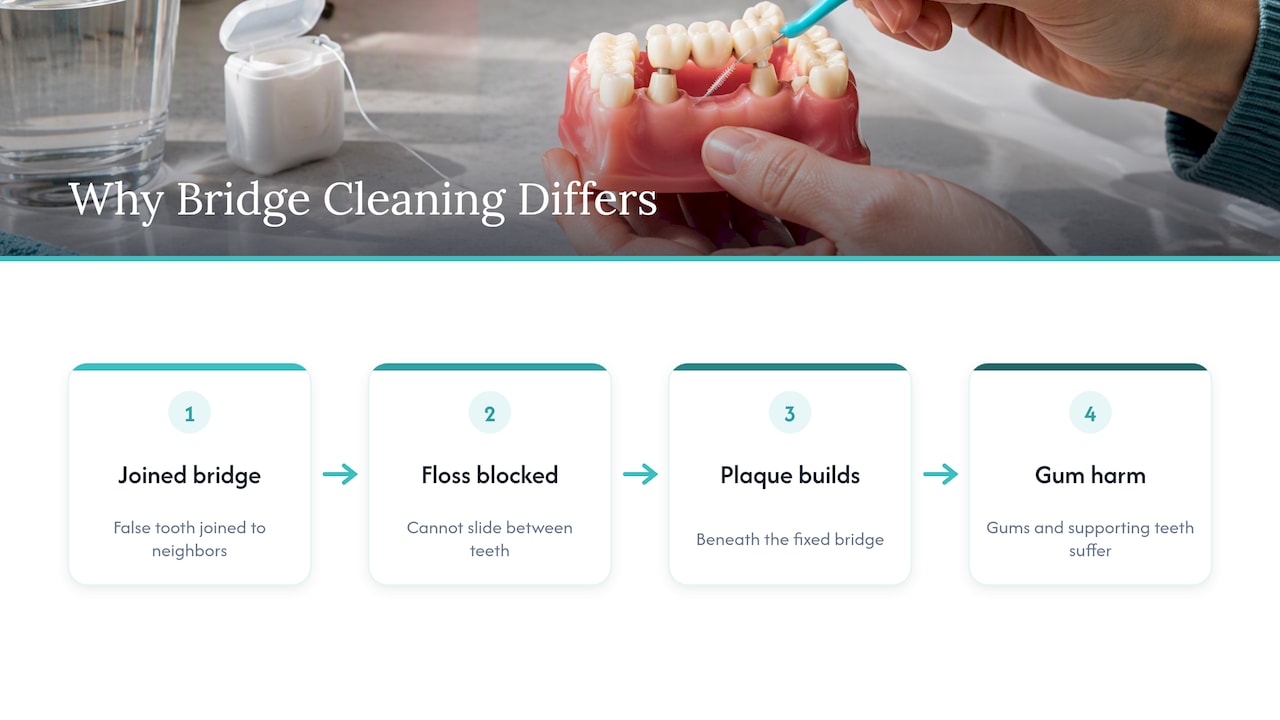
A fixed bridge replaces a missing tooth with an artificial one that is anchored to the teeth on either side. Unlike a natural tooth, the false tooth does not sit in a gap you can floss straight down into. It is joined to its neighbors, so floss cannot simply slide between them and pull out.
That is why the area beneath it needs a different approach. The American Dental Association (ADA) explains that toothbrush bristles cannot effectively clean tight spaces between teeth, and that floss and other interdental cleaners are what remove trapped food and plaque along the gumline. UMass Memorial Health makes the point specifically for restorations: daily flossing removes plaque from between teeth, under bridges, and around implants.
A government oral-health guide from Hong Kong gives the reason in plain terms: plaque builds up beneath a fixed bridge, which is why it advises daily cleaning there with super floss. When that plaque stays put, the gums around the bridge and the natural teeth holding it are the first to suffer. If you want the longer view of why this matters, our page on how long bridges last and how to extend yours covers it.
Which tool should you use?
There is no single best tool. The best one is the one you will actually use every day without hurting your gums. Here is how the common options compare.
| Tool | Best for | What to know |
|---|---|---|
| Super floss | Most fixed bridges | Stiff end threads under the pontic, spongy section cleans against the supporting teeth |
| Floss threader with regular floss | Tight bridges, or when you prefer ordinary floss | A small plastic loop that pulls floss through the space |
| Interdental brush | Bridges with a visible gap under the pontic | Pick a size that fits without forcing |
| Water flosser | Anyone who struggles with hand flossing | Pulsing water rinses out food and loosens plaque |
The ADA lists floss threaders among floss-related products and recognizes water flossers, interdental brushes and other powered or manual cleaners as interdental devices. Many people end up using two: a hand tool for the precise work and a water flosser for convenience or on busy nights.
How to use super floss under a bridge
Super floss is the tool most dentists hand out for bridges because each strand has three zones in one piece. The Hong Kong government guide describes the method: pass the stiff end beneath the bridge, use the spongy section against each supporting tooth, and move it gently beneath the false tooth.
In practice:
- Pull off a strand and hold the stiff, plastic-like end between your fingers.
- Guide the stiff end between the gum and the underside of the false tooth, starting from the cheek side, until it comes out on the tongue side.
- Pull the strand through until the thick, spongy section sits under the pontic.
- Hold both ends and move the spongy section gently side to side beneath the false tooth, so it brushes the underside and the gumline.
- Slide the spongy part against the side of each supporting tooth, hugging the tooth surface.
- Pull the strand out and throw it away.
Never reuse it. The ADA advises that used floss or interdental devices should be discarded after use because they can fray, work less well, or transfer bacteria.
How to floss under a bridge with a threader
If you prefer ordinary floss, a floss threader does the job of the stiff end. Thread a length of floss through the loop, pass the pointed end under the bridge, and pull the floss through. Then remove the threader and work the floss as you would anywhere else.
UMass Memorial Health recommends about 18 inches of floss, slid gently between the teeth and curved into a C against each tooth, then moved up and down against both sides several times. The ADA’s five-step technique says the same, adding that the floss should be held tightly and guided with a gentle rubbing motion rather than snapped into place.
A few practical notes:
- Wind most of the floss around one middle finger and take up the used section on the other, so you always have a clean stretch.
- Slide the floss under the false tooth first, then clean up against each abutment (the natural tooth anchoring the bridge), wrapping the floss around it in a C shape.
- Waxed or unwaxed makes no difference to how well it works. The ADA reports no effectiveness difference between waxed and unwaxed floss, though it notes rare cases of sensitivity to waxed or coated floss. Choose whichever slides more easily through your bridge.
Interdental brushes: when they work
If there is a visible gap beneath the false tooth, a small interdental brush can clean it quickly. Slide the brush gently in and out under the pontic and along the sides of the supporting teeth. The key is size: the brush should pass through with light resistance. If you have to push, it is too big, and it can scrape the gum. Your hygienist can show you which size fits your bridge, and a bridge can need two sizes in different spots.
Interdental brushes are quick, but they are not a full substitute for floss where the teeth touch each other. Combining a brush under the bridge with floss between the neighboring natural teeth covers both areas.
Using a water flosser with a bridge
A water flosser is often the easiest option for people with limited hand dexterity, braces-style fixed work, or simply a short morning routine. The ADA’s MouthHealthy guide says that a fixed bridge can make ordinary flossing difficult and that people with bridges may find a water flosser useful for reaching hard spots.
The ADA also explains that water flossers emit steady pulses of water that remove food from between teeth, and that ADA-Accepted models have been tested for safety and plaque removal and can help reduce gingivitis. Look for the ADA Seal if you are shopping for one.
How to use it well:
- Fill the reservoir with lukewarm water.
- Lean over the sink and put the tip in your mouth before turning the unit on, so the water does not spray.
- Start at the lowest pressure setting and build up only as far as is comfortable.
- Aim the tip at the gumline, angled slightly toward the space beneath the false tooth.
- Pause along the underside of the pontic and beside each supporting tooth, then move to the next tooth.
- Let the water drain into the sink as you go.
The ADA says water flossers may suit people who have difficulty flossing by hand, including those with fixed bridges, and still recommends cleaning between teeth once daily, brushing twice daily for two minutes, and seeing a dentist regularly. So a water flosser joins your routine; it does not replace brushing or checkups.
A simple daily routine
Consistency matters more than any single gadget. A routine that holds up for most bridge wearers:
- Morning: Brush for two minutes with a soft brush, paying attention to where the bridge meets the gum.
- Evening: Brush again, then clean under the bridge with super floss, a threader, an interdental brush, or a water flosser. Doing it at night means plaque does not sit there overnight.
- Once a day, not more: The ADA recommends cleaning between teeth once daily. More is not better if it irritates the gums.
Pick a time you will remember, such as right after brushing before bed. Keep the tools where you can see them. Most people who keep up the habit say it takes under two minutes once they know their bridge.
Our page on four steps to clean under the pontic walks through the same routine in a quick format you can keep handy.
Common mistakes that hurt the gums
Forcing the tool. The ADA states that cleaning between teeth should not cause pain, that excessive force can damage tissue, and that persistent pain is a reason to talk to your dentist. If a strand will not pass, stop, try a threader, or ask us to check the fit.
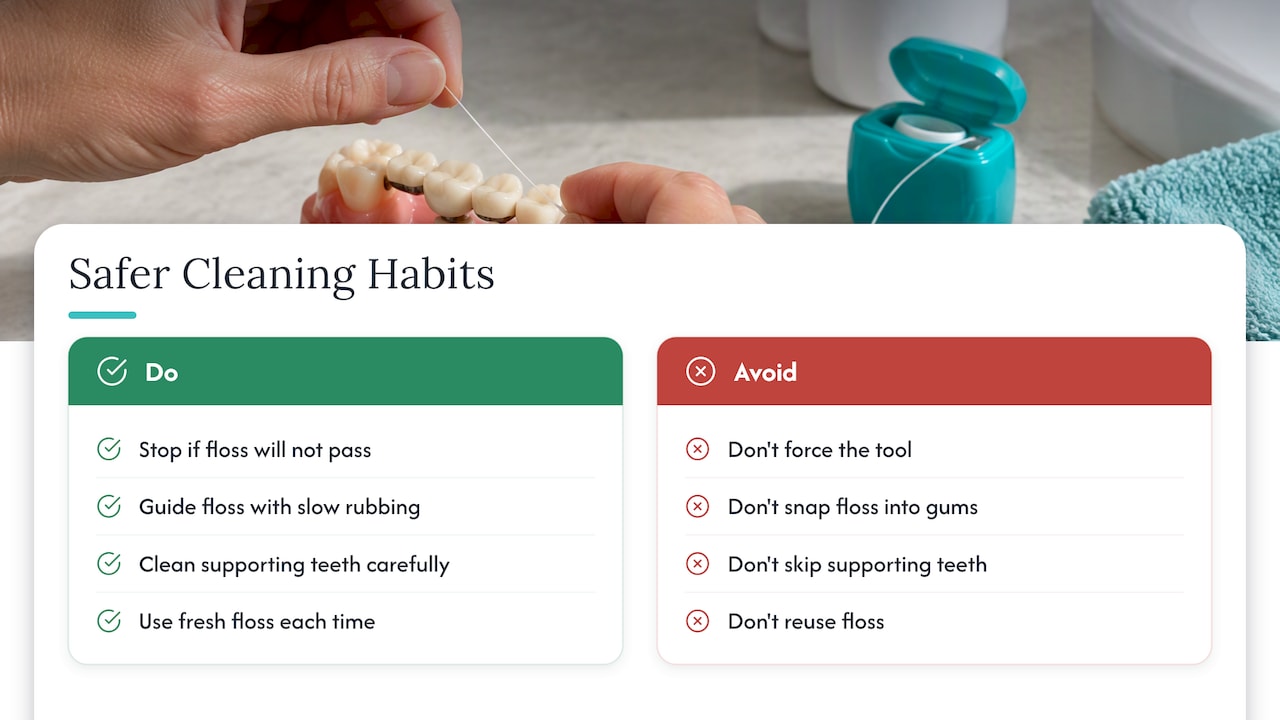
Snapping the floss. Pushing floss down hard into the gum can cut the tissue. Guide it in with a slow rubbing motion.
Skipping the supporting teeth. The natural teeth holding a bridge carry extra load. Clean them as carefully as the area under the false tooth.
Reusing floss or a strand. Fresh each time.
Stopping when the gums bleed. Gums that are inflamed from plaque often bleed at first when you start cleaning properly. Gentle daily cleaning usually calms them over a week or two. If bleeding continues, or the gums stay swollen or sore, book a visit so we can check for gum disease, which can need professional treatment such as scaling and root planing.
Our perspective: why we teach this at the chair
We have never met a patient who skipped cleaning under a bridge because they did not care. They skipped it because nobody showed them how, and the first attempt at home felt clumsy.
That is why we think bridge care starts at the chair, not in a pamphlet. When we place or review a bridge, we want the patient to leave knowing which tool suits their mouth, and to have tried it with us beside them. A bridge that is easy to clean is a bridge that gets cleaned.
Our approach is built around individualized care plans and a calm, family-friendly setting, so first-time and anxious patients can ask the basic questions without feeling rushed. Preventive visits and professional cleanings are part of that plan, because a bridge needs both the daily routine at home and regular checks by a dentist.
If something does go wrong, such as a loose bridge or a sore spot, we reserve same-day emergency time, so you do not have to wait or try to fix it yourself.
the author
Your bridge and our team in Littleton
If you have a bridge, or you are thinking about replacing a missing tooth, we can show you the right cleaning technique on your own teeth and check how the bridge is fitting. Our restorative dentistry services include bridges, crowns, implants and dentures, and our general dentistry visits cover cleanings, exams and x-rays. New to us? Our new patient page is a good place to start.

Bring the tools you currently use to your appointment, and we will tell you honestly whether they suit your bridge.
When to call your dentist
Cleaning should be uncomfortable at most for a few days when you begin, never painful. Get in touch if you notice:
- Pain that lasts or gets worse when you clean under the bridge.
- Gums that keep bleeding or look red and puffy after a couple of weeks of gentle daily cleaning.
- A bad taste or odor that persists.
- A bridge that feels loose, shifts when you bite, or has come off. In that case, do not use glue. Our guide on dental bridge problems explains why, and what we can do the same day.
- Pain or swelling that comes on suddenly. Our emergency dentistry team can see you promptly.
The same habits protect other restorations too. If you wear a partial denture, see our partial denture care routine, and for a temporary crown, our guide to temporary crown care.
FAQ
How do I clean under a dental bridge every day?
Use super floss, a floss threader with regular floss, a small interdental brush or a water flosser to reach beneath the false tooth once a day. Brush twice a day as usual. Work gently along the gumline and around the two supporting teeth, and use a fresh piece of floss or strand each time.
Can I use a water flosser instead of floss with a bridge?
For many people, yes. The ADA says water flossers may suit people who find hand flossing difficult, including those with fixed bridges. Choose an ADA-Accepted model, start on a low setting and aim at the gumline under the false tooth. Ask your dentist whether it should be your only method or part of a mix.
How do I floss a bridge if the floss will not go through?
Switch to a floss threader or super floss, which has a stiff end that passes under the pontic. Do not force or snap ordinary floss. If nothing passes comfortably, the space may be very tight or the bridge may need adjusting, so have your dentist check it.
Does cleaning under a bridge hurt?
It should not. The ADA says cleaning between teeth should not cause pain, and that excess force can damage tissue. Mild tenderness can happen if your gums are inflamed at first, but it should ease as the area gets cleaner. Pain that persists is worth a dental visit.
Can a dental bridge be whitened?
Whitening gels change natural tooth color, not the porcelain or ceramic of a bridge, so the bridge will not lighten and may look darker beside whitened teeth. Talk to your dentist before whitening so any color plan accounts for your restorations.
Sources
- Flossing Crowns, Bridges, and Implants, UMass Memorial Health
- Dental Floss and Interdental Cleaners, American Dental Association
- Flossing, MouthHealthy (American Dental Association)
- Water Flossers and Water Flossing, MouthHealthy (American Dental Association)
- Oral Care Tips, Oral Health Care Zone for Grown-ups, Hong Kong Department of Health