

Yes, you can usually see an out-of-network dentist, but expect to pay more, handle more paperwork, and possibly cover the bill upfront before your insurer reimburses you. The gap between what your plan pays and what the dentist charges is called balance billing, and it’s the single biggest financial risk of going out of network. Before any treatment, call your insurer for a written pre-treatment estimate and ask who is responsible for filing the claim.
TL;DR:
- Out-of-network dental care often results in higher bills due to balance billing, with some procedures potentially costing hundreds of dollars more than expected.
- Insurers typically use a “usual, customary, and reasonable” fee benchmark set at the 80th or 90th percentile, which can significantly lower reimbursements and increase patient liabilities.
- Many dental plans have annual caps and different coverage tiers, meaning out-of-network procedures like crowns can exceed the yearly benefit limit and leave patients responsible for the full cost.
- Asking for a written pre-treatment estimate and the insurer’s allowed dollar amount before procedures can prevent costly surprises and clarify your financial responsibility.
- Moving quickly to secure records and estimates is advised if your dentist drops out of network, especially for ongoing treatments that might be less expensive to complete with your current provider.
Table of Contents
- What Does “Out of Network Dentist” Mean for Your Coverage?
- How Does Out-of-Network Dental Reimbursement Actually Get Calculated?
- What Do Out-of-Network Dental Costs Actually Look Like?
- When Does Seeing an Out-of-Network Dentist Still Make Sense?
- What Should You Ask Before You Sit in the Chair?
- What If Your Current Dentist Drops Out of Network?
- How South Littleton Family Dental Keeps Billing Clear for Patients
- Why Billing Surprises Keep Catching Patients Off Guard
- Ready to Avoid Surprise Dental Bills in Littleton, CO?
- Sources
What Does “Out of Network Dentist” Mean for Your Coverage?
An out-of-network dentist is someone who hasn’t signed a contract with your insurance company to accept its negotiated fees. In-network dentists agree to discounted rates in exchange for steady referrals, which caps what they can charge you. Out-of-network dentists set their own fees, and your plan pays only a portion of what it considers reasonable, leaving you responsible for the rest.
How much that matters depends entirely on your plan type:
- PPO plans (Preferred Provider Organization) typically still pay something toward out of network care, just at a lower percentage than in-network visits.
- DHMO plans (Dental Health Maintenance Organization) usually pay nothing at all if you step outside the network, since the whole model relies on a fixed roster of contracted providers.
- Indemnity plans often reimburse in-network and out-of-network dentists at the same rate, making network status less of a financial issue.
One detail catches people off guard: unlike many medical plans, stand-alone dental plans aren’t covered by the ACA’s federal out-of-pocket maximum. There’s no federal ceiling protecting you from large dental bills the way there is for a medical emergency, so a major procedure gone sideways can hit your wallet harder than you’d expect.
How Does Out-of-Network Dental Reimbursement Actually Get Calculated?
Insurers don’t just pay a fixed dollar amount for out-of-network claims. They use an internal benchmark, often called “usual, customary, and reasonable” (UCR), to decide what a procedure is worth in your area. That number is commonly set at the 80th or 90th percentile of local fees, and carriers rarely publish the exact figure, which is exactly why two patients with different plans can get wildly different reimbursement checks for the same crown.
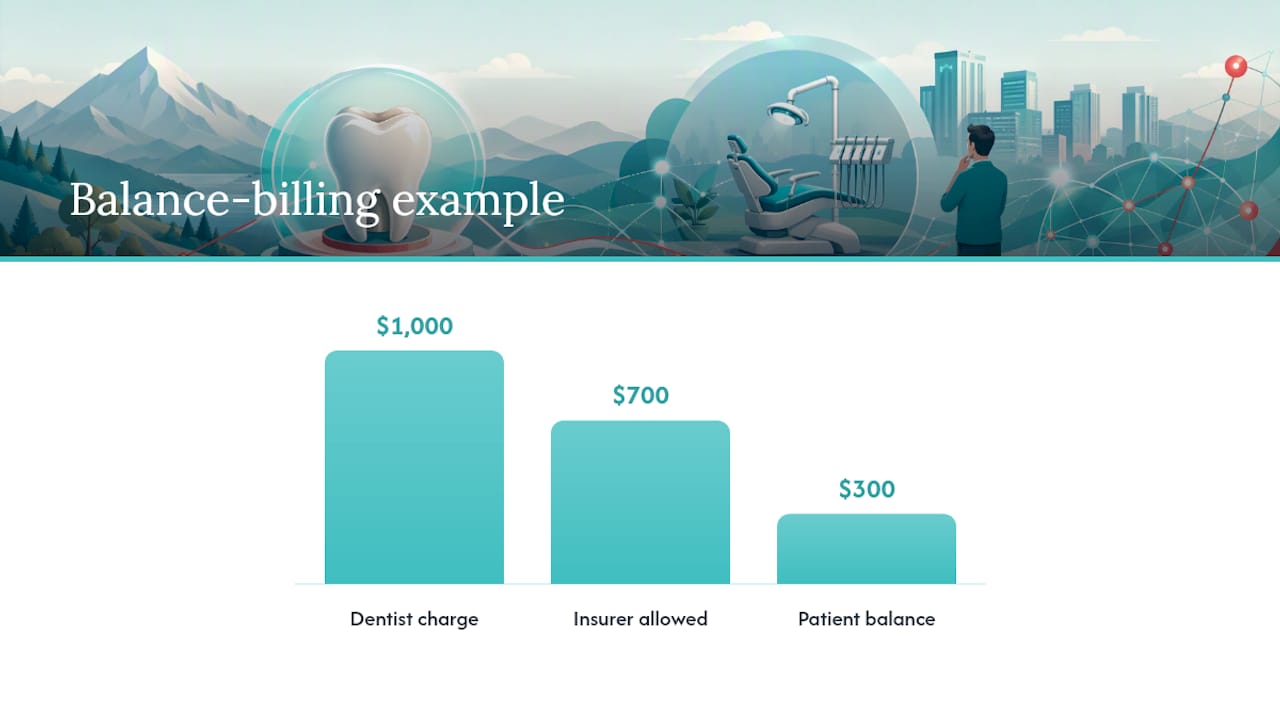
The gap between billed and allowed amounts is where balance billing lives. If your dentist charges $1,000 for a procedure but your insurer’s allowed amount is $700, you could owe the $300 difference on top of your normal coinsurance, even though the service was technically “covered.”
Who gets paid also varies by state:
- In roughly two dozen states, assignment-of-benefits laws require insurers to pay the dentist directly, even out of network.
- Self-funded employer plans governed by ERISA are often exempt from those state rules, meaning the insurer may cut a check to you instead, and you’re on the hook for paying the dentist.
Ask your HR department or benefits administrator whether your plan is self-funded. That one question tells you whether you’ll likely need to pay upfront and wait for reimbursement.
What Do Out-of-Network Dental Costs Actually Look Like?
Most dental plans, in or out of network, structure benefits around three tiers rather than one flat rate:
- Preventive care (cleanings, exams, X-rays) is often covered at 100%.
- Basic restorative care (fillings, simple extractions) is often covered around 80%.
- Major restorative care (crowns, bridges, root canals) is often covered around 50%.
Those percentages, per the American Dental Association, assume you’ve met your deductible and haven’t hit your annual maximum, which for most plans sits well below what a full mouth of major work actually costs.
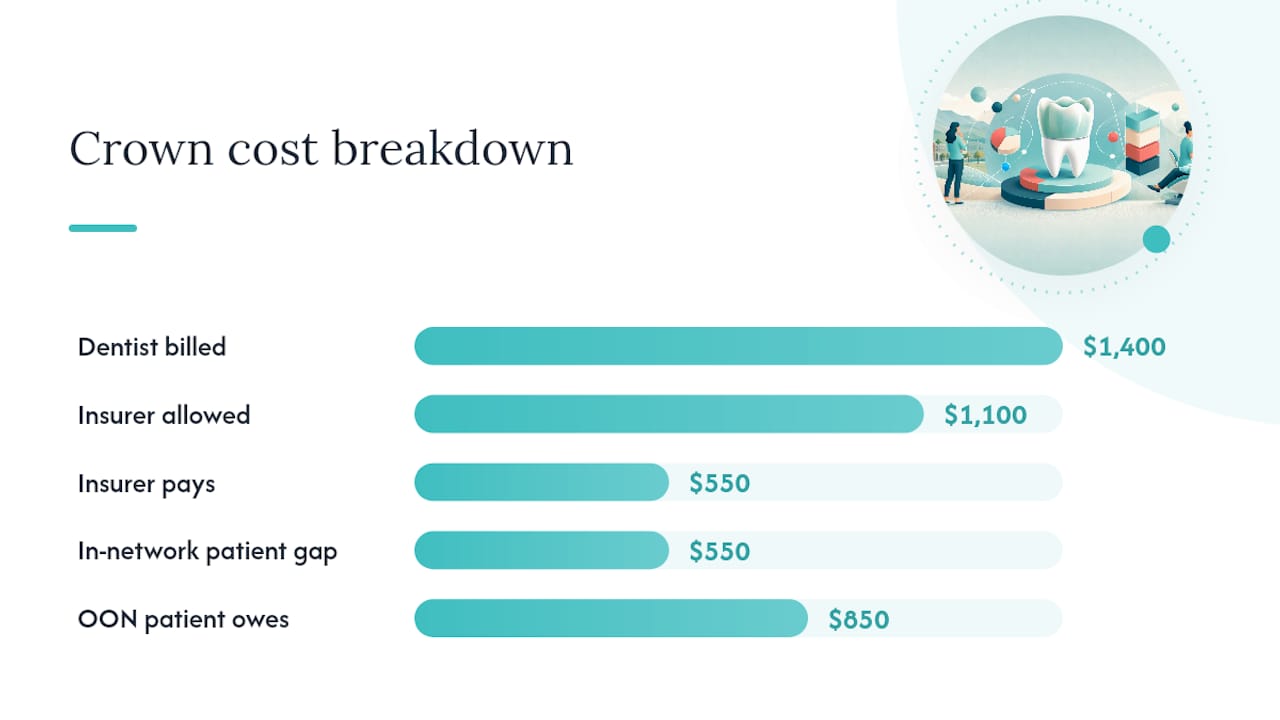
Here’s where the math gets uncomfortable. Say your out-of-network dentist bills $1,400 for a crown, but your insurer’s allowed amount for that code is $1,100. At 50% coverage, your plan pays $550 toward the allowed amount, not the billed amount, leaving you owing $850. That’s your $550 coinsurance share plus the $300 balance the dentist can still bill you for. An in-network dentist contracted at that same $1,100 rate couldn’t legally charge you more than the $550 gap.
Annual maximums compound this fast. If your plan caps benefits at $1,500 a year and you need two crowns, you’ll blow through that ceiling on the second one and pay the remaining balance in cash.
When Does Seeing an Out-of-Network Dentist Still Make Sense?
Money isn’t the only variable. Some patients stick with an out-of-network dentist for reasons that hold up under scrutiny.
- You’ve built years of trust with a dentist who knows your history, your anxiety triggers, or a complicated bite.
- Your case needs a specialist, like an oral surgeon or periodontist, who simply isn’t in your network.
- You live somewhere with a thin local network, which happens more in rural areas than city dwellers realize.
- You need care today, and the nearest in-network appointment is weeks out.
Run a quick gut check before committing: does the value of continuity or specialty skill outweigh the extra 20 to 50 percent you might pay? If the procedure is minor and routine, an in-network switch usually saves more than the hassle of switching costs you.
Pro Tip: If you’re on the fence, ask the out-of-network office for a written estimate first, then call an in-network practice for a comparison quote on the exact same procedure code. The dollar gap makes the decision for you.
What Should You Ask Before You Sit in the Chair?
A few phone calls before treatment can save you hundreds of dollars in surprises.
- Call your insurer and ask for the allowed dollar amount, not just a percentage, for the specific procedure code your dentist plans to use.
- Ask whether the plan is fully insured or self-funded, since that determines whether the insurer pays the dentist directly or reimburses you.
- Ask the dental office whether they’ll file the claim on your behalf or if you’re expected to submit it yourself.
- Ask whether payment is due upfront, and what financing or payment plan options exist if it is.
- Request a written pre-treatment estimate and compare it line by line against your insurer’s explanation of benefits (EOB) once treatment is done.
Getting the insurer to name a specific dollar figure, rather than a vague percentage, is the single most useful piece of information you can walk into an appointment with, according to Delta Dental’s own guidance on network differences.
What If Your Current Dentist Drops Out of Network?
Practices leave insurance networks more often than patients expect, usually over reimbursement rates or contract terms. If it happens to you, don’t panic, but move fast.
- Confirm the exact date the change takes effect and get it in writing from the practice.
- Request your full dental records and any outstanding treatment plan estimates before the switch.
- Get a cost-to-complete estimate from your current dentist and a comparison quote from an in-network alternative.
- Ask whether the practice offers a same-day emergency option if you need care during the transition, and whether they’ll still help file claims.
If the cost difference is small and you’re mid-treatment on something like a root canal or implant, finishing with the same dentist often beats starting over elsewhere.
How South Littleton Family Dental Keeps Billing Clear for Patients
This dental practice builds estimates and claims help into every visit, which is exactly the kind of transparency this article recommends asking for. Patients have access to cleaning packages, emergency exams, same-day emergency appointments, and individualized care plans that spell out costs before treatment starts, reducing the guesswork that leads to balance-billing surprises.
Why Billing Surprises Keep Catching Patients Off Guard
Most billing complaints trace back to one root cause: patients assumed a percentage meant a fixed price. A “50% covered” crown sounds simple until you learn it’s 50% of the insurer’s allowed amount, not the dentist’s bill. My advice, drawn from how these claims actually process: always push your insurer for the allowed-dollar figure and ask directly whether your claim will run under group-level rules or individual reimbursement. A five-minute phone call beats a $400 surprise every time.
— Admin
Ready to Avoid Surprise Dental Bills in Littleton, CO?
Southlittletonfamilydental gives you a written estimate before any drill touches your tooth, whether you’re coming in for a routine cleaning or a same-day emergency exam. That’s the real advantage over guessing your way through an out-of-network claim: you know the number before you owe it.
New patients can start with the $99 cleaning package or the $49 emergency exam, and flexible payment plans are available for larger restorative work like crowns or implants. If you’re weighing whether to stay with your current dentist or need a same-day emergency appointment, book a visit at South Littleton Family Dental and ask for a pre-treatment estimate before you commit to anything.
Sources
- Typical dental plan benefits and limitations | ADA
- In-network vs out-of-network benefits (Delta Dental guidance)