
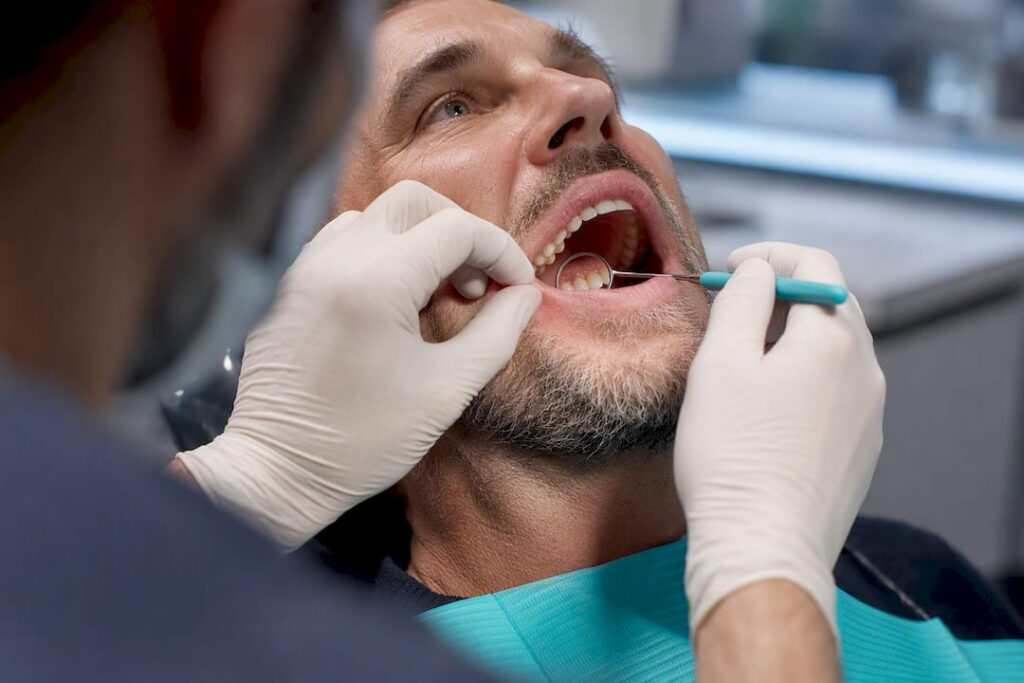
Smoking damages gum tissue, raises the chance of periodontitis and tooth loss, and makes dental treatments less successful. Roughly 62% of current smokers age 30 and older already have periodontitis, and the risk is compounded by nicotine’s effect on healing. Every nicotine product, including vapes, carries some version of this risk. Quitting helps, though not every effect reverses.
TL;DR:
- Current smokers are nearly five times more likely to develop periodontitis, with 62% of adults over 30 affected, highlighting the significant oral health risk.
- Nicotine causes blood vessel constriction, reducing oxygen and nutrients to gums, which impairs healing and masks symptoms, making disease harder to detect early.
- Smoking shifts bacteria in the mouth toward more aggressive types, increases plaque buildup, and accelerates gum tissue damage, all contributing to deepening periodontal pockets.
- Smoking reduces the effectiveness of dental treatments, with smokers experiencing less improvement after scaling, root planing, and higher implant failure rates when smoking more than 20 cigarettes daily.
- Quitting improves gum health within months to years, but full healing and reversal of existing bone loss can take over a year, emphasizing the importance of early evaluation and cessation support.
Table of Contents
- How Smoking and Gum Disease Are Connected Biologically
- Signs of Smoker’s Mouth and Why They’re Easy to Miss
- The Numbers Behind Smoking’s Effect on Gum Disease
- Why Smoking Changes the Odds for Dental Treatment
- What Actually Improves When You Quit Smoking
- Protecting Your Gums Starting Today
- Our Approach to Patients Who Smoke
- Where the Real Risk Gets Underestimated
- Getting Evaluated and Treated at South Littleton Family Dental
- Sources
How Smoking and Gum Disease Are Connected Biologically
Gum tissue depends on steady blood flow to fight bacteria and repair itself. Nicotine constricts blood vessels, cutting oxygen and nutrient delivery to the gums right when they need it most. That vasoconstriction is one reason gum disease in smokers tends to progress quietly, without the redness and swelling that usually tip people off.
Tobacco smoke also blunts the immune response at the cellular level. Neutrophils, the white blood cells that patrol gum tissue for bacterial invaders, become less effective in smokers, so infections that a healthy immune system would contain instead spread deeper into the supporting bone and ligament.
There’s a third mechanism that gets less attention: the mouth’s bacterial balance shifts. Smoke exposure and nicotine favor more aggressive, disease-associated bacteria while increasing how much plaque sticks to the teeth in the first place. The combination of more plaque and a rougher biofilm sets up a feedback loop that is hard to break without intervention.
Combustible cigarettes carry the strongest evidence of harm, but they’re not the only culprit:
- Nicotine narrows blood vessels regardless of delivery method, including vaping devices.
- Combustion products in traditional cigarettes add tar and chemical byproducts that worsen tissue damage beyond what nicotine alone causes.
- Heated tobacco products reduce some combustion exposure but still trigger inflammatory changes in gum tissue.
The number that stands out: current smokers face nearly five times the risk of periodontitis compared with people who never smoked, a gap far larger than most other modifiable risk factors for gum disease.
Signs of Smoker’s Mouth and Why They’re Easy to Miss
Tobacco use leaves a recognizable pattern in the mouth, though the signs don’t always show up the way people expect. Watch for these:
- Persistent bad breath that doesn’t improve with brushing or mouthwash.
- Brown or yellow staining on the tooth surfaces, especially near the gumline.
- Gum recession that exposes more of the tooth root over time.
- Deeper gum pockets where bacteria collect below the gumline.
- Teeth that feel loose or shift position as supporting bone breaks down.
- Gum tissue that looks pale or fibrous rather than pink and healthy.
Here’s the paradox that trips up a lot of smokers and even some clinicians: gums that are dying of infection often bleed less, not more, because constricted blood vessels mask the inflammation that would normally cause bleeding on probing. That means a smoker who never sees pink in the sink can still have advanced disease. Simple gingivitis, if caught early, reverses with better brushing and flossing. Periodontitis, marked by bone loss and deepening pockets, does not reverse on its own and needs professional treatment.
The Numbers Behind Smoking’s Effect on Gum Disease
The statistics on smoking and oral health aren’t subtle. Population data consistently shows smokers carrying a disproportionate share of gum disease and tooth decay compared with people who’ve never smoked.
By the numbers: Current smokers are about 5 times more likely to have periodontitis, and roughly 40% have untreated tooth decay versus about 20% of never-smokers. Among smokers 30 and older, periodontitis prevalence sits near 62%.
Those figures translate into real consequences down the line. Smokers lose teeth at higher rates than nonsmokers, and the gap widens with age as decades of reduced healing capacity and bone loss compound. But population averages hide a lot of individual variation. Someone who smoked half a pack for five years is not carrying the same risk as someone with a forty-year, two-pack-a-day history. Pack-years, the total lifetime dose of tobacco exposure, matters more than smoker status alone. Oral hygiene habits, genetics, and whether diabetes is also in the picture all shift where an individual actually lands within that risk range. Smoking and diabetes together are a particularly rough combination: both impair blood flow and immune response through overlapping pathways, so a smoker with poorly controlled blood sugar faces compounded risk that neither factor explains alone.
Why Smoking Changes the Odds for Dental Treatment
Smoking doesn’t just raise the odds of getting gum disease. It changes how well treatment works once you have it. Clinical studies consistently find smokers get less pocket-depth reduction and less gain in clinical attachment level after scaling and root planing compared with nonsmokers treated for the same disease severity.
- Non-surgical periodontal therapy tends to produce shallower improvements in smokers, even with identical technique and plaque control.
- Surgical periodontal procedures show similar gaps, with smokers healing slower and regaining less attachment.
- Dental implant failure risk rises sharply in patients who smoke 20 or more cigarettes a day, with early failures around the implant’s integration period standing out most.
- Oral surgery in general carries higher rates of postoperative infection and wound breakdown in smokers, which is why many practices build extra healing time into the plan.
Pro Tip: If you’re considering dental implants and you smoke, ask specifically about your individual failure risk rather than a general statistic. Frequency, duration, and whether you can pause smoking around surgery all shift the number in your favor or against it.
These findings shape how dentists plan treatment. Many will recommend delaying elective implant placement until a patient has some sustained quit period behind them, and will build cessation support into the pre-op conversation rather than treating it as a footnote.
What Actually Improves When You Quit Smoking
Cessation moves the needle, and it moves it faster than most people assume for some measures, slower for others. Clinical studies tracking former smokers after periodontal therapy find measurable gains in probing depth and attachment level within months, with continued improvement over the following year or two.
- Gum tissue color and firmness typically improve within weeks as blood flow normalizes.
- Bleeding on probing may increase temporarily after quitting, which sounds alarming but actually reflects the immune system regaining the ability to signal inflammation properly.
- Full periodontal healing capacity can take a year or more to approach that of someone who never smoked.
- Bone loss that already occurred does not reverse; quitting stops further damage but doesn’t rebuild lost support.
The recovery curve isn’t instant: even after quitting, immune and healing improvements accumulate gradually rather than snapping back overnight, which is exactly why pairing cessation support with active dental treatment produces better results than either one alone. Nicotine replacement therapy and behavioral counseling around the time of a dental procedure give both the mouth and the habit a better shot at recovery together.
Protecting Your Gums Starting Today
You don’t have to wait for a quit date to start limiting damage. A few habits make a measurable difference even before you cut back on tobacco entirely.
- Brush twice daily and clean between teeth every day. Smokers’ extra plaque buildup makes flossing or interdental brushes non-negotiable, not optional.
- Cut back gradually or set a quit date. Every reduction in exposure lowers ongoing tissue damage, even short of full cessation.
- Stay hydrated and limit alcohol. Both smoking and drinking dry out oral tissue, and the combination accelerates irritation.
- Schedule cleanings more often than the standard six-month interval. Smokers typically benefit from more frequent professional plaque and tartar removal.
- Ask about localized antimicrobial treatment or a referral to a periodontist if pockets are already deep.
Pro Tip: Bring up your smoking history proactively at your next cleaning, even if no one asks. It changes how your dentist interprets bleeding patterns, pocket depth, and healing expectations for your case specifically.
Watch for red flags that mean you shouldn’t wait for your next scheduled visit: loose teeth, visible pus, gum pain that’s getting worse, or pockets that seem to be deepening. Any of those warrants a same-day evaluation rather than a routine appointment.
Our Approach to Patients Who Smoke
At South Littleton Family Dental, we ask about tobacco and vaping history at every new patient visit because it genuinely changes how we read your gum exam. We prioritize prevention first and build individualized care plans around your actual risk, not a generic protocol. If something feels urgent, same-day evaluation is available rather than making you wait weeks for an answer. Bring your full smoking or vaping history to your appointment. It helps us catch problems your gums might otherwise be hiding.
Where the Real Risk Gets Underestimated
The conventional advice on smoking and gum health stops at “quit smoking, brush more.” That’s not wrong, but it undersells two things the evidence actually supports. First, vaping is not the safe harbor a lot of smokers treat it as. The pro-inflammatory changes and microbiome shifts tied to e-cigarette and heated tobacco use mean switching products doesn’t get you out of the risk pool, even if it feels like a step in the right direction.
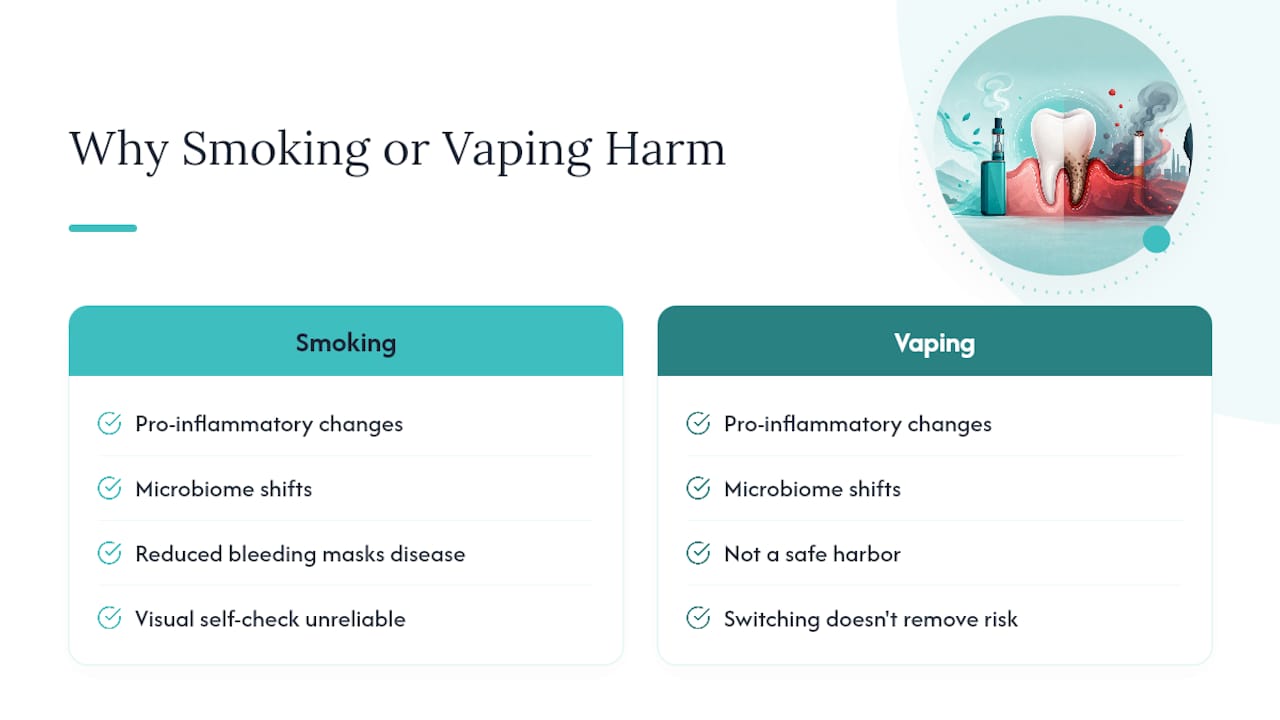
Second, the masked-bleeding problem deserves more attention than it gets. A smoker who isn’t seeing blood in the sink has every reason to assume their gums are fine, and that assumption is exactly backward. Reduced bleeding in a smoker can mean the disease is advancing quietly rather than resolving.
If there’s one priority to take from this, it’s not “quit someday.” It’s this: get a periodontal evaluation now, regardless of how your gums look or feel, because visual self-assessment is the least reliable tool a smoker has.
— Admin
Getting Evaluated and Treated at South Littleton Family Dental
If you smoke or vape and haven’t had your gums checked recently, a periodontal assessment tells you where you actually stand instead of relying on symptoms that smoking is known to mask. We offer a $99 cleaning, exam, and X-ray package as an accessible starting point for exactly this kind of evaluation, and a $49 emergency exam if something urgent comes up between cleanings.

Beyond cleanings, we handle the fuller range of what smoking-related gum damage sometimes requires, from scaling and root planing to implant candidacy evaluations for patients considering replacing teeth lost to periodontal disease. Every plan is built around your specific smoking history and current gum condition rather than a one-size protocol. Call our Littleton office or book online, and mention your tobacco or vaping use when you schedule so we can tailor the exam accordingly.
This article is general information, not a substitute for advice from a qualified doctor. Consult a qualified healthcare professional about your own circumstances before acting on anything here.
Sources
- NIDCR — Periodontal disease statistics in adults
- CDC — Untreated cavities and smoking infographic
- Influence of Smoking on Periodontal and Implant Therapy: A Narrative Review (PMC10094532)
- Vaping, heated tobacco, and periodontal health: a systematic review (2026 DOI)