

A strong gag reflex does not mean you cannot have dental care. It means your visit needs a plan. The most reliable approach combines a few things: tell your dentist before anything goes in your mouth, use nasal breathing and distraction, and ask about options such as nitrous oxide if those are not enough. Most people who gag during X-rays, impressions or cleanings can get treatment done comfortably once the team adjusts the way they work.
Below, we explain why gagging happens, what you can do at home and in the chair, how dentists change their technique for impressions and X-rays, and when sedation enters the conversation.
TL;DR
- Gagging is a protective reflex, not a weakness. Anxiety, smell, taste and even imagining treatment can set it off.
- Tell your dentist and hygienist before the appointment starts so they can adjust the tools, the position and the pace.
- In the chair, breathe slowly through your nose, sit upright with your head slightly forward, and give your mind something else to do.
- If techniques are not enough, a dentist can discuss nitrous oxide or deeper sedation, each with its own safeguards.
- Practice-based desensitization and psychological methods show promise, but the research is still small.
Table of Contents
- Why some people gag more than others
- Tell your dentist first
- What you can do in the chair
- Calming the nerves that feed the reflex
- How dentists change their technique
- Numbing the throat: what to know
- Desensitization and psychological approaches
- When techniques are not enough: nitrous oxide and sedation
- Which approach fits which situation
- Our perspective
- Care at South Littleton Family Dental
- When to speak up or seek help
- FAQ
- Sources
Why some people gag more than others
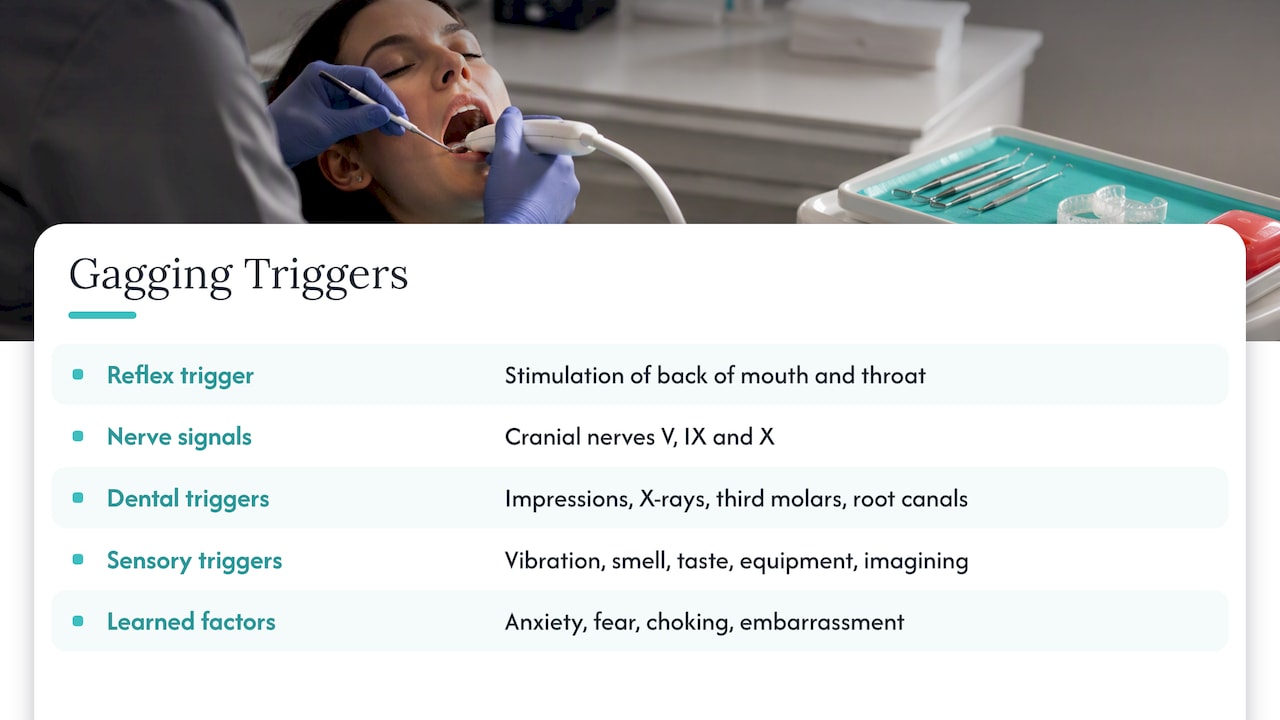
Gagging is a protective reflex. A 2023 systematic review describes it as a response to stimulation of the back of the mouth and throat, with signals traveling through cranial nerves V, IX and X. Its job is to keep things out of your airway. In dentistry, the same review lists impressions, posterior X-rays, third-molar treatment and root canal treatment as common triggers.
The trigger is not always physical contact. The review reports that vibration, the smell or taste of materials, the sight of equipment and even imagining dental treatment can bring it on. That explains why some people start gagging while still in the waiting room.
There is also a learned layer. Authors of a 2025 paper on psychological interventions argue that anxiety, learned associations, fear of choking or embarrassment can amplify gagging. One bad experience with an impression tray can teach your body to brace for the next one. That is useful to know, because learned responses can be unlearned.
So if you are asking whether your gag reflex is “in your head” or “physical,” the honest answer is usually both. A sensitive reflex and a nervous mind feed each other.
Tell your dentist first
This is the single most useful step, and it costs nothing. A dentist who knows you gag will work differently from the first minute.
When you book, mention it. When you sit down, say it again to the hygienist and dentist. Be specific about what sets you off:
- X-ray film or sensors placed toward the back of the mouth
- Impression trays and the putty-like material
- Having your head tipped back
- Water or suction near the back of your tongue
- Certain tastes or smells
- Long procedures where you feel you cannot swallow
Also agree on a signal, such as raising your left hand, that means “pause.” Knowing you can stop the procedure at any moment reduces tension, and less tension usually means less gagging.
If you are new to a practice, a short first visit focused on talking and a gentle exam is a perfectly reasonable request. You do not have to prove anything on day one.
What you can do in the chair
The tips below come from clinical reviews and from patient guidance published by a major oral-care brand. None of them is a cure, and different ones work for different people. Try a few and keep what works.
Breathe through your nose
Slow nasal breathing is the first thing most dental teams recommend. The clinical review Dental Management of the ‘Gagging’ Patient describes controlled rhythmic or relaxed abdominal breathing as a relaxation measure. A simple pattern: breathe in through your nose for a count of three, out for a count of three, and keep your shoulders loose. If you are focusing on your breath, you are less focused on the back of your throat.
Sit upright and lean slightly forward
A fully reclined chair lets saliva and material pool toward your throat. For impressions, Colgate’s patient guidance suggests sitting upright with your head forward. Ask your dentist whether the chair can be raised for that part of the visit.
Let saliva drool
Trying not to swallow can make gagging worse. The same Colgate guidance says to allow saliva to drool rather than fight it. Ask for a towel or bib and let go of the embarrassment. Your dental team has seen it many times.
Give your brain something else to do
Distraction is among the methods the 2023 review supports. Options that work in practice:
- Headphones with music, a podcast or an audiobook
- A show on the ceiling screen if the office has one
- Lifting one leg slightly off the chair and holding it there
- Counting backward from 100 by sevens
- Squeezing a stress ball or pressing your fingertips together
The clinical review also mentions dimmed lighting and keeping instruments out of sight as ways to lower the sensory load. You can simply ask for these.
Relax your tongue
A tense, humped tongue tends to trigger more gagging. Let it rest flat and soft in the floor of your mouth, with the tip behind your lower front teeth. Exhale slowly as you relax it. If you cannot tell whether your tongue is tense, it usually is. Practice at home in front of a mirror, then use the same cue at the office.
Skip the heavy meal
Plenty of people feel better with a light, normal meal beforehand rather than an empty stomach or a full one. If your appointment involves sedation, though, follow the fasting instructions the office gives you, because those are medical and not optional.
Calming the nerves that feed the reflex
If your gagging is tied to dread, working on the dread is part of the solution. Some patients find it helpful to rehearse the visit in advance: what the room looks like, what the hygienist will do, what each sound is. A dental social story is one way to do that, a short illustrated walkthrough of the visit that you read in the days before. It was built for children and adults who find new sensory situations hard, but the idea of rehearsing each step suits anyone whose body reacts before the appointment starts.
Parents, this applies to kids too. A child who gags at X-rays often just needs a calm explanation, a slower pace and a chance to practice holding the sensor. Our children’s dentistry page is a good place to start if you are choosing a first family dentist.
How dentists change their technique
Good dental teams do not just tell you to relax. They change the procedure.
Impressions
Gagging during dental impressions is one of the most common complaints. The thick material and the tray sit right where the reflex is most sensitive. The clinical review lists several modifications dentists can use: sectional rather than full trays, special trays, lower trays for upper-arch impressions and alternative impression approaches. If you have had a miserable experience before, ask whether an alternative to a standard tray is possible for your case.
Before your next impression:
- Tell the dentist or assistant you gag.
- Sit upright, head slightly forward.
- Ask them to explain each step before it happens.
- Breathe through your nose and let saliva drool.
- Agree on your “stop” signal.
X-rays
Posterior X-rays are a frequent trigger. Dentists can place the sensor more gently, take smaller or fewer images at a time, or break the series into two shorter visits. Some people find that breathing steadily through the nose and focusing on a fixed point on the wall helps through the few seconds it takes.
Longer procedures
Fillings, crowns, root canals and extractions can feel long when you are trying not to gag. Short breaks, careful suction placement, rubber dam or cotton rolls used thoughtfully and a calm pace all make a difference. Ask the dentist to tell you before they use suction or water near the back of your mouth.
Numbing the throat: what to know
Topical numbing is a common idea, and it is something dentists sometimes use on the soft palate. It does not always stop the reflex, because gagging has a psychological component too. It also carries a practical caution: if your throat is numb, you may not feel normal swallowing, so follow your dentist’s instructions about eating and drinking afterward. Our guide to dental numbing timelines and when to call 911 explains what to expect and which symptoms need urgent help.
Desensitization and psychological approaches
If gagging has kept you away from the dentist for years, longer-term approaches can help. The clinical review describes desensitization through repeated tongue or anterior soft palate stimulation, swallowing with the mouth open and gradual practice with dental instruments. In plain terms, you slowly teach your reflex that nothing bad happens when something touches those areas.
A 2025 scoping review looked at psychological methods such as systematic desensitization, hypnotherapy and relaxation. It found eight studies involving 14 participants, averaging five sessions over 19.3 weeks. A separate 2025 British Dental Journal review reported that all participants tolerated dental treatment afterward and 87.5% had no gagging during procedures. Some patients also tolerated denture impressions or wearing dentures, with limited follow-up suggesting benefits at six and 12 months.
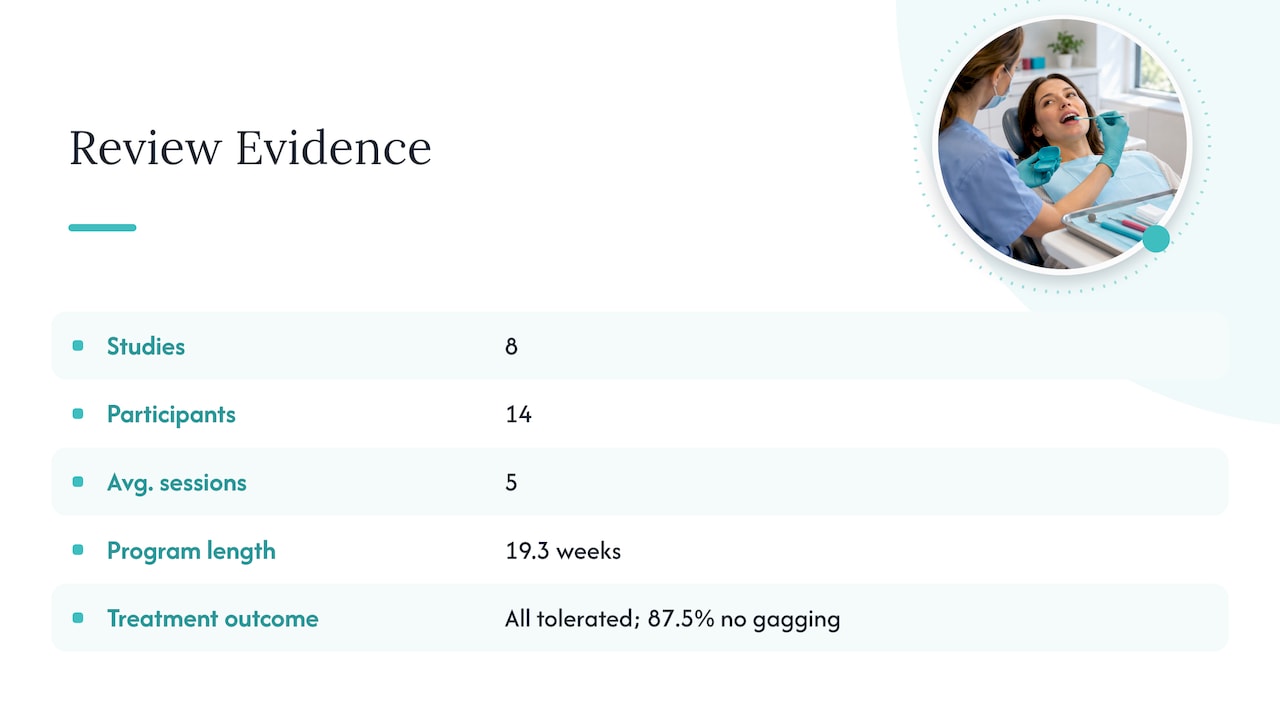
Those numbers are encouraging, but read them with care. The same review says the evidence consists mainly of small case reports and that larger, standardized studies are needed. It means these methods are worth trying, not that they will work for everyone. A psychologist or a dentist trained in behavioral techniques is the right person to guide this kind of program.
One caution on DIY desensitization: do not push through intense gagging or panic on your own. Go gradually, stop when it gets uncomfortable, and bring the topic to your dentist if you are not making progress.
When techniques are not enough: nitrous oxide and sedation
Some people gag no matter what they try. That is when sedation becomes a reasonable conversation, not a last resort or a failure.
Nitrous oxide
The American Dental Association states that appropriately administered nitrous oxide-oxygen is a safe and effective way to manage pain and anxiety in dentistry and has an inherent safety margin. A 2023 review also supports it as one of the practical options for managing gagging, alongside distraction and low-level laser therapy, and recommends tailoring management to the procedure, severity, age and available resources. Nitrous oxide is not guaranteed to stop gagging, but it often takes the edge off the anxiety that drives it.
Deeper sedation
The ADA also notes that nitrous oxide combined with other sedative agents can produce minimal, moderate or deep sedation, or general anesthesia, so the safeguards depend on the level reached. For severe cases, there is published evidence: a South Korean case report describes extensive dental treatment in a patient with severe gag reflex using IV sedation. It is a single case, not proof that it suits everyone.
What should you expect if moderate sedation is on the table? ADA guidelines call for a medical and medication review, a check of fasting status, informed consent, baseline vital signs and emergency oxygen and airway equipment. Patients with significant medical conditions may need medical consultation first. During the procedure, the dentist must continuously assess consciousness, oxygenation and breathing, monitor pulse oximetry, keep an anesthesia record and make sure you recover satisfactorily before you leave.
Some offices bring in a dentist anesthesiologist for sedation. According to the American Society of Dentist Anesthesiologists, these professionals provide sedation or general anesthesia and typically work with the dentist providing care.
Before you agree to any sedation, ask:
- What level of sedation is planned?
- Who monitors me, and what training do they have?
- Do I need to fast, and for how long?
- Do I need someone to drive me home?
- How do my medications and health conditions affect the plan?
Our page on dental anxiety and sedation options walks through safety questions to ask any dentist.
Which approach fits which situation
| Situation | Where to start | If that is not enough |
|---|---|---|
| Gag only during X-rays | Nasal breathing, small sensor placement, shorter series | Spread X-rays over two visits, ask about nitrous oxide |
| Gag during impressions | Upright position, sectional or lower tray, drooling saliva | Alternative impression approach, nitrous oxide |
| Gag during cleanings | Tell the hygienist, breaks, careful suction | Topical numbing, nitrous oxide |
| Gag mostly from dread | Rehearsal, music, relaxation, a calm first visit | Psychological methods, sedation discussion |
| Severe gagging, years of avoidance | Consultation visit, written plan with your dentist | Behavioral therapy and medically supervised sedation |
Our perspective
We see gagging as a communication problem more often than a medical one. The patients who struggle most are usually the ones who stayed quiet, tried to tough it out and left feeling embarrassed. Our approach is built on the opposite: say what you feel, and we will change the visit to fit.
That is how we think about care generally. We aim for compassionate, individualized plans, and we try to reduce anxiety and discomfort from the first conversation. For someone who gags, that means slowing down, explaining each step before it happens, and agreeing on a stop signal. It also means being honest about the research: relaxation and behavioral methods help many people, the evidence is still small, and no single trick works for everyone.
We also believe the decision about sedation belongs to you and your dentist, with safety first. If your gag reflex has kept you out of the chair, a conversation about it is a better first step than any procedure. Book that conversation, and we will build the plan from there.
— the author
Care at South Littleton Family Dental
If you live in or near Littleton, CO, you can see us for general dentistry, restorative work, same-day emergency care and more. Tell us about your gag reflex when you call, and we will plan your visit around it. Start with our general dentistry services or, if you are in pain right now, our emergency dentistry page.

Gagging often comes up for people considering dentures, bridges or crowns, because those involve impressions. Our restorative dentistry page outlines what each treatment involves, so you know what to expect before you sit down.
When to speak up or seek help
Speak up at the start of any appointment. Do not wait until you are mid-procedure with a tray in your mouth. Beyond that, these situations deserve a dedicated conversation:
- You have skipped X-rays, cleanings or needed treatment because of gagging.
- Gagging happens with things that should not trigger it, such as brushing your back teeth or talking.
- You feel panic, shortness of breath or a fear of choking, not just a reflex.
- You are planning dentures, a bridge, implants or other work that needs impressions or long visits.
- Home practice has not improved things after several weeks.
Also tell a doctor if gagging is new, constant or comes with swallowing trouble, reflux, a persistent sore throat or nausea outside the dental office. Those signs point to something other than a dental reflex and deserve a medical evaluation. If you have severe, uncontrolled panic, a psychologist trained in anxiety or behavioral techniques can work alongside your dentist.
FAQ
How can I stop my gag reflex at the dentist?
You usually cannot switch it off, but you can reduce it. Tell the team, breathe slowly through your nose, sit upright with your head forward, let saliva drool and use distraction such as music. If that is not enough, ask about nitrous oxide or other sedation.
Why do I gag during dental impressions?
The tray and thick material sit near the back of your mouth, where the protective reflex is sensitive. Dentists can use sectional or special trays, a lower tray for upper impressions, or another impression method. Say you gag before they start.
Can a dentist numb a gag reflex?
Topical numbing of the soft palate is sometimes used, but it does not work for everyone because anxiety also drives gagging. Numbness can affect swallowing, so follow your dentist’s directions about eating and drinking afterward.
Is a strong gag reflex a reason to avoid the dentist?
No. Avoidance usually lets small problems grow into bigger, more complicated ones. A dentist can adapt X-rays, impressions and procedures, and you can work on desensitization over time.
Is sedation safe for severe gagging?
The ADA describes properly administered nitrous oxide as safe and effective. Deeper sedation requires a medical review, monitoring and recovery checks under ADA guidelines. Ask your dentist what level is planned and who monitors you.
Sources
- An Overview about New Methods in Management of Gag Reflex (2023 systematic review)
- Psychological interventions for gagging (2025 scoping review)
- The effectiveness of psychological interventions for the management of gagging (British Dental Journal, 2025)
- Dental Management of the ‘Gagging’ Patient: An Update
- Getting a Dental Impression: How to Cope With Your Gag Reflex (Colgate)
- Dental treatment in patients with severe gag reflex using IV sedation (case report)
- Nitrous Oxide (American Dental Association)
- ADA Guidelines for the Use of Sedation and General Anesthesia
- About Us (American Society of Dentist Anesthesiologists)
- Dental Social Stories