
Most low-risk adults need bitewing X-rays at intervals generally ranging from about one to three years, while high-risk patients need them more frequently, often every several months to a year and a half. Children and teens typically have intervals roughly between one and two years. Full-mouth or panoramic images are usually spaced several years apart. There’s no universal schedule. Under the ADA/AAOMR framework, your dentist sets your interval based on your actual risk, not a calendar default.
TL;DR:
- The frequency of dental X-rays is primarily determined by your individual caries and periodontal risk, not your age or a fixed schedule.
- Children and teens typically need bitewings every 12 to 24 months, while low-risk adults usually wait 12 to 36 months between bitewings.
- High-risk adults with active decay or periodontal issues may require X-rays every 6 to 18 months, and panoramic images every 3 to 5 years unless specific concerns arise.
- Digital sensors significantly reduce radiation exposure, and prior X-rays should be checked to avoid unnecessary retakes, especially for pregnant women or those with ongoing dental issues.
- Dentists follow conservative, risk-based guidelines aligned with ADA and AAOMR recommendations, emphasizing justification and minimization of each X-ray.
Table of Contents
- How Often Are Dental X-Rays Needed by Age and Risk Level?
- What Are the Different Types of Dental X-Rays?
- Are Dental X-Rays Safe, and What Does the Research Say?
- How Do Dentists Decide When You Need an X-Ray?
- How Can You Reduce Unnecessary X-Ray Exposure?
- How South Littleton Family Dental Approaches X-Ray Frequency
- Get an Individualized X-Ray Plan at South Littleton Family Dental
- Where This Guidance Comes From
- Sources
- FAQ
How Often Are Dental X-Rays Needed by Age and Risk Level?
The single biggest factor in your X-ray schedule isn’t your age. It’s your caries and periodontal risk. A 45-year-old with a clean track record and no cavities in a decade gets treated very differently than a 45-year-old with active decay or dry mouth from medication.
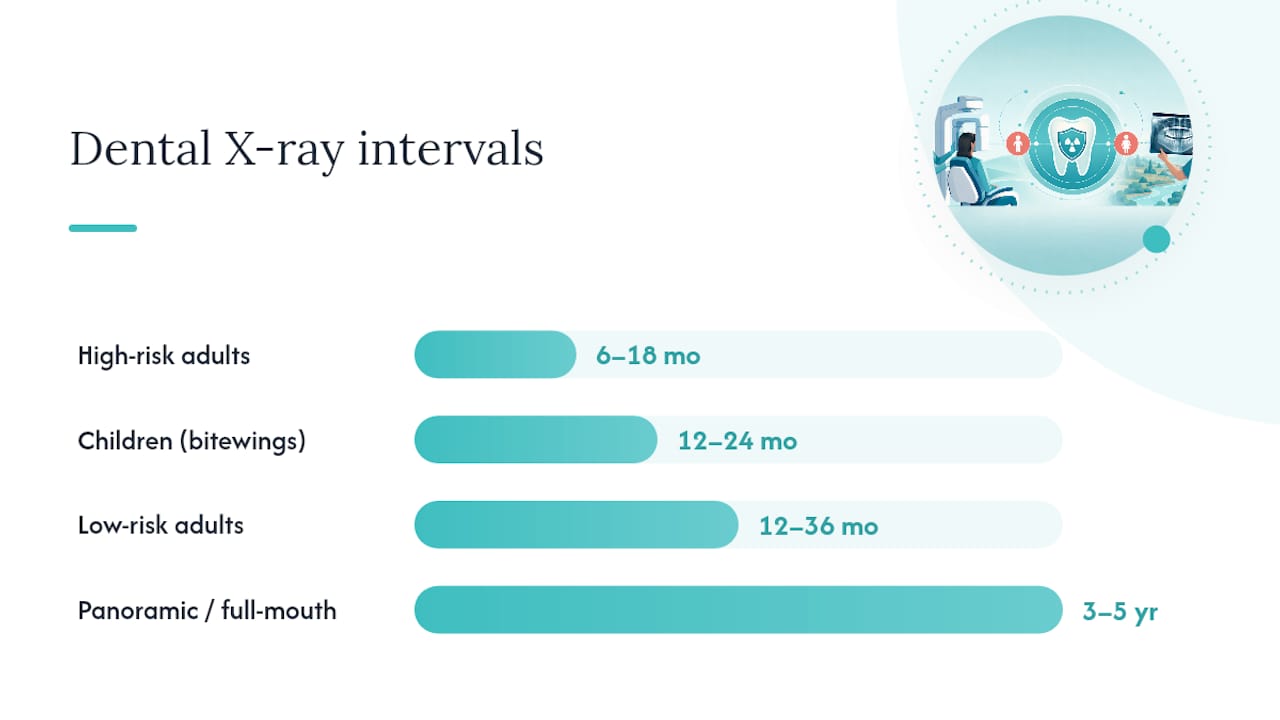
Children with primary or mixed dentition usually get bitewings every 12 to 24 months. Kids’ teeth develop faster and their enamel is thinner, so decay can progress from a shadow to a cavity in less time than it takes in adult teeth. A child with a history of cavities may need images closer to the 12-month mark; a child with excellent home care and no decay history can often stretch toward 24 months.
Adolescents are watched for a different reason: erupting molars, wisdom teeth positioning, and orthodontic planning. Interval decisions here lean heavily on what the dentist sees clinically rather than a fixed timeline.
Low-risk adults who show no active decay, have healthy gums, and keep up with cleanings typically sit at the 12 to 36 month range for bitewings. Panoramic or full-mouth series stretch even further, often 3 to 5 years or more, unless something specific comes up.
High-risk adults are a different story. Active cavities, dry mouth (a common side effect of dozens of common medications), a history of periodontal disease, or heavy tartar buildup push the interval down to every 6 to 18 months.
Seniors and patients with partial tooth loss get imaging tailored to whatever restorations they have. If you’ve got several crowns, bridges, or implants, your dentist watches those sites more closely, especially if you report new sensitivity or discomfort.
These ranges reflect the ADA–AAOMR patient-selection consensus, which treats them as clinical guidance rather than fixed rules. Your actual schedule depends on:
- Whether you’ve had cavities in the past 2 to 3 years
- Current gum health and pocket depths
- Dry mouth or medications that reduce saliva flow
- Visible decay, cracked fillings, or loose restorations
- How long it’s been since your last set of diagnostic images
What Are the Different Types of Dental X-Rays?
Not all dental X-rays serve the same purpose, which is why they don’t share the same recall window.
- Bitewings capture the crowns of upper and lower teeth in one bite. They’re the workhorse for catching cavities between teeth before you’d ever feel them, which is why they’re the image most often repeated on a routine schedule.
- Periapicals zoom in on a single tooth root and the bone around it. Dentists order these when something specific is going on, like a suspected abscess or unexplained pain, not as routine surveillance.
- Panoramic X-rays capture the entire jaw in one wide image. They’re used to track wisdom teeth, jaw development, and broader pathology, and they’re typically taken every 3 to 5 years or when a specific concern arises.
- Full-mouth series combine multiple bitewings and periapicals into a complete baseline. Dentists use these for new patients or when extensive treatment planning is underway, not as an annual habit.
- Cone-beam CT (CBCT) produces 3-D images for implant planning or complex pathology. It’s a specialized tool, not something used for routine caries screening.
Are Dental X-Rays Safe, and What Does the Research Say?
Dental X-rays carry low radiation doses. Several routine dental exams deliver less radiation than a single day of natural background exposure most people absorb just living on the planet. That’s the reassuring part.
The more nuanced part is cumulative exposure. A systematic review published in PLOS One found no clear epidemiological evidence tying a single dental X-ray exam to cancer risk, but the researchers flagged that cumulative exposure across a lifetime, especially in childhood, deserves continued attention and better contemporary study. A separate review in PubMed Central echoes that caution: doses have dropped significantly with digital sensors, but low-dose cumulative exposure over decades can’t be fully ruled out as a factor worth monitoring.
The evidence doesn’t say dental X-rays are risky. It says the field can’t yet close the book on cumulative, lifetime exposure, which is exactly why justification and minimization matter for every single image ordered.
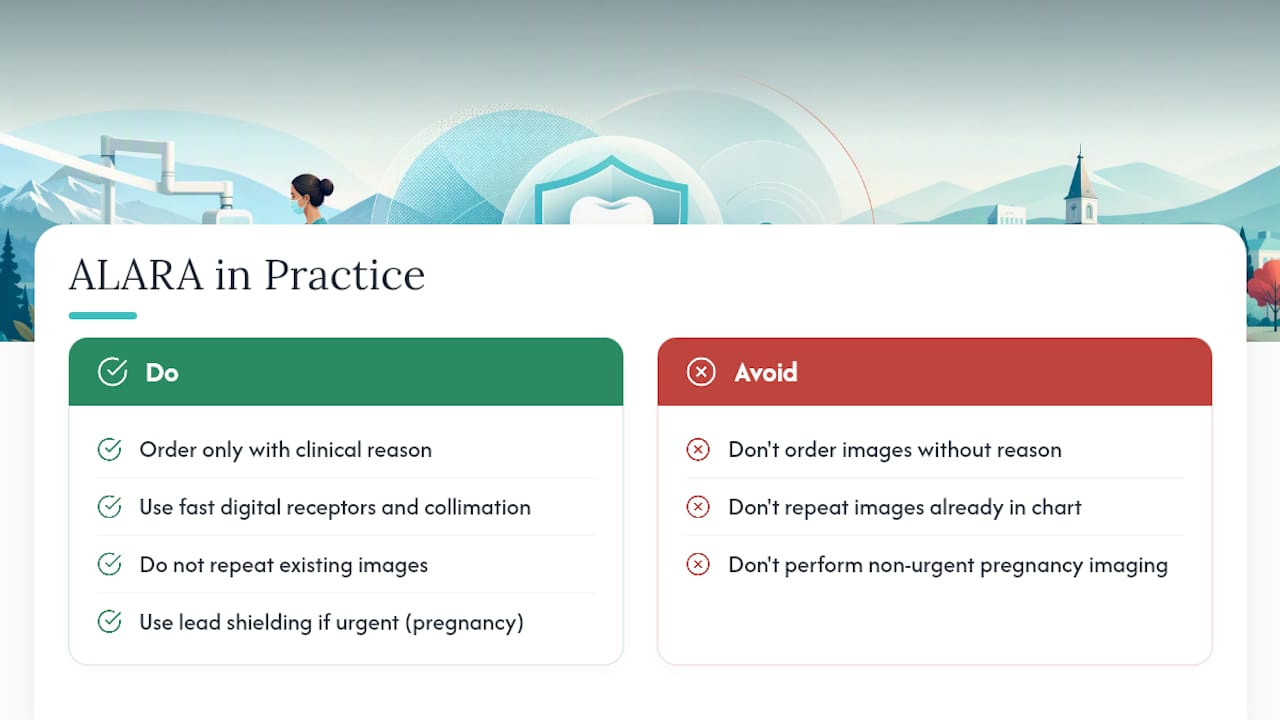
This is where ALARA comes in: As Low As Reasonably Achievable. It’s the guiding principle behind the 2026 ADA/AAOMR update, and it means three things in practice: no image gets ordered without a clinical reason, dentists use the fastest digital receptors and proper collimation to shrink the radiation field, and nobody repeats an X-ray that already exists in your chart.
Pregnant patients should have non-urgent imaging deferred, with lead shielding used if an urgent image can’t wait. Children get dose-reduced protocols and more individualized selection criteria, since their tissue is more radiosensitive than an adult’s.
How Do Dentists Decide When You Need an X-Ray?
Your dentist isn’t flipping a coin or defaulting to “it’s been a year.” A few concrete steps drive the decision:
- Caries risk assessment. Your dentist scores your risk as low, moderate, or high based on diet, fluoride exposure, plaque control, and cavity history.
- Clinical exam findings. Visible decay, cracked restorations, gum recession, or bite changes can trigger imaging outside your regular schedule.
- Review of prior images. A dentist should check what’s already on file before ordering anything new.
- Shared conversation. You should hear the reason for the image and what your dentist expects to learn from it.
Pro Tip: Before any new X-ray, ask your dentist one direct question: “What are you looking for, and would this change my treatment?” If the answer is vague, it’s worth asking whether the image can wait.
How Can You Reduce Unnecessary X-Ray Exposure?
A few habits go a long way toward keeping your lifetime exposure as low as it reasonably can be.
- Ask whether the office uses digital sensors, which cut radiation dramatically compared to older film.
- Request that prior X-rays be transferred from a former dentist before your first visit, rather than starting over with a full new series.
- If you’re pregnant or simply want extra caution, ask about lead shielding and whether non-urgent imaging can be deferred.
- Keep your own record of when and what type of X-ray you’ve had, since most people can’t recall this offhand.
Pro Tip: Take a photo of your last dental X-ray paperwork or ask for a digital copy. It saves you from an unnecessary retake the next time you switch providers.
How South Littleton Family Dental Approaches X-Ray Frequency
At South Littleton Family Dental, imaging decisions follow the same evidence-based, ALARA-driven logic outlined above. The practice uses digital imaging technology to keep doses low and relies on individual risk conversations rather than a one-size-fits-all schedule.
Same-day emergency imaging is available when a clinical situation calls for it, and new-patient preventive visits are built to include an exam and imaging discussion tailored to your history. If you’ve had X-rays elsewhere, bring them, or the dates and types, to your first visit so nothing gets duplicated unnecessarily.
— Admin
Get an Individualized X-Ray Plan at South Littleton Family Dental
Skip the guesswork about whether you’re due for X-rays or overdue for a cleaning. South Littleton Family Dental builds every imaging decision around your actual risk profile, not a generic annual default, using digital sensors and the same ALARA principles outlined by the ADA.

New patients can start with the $99 cleaning and exam package, which includes a conversation about your risk factors and whether imaging is actually needed at that visit. If you’re dealing with pain or a dental emergency, same-day emergency exams are available for $49, with imaging performed only when it changes the treatment plan. For anyone managing ongoing dental needs, the general dentistry team will review any prior X-rays you bring in and map out an interval that fits your history instead of a generic timeline. Call the office or book online to get your individualized plan started.
Where This Guidance Comes From
This article draws on the ADA/AAOMR 2026 patient-selection recommendations, the FDA’s guide to patient selection, the PLOS One systematic review, the PMC review on dental X-ray exposure, and Cleveland Clinic’s patient guidance. Operational scheduling context comes from Anetco Dental’s overview of X-ray practice windows.
This article is general information, not a substitute for advice from a qualified doctor. Consult a qualified healthcare professional about your own circumstances before acting on anything here.
Sources
- ADA / FDA Guide to Patient Selection for Dental Radiographs | FDA
- Negative health effects of dental X-rays: A systematic review | PLOS One
- Health effects from exposure to dental diagnostic X-ray | PMC
- X-Rays/Radiographs | American Dental Association
FAQ
What Are the New Dental X-Ray Guidelines for 2026?
The 2026 ADA/AAOMR update reinforces patient-selection criteria: imaging frequency should be based on individual caries and periodontal risk rather than a fixed calendar schedule, with typical bitewing intervals of 6 to 18 months for high-risk patients and 12 to 36 months for low-risk adults.
Why Do Dentists Recommend X-Rays So Often?
Dentists order X-rays to catch decay and bone loss between teeth and under the gumline that a visual exam can’t detect, and the interval is set by your personal risk level, not routine habit. If your dentist’s recommended interval seems frequent, ask what specific risk factor is driving it.
Can Too Many Dental X-Rays Be Harmful?
Single dental X-ray doses are low, and no clear evidence links a single exam to cancer risk, according to the PLOS One systematic review. Cumulative exposure over a lifetime is still worth minimizing, which is why dentists follow the ALARA principle and avoid duplicate imaging.
How Long Should You Wait Between Dental X-Rays?
It depends on your risk category: low-risk adults typically wait 12 to 36 months between bitewings, high-risk adults wait 6 to 18 months, and panoramic images are usually spaced 3 to 5 years apart unless a specific issue arises.
Does South Littleton Family Dental Offer Digital X-Rays?
Yes. South Littleton Family Dental uses digital imaging technology that reduces radiation dose compared to older film systems, and imaging decisions are based on individual risk assessment rather than a fixed schedule.