
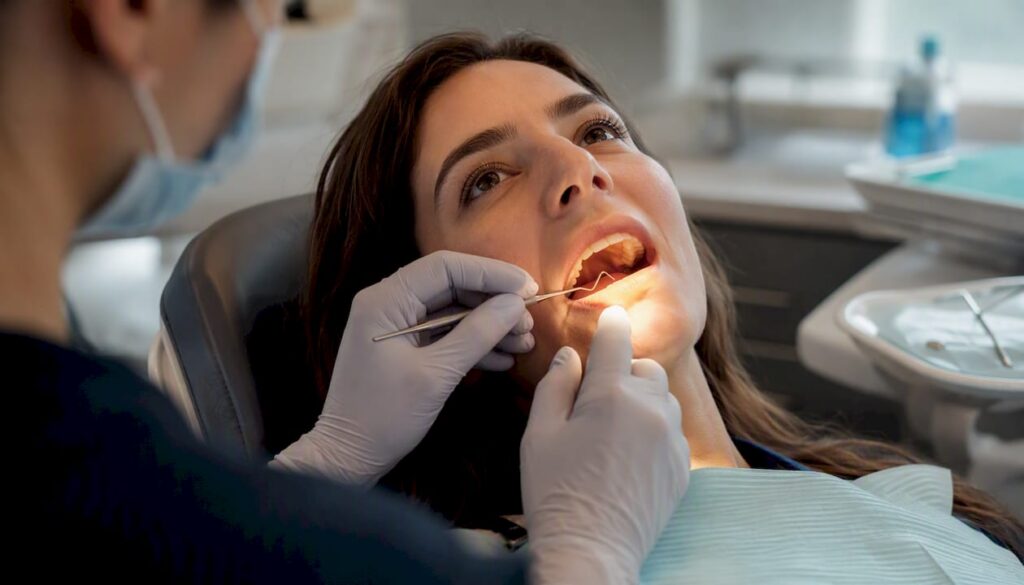
Yes, most small chips in a dental crown can be repaired without pulling the whole thing off. Minor chips in the porcelain surface, rough edges, or a small fracture at the biting edge are usually fixable in a single visit with polishing or composite bonding. Larger fractures, exposed metal or tooth structure, or a crown that’s come loose entirely often mean replacement is the safer long-term call. Which path applies to you depends on how big the chip is, what the crown is made of, whether the edges (dentists call this the “margin”) still seal tightly against your tooth, and whether the tooth underneath shows any decay.
Right now, before you do anything else: find any broken pieces and put them in a clean container, avoid chewing on that side of your mouth, and smooth any sharp edge with a bit of orthodontic wax or even sugar-free gum if wax isn’t handy. Then call your dentist.
- Save any fragment that broke off, even a tiny one.
- Stop chewing on that side immediately.
- Cover a sharp edge with wax, gum, or a cotton ball soaked in water.
- Skip the super glue, no matter how tempting.
- Call your dental office the same day, even if it doesn’t hurt yet.
If you’re in pain, the crown feels loose or wiggly, or you can see exposed tooth or a pink/red area underneath, treat that as urgent and get seen within 24 hours.
Pro Tip: Snap a photo of the chip with your phone before you call the dentist. Front lighting, close focus, no flash glare. It helps the front desk triage how urgent your case is and gives the dentist a head start before you even sit in the chair.
Table of Contents
- How to Check the Chip and Judge How Serious It Is
- What to Do in the First 24 Hours
- Dental Repair Techniques: What Each Involves and How Long They Last
- How Dentists Decide Between Repair and Replacement
- What Repairing or Replacing a Crown Typically Costs
- Red Flags That Turn a Chipped Crown Into an Emergency
- How to Prevent Crowns From Chipping and Care for a Repaired One
- What to Expect at Your Appointment
- How South Littleton Family Dental Can Help Right Now
- Quick Recap: The Essential Facts on Chipped Crown Repair
- Frequently Asked Questions
- Sources
How to Check the Chip and Judge How Serious It Is
Run your tongue over the tooth first. That alone tells you a lot. A smooth, small nick that doesn’t catch on your tongue and doesn’t hurt is usually cosmetic. A jagged edge that snags your tongue or cheek, or a spot that stings with cold water, points to something more involved.
Work through this quick mental checklist:
- Sharp or jagged edge? That’s a laceration risk to your tongue and cheek, not just cosmetic.
- Sensitivity to hot, cold, or sweet? Can mean the chip has exposed the crown’s core material or, worse, the tooth underneath.
- Pain when you bite down? Often signals the fracture goes deeper than the surface layer.
- Does the crown feel loose or rock slightly? That’s a margin problem, not a chip problem, and it needs prompt attention.
- Can you see a dark line or gap where the crown meets the gum? That’s the margin failing, which lets bacteria in even if the chip itself looks small.
The material matters for what you’re looking at. A chip in an all-porcelain or porcelain-fused-to-metal crown often shows as a bright white or gray patch where the glossy glaze has flaked off, sometimes revealing a dull metal substructure underneath. A chip in a zirconia crown tends to look like a small flake or crack line in an otherwise very hard, glassy surface, since zirconia resists chipping better than porcelain but can still fracture under heavy bite force. According to a literature review on veneered zirconia crowns, chipping rates in these restorations have been reported to vary widely across different studies, depending on design and how the crown was fabricated.
A chip is likely cosmetic-only if it’s small, doesn’t reach the gum line, doesn’t cause sensitivity, and the crown still feels solid. It becomes a decay risk the moment it opens a path for bacteria at the margin, even if the chip itself looks minor from the outside.
Pro Tip: If you find a broken piece, don’t rinse it under hot water or scrub it. Rinse gently with cool water, pat it dry, and store it dry in a small container. A dentist can sometimes bond that exact fragment back onto your crown for a better color match than building it back up with composite.
What to Do in the First 24 Hours
- Rinse your mouth with warm salt water to clear away any grit or fragments and calm irritated gum tissue.
- Protect any sharp edge with orthodontic wax pressed over the spot, or sugar-free gum in a pinch.
- Avoid chewing on that side entirely, and skip hard, sticky, or crunchy foods until you’re seen.
- Take an over-the-counter pain reliever like ibuprofen if you’re sore, following the label dosage.
- Store any recovered fragment in a clean, dry container and bring it with you to your appointment.
- Call your dental office and describe what happened clearly.
When you call, the front desk will move faster if you can answer a few things right away:
- When did the chip happen, and what were you doing (biting ice, a fall, grinding at night)?
- Is there any pain, and how would you rate it on a scale of 1 to 10?
- Do you have the broken piece?
- Is the crown still firmly attached, or does it feel loose?
- Any swelling, bleeding, or fever?
Do not attempt to reattach a fragment yourself with super glue or any household adhesive. These products aren’t biocompatible, can irritate or damage your gum tissue, and often make the eventual professional repair harder because the bonding surface gets contaminated. If you notice swelling, a fever, or bleeding that won’t stop after a few minutes of gentle pressure, mention that immediately when you call. It changes how fast you need to be seen.
Dental Repair Techniques: What Each Involves and How Long They Last
Not every chip needs the same fix, and the range of options is wider than most patients expect. Here’s what a dentist is actually choosing between.
Polishing and smoothing handles the smallest cases: a rough edge or minor surface flake with no exposed structure underneath. The dentist uses fine polishing discs to round the edge and restore a smooth finish. It takes minutes, costs the least, and it’s purely cosmetic and comfort-focused. It doesn’t rebuild lost material.
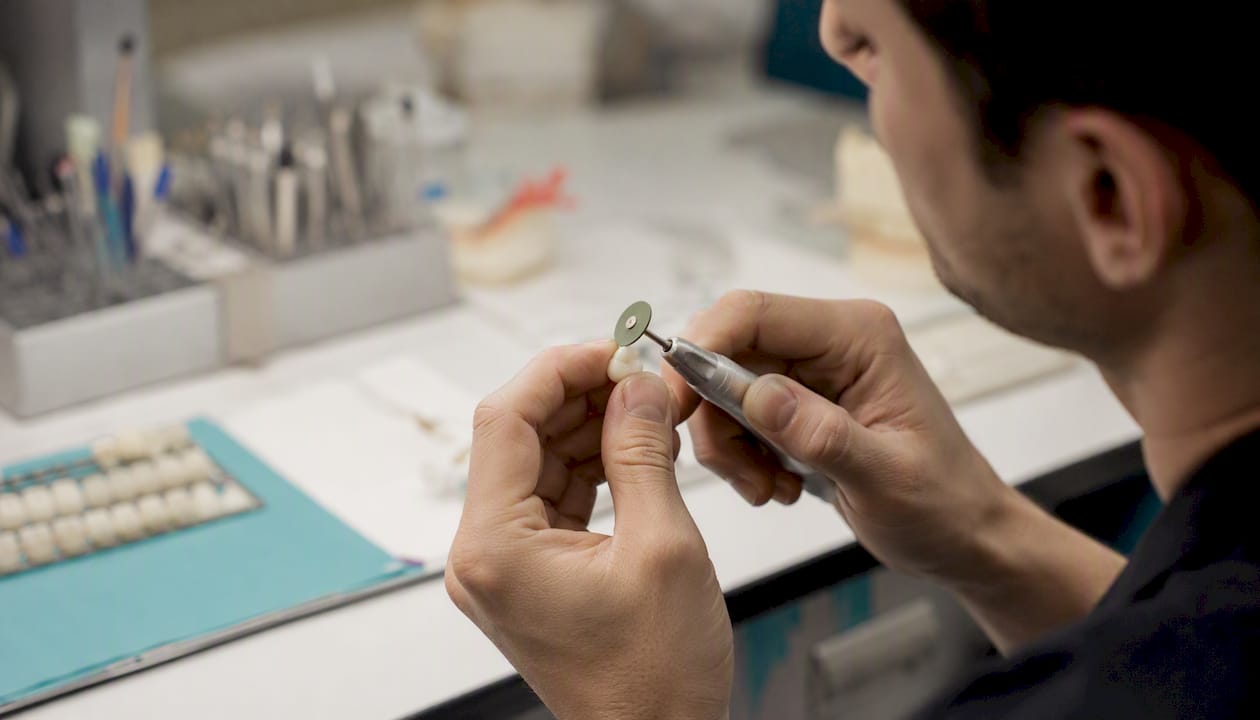
Composite bonding is the workhorse fix for small to moderate chips in porcelain or ceramic crowns. The dentist roughens the chipped area, applies a bonding agent, then layers tooth-colored resin to rebuild the missing shape, curing it with a light and polishing it to match the surrounding surface. It’s fast, usually done in one visit, and reasonably affordable. The tradeoff is durability: composite doesn’t bond to porcelain as strongly as porcelain bonds to porcelain, so these repairs can wear or discolor faster, particularly if you grind your teeth.
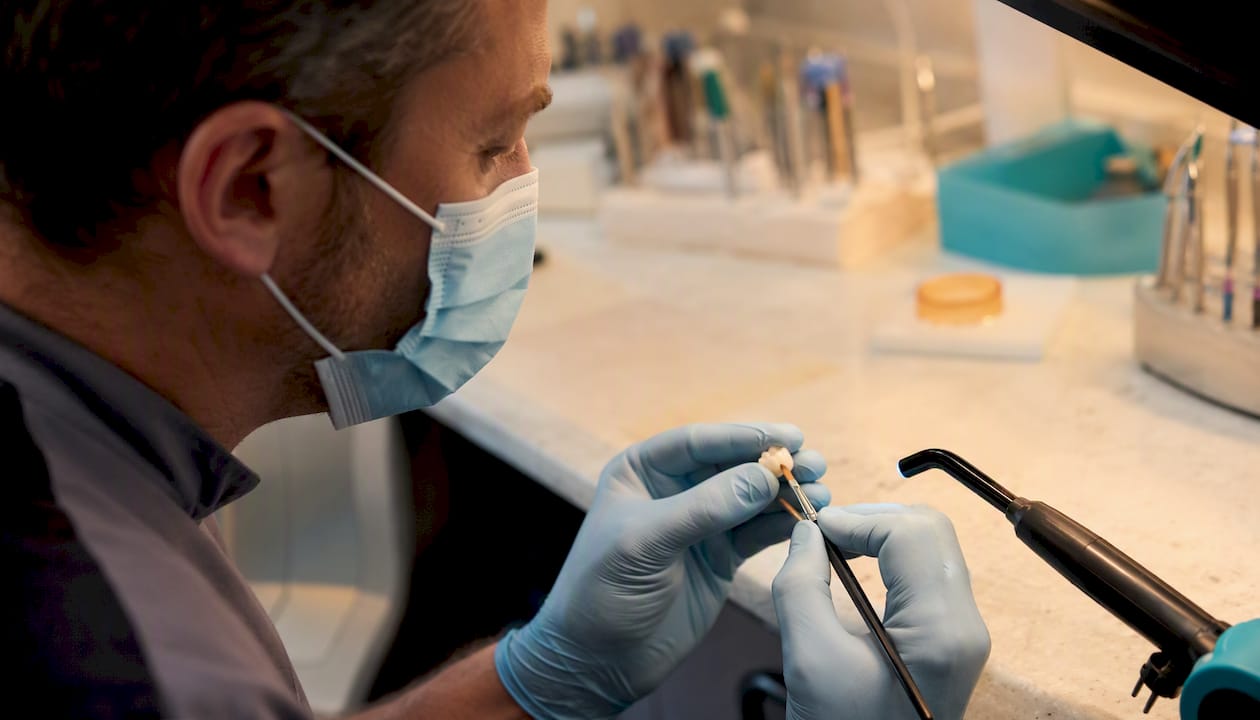
Re-cementing or rebonding applies when the crown itself is intact but has come loose, or when you’ve saved a clean fragment that still fits. If the piece fits precisely and its edges are undamaged, dentists can sometimes bond the original fragment back in place, which typically gives a better color and shape match than rebuilding with composite from scratch.
Intraoral repair protocols cover more involved chips in veneered zirconia or porcelain crowns, done without removing the crown from your mouth. The process generally follows a sequence: the surface gets cleaned and mechanically roughened with air-particle abrasion, then treated with a chemical primer (hydrofluoric acid etching for porcelain, or an MDP primer for zirconia), followed by adhesive resin application and final polishing. This layered approach is what current FDI-aligned clinical guidance recommends for durable results, and skipping any one of those steps tends to shorten how long the repair lasts.
When the damage is too extensive for any of the above, a dentist may recommend a partial restoration like an onlay, or move straight to full crown replacement, particularly if the underlying tooth has lost significant structure or the margin can’t be salvaged.
| Repair Method | Best For | Typical Durability |
|---|---|---|
| Polish/smooth | Tiny surface rough spots | Cosmetic only, no structural rebuild |
| Composite bonding | Small to moderate porcelain chips | Months to a few years, wears faster than porcelain |
| Rebond original fragment | Clean break with intact piece | Comparable to original crown if bond succeeds |
| Intraoral repair protocol | Moderate zirconia/porcelain chipping | Multi-year with proper surface treatment |
| Full replacement | Bulk fracture, failed margin, decay | Comparable to a new crown’s expected lifespan |
Pro Tip: Ask specifically which protocol your dentist plans to use if you have a zirconia crown. Zirconia needs an MDP primer to bond properly. Skipping it is one of the most common reasons an intraoral zirconia repair fails early.
How Dentists Decide Between Repair and Replacement
This isn’t guesswork on the dentist’s part. There’s an actual clinical framework behind the decision, and knowing it helps you understand why your dentist recommends what they do.
The core factors a dentist walks through include:
- Where the defect sits (localization): a chip confined to one cusp tip behaves very differently than one that crosses the margin.
- Margin integrity: whether the seal between crown and tooth is still tight, or whether there’s a visible gap letting bacteria in.
- Recurrent decay: any new cavity activity under or around the crown usually tips the decision toward replacement.
- Bulk fracture versus surface chip: a crack through the structural core of the crown is a different problem than a surface flake.
- How much healthy tooth is left supporting the crown.
- The restoration’s age and how it’s held up otherwise.
- Your personal caries risk and preferences, since a patient prone to decay may need a more conservative margin than someone with excellent oral hygiene.
As one clinical review of restoration decision-making puts it, localized defects with sound underlying tooth structure are generally repairable, while bulk fracture, extensive recurrent decay, or a compromised margin call for replacement.
Repairing rather than replacing a defective restoration preserves more of the natural tooth, reduces the chance of pulp irritation from another round of preparation, and often means less time in the chair overall.
That repair-first thinking isn’t a fringe opinion. Survey data from the ADA’s ACE Panel found that roughly 80% of responding dentists repair defective restorations rather than automatically replacing them, with noncarious marginal defects, partial fractures, and margin repairs for caries topping the list of reasons.
Worth knowing before you assume every dentist offers this: not every practice performs intraoral crown repairs as a matter of course. Some clinicians prefer to refer out or default to replacement, particularly for fractured all-ceramic crowns, so it’s reasonable to ask directly whether your dentist offers repair as an option before assuming replacement is the only path.
What Repairing or Replacing a Crown Typically Costs
Costs vary by clinic, region, and crown material, but here’s a realistic range of what U.S. patients typically encounter for each type of fix.
| Procedure | Typical Cost Range | Typical Timeline |
|---|---|---|
| Polish/smooth | $0 to $70 | Same visit, minutes |
| Composite bonding repair | $100 to $350 | Same-day, one visit |
| Re-cement loose crown | $50 to $190 | Same-day, one visit |
| Intraoral zirconia/porcelain repair | $150 to $450 | Same-day, one visit |
| Full lab-made crown replacement | $800 to $2,000 | Two visits, 1 to 3 weeks for lab fabrication |
These figures shift depending on your crown’s material, whether the tooth needs a core buildup or root canal work before a new crown goes on, and local lab fees. Dental crown costs, material choice alone can swing full replacement pricing significantly, with premium ceramics costing more than metal-based options.
Insurance often treats repair and replacement differently. Many dental plans cover a portion of crown repair with fewer restrictions than replacement, though most plans also enforce a replacement frequency limit (commonly five to eight years) before they’ll pay toward a new crown at all. It’s worth calling your insurer for preauthorization before a scheduled repair or replacement whenever your situation isn’t a same-day emergency, since that call can save you an unpleasant surprise on the bill.
If your case is straightforward, same-day emergency appointments can often handle polishing, bonding, or re-cementing in one sitting. A same-day emergency exam is usually enough to determine which category you’re in. Full replacement almost always requires a lab-made crown, which means at least two visits spaced a week or more apart.
Red Flags That Turn a Chipped Crown Into an Emergency
Most chipped crowns are not emergencies. Some absolutely are, and knowing the difference keeps you from either panicking unnecessarily or waiting too long on something serious.
Treat these as same-day, call-now situations:
- Severe or worsening pain that over-the-counter medication doesn’t touch.
- Visible swelling in the face, jaw, or gum near the tooth.
- A fever alongside tooth pain or swelling.
- The crown has fully come off, or you can see exposed tooth structure or a pinkish area (possible pulp exposure).
- Bleeding from the gum around the tooth that doesn’t stop with gentle pressure after 10 minutes.
- Any trouble breathing or swallowing, which needs an emergency room, not a dental office.
For timing, use this guide:
- Same-day: severe pain, visible swelling, fever, exposed pulp, or a crown that’s completely detached.
- Within 24 to 48 hours: persistent sensitivity, a jagged edge irritating your tongue or cheek, or a crown that feels loose but hasn’t come off.
- Routine visit within a couple of weeks: a small cosmetic chip with no pain, no sensitivity, and a crown that still feels solid.
According to patient guidance from the ADA, even a painless chip can expose the crown’s margin to bacteria and lead to decay underneath, which is exactly why “it doesn’t hurt yet” isn’t the same as “it’s fine to wait.”
How to Prevent Crowns From Chipping and Care for a Repaired One
Prevention is mostly about habits, not products. Brush twice daily, angling your brush gently at the gum line where the crown meets your natural tooth, and floss carefully around that margin daily. A soft-bristled brush and fluoridated toothpaste protect both the crown edge and the tooth structure underneath it.
Behavior matters just as much as brushing technique:
- Skip chewing ice, hard candy, or unpopped popcorn kernels.
- Don’t use your teeth as tools to open packages or bite fishing line.
- If you clench or grind at night, ask about a night guard, since bruxism is one of the most common causes of crown chips and fractures in the first place.
- Nuts and other hard foods are fine in moderation, but bite carefully and avoid molars with a known repair or a thinner margin.
Once your crown is repaired, schedule a follow-up so your dentist can check margin integrity and confirm your bite is properly aligned. These checks typically happen at your regular cleaning, and they catch small issues, like a slightly high bite spot putting extra pressure on the repair, before they cause another chip.
If chipping keeps happening on the same tooth, it’s worth asking your dentist whether a more fracture-resistant material, like zirconia, makes sense for a future replacement. Zirconia generally holds up better under heavy bite force than traditional porcelain, though as noted earlier, it isn’t chip-proof either.
What to Expect at Your Appointment
A crown-chip visit follows a fairly predictable flow. Your dentist will ask about when and how it happened, take a look visually, check your bite for interference or pressure points, and likely take an X-ray to confirm there’s no decay or infection hiding underneath the crown. From there, they’ll walk you through your realistic options.
- History and symptom review: when it happened, pain level, any looseness.
- Visual and bite exam: checking the chip’s size, the margin, and how your teeth come together.
- X-rays if needed: to rule out decay, infection, or bone changes near the root.
- Treatment discussion: repair versus replacement, with reasoning specific to your case.
- Same-day treatment or lab referral: many repairs happen in one visit; replacement typically requires a temporary crown while a permanent one is fabricated.
Before you leave, it’s worth asking a few direct questions:
- How long should this repair reasonably last?
- What material options exist if we’re talking about full replacement?
- What will this cost, and what does my insurance likely cover?
- Should I be wearing a night guard going forward?
- What symptoms should send me back in sooner rather than later?
Your dentist will typically document the visit with photos and X-rays, both to track how the repair holds up over time and to record your informed consent for whichever path, repair or replacement, you choose together. For a closer look at what a restorative visit actually involves, the restorative dentistry process at a practice like this one follows that same structured evaluation.
Dentist Perspective: Why Conservative Repair Is Often Preferred
Repair-first isn’t a compromise option. It’s frequently the smarter clinical call when the tooth structure underneath is sound. Every time a crown comes off for replacement, there’s some risk to the tooth and its nerve, from the fit of the temporary to the re-preparation of the margin. If a chip is localized and the seal is intact, fixing it in place avoids putting the tooth through that cycle again.
Patients sometimes assume repair is a lesser fix, something you settle for because replacement is too expensive. That’s backwards. When the underlying structure is healthy, a well-executed intraoral repair, done with the right surface preparation, can hold up for years and spares the tooth from unnecessary intervention. The decision is never one-size-fits-all. It depends on the specific chip, the specific tooth, and the specific patient sitting in the chair, which is exactly why a proper exam matters more than guessing from a mirror at home.
How South Littleton Family Dental Can Help Right Now
If you’re dealing with a chipped crown today, you don’t need to wait days for someone to look at it. South Littleton Family Dental offers same-day evaluation for crown damage, whether that means a quick polish, a composite repair, or determining that replacement is the better route for your situation.

The practice handles the full range of what a chipped crown might need: emergency dentistry for urgent pain or a crown that’s come loose, restorative dentistry for repair and replacement work, and night guard fittings if grinding is behind your chip in the first place. New patients can also take advantage of current specials, and flexible payment options make it easier to get treatment started without delaying care over cost. You can reach the Littleton, CO office directly or book online through the South Littleton Family Dental website. If your crown chipped today, call now or request a same-day slot rather than waiting for it to get worse.
Quick Recap: The Essential Facts on Chipped Crown Repair
Small, localized crown chips are usually repairable in one visit, while bulk fractures, exposed tooth structure, or failed margins typically call for replacement.
| Point | Details |
|---|---|
| Repairability depends on scope | Small surface chips with an intact margin are usually fixable; bulk fractures or exposed tooth need replacement. |
| Act within hours, not days | Save any fragment, avoid chewing on that side, and protect sharp edges with wax until you’re seen. |
| Watch for emergency signs | Severe pain, swelling, fever, or a fully detached crown mean same-day care, not a routine appointment. |
| Repair-first is standard practice | About 80% of dentists surveyed by the ADA’s ACE Panel repair restorations rather than defaulting to replacement. |
| Get same-day help locally | South Littleton Family Dental offers same-day emergency evaluation and repair options for chipped crowns in Littleton, CO. |
Frequently Asked Questions
Can a chipped crown be repaired without replacing it entirely?
Often, yes. Small chips confined to the crown’s surface, with the margin still sealed and no decay underneath, are commonly fixed with polishing, composite bonding, or an intraoral repair protocol rather than full replacement.
How much does chipped crown repair typically cost?
Minor fixes like polishing or bonding can cost a few hundred dollars, while intraoral repairs for porcelain or zirconia crowns are moderately priced. Full replacement, when needed, costs significantly more.
Is a chipped crown always a dental emergency?
No. A small, painless cosmetic chip can typically wait for a routine appointment within a couple of weeks. Severe pain, swelling, fever, or a crown that’s completely detached needs same-day attention.
What should I do if a piece of my crown breaks off completely?
Save the fragment in a clean, dry container and call your dentist. If the piece is intact and undamaged, it can sometimes be bonded back onto the crown for a better match than rebuilding it with composite.
Which crown material chips the least?
Zirconia generally resists chipping better than traditional porcelain, though no material is chip-proof. Reported chipping rates for veneered zirconia crowns range widely, from 0% to 44%, depending on the crown’s design and how it was made.
Will my dental insurance cover crown repair?
Many plans cover a portion of crown repair, though most enforce a replacement frequency limit before covering a brand-new crown. Calling your insurer for preauthorization before a nonemergency repair is a smart step.
This article is general information, not a substitute for advice from a qualified doctor. Consult a qualified healthcare professional about your own circumstances before acting on anything here.
Sources
- FDI and repair protocols review (PMC)
- Clinical Decision-Making for Restoration — Strassler/UMaryland
- Intraoral repair of veneered zirconia crowns — literature review (2018)
- Case reports / review on rebonding fragments (PubMed)