
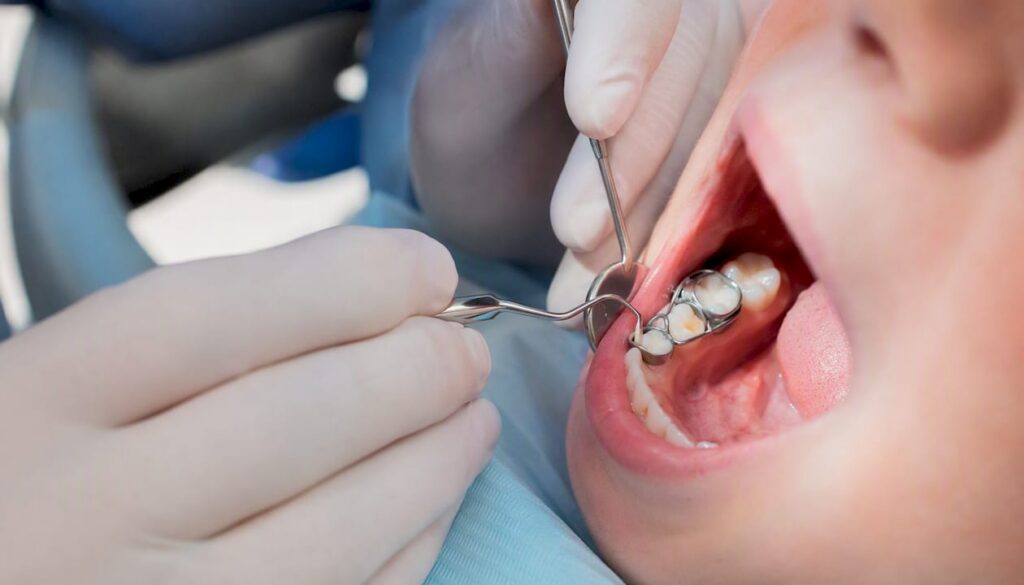
A dental space maintainer is a custom appliance that holds open the gap left by a prematurely lost baby tooth so the permanent successor has room to erupt correctly. According to the American Academy of Pediatric Dentistry, placement is a case-by-case decision based on which tooth was lost, the child’s dental age, and how far away the permanent tooth is from erupting. Not every early loss requires one, but when a primary molar goes too soon, the teeth on either side can drift within weeks.
Here is what to do right now:
- Ask for a periapical X-ray at the next appointment to confirm the permanent successor’s position and root development stage.
- Discuss fixed versus removable options with the dentist, keeping your child’s age and cooperation level in mind.
- Confirm a follow-up schedule so the appliance and eruption progress are monitored every four to six months.
Key takeaways
Space maintainers are a proven short-term tool for preserving arch length after premature baby tooth loss, but their success depends on the right appliance, consistent hygiene, and scheduled monitoring.
| Point | Details |
|---|---|
| Act quickly after early tooth loss | Adjacent teeth drift fast; evaluation and X-rays should happen within weeks, not months. |
| Fixed appliances suit most young children | Band-and-loop and lingual arch designs remove the compliance burden for kids under 8–9. |
| Hygiene around bands is non-negotiable | Plaque at the band margin causes decalcification; brush twice daily and use a floss threader. |
| Insurance coverage varies widely | Ask about pre-authorization and whether lab fees are covered separately before the appointment. |
| Southlittletonfamilydental | Provides evaluation, imaging, and fixed or removable appliance fitting in Littleton, CO, with same-day emergency access. |
Table of Contents
- What is a space maintainer in dental care, and why does your child need one?
- Common types of space maintainers
- What to expect at the fitting appointment
- Daily care, common problems, and risks
- How long does a space maintainer stay in?
- Cost and insurance coverage
- What authoritative guidelines and reviews say
- How dentists decide, and questions to ask at the appointment
- An honest take on space maintainers and follow-up care
- Southlittletonfamilydental is ready to evaluate your child’s smile
- Sources
What is a space maintainer in dental care, and why does your child need one?
When a baby tooth is lost prematurely, the neighboring teeth do not stay put. They drift toward the gap, and the tooth above or below it can over-erupt into the open space. The result is a narrowed arch with less room for the permanent tooth, which may then erupt crooked, become impacted, or require far more orthodontic work later.
The most common causes of premature loss are severe decay, dental trauma, and ectopic eruption (where a permanent tooth pushes a baby tooth out of position before it is ready). Primary molars are the highest-risk teeth because they hold the most arch length and are not replaced by permanent molars until roughly age 11–12 for the second primary molar.
Dentists weigh several factors before recommending a maintainer: which specific tooth was lost, the child’s chronological and dental age, how much space has already closed, the eruption stage of the permanent successor on X-ray, and whether the child can manage the hygiene demands of an appliance. A child who lost a primary incisor at age five with a permanent tooth already close to the surface may not need one at all. A child who lost a first primary molar at age four, with the permanent premolar still years away, almost certainly does.
Common types of space maintainers
The NCBI clinical review on space maintainers organizes these appliances into two broad categories: fixed and removable. Fixed devices are cemented in place and are the standard choice for younger children who cannot reliably wear and care for a removable appliance. Removable options work better for older, more responsible kids, or when multiple teeth are missing.
Fixed appliances
- Band-and-loop: A stainless steel band is cemented to the tooth adjacent to the gap; a wire loop extends across the space to hold it open. Simple, durable, and the most commonly placed unilateral maintainer.
- Crown-and-loop: Same concept, but a stainless steel crown replaces the band when the anchor tooth has significant decay or a large restoration. Offers more retention.
- Distal shoe: Used specifically when the first permanent molar has not yet erupted. A metal extension slides just below the gumline to guide the permanent molar into position. Requires careful monitoring and is the most technique-sensitive design.
- Lower lingual holding arch (LLHA): Bands on both lower first permanent molars connected by a wire that runs along the inside of the lower front teeth. Holds bilateral space in the lower arch simultaneously.
- Nance appliance / transpalatal arch: The upper-arch equivalent of the LLHA. A wire connects the upper first permanent molars and rests against the palate (often with an acrylic button for added anchorage). Used when multiple upper primary teeth are lost.
Removable appliances
Removable maintainers resemble a partial denture with acrylic teeth to fill the visible gap. They work well for older children who have lost multiple teeth and can manage insertion and removal, but they depend entirely on the child actually wearing the device. Compliance is the single biggest limitation.
Material trade-offs
Traditional designs use stainless steel bands and wire, which are durable and cost-effective but visible. A 2025 review in the Dental Journal of Advance Studies describes glass fiber-reinforced composite loops as a newer esthetic alternative that can be fabricated in a single visit, though they show higher debonding rates than conventional banded appliances. For most young children, durability wins over esthetics.
| Appliance | Best for | Main advantage | Main limitation |
|---|---|---|---|
| Band-and-loop | Single missing tooth, one side | Simple, durable | Visible metal |
| Crown-and-loop | Anchor tooth with decay | Strong retention | Requires crown prep |
| Distal shoe | Unerupted first permanent molar | Guides molar eruption | Subgingival; needs X-ray monitoring |
| LLHA | Multiple lower primary molars | Bilateral coverage | Hygiene around wire |
| Nance / transpalatal arch | Multiple upper primary molars | Palatal anchorage | Plaque under acrylic button |
| Removable partial | Older child, multiple teeth | Esthetic, easy to clean | Requires consistent wear |
What to expect at the fitting appointment
The first visit is mostly diagnostic. The dentist takes a periapical X-ray to confirm the permanent successor’s root development and position before recommending any appliance. Skipping this step is a red flag worth noting.
If a fixed maintainer is chosen, the dentist takes an impression or a digital scan of the arch. That record goes to a dental lab, which typically fabricates the appliance within one to two weeks. A second appointment is then scheduled for cementation: the band is fitted to the anchor tooth, the appliance is checked for fit and occlusion, and glass ionomer or zinc phosphate cement is used to seat it. The whole cementation visit usually takes 30–45 minutes.
Some band-and-loop designs can be fabricated chairside in a single visit using prefabricated bands and bent wire, which cuts the timeline to one appointment. The ADA’s MouthHealthy resource notes that parents should expect a brief adjustment period as the child gets used to the feel of the appliance.
Follow-up visits are typically every four to six months, aligned with routine cleanings. Call the dental office sooner if the band feels loose, the child reports pain or swelling, or the appliance appears to have shifted position.
Daily care, common problems, and risks
Fixed maintainers do not require removal, but they do require deliberate hygiene. The band-tooth junction is a plaque trap, and cement failure is the most common reason a maintainer needs to be recemented or replaced.
What to watch for:
- Dislodgement or loose band: The most frequent problem. A loose appliance can shift and actually close the space it was meant to hold open.
- Plaque accumulation and decalcification: White spot lesions can form around bands if brushing is inconsistent. These are early-stage cavities.
- Soft-tissue irritation: Wire ends can occasionally irritate the cheek or tongue, especially after initial placement.
- Interference with eruption: If the appliance is left in too long, it can physically block the permanent tooth from erupting. This is why scheduled monitoring matters.
Foods to avoid: Sticky candies (gummies, caramel, taffy), hard candies, chewing gum, and chewy granola bars. These are the most common culprits for pulling a band loose.
Brushing around the band twice daily with a soft-bristled brush and flossing with a floss threader or orthodontic flosser keeps the margins clean. Professional cleanings every six months, or more frequently if the dentist recommends it, are part of the standard care plan. For general hygiene guidance specific to your child’s full dental care routine, South Littleton Family Dental’s general dentistry services cover preventive protocols for all ages.
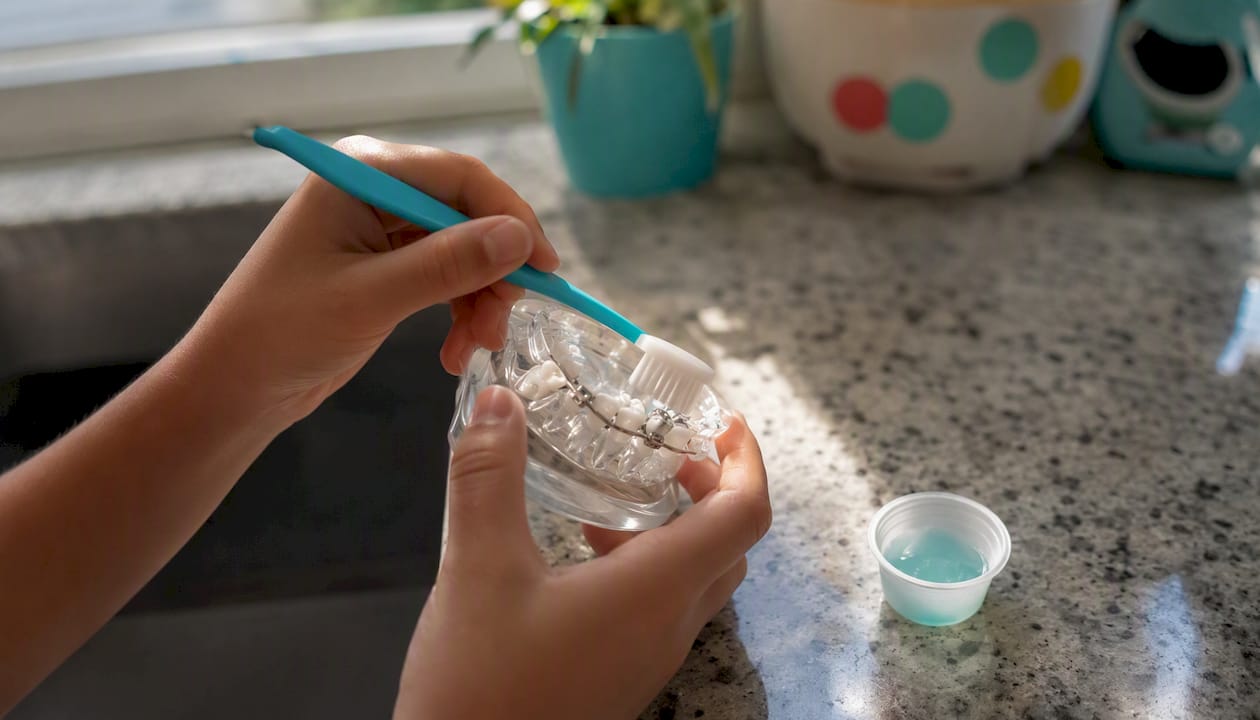
Pro Tip: Take a photo of the appliance right after it is placed. If it ever looks different or your child says something feels off, that photo gives the dentist an immediate before-and-after comparison.
How long does a space maintainer stay in?
The short answer: until the permanent tooth is ready to erupt into the space, or until the dentist determines it is no longer needed. There is no fixed calendar date. Duration depends entirely on the child’s individual eruption timeline, which varies considerably.
The duration a child needs to wear a space maintainer varies widely, depending on the child’s individual eruption timeline and the tooth lost. Periodic X-rays track root development of the permanent tooth; when the root is roughly two-thirds formed and the tooth is close to the gumline, removal is usually appropriate.
Removal of a fixed maintainer is straightforward and painless. The dentist uses a band-removing instrument to crack the cement seal, lifts the band off the anchor tooth, and checks the space and adjacent teeth. No anesthesia is needed. The dentist will also confirm on X-ray that the permanent tooth is erupting on the correct path before declaring the case complete.
Cost and insurance coverage
Fixed space maintainers typically have a variable cost depending on the appliance type and complexity, with bilateral designs generally costing more than unilateral ones. Removable appliances can cost more because of the lab work involved in fabricating the acrylic component. Costs vary by region, the specific appliance type, and whether any recementation visits are needed down the line.
Insurance coverage is inconsistent. A small number of plans exclude them entirely.
Questions to ask your insurer and dental office before the appointment:
- Is a pre-authorization required, and how long does it take?
- What percentage does the plan cover, and does it apply to both the appliance and the lab fee separately?
- Is recementation covered if the band comes loose?
- Is there an age limit or a per-tooth limit on space maintainer benefits?
- Does the plan require a waiting period for this type of appliance?
Getting a written benefits breakdown before the appointment prevents billing surprises. The dental office’s front desk can usually submit a pre-authorization request on your behalf.
What authoritative guidelines and reviews say
The AAPD’s clinical guidance is the professional standard in the United States for pediatric dental decisions. Its position on space maintenance is clear: these appliances are designed to prevent loss of arch length, width, and perimeter after premature primary tooth loss, and the decision to place one is made case by case.
The NCBI clinical review reaches a more cautious conclusion: space maintainers reliably prevent arch length loss in the short term, but the evidence for long-term reduction in malocclusion severity is mixed. In plain terms, a maintainer reduces the risk of certain problems but does not guarantee your child will avoid braces later. Effectiveness depends heavily on appliance selection, hygiene, and consistent follow-up, per AAPD clinical guidance.
How dentists decide, and questions to ask at the appointment
The clinical decision follows a short framework: which tooth was lost, how far away the permanent successor is, the child’s current dental age and occlusion, existing crowding, oral hygiene level, and the child’s ability to cooperate with an appliance. A child with excellent hygiene and a permanent tooth close to erupting may be monitored without a maintainer. A younger child with poor hygiene and years to wait almost always needs a fixed device.
Questions to bring to the appointment:
- Did you take an X-ray to check the permanent tooth’s position before recommending this?
- Which specific appliance are you recommending, and why that design over the alternatives?
- How long do you expect my child to need it?
- What are the risks if we choose not to place one?
- How often will we need follow-up visits?
- What foods should my child avoid?
- How will we know when it is time to remove it?
- What happens if the band comes loose between appointments?
- Who do I call for an after-hours repair or emergency?
- What is the total cost, and what does insurance typically cover for this?
Red flags that warrant a second opinion: A dentist who recommends a maintainer without taking an X-ray first, or who cannot explain which permanent tooth the appliance is preserving space for, or who offers no follow-up plan. A tooth extraction followed by zero discussion of space maintenance is also worth questioning, especially for a child under age 10.
An honest take on space maintainers and follow-up care
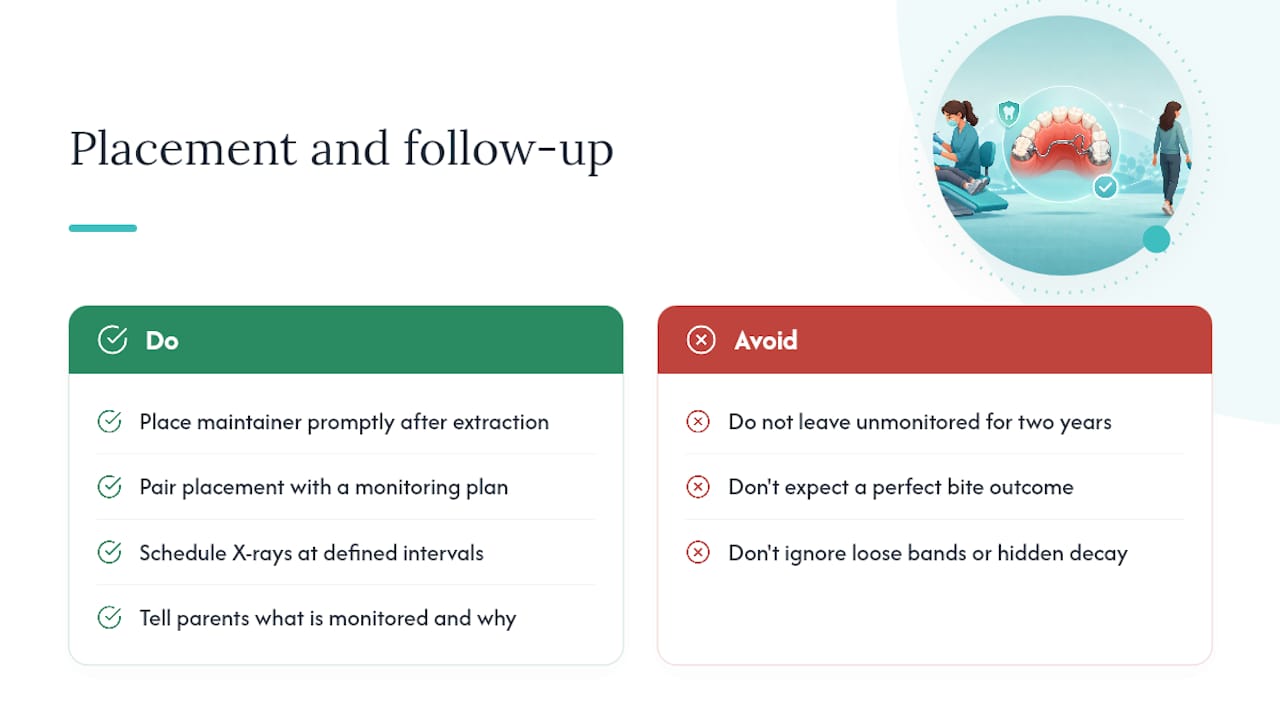
Space maintainers are one of the most underused preventive tools in pediatric dentistry, and the reason is almost always the same: parents were not told about them quickly enough after an extraction or traumatic loss. The window matters. Once adjacent teeth have drifted, a maintainer cannot reopen the space; it can only hold what remains.
What the guidelines do not say loudly enough is that the appliance is only half the intervention. The follow-up schedule is the other half. A maintainer that is placed and then not monitored for two years can cause the very problem it was meant to prevent, blocking an erupting permanent tooth or harboring decay under a loose band. At Southlittletonfamilydental, the approach is to pair every appliance placement with a clear monitoring plan, including X-rays at defined intervals, so parents know exactly what is being watched and why.
The other thing worth saying plainly: a space maintainer does not guarantee a perfect bite. The NCBI review’s mixed evidence on long-term malocclusion outcomes is real. Think of it as reducing the severity and cost of future orthodontic treatment, not eliminating the possibility of it. That framing helps parents make a realistic, informed decision rather than expecting a single appliance to solve everything.
Southlittletonfamilydental is ready to evaluate your child’s smile
Losing a baby tooth early is stressful, and the next step should not be a guessing game. At Southlittletonfamilydental in Littleton, CO, the team provides pediatric dental evaluations, digital imaging, and both fixed and removable appliance options when a maintainer is clinically indicated. Same-day emergency exams are available for urgent situations, including a dislodged appliance or a tooth lost unexpectedly.

To schedule, bring any previous X-rays your child has had, and let the front desk know the reason for the visit so the right imaging can be prepared in advance. New patients can take advantage of the cleaning, exam, and X-ray offer to get a full diagnostic picture before any treatment decision is made. For after-hours concerns or a loose band, the emergency dental line connects you directly to the practice. Book online or call the Littleton office to get started.
Sources
- AAPD: Management of the developing dentition and occlusion in pediatric dentistry (oral health policies & recommendations)
- Dental Space Maintainers for the Management of Premature Loss of Deciduous Molars: review (NCBI Bookshelf)
- Space Maintainers Redefined: Contemporary Modifications and Trend (Dental Journal of Advance Studies, 2025)
This article provides general information for educational purposes and is not a substitute for professional dental advice. Consult a licensed dentist to determine whether a space maintainer is appropriate for your child’s specific situation.