
Porcelain veneers typically take 2 to 3 weeks from tooth preparation to final bonding, while composite veneers are often finished in a single visit lasting 30 to 60 minutes per tooth. The biggest swing factors are whether you need pretreatment for decay or gum disease, how many teeth you’re restoring, your dentist’s lab turnaround, and whether bruxism needs to be addressed first.
TL;DR:
- A thorough initial consultation is crucial to address oral health issues like decay or gum disease first, which can delay veneer placement if untreated.
- Digital scans and in-house labs can reduce overall treatment time, but skipping preparatory steps for speed can compromise the longevity and effectiveness of veneers.
- Porcelain veneers offer about a 95% survival rate at 10 years when bonded to healthy enamel, whereas composite veneers usually last between 3 and 10 years, depending on care.
- Prioritize a detailed consultation to confirm your candidacy and avoid rushing into veneer procedures before addressing underlying dental issues.
Table of Contents
- Initial consultation and candidacy check
- Treatment planning and smile design: mock-ups and shade selection
- Porcelain veneers: step-by-step timeline and realistic time windows
- Composite and prefabricated resin veneers: single visit options and timeline trade-offs
- Placement day: what happens during bonding and how long it takes
- Aftercare and recovery: the first 48 hours and getting back to normal
- Longevity, maintenance, and when veneers need repair or replacement
- Insurance, cost timing, and scheduling tips to shorten the calendar
- How a modern practice organizes the veneer timeline
- What the timeline advice usually gets wrong
- Next steps: booking a veneer consultation
- Sources
- FAQ
Initial consultation and candidacy check
The first appointment is where your dentist decides whether you’re ready for veneers right now or need some groundwork first. A thorough consultation includes a visual exam, X-rays, a periodontal check, bite analysis, photographs, and a conversation about what you want your smile to look like. This visit sets the tone for everything that follows.
Not every mouth is ready for veneers on day one. Untreated cavities, active gum disease, or significant teeth grinding can all delay the process because they need to be resolved first, sometimes through restorative dentistry like fillings or periodontal therapy. The American Dental Association’s patient guidance is direct on this point: cosmetic work should wait until underlying oral health issues are treated, and veneers are generally considered cosmetic rather than medically necessary in most cases.
What typically happens at this visit:
- A full oral exam and X-rays to rule out decay or infection.
- A periodontal check to confirm your gums are healthy enough for bonding.
- A bite and bruxism assessment, since grinding can shorten a veneer’s life before it even goes in.
- Photographs and a discussion of your goals, which shape the smile design later.
If your teeth and gums are healthy, your dentist can often give you a realistic calendar right at this visit. If not, expect a staged plan: treat the underlying issue first, then move to veneers once things have settled.
Pro Tip: Bring any recent dental records or X-rays to your consultation. It can save you a repeat set of images and shave days off your timeline.
Treatment planning and smile design: mock-ups and shade selection
Once you’re cleared for veneers, the next phase is planning what they’ll actually look like. This usually means intraoral scans or physical impressions, updated photographs, and bite records that give your dentist a precise map of your mouth. Shade selection also happens here, matching the veneer color to either your natural teeth or a brighter target shade you’ve discussed.
Many practices offer a digital mock-up or a wax-up trial veneer before committing to the final design. This extra step adds a short appointment, but it lets you see and even feel a preview of the result before any enamel is removed, which helps avoid costly redos later. Skipping this step to save time can backfire if the final shape or shade doesn’t match expectations.
Records and steps typically involved at this stage:
- Digital intraoral scans or traditional impressions of your teeth.
- Photographs and shade matching against a guide or your desired result.
- A wax-up or digital mock-up to preview the design before preparation begins.
- Bite records to confirm the veneers won’t interfere with your natural chewing pattern.
Whether your dentist uses a digital workflow or traditional impressions matters for your calendar. Digital scans generally transmit to the lab faster and reduce the odds of a remake, which can shorten total treatment time when paired with an efficient lab. Traditional impressions still work well but tend to add a day or two to the front end of the process.
Porcelain veneers: step-by-step timeline and realistic time windows
Porcelain veneers follow a predictable sequence, and knowing the expected duration of each step helps you plan time off work or social events around it.
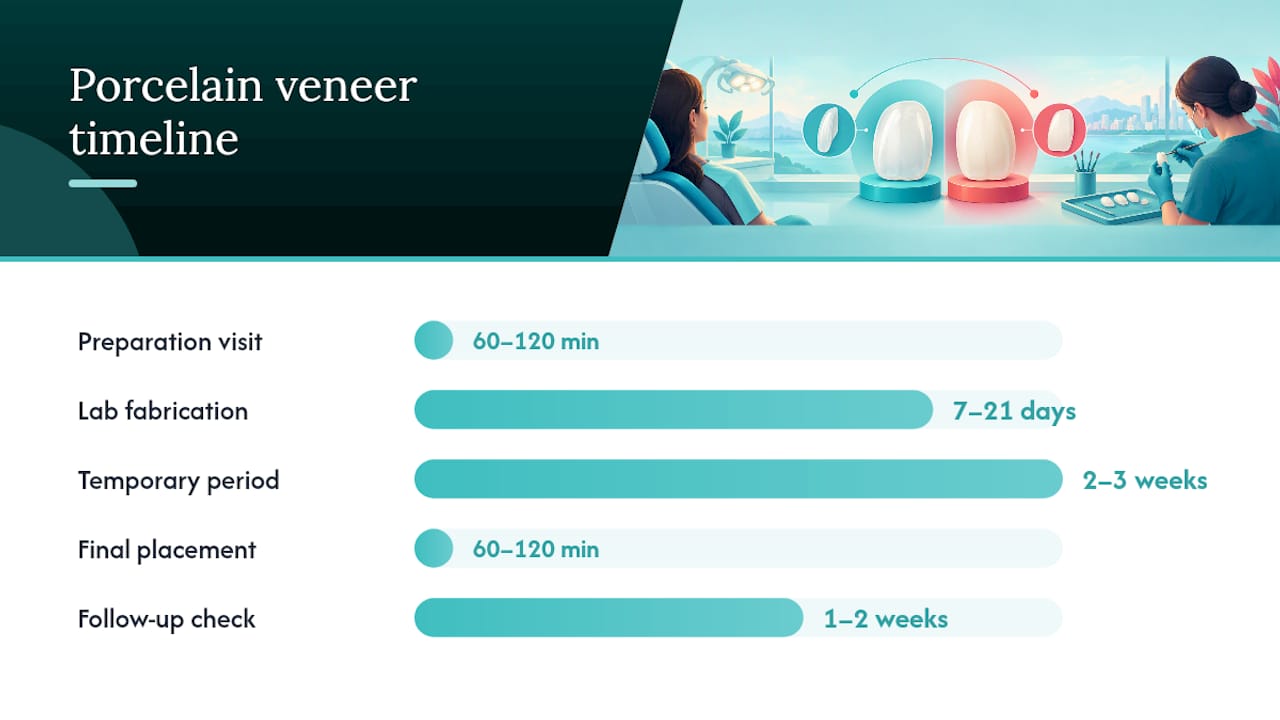
- Preparation visit (60 to 120 minutes): Your dentist removes a thin layer of enamel, takes final impressions or scans, and may place temporary veneers while you wait for the permanent ones.
- Lab fabrication (typically 7 to 21 days): A dental lab crafts your custom porcelain veneers. Complex shading, characterization, or a larger number of teeth can push this toward the longer end of the range.
- Temporary veneer period (usually 2 to 3 weeks): Temporaries protect the prepared teeth and give you a preview of your new smile shape while the lab finishes the permanent restorations.
- Final placement visit (60 to 120 minutes): Your dentist checks the fit and color, makes small adjustments, and bonds the veneers permanently.
Cleveland Clinic’s patient guidance describes this as two separate appointments spaced weeks apart, with the lab work happening in between and temporaries used to bridge the gap. That structure is standard across most practices offering porcelain veneers.
A systematic review of porcelain laminate veneers found a cumulative survival rate of about 95% at 10 years when the veneers are properly bonded to enamel, according to a review published in PMC. That durability is part of why the extra weeks of lab time are worth it for most patients.
After final placement, plan for a follow-up appointment 1 to 2 weeks later so your dentist can check your bite and confirm there’s no lingering sensitivity. This short check-in catches minor issues before they become bigger ones.
Composite and prefabricated resin veneers: single visit options and timeline trade-offs
If a multi-week timeline doesn’t fit your schedule, composite veneers offer a faster path, though with some trade-offs in longevity and finish.
- Direct composite veneers are sculpted onto your teeth chairside, typically in 30 to 60 minutes per tooth, making them a good fit for small corrections or a tighter budget.
- Direct-indirect composite technique is a hybrid approach: the composite is shaped in your mouth, removed briefly for extraoral heat tempering to improve its strength, then bonded back in the same visit. Clinical literature describes this as a useful compromise between speed and material performance.
- Prefabricated resin veneers (PCRVs) can be delivered in a single visit with immediate esthetic results, but a case report on PCRVs notes that published follow-up periods are short, and the surface polish may need touch-ups sooner than porcelain would.
The common thread across all three composite options is speed. You walk in and walk out the same day with a finished result, but you’re trading some of porcelain’s proven long-term durability for that convenience. For patients who want a quick cosmetic fix or a temporary solution before committing to porcelain later, composite is often the more practical starting point.
Placement day: what happens during bonding and how long it takes
The bonding appointment, whether for porcelain or composite, follows a consistent sequence designed to maximize how well the veneer holds up over time.
- Try-in: Your dentist places the veneer without cement first, checking color, fit, and how it sits against your gum line.
- Etching and adhesive: The tooth surface is etched to create a rougher bonding surface, then coated with a dental adhesive.
- Cementation: Resin cement is applied to the veneer, which is then seated onto the tooth.
- Excess removal and curing: Extra cement is cleaned away before a curing light hardens the bond in seconds.
- Bite check: Your dentist checks how your teeth meet and files down any high spots so your bite feels natural.
Each of these steps matters for longevity. A veneer bonded to enamel rather than dentin holds up significantly better over time, which is one reason your dentist is careful about where the preparation margins fall.
Most placement visits run 60 to 120 minutes depending on how many teeth are involved. You’ll likely still feel some numbness from local anesthesia right after, and your dentist will usually schedule a brief follow-up within a week or two to fine-tune your bite once the numbness has fully worn off and you can feel how things line up naturally.
Pro Tip: If your bite feels even slightly off after the numbness wears off, call your dentist. A five-minute adjustment now prevents chipping or discomfort later.
Aftercare and recovery: the first 48 hours and getting back to normal
The first day after your veneers are placed is mostly about waiting out the anesthesia and being gentle with your new teeth. Numbness typically fades within a few hours, and most dentists recommend sticking to soft foods until then to avoid accidentally biting your cheek or tongue.
Most patients resume normal activities the same day once anesthesia wears off, and there’s no real downtime associated with veneer placement, according to Cleveland Clinic’s patient guidance. That said, it’s smart to avoid very hard or sticky foods for the first day or two while you get used to the new surfaces and any minor bite adjustments settle in.
Watch for these signs and call your dentist if you notice them:
- A veneer that feels loose or shifts when you bite down.
- Sharp or persistent sensitivity that doesn’t fade after a few days.
- A bite that still feels uneven or causes discomfort when chewing.
Most people are back to eating normally within a few days of any final adjustment, and the transition is usually smoother than patients expect going in.
Longevity, maintenance, and when veneers need repair or replacement
How long your veneers last depends heavily on the material and how well you take care of them.
- Porcelain veneers show a cumulative survival rate of roughly 95% at 10 years when properly bonded to enamel, with fracture and debonding being the most common, though uncommon, complications.
- Composite veneers generally have shorter lifespans, often ranging from 3 to 10 or more years depending on the technique and how well they’re maintained.
- Cleveland Clinic notes that veneers overall commonly last between 5 and 15 years before replacement becomes necessary.
- Bruxism, weak enamel bonding, physical trauma, poor oral hygiene, and a highly acidic diet can all shorten that lifespan considerably.
Keeping up with routine cleanings and avoiding habits like ice chewing or using your teeth as tools goes a long way toward getting the most out of either material.
Insurance, cost timing, and scheduling tips to shorten the calendar
Dental insurance rarely covers veneers, since the ADA classifies them as a cosmetic treatment in most cases rather than a medical necessity. Some plans make exceptions when a documented medical need exists, such as repairing damage from trauma, so it’s worth asking your provider directly. Patients on Medicare or other senior-focused plans should check their specific dental, vision, and hearing coverage options, since cosmetic exclusions are common there too.
The single biggest cause of a longer timeline is pretreatment: filling cavities, treating gum disease, or addressing bite issues before veneers can even begin. Combining these appointments whenever it’s clinically safe to do so is the most reliable way to compress your overall schedule.
A few practical ways to keep your calendar tight:
- Ask whether your dentist uses digital scanning instead of traditional impressions, since it often speeds up lab turnaround.
- Ask about in-house or expedited lab partnerships that can shave days off fabrication time.
- Try to consolidate any needed pretreatment into a single preparatory phase rather than spacing it across multiple visits.
How a modern practice organizes the veneer timeline
Veneer candidates move through consultation, imaging, and smile design before any enamel is touched, with same-day emergency care available if something unexpected comes up along the way. Individualized care plans mean provisional care, lab coordination, and final bonding are scheduled around actual needs rather than a one-size-fits-all calendar. That structure is what makes a realistic timeline possible from the first visit.
What the timeline advice usually gets wrong
Most articles on this topic treat the porcelain-versus-composite choice as purely a speed question, and that framing misses the real trade-off. The faster option isn’t automatically the better one, and the slower option isn’t automatically the safer one either. What actually determines your outcome is whether the pretreatment phase gets skipped.
Patients who rush past the consultation, whether chasing a quick composite fix or an expedited porcelain lab turnaround, are the ones most likely to end up with a veneer bonded over a problem that should have been treated first. The ADA’s own caution about unlicensed veneer providers exists for exactly this reason: speed sold as a feature, with diagnosis treated as optional.
If you take one thing from this walkthrough, let it be this: the consultation is not a formality you get through before the “real” treatment starts. It’s the step that determines whether your timeline holds up, and whether your veneers do too.
— Admin
Next steps: booking a veneer consultation
Getting an accurate timeline for your own veneers starts with a consultation, not a guess based on averages. At South Littleton Family Dental, that first visit covers your candidacy, a digital mock-up if you want to preview your smile, and a realistic calendar based on your specific teeth rather than a generic estimate.

Bring any recent photographs of your smile and prior dental records if you have them. It helps your dentist build a plan faster and avoid repeating steps you’ve already done elsewhere.
A few things worth asking about during your visit:
- Whether a digital workflow or an expedited lab option could shorten your particular timeline.
- Whether porcelain or a composite approach fits your goals and budget better.
- Whether same-day emergency care applies if you’re dealing with a broken or chipped tooth right now.
If cosmetic work isn’t your only concern, the practice also handles general dentistry and restorative care, so any pretreatment your veneers need can often be scheduled under one roof.
Sources
For readers who want to verify the clinical details in this article, the systematic review on porcelain veneer survival, the ADA’s patient guidance on veneers, and Cleveland Clinic’s procedural overview cover the timelines and evidence referenced throughout.
This article is general information, not a substitute for advice from a qualified doctor. Consult a qualified healthcare professional about your own circumstances before acting on anything here.
- Porcelain laminate veneer survival systematic review / PMC7961608
- Veneers | MouthHealthy (American Dental Association)
- Prefabricated resin veneer: case report / PMC6076878
- Dental veneers procedural overview | Cleveland Clinic
FAQ
What is the 4-8-10 rule for veneers?
Definitions of this rule vary across dental marketing sources and it isn’t a formal clinical standard from the ADA or major dental organizations. Some practices use it informally to describe rough enamel reduction depths in millimeters, but you should ask your own dentist how they plan your specific preparation rather than relying on a general rule.
Can I bite into an apple with veneers?
Porcelain veneers are strong enough for normal biting once fully bonded and adjusted, and most patients return to regular eating within days of their final appointment. Very hard foods still carry some risk of chipping over the years, so many dentists recommend cutting harder foods rather than biting directly into them when possible.
Can you go back to normal teeth after porcelain veneers?
Porcelain veneers require removing a thin layer of enamel, and enamel doesn’t grow back, so the process is generally not reversible. If a veneer is removed later, the tooth typically needs a replacement veneer, crown, or another restoration to protect the prepared surface underneath.
What do people wish they knew before getting veneers?
Many patients underestimate how much the pretreatment phase, like fixing cavities or gum disease first, can extend the overall timeline compared with what they expected going in. It also helps to know that porcelain veneers show strong long-term survival at around 95% at 10 years when properly bonded, which is worth factoring in against the faster but shorter-lived composite option.