

For most adults and children, a routine dental exam every six months is the standard answer, and it is a sound starting point. But the research behind that number is thinner than most people assume, and the better question is how often you need to go. That depends on your gum health, your cavity history, your medications, your health conditions and your age. Below we explain what the evidence says, what raises or lowers your risk, and how to build a schedule you can actually keep.
TL;DR
- Major health references say most adults and children should have an exam about every six months, and some people need to go more often.
- Large trials and reviews found little to no difference in oral health between six-month visits and visits set by individual risk, so a personalized interval makes sense for adults.
- Gum disease, frequent cavities, dry-mouth medicines, smoking, pregnancy and conditions such as diabetes can all mean more frequent visits.
- Swollen or bleeding gums, tooth pain or any new mouth discomfort should not wait for your next scheduled checkup.
- Ask your dentist to name your interval and the reason for it at the end of every visit.
Table of Contents
- The short answer: every six months, unless your mouth says otherwise
- What the research actually shows
- Is a cleaning needed every six months too?
- Who should go more often
- Checkup frequency for kids
- What happens at a checkup, and why it matters for timing
- Signs you should not wait for the next checkup
- Insurance, cost and the cost of waiting
- A simple way to set your own schedule
- Our perspective: personalized, not automatic
- Ready to find your interval?
- FAQ
- Sources
The short answer: every six months, unless your mouth says otherwise
The rule you have heard all your life is real. MedlinePlus, the National Library of Medicine’s health information site, says most adults and children should have a routine dental exam every six months, and that some people may need exams more often. That is where most practices begin, and it is where we begin with new patients too.
The key phrase is “some people may need more.” Six months is a default, not a law of nature. It works as a safe, easy-to-remember interval for the average mouth. Your mouth may not be average. A person with a long history of cavities and a person who has never had one are not the same patient, and a good dentist will not treat them the same way.
Here is a quick way to think about it:
| Your situation | Typical starting point |
|---|---|
| Healthy gums, few or no cavities, good home care | Every six months is the common default; your dentist may stretch it if your risk is low |
| Gum disease, frequent cavities, or a family history of oral problems | More often than every six months, as your dentist advises |
| Smoking, pregnancy, dry-mouth medicines | More often, as your dentist advises |
| Diabetes, heart disease, HIV, osteoporosis or an immune-system condition | More often, as your dentist advises |
| Baby with a first tooth | First visit by the first birthday, then usually every six months |
The rows come from the MedlinePlus guidance on who may need more frequent exams. Your own interval should come from your dentist after an exam, not from a table.
What the research actually shows
If you read about dental checkup frequency for long, you will run into a surprise: the six-month figure has little hard evidence behind it. That does not mean checkups are pointless. It means the exact spacing is less settled than the confident advice suggests.
Six months versus a risk-based schedule
The INTERVAL randomized trial, run in UK primary-care dental practices, followed adults for four years. It found no evidence of a difference in oral health between people recalled every six months and people recalled on a risk-based schedule. Adults judged suitable for a 24-month interval also showed no evidence of a difference compared with the other two groups.
The 2020 Cochrane review reached a similar conclusion. Over four years, it found little to no difference in adults between six-monthly and risk-based checkups for cavities, gum disease or quality of life. It also found moderate- to high-certainty evidence of little to no difference between 24-monthly and six-monthly or risk-based checkups for cavities, gum bleeding and oral-health-related quality of life.
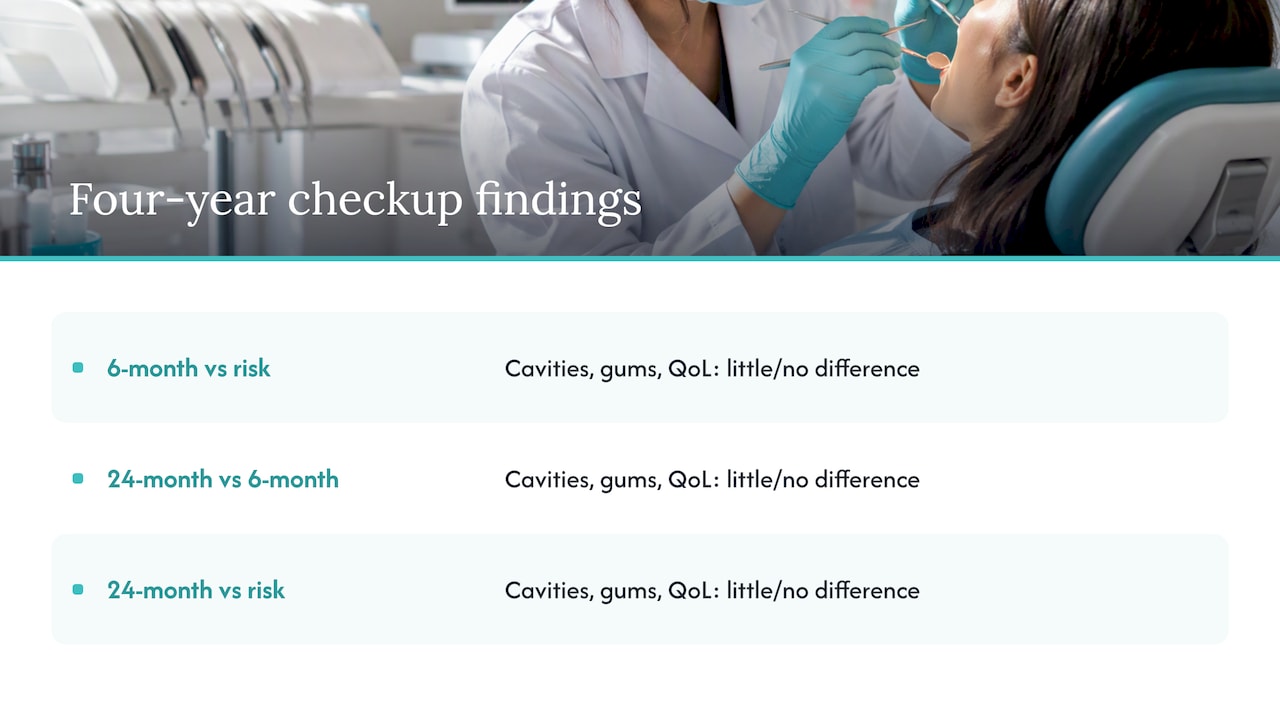
A 2023 scoping review covering studies from 2008 to April 2023 called the evidence for any fixed, universal visit frequency weak overall. Its authors recommend tailored, risk-based recommendations for adults rather than one interval for everybody.
What the evidence does not tell us
These findings come with limits that matter to you as a patient.
- The participants were adults who already attended a dentist regularly and who were screened for suitability. They tell us little about people with severe gum disease or those who skip care for years.
- The INTERVAL trial was run in the UK, where dental systems and routines differ from those in the US.
- The INTERVAL investigators noted that the preferred strategy depends partly on how costs and patient-valued benefits are weighed, even though measured oral-health outcomes did not differ materially.
- For children and adolescents, the 2023 review found the evidence insufficient and uncertain, and called for better randomized and cohort studies. That is a reason to be conservative with kids, not a reason to skip visits.
- The U.S. Preventive Services Task Force, in its 2023 recommendation, said the evidence is insufficient to assess the benefits and harms of routine oral-health screening by primary-care clinicians in adults without symptoms. That statement is about screening in a primary-care setting, not about whether you should see a dentist.
The fair reading: nobody has proven that six months is better than a well-chosen alternative, and nobody has proven that going less often is safe for everyone. What the evidence supports is matching the interval to the person.
Is a cleaning needed every six months too?
A checkup and a cleaning are related but not identical. MedlinePlus describes a dental exam as part of a checkup that usually includes a cleaning, an examination of your teeth and mouth, and sometimes X-rays. A professional cleaning is scaling and polishing. If the exam finds a problem, treatment may need a separate appointment.
On cleaning spacing, MedlinePlus says many dentists recommend a professional cleaning every six months, and that visits every three to four months may be needed when the gums become unhealthy. That is the practical split: healthy gums, a longer or standard interval; unhealthy gums, a shorter one.
The 2023 scoping review also looked at adults who attend routinely and do not have severe periodontitis. Over two to three years, it found little or no difference in gingivitis, probing depths or quality of life between having scaling and polishing at 6 or 12 months and having none scheduled. In plain terms, for a person with healthy gums, a cleaning on a rigid six-month clock may not change much. For someone with gum disease, the story is different, and that is where you want the shorter interval and professional attention.
There is one more point that gets lost. The American Dental Association notes that home care is essential for keeping cavity and gum disease risk down. Someone visiting twice a year spends about two hours a year in the dental chair, compared with roughly 30 hours a year brushing and cleaning between teeth. The dental visit finds problems and removes what home care cannot. Your daily routine does most of the work in between.
Who should go more often
MedlinePlus lists the situations where more frequent exams may be appropriate:
- Gum disease
- Frequent cavities
- A family history of oral-health problems
- Medicines that cause dry mouth
- Smoking
- Pregnancy
- Diabetes
- Heart disease
- HIV
- Osteoporosis
- Immune-system conditions
Why do these matter? Saliva protects teeth, so a dry mouth raises cavity risk. Gum disease and conditions like diabetes tend to affect each other. Smoking changes how gums heal and respond to infection. Pregnancy can change gum behavior. You do not need to understand every mechanism. You need to tell your dentist your full health history and medication list at every visit, because that information drives the interval.
If you fit one of these groups, ask directly: “Given my history, what interval do you recommend, and what are you watching for?” A clear answer is a sign of a practice that individualizes care.
Checkup frequency for kids
Children get their own rhythm. MedlinePlus says a baby should have a first dental appointment within six months after the first tooth comes in, or by the first birthday, and that babies are usually checked every six months afterward. For most kids, that six-month pattern continues through childhood.
The research here is honest about its gaps: the best interval for children and adolescents is still uncertain, with calls for better studies. Meanwhile, kids change quickly. New teeth erupt, baby teeth loosen, and cavities can move fast in thin enamel. A regular visit lets a dentist catch early decay, apply fluoride or sealants when appropriate, and help a child get used to the chair before anything hurts.
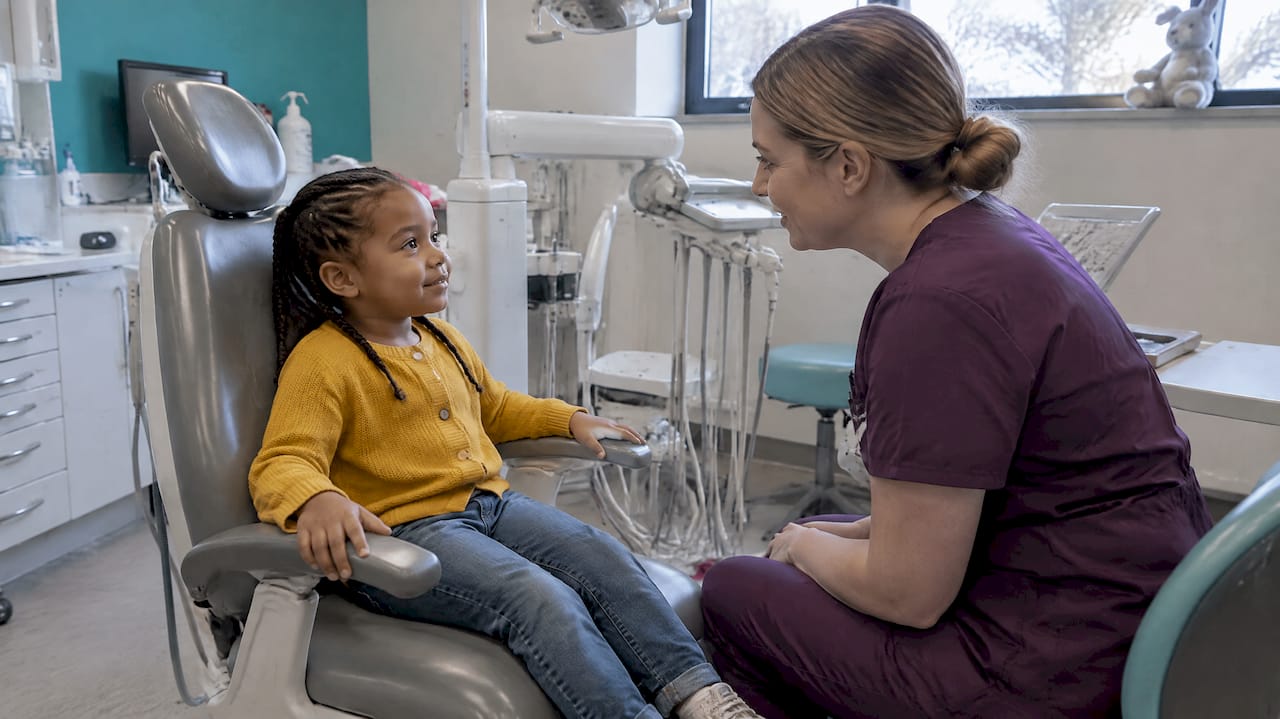
That last part matters most for anxious or sensory-sensitive children. If your child is autistic or easily overwhelmed by new places, preparing ahead helps. This guide to dental social stories for kids explains how to start preparing a couple of weeks before the appointment and how to share the plan with the dental team.
A few habits make the first visits easier:
- Book the first visit as a short, friendly introduction rather than waiting for a problem.
- Pick a time of day when your child is rested and fed.
- Describe what will happen in simple, neutral words. Avoid words like “hurt” or “shot.”
- Tell the office about any worries in advance so the team can plan.
- Keep brushing basics right. Our guide on how much toothpaste your child should use breaks down amounts by age.
If you are choosing a practice for the whole household, our list of family dentist benefits busy parents can check covers what to look for.
What happens at a checkup, and why it matters for timing
Knowing what a visit includes helps you judge whether you need one now. A typical checkup includes:
- A look at your teeth and gums. The dentist checks for cavities, worn or cracked teeth, old fillings that are failing, and signs of gum disease.
- A check of the soft tissues. This includes the tongue, cheeks, floor of the mouth and throat. At our office this is where an oral cancer screening fits in.
- A cleaning. Scaling removes hardened plaque (tartar) that brushing cannot, and polishing smooths the surface.
- X-rays, sometimes. Not every visit needs them. How often depends on your risk and your history. We cover the topic in our post on how often dental X-rays are really needed.
- A plan. Findings, a recommended interval and any treatment you need.
Much of the value is in the last item. A checkup that ends with “see you in six months” and no explanation is a missed chance. You should leave knowing whether your gums are stable, whether any tooth is being watched, and why your next visit is when it is.
If you are due for a general exam and cleaning, our general dentistry team handles exams, cleanings, X-rays, fillings, crowns and sealants for patients of all ages.
Signs you should not wait for the next checkup
A schedule is for a healthy mouth. Symptoms override it. MedlinePlus advises contacting a dentist promptly instead of waiting for the next routine visit if you notice:
- Swollen gums
- Dark red gums
- Bleeding gums
- Tooth pain
- Any other discomfort in your mouth
A few real-world examples:
- A tooth that hurts when you bite or drink something cold. This can mean a cavity or a crack, and waiting often turns a small filling into a root canal.
- Gums that bleed every time you floss. This is common, and it is usually a sign of inflammation, not a reason to stop flossing. Get it checked.
- Upper back-tooth pain with a stuffy nose. Sinus pressure can mimic a toothache. Our guide to sinus tooth pain and when to see a dentist walks through three checks.
- A tooth that has become loose as an adult. That is urgent. See our steps for a loose adult tooth.
- A broken or knocked-out tooth, or swelling with fever. Call right away.
For sudden pain, a chipped tooth or a lost filling, our emergency dentistry service offers same-day care in Littleton, so you do not have to wait for a routine slot.
Insurance, cost and the cost of waiting
Cost is a real reason people stretch their intervals. Many dental plans cover two exams and cleanings a year, which is one reason six months became the habit. Others have waiting periods before certain services are covered. If you are shopping for coverage, it is worth knowing which options let you dental plans with no waiting period start using benefits sooner, because a waiting period can push a needed visit back by months.
Two practical points:
- Check your plan’s frequency limits. Some plans cover two cleanings per year, some limit X-rays. If your dentist recommends visits every three or four months for gum health, ask how your plan treats the extra visits.
- Compare the cost of prevention with the cost of repair. A routine exam is almost always cheaper than a crown, a root canal or an extraction after a problem has grown. That is a general pattern, not a promise for any specific case.
We accept dental insurance and also offer flexible payment plans. Call the office and we will explain what your visit is likely to involve before you book.
A simple way to set your own schedule
Here is how we suggest you put all this together.
- Start at six months if you have no recent exam history, because it is the widely used default.
- Ask for a risk assessment at that first visit: gums, cavities, medications, health conditions, diet, home care.
- Get a named interval and the reason for it. Write it down or add it to your calendar before you leave.
- Shorten it if your gum health slips, you start a medication that dries your mouth, you become pregnant, or a health condition changes.
- Lengthen it only with your dentist’s agreement, and only if your risk is genuinely low.
- Keep home care non-negotiable. Brush twice a day with fluoride toothpaste and clean between your teeth daily.
- Never use the schedule as a reason to ignore symptoms.
For adults who want extra protection against cavities in back teeth, sealants for adults are worth discussing at a checkup.
Our perspective: personalized, not automatic
We have seen both extremes. Some patients come in every six months for years with nothing to treat and wonder whether the visits are worth it. Others come in only when something hurts, and by then the treatment is bigger, costlier and more stressful than it needed to be.
Our view is that the calendar should follow the patient, not the other way around. We build an individual care plan for each person, and the recall interval is part of it. A low-risk adult with steady gums may be fine at the standard interval, and we will tell you if we think you can safely wait longer. A patient with active gum disease, a heavy cavity history or a medical condition that affects the mouth may need to see us more often, and we will explain why in plain language.
We also know that many people put off visits because of anxiety or past discomfort. That is a real barrier, and it is part of why we focus on a calm, family-friendly visit and clear explanations. A short, regular, comfortable appointment beats a long emergency visit every time. And because we offer same-day emergency care, you never need to sit with a painful tooth waiting for your next scheduled slot.
— Admin
Ready to find your interval?
If you are new to the area or overdue, we welcome new patients of all ages, including children and first-time dental patients. Start with an exam and cleaning, and we will give you a clear recommendation for how often to come back. Take a look at our new patient special, or visit South Littleton Family Dental to book in Littleton, CO.
FAQ
How often should you go to the dentist?
For most adults and children, a routine exam about every six months is the standard guidance. Some people need to come in more often, including those with gum disease, frequent cavities, dry-mouth medicines, or conditions such as diabetes. Ask your dentist to set an interval based on your own risk.
Is a cleaning every six months necessary?
Not for everyone. Trials and reviews found little to no difference in outcomes for low-risk adults between six-month and risk-based schedules. But if your gums are unhealthy, cleanings every three to four months may be needed, so let an exam decide.
When should a child have a first dental visit?
By the first birthday, or within six months after the first tooth comes in. After that, babies are usually checked about every six months. Early, short visits help children get comfortable with the dentist.
Can I wait until something hurts?
We advise against it. Many problems, such as early cavities and gum disease, cause little or no pain at first. Waiting often means larger and costlier treatment. Pain, swelling or bleeding should always prompt a call to a dentist right away.
Sources
- Dental Exam: MedlinePlus Medical Test
- Dental care – adult: MedlinePlus Medical Encyclopedia
- USPSTF: Oral Health in Adults, Screening and Preventive Interventions
- Effect of Different Frequencies of Dental Visits on Dental Health (2023 scoping review)
- Risk-based, 6-monthly and 24-monthly dental check-ups for adults (INTERVAL trial)
- Cochrane: How often should you see your dentist for a check-up?
- American Dental Association: Home Oral Care