
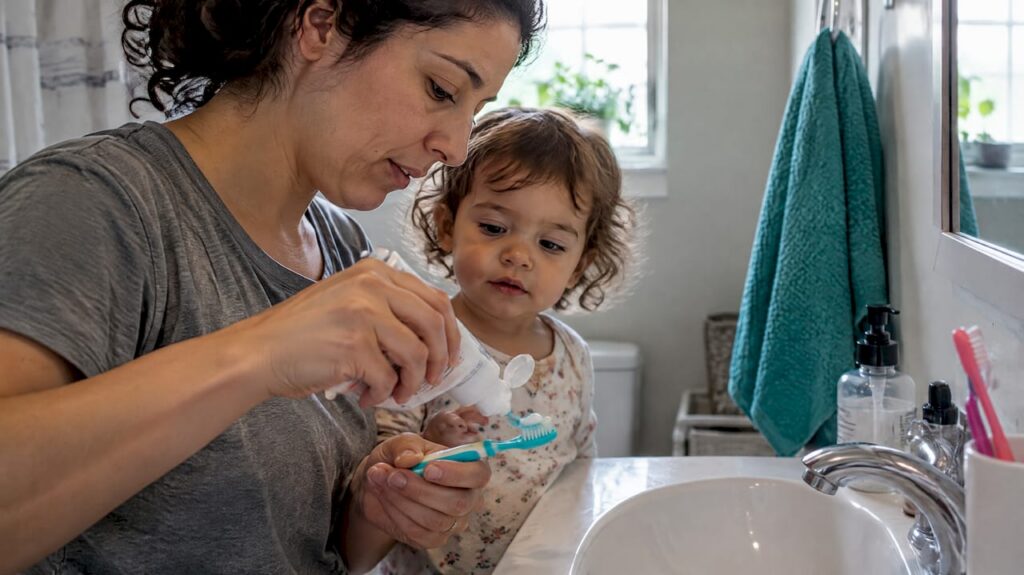
Use a smear of fluoride toothpaste about the size of a grain of rice for a child under 3, and a pea-sized amount from age 3 to 6. That is the American Dental Association’s guidance, and it applies from the moment the first tooth appears. The amounts are small on purpose. Young children swallow much of what goes on the brush, so the dose is set to protect teeth without giving a developing smile too much fluoride.
Below you will find the amounts by age, what each looks like on a brush, how to handle a child who refuses toothpaste or swallows it, and the questions we hear most from Littleton parents.
TL;DR
- Under 3 years: a smear of fluoride toothpaste, about the size of a grain of rice, starting when the first tooth erupts.
- Ages 3 to 6: a pea-sized amount, brushed twice a day.
- You dispense it. Young children cannot judge the amount, so put the toothpaste on the brush yourself and help with brushing until they have the hand control to do it well.
- Spit, don’t rinse. Encourage spitting out the excess and skip the water rinse so the fluoride stays on the enamel.
- If a child eats a lot of toothpaste, call Poison Control at 1-800-222-1222 rather than waiting for symptoms.
Table of Contents
- The right toothpaste amount by age
- When to start fluoride toothpaste
- Why the amount matters: fluorosis and swallowing
- How to brush a small child’s teeth
- Common mistakes that add up
- What to do if your child swallows toothpaste
- Our perspective: make the routine easy, not perfect
- Getting help from a dentist who works with children
- Quick answers for specific situations
- FAQ
- Sources
The right toothpaste amount by age
The ADA’s guideline on fluoride toothpaste for young children gives two amounts. A smear is roughly 0.1 g of toothpaste, which delivers about 0.1 mg of fluoride. A pea-sized amount is roughly 0.25 g, delivering about 0.25 mg.
| Age | Amount | What it looks like | How often |
|---|---|---|---|
| First tooth to age 3 | Smear | A grain of rice, spread thinly across the bristles | Twice a day |
| Ages 3 to 6 | Pea-sized | About the size of a small green pea, not a ribbon across the brush | Twice a day |
| Over 6 | Pea-sized is still a sensible habit | Children can usually spit reliably by now | Twice a day |
The twice-a-day schedule matches the CDC’s oral health tips for children, which also say to help your child brush until they can do it well on their own.
What a smear really looks like
Parents often over-apply because the toothpaste commercials show a full ribbon sitting on top of the bristles. A smear is the opposite: press the tube against the brush and drag it flat, so the paste is pressed into the bristles rather than sitting on top. If you can see a little curl or blob, it is too much for a toddler.
What a pea-sized amount really looks like
Think of a pea, not a chickpea. It should sit in the middle of the brush head and not cover the width of it. At 3 many children are still swallowing some of the paste, so the pea is a ceiling, not a target.
When to start fluoride toothpaste
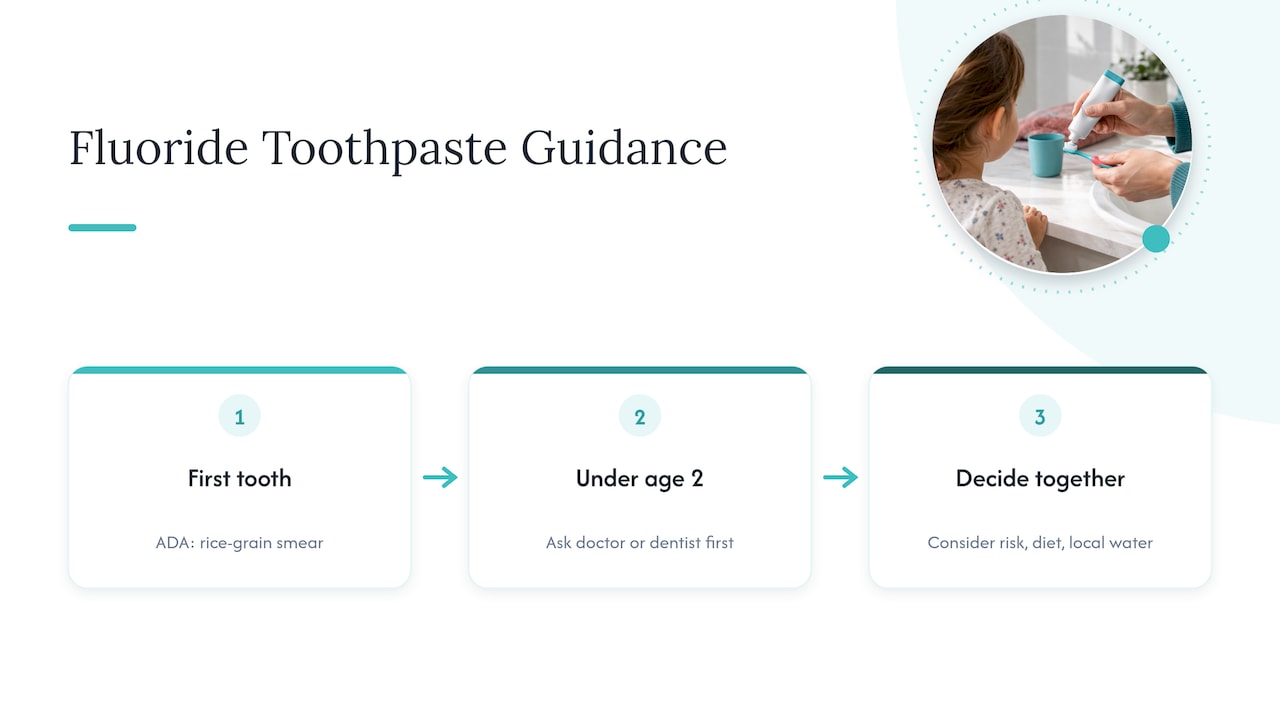
Start when the first tooth comes through the gum, usually around six months, though timing varies a lot from child to child. The ADA recommends a rice-grain smear from that first tooth. The CDC’s tips for children take a more cautious line for children under 2: talk with your doctor or dentist first about using fluoride toothpaste.
Those two positions are easy to reconcile in practice. Bring up toothpaste at your child’s first dental visit or at the well-child visit around their first birthday, and make the decision together with someone who knows your child’s cavity risk, diet and local water. If your child already has visible white spots, frequent snacking or sugary drinks at night, the case for starting early is stronger.
The reason to start early rather than wait is simple. The ADA’s chosen-wisely statements for patients say to use fluoride toothpaste for children rather than a non-fluoride product, because fluoride is what protects enamel from decay.
Do we need “training toothpaste”?
Usually not. Many toothpastes marketed for babies and toddlers contain no fluoride and are designed mainly to be safe if swallowed. Poison Control explains that the better approach is a tiny, age-appropriate amount of regular fluoride toothpaste from the first tooth. A fluoride-free paste is not harmful, it just skips the cavity protection your child needs. Before age 2 you can also simply brush with a soft, small-headed brush and a smear, or ask your dentist what they advise for your child.
Why the amount matters: fluorosis and swallowing
Fluoride works on the surface of the tooth. The risk comes from swallowing it. According to the CDC, dental fluorosis, which shows up as white spots or lines on permanent teeth, can develop when young children take in too much fluoride while those teeth are still forming under the gums. Fluorosis from toothpaste is usually mild and cosmetic, but it is preventable, and the easiest prevention is a small, correct dose.
There is also a poison-center side to the story. The CDC notes that more than 10,000 calls a year to poison centers involve children under 6 swallowing toothpaste. Most of these end with nothing worse than a mild stomach upset, but they show how common the habit is, and how sweet and fruity flavors encourage it.
That is why we tell families to treat toothpaste like a medicine: kept up high, dispensed by an adult, and used in the amount on the label.
How to brush a small child’s teeth
- Wash your hands and sit comfortably. For babies, a lap-to-lap position with the child’s head cradled works well. For toddlers, stand behind them at the mirror.
- Dispense the toothpaste yourself. Squeezing a tiny amount is a fine motor skill children rarely master. The JADA article on fluoride toothpaste for young children is behind the ADA’s recommendation that parents control the dose.
- Brush every surface. Do the outsides, the insides and the chewing surfaces with small circles, two minutes if your child will tolerate it. Work up to this; a minute of good brushing beats two minutes of struggle.
- Encourage spitting. Show them how. Don’t worry if the early attempts are drooly.
- Skip the big rinse. The AAPD’s guideline on fluoride therapy favors regimens that maximize topical contact with the teeth. Rinsing with lots of water washes away the fluoride you just applied, so spit and leave a thin film behind.
- Do the last brush at night. Nothing but water after it. Bedtime is when saliva flow drops and teeth are most vulnerable.
When can they brush on their own?
A rule of thumb that experts cite in the JADA literature: children generally need the dexterity to tie their own shoelaces before they can brush effectively alone. For most that is around age 7 or 8. Until then, let them have a turn first, then you finish. It keeps the habit theirs while the quality is yours.
Common mistakes that add up
- Loading the brush from habit. Adult-sized ribbons on a child’s brush multiply the dose several times over.
- Letting the child squeeze the tube. It turns toothpaste into a game and the dose into a guess.
- Using mouthwash too early. Poison Control relays the ADA recommendation that children younger than 6 should not use mouthwash, because they may swallow large amounts.
- Using an adult prescription paste. Prescription-strength fluoride toothpastes contain 5,000 ppm fluoride, versus 1,000 to 1,500 ppm in standard over-the-counter toothpastes, according to the ADA. Keep them out of reach, and never use a family member’s prescription paste on a child unless a dentist has said to.
- Stopping at age 6. The amount changes; the twice-daily habit does not.
What to do if your child swallows toothpaste
Stay calm. Poison Control notes that small accidental swallows of over-the-counter fluoride toothpaste are unlikely to be toxic, and the most common effect is an upset stomach, with nausea, vomiting or diarrhea. A little milk or yogurt can settle it, since calcium binds fluoride.
If you are not sure how much was eaten, if your child ate a large amount, or if the product was prescription-strength, use the Poison Control web tool or call 1-800-222-1222. The line is free and staffed around the clock, and it covers Colorado. If your child has trouble breathing, seizures or is unresponsive, call 911.
A good habit after any scare: put the tube back out of sight and reach, and make dispensing an adult-only job.
Our perspective: make the routine easy, not perfect
We see a lot of families at our Littleton office, and the pattern is consistent. Parents rarely struggle with knowing that toothpaste matters. They struggle with a squirming toddler, a strong-willed four-year-old and the guilt that comes from skipping a night.
Our view is that the right amount is the easy part. Rice grain, then pea. The harder part is building a calm routine that a child does not dread, and that is where a dental visit can help rather than add pressure. A child who has had a gentle, unhurried first visit tends to treat brushing as a normal part of the day rather than a fight. We build care plans around the individual child, including those who are anxious or sensitive to taste and texture, and we would rather spend a few extra minutes showing a parent the smear on a real brush than hand over a leaflet.
Three things we tell most parents:
- Do the same two brushing times every day, tied to something that already happens, like pajamas and breakfast.
- Let your child hold a second brush while you brush. Children copy what they see.
- Bring the toothpaste you use at home to the visit. Flavor, fluoride level and amount are easy to check in person.
If your child is nearing the age when back molars arrive, our guide to when molars come in covers what to expect, because that is when brushing gets harder and cavities more likely.
— Admin
Getting help from a dentist who works with children
A toothpaste routine is the foundation, but it does not replace professional care. Cleanings, fluoride treatments and sealants add protection that home brushing cannot, and an exam lets us spot early decay before it hurts. If you are weighing whether a family dental office suits you, 8 family dentist benefits busy parents can check is a useful checklist. If a visit includes x-rays, our page on dental x-ray safety for families explains what to ask about digital sensors.
At South Littleton Family Dental in Littleton, CO, we see children and adults, with same-day care for dental emergencies. You can read about our children’s dentistry and new patient offer or our general dentistry services, and book your child’s first visit when you are ready. If a cavity has already started, we can talk through options such as silver diamine fluoride, including consent, cost and the dark staining it leaves.
Quick answers for specific situations
My toddler hates toothpaste. Try a different flavor, or brush with only water for a few days while the routine settles, then reintroduce the smear. Consistency matters more than any single session.
My child has a rice-grain-sized amount but keeps swallowing it. That is expected and fine at this age, which is exactly why the amount is so small. Keep modeling spitting.
We use well water. Ask your dentist before relying on any assumption about fluoride in your water; the amounts vary and your dentist can advise on the right plan for your child.
My child is 5 and I’m still dispensing. Good. That is the guidance, and it is a habit worth keeping until they show reliable control.
FAQ
How much toothpaste should a 1-year-old use?
A smear about the size of a grain of rice on a soft, child-sized brush, twice a day, once teeth are present. Spread it thinly across the bristles. If you are unsure about fluoride at this age, ask your dentist or pediatrician at the first-birthday visit, since the CDC suggests checking with them first for children under 2.
When should my child switch from a smear to a pea-sized amount?
At age 3. From then until about age 6, a pea-sized amount is the ADA’s recommendation. If your child still swallows most of the toothpaste, keep the smear a little longer and ask your dentist, who can look at your child’s cavity risk.
Is fluoride toothpaste safe for kids?
When used in the recommended amount, yes. The risk comes from swallowing too much while permanent teeth are forming, which can cause mild fluorosis. That is why the amounts are small and why an adult should dispense the toothpaste and supervise.
Should my child rinse after brushing?
It is better to spit and not rinse. The fluoride protects by staying in contact with the teeth, so a big rinse of water washes some of it away. Children under 6 should also avoid mouthwash, as they may swallow it.
What if my child eats toothpaste straight from the tube?
A small amount of regular fluoride toothpaste is unlikely to cause harm beyond a stomach upset. If it was a large amount or a prescription-strength paste, call Poison Control at 1-800-222-1222 straight away and follow their advice.
Sources
- Fluoride Toothpaste for Young Children Guideline, American Dental Association
- Toothbrushes, American Dental Association
- Fluoride: Topical and Systemic Supplements, American Dental Association
- ADA Becomes First Dental Organization to Join the Choosing Wisely Campaign
- About Dental Fluorosis, CDC
- Oral Health Tips for Children, CDC
- My child ate toothpaste: What should I do, Poison Control
- Mouthwash: Swish and spit, Poison Control
- Guideline on Fluoride Therapy, AAPD
- Fluoride toothpaste use for young children, JADA