
A loose permanent tooth in an adult is never normal, and it usually points to gum disease, trauma, bruxism, or infection. If the tooth loosened after an injury, or you have swelling, fever, or heavy bleeding, get same-day care or go to the ER. If it’s been loosening gradually with no injury involved, protect it with gentle home care and book a dentist visit within a day or two.
TL;DR:
- Most adult loose teeth stem from periodontal disease, trauma, bruxism, or infection, and early detection significantly improves the chances of saving the tooth.
- Emergency situations include knocked-out teeth, spreading swelling, difficulty swallowing or breathing, or bleeding that won’t stop, requiring immediate ER or urgent dental care.
- Gradual looseness without trauma should prompt a dental visit within one or two days, as delays can lead to further bone loss and reduce treatment success.
- At home, avoid DIY fixes, use gentle rinses and soft foods, and consider a temporary stabilizer like gauze until professional help can assess and treat the issue.
- A comprehensive dental exam, mobility grading, X-rays, and periodontal assessment determine diagnosis, with treatments ranging from deep cleaning and splinting to root canals or extraction depending on severity.
Table of Contents
- What Causes a Loose Tooth in Adults, and How Do You Check for It?
- When Is a Loose Tooth an Emergency vs. a Same-Day Appointment?
- How Do You Protect a Loose Tooth at Home Until You See a Dentist?
- What Will a Dentist Check to Diagnose a Loose Tooth?
- What Treatments Fix a Loose Tooth, and How Long Do They Take?
- Can a Loose Tooth Be Saved, and How Do You Prevent It From Happening Again?
- How South Littleton Family Dental Handles a Loose Adult Tooth
- The Real Lesson Behind a Loose Adult Tooth
- Get a Same-Day Emergency Exam for a Loose Tooth
- Trusted Resources for More Detail
- Sources
- FAQ
What Causes a Loose Tooth in Adults, and How Do You Check for It?
Checking mobility yourself is fine, but do it carefully. Rinse your mouth, then use a clean fingertip (not your tongue, which exaggerates movement) to gently press the tooth from the front and back. Slight give is worth noting; if it shifts visibly or moves in more than one direction, that’s a sign to get evaluated soon.
Periodontal disease is the leading cause of a loose permanent tooth, and it’s rarely subtle once you know what to look for. Bleeding gums when you brush, a persistent bad taste or breath, gum recession that makes teeth look longer, and visible gaps forming between teeth all point toward periodontitis eating away at the bone that anchors your teeth.
Trauma is the other big driver, whether from a fall, a sports collision, or biting down wrong on something hard. Beyond that, several less obvious culprits show up often in dental chairs:
- Bruxism, or chronic teeth grinding, that loosens teeth over months without the person realizing they grind at night.
- Failed restorations or a crown sitting too high, which puts abnormal force on one tooth every time you bite.
- Endodontic infection, where an abscess at the root tip destroys supporting bone from the inside out.
- Systemic bone loss, including osteoporosis, which can thin the jawbone along with the rest of the skeleton.
- Orthodontic movement, expected with braces or aligners but worth flagging if it feels excessive.
- Pregnancy-related gum changes, driven by hormone shifts that make gums more prone to inflammation and, in some cases, mobility.
Red flags that suggest infection rather than simple mobility include a pimple-like bump on the gum, a foul taste when you press the tooth, throbbing pain that wakes you up, or swelling that spreads toward your jaw or neck.
When Is a Loose Tooth an Emergency vs. a Same-Day Appointment?
Some situations don’t wait for a Monday opening. Go to an emergency room or an emergency dentist immediately if you have:
- A tooth that’s been knocked visibly out of position or is hanging by tissue after an injury.
- Difficulty breathing or swallowing.
- Swelling that’s spreading to your face, neck, or under your jaw, especially with fever.
- Bleeding that won’t stop after 10 to 15 minutes of firm gauze pressure.
Sudden looseness accompanied by pain, a bad taste, visible pus, or a tooth that got knocked loose but stayed in the socket calls for same-day dental care, even without a full-blown emergency. For knocked-out or displaced teeth specifically, treatment within about one hour dramatically improves the odds of saving the tooth, so don’t wait it out overnight hoping it settles.
Gradual mobility with no trauma, usually from periodontal disease, is less frantic but still deserves a prompt visit rather than a “wait and see” approach. Bone loss around a tooth doesn’t reverse on its own, and every week of delay lets more of it disappear. Dentists consistently report that teeth caught early, before advanced bone loss sets in, respond far better to splinting, deep cleaning, and other conservative treatments than teeth that have been wobbling for months.
How Do You Protect a Loose Tooth at Home Until You See a Dentist?
While you’re waiting for your appointment, the goal is simple: don’t make things worse. A few habits protect the tooth without pretending to fix it.
- Rinse gently with warm salt water two to three times a day to calm inflamed gum tissue.
- Switch to a soft-food diet: eggs, yogurt, soup, mashed vegetables, nothing that requires hard biting.
- Chew on the opposite side of your mouth whenever possible.
- Brush around the tooth with a soft-bristled brush using light pressure rather than skipping it entirely.
- If the tooth feels genuinely wobbly and painful, biting gently on a folded piece of clean gauze can offer temporary stabilization until you’re seen.
What you should never do is just as important. Don’t try to wiggle it “to see how bad it is.” Don’t attempt to pull it yourself, and don’t reach for super glue, dental wax, or any homemade splint. Attempting a DIY extraction or improvised fix risks fracturing the root or introducing infection, which can turn a savable tooth into one that has to be removed.
For pain and swelling, over-the-counter ibuprofen or acetaminophen and a cold compress against the cheek usually help. Antibiotics are sometimes necessary, but only after a dentist has actually looked at the tooth and confirmed an infection; taking leftover antibiotics on your own can mask symptoms without treating the actual problem.
Pro Tip: Keep a small piece of clean gauze in your bag or car if your tooth has been loose for more than a day. Biting down on it gently for a few minutes before eating or talking can reduce the shifting that aggravates the ligament around the root.
What Will a Dentist Check to Diagnose a Loose Tooth?
Expect a fairly methodical exam, not a quick glance. Dentists grade mobility on a standard scale, usually Grade I (slight side-to-side movement), Grade II (movement up to 1 millimeter), or Grade III (movement in multiple directions, including vertically), because that grade heavily influences what treatment makes sense.
Alongside the mobility check, most visits include:
- Periodontal probing, measuring pocket depth around each tooth to see how much attachment and bone have already been lost.
- Dental X-rays, typically periapical or bitewing images, to visualize bone levels and check for abscesses at the root tip; a panoramic image or CBCT scan gets ordered when the picture is unclear or surgery is being considered.
- Pulp vitality testing, using cold or electrical stimulus to confirm whether the nerve inside the tooth is still alive.
- A visual check for a sinus tract (a small bump near the gum line) or other signs pointing to an active abscess.
None of these findings work in isolation. A dentist weighs pocket depth, the amount of bone visible on the X-ray, and the mobility grade together to decide whether the tooth responds to non-surgical periodontal therapy, needs a root canal, requires splinting, or has passed the point where extraction is the more realistic path.
What Treatments Fix a Loose Tooth, and How Long Do They Take?
Treatment tracks almost entirely to the cause, which is why the diagnostic step matters so much.
For periodontal disease, the starting point is scaling and root planing, a deep cleaning below the gumline that removes bacterial buildup on the root surface. Many patients see mobility improve within weeks once inflammation drops, though established bone loss sometimes needs surgical intervention, including flap surgery or bone and gum grafting, to rebuild lost support.
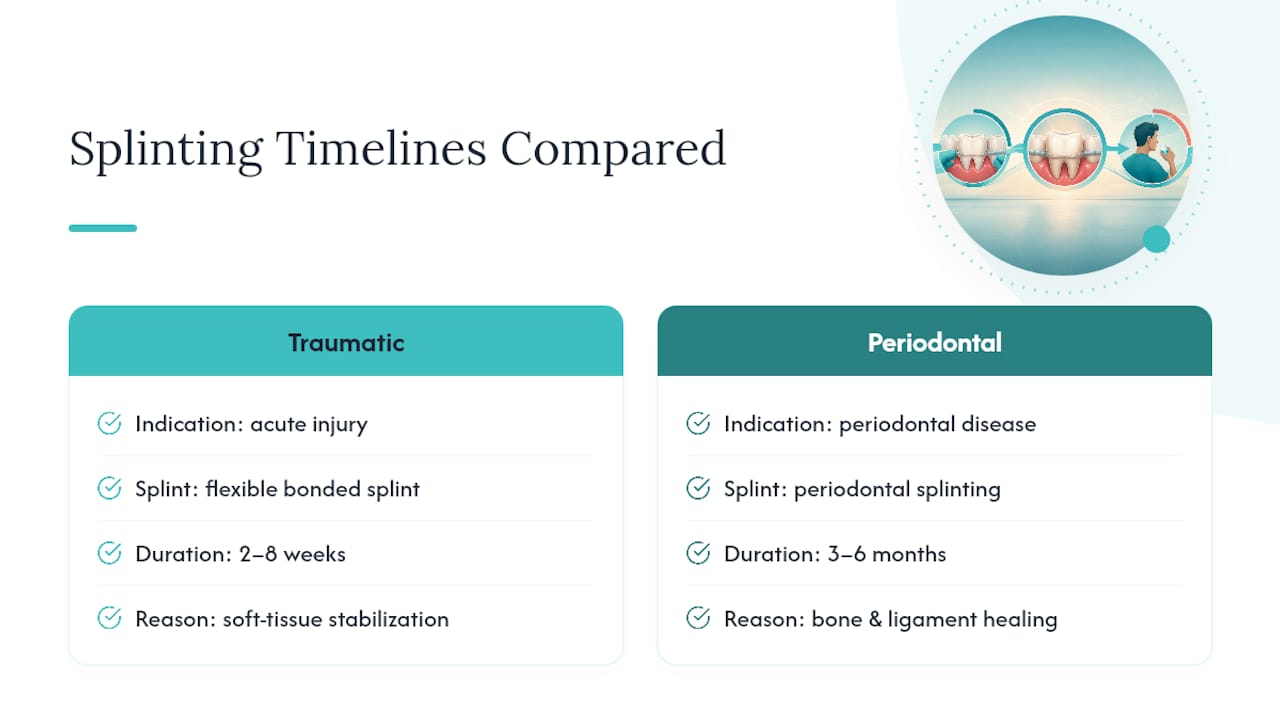
Splinting comes up for both trauma and periodontal cases, but the timelines differ substantially. A flexible splint bonding the loose tooth to its neighbors typically stays in place 2 to 8 weeks after a traumatic injury, while periodontal splinting often runs 3 to 6 months since the underlying bone and ligament need more time to stabilize.
If the pulp inside the tooth is infected or dying, root canal therapy removes the infected tissue and seals the canal, which is often what stops the bone destruction that was loosening the tooth in the first place.
Occlusal management matters more than most people expect. If a high filling or crown is taking the brunt of your bite, adjusting or replacing it can resolve mobility within days. Undiagnosed bruxism is a common hidden contributor, and a custom night guard often prevents further loosening once grinding is identified as the driver.
When the tooth has lost too much supporting bone or the infection is too advanced, extraction becomes the realistic option, followed by a replacement such as an implant, bridge, or removable partial denture. Southlittletonfamilydental’s tooth extraction and restorative dentistry services cover both the removal and what comes next. Across every one of these pathways, one pattern holds: the earlier a loose tooth gets evaluated, the more conservative and successful the treatment tends to be.
Can a Loose Tooth Be Saved, and How Do You Prevent It From Happening Again?
Prognosis hinges on four variables: how much bone is left around the root, the mobility grade at diagnosis, whether infection is present, and health factors like diabetes, osteoporosis, or smoking that slow healing. A Grade I tooth with mild bone loss and no infection has a good outlook. A Grade III tooth with heavy bone loss and an active abscess is a much harder case, and extraction becomes more likely the longer it’s ignored.
Ongoing periodontal maintenance, usually cleanings every three to four months rather than the standard twice-yearly schedule, is how dentists track whether a treated tooth is actually stabilizing or continuing to lose ground.
Daily prevention isn’t complicated, but it has to be consistent:
- Brush twice daily and clean between teeth with floss or an interdental brush every day.
- Keep up with professional cleanings on the schedule your dentist recommends, especially through general dentistry checkups.
- Quit smoking, which measurably slows gum healing and accelerates bone loss.
- Address bruxism with a night guard and wear a mouthguard for contact sports.
| Prognosis factor | Favorable | Unfavorable |
|---|---|---|
| Bone loss | Minimal, localized | Extensive, generalized |
| Mobility grade | Grade I | Grade III |
| Infection | None present | Active abscess |
| Health factors | Non-smoker, controlled health | Smoking, uncontrolled diabetes |
When extraction is unavoidable, planning the replacement early, ideally within a few months, helps preserve the jawbone that would otherwise shrink once the tooth is gone.
How South Littleton Family Dental Handles a Loose Adult Tooth
A loose tooth walking through the door gets triaged first: is this trauma, infection, or slow-building periodontal wear? That answer decides whether you’re seen the same day or scheduled for a focused exam within days. From there, the workup follows the same sequence outlined above: mobility grading, periodontal probing, and X-rays to see what’s happening beneath the gumline.
If the tooth needs immediate stabilization, that happens before anyone talks about long-term treatment. Definitive care, whether that’s deep cleaning, a splint, a root canal referral, or an extraction and replacement plan, gets staged afterward based on what the diagnostics actually show.
, and round out the practical proof of how this workflow plays out for real patients. The clinic’s emergency dentistry page and guidance on temporary crown care outline what to expect if you’re managing a loosened restoration or an urgent dental issue while waiting to be seen.
The Real Lesson Behind a Loose Adult Tooth
Most advice about loose teeth treats the symptom as the problem. It isn’t. Mobility is a downstream signal of something else, usually years of low-grade bone loss that nobody flagged because it didn’t hurt until recently. That’s the gap in conventional wisdom: people wait for pain before they wait for evidence, and by the time a loose tooth hurts, it has often already lost more bone than it would have lost if caught six months earlier.
The instinct to “wait and see if it tightens up” is where people lose otherwise savable teeth. It rarely tightens on its own, except in the narrow case of temporary inflammation or minor orthodontic shifting. Bone loss doesn’t self-correct.
If there’s one thing worth prioritizing, it’s the X-ray, not the home remedy. Salt water and soft food buy you time. They don’t diagnose anything. The mobility grade and the bone level on imaging are what actually tell a dentist whether this tooth is fixable or whether the conversation needs to shift toward extraction and replacement, and that conversation goes better the earlier it happens.
— Admin
Get a Same-Day Emergency Exam for a Loose Tooth
Some dental practices offer a faster path than waiting out a loose tooth at home hoping it settles down: a same-day emergency exam that gets you an actual diagnosis, mobility grade, and X-ray the day symptoms start, instead of days of guesswork.

Some dental practices offer emergency exams and cleaning packages for new patients, along with same-day availability when a tooth suddenly loosens, hurts, or shows swelling. Current prices and services can be found on the practice’s website. Beyond triage, the office handles the full range of what a loose tooth might need next, from restorative dentistry like crowns and bridges to extractions and implant planning if the tooth can’t be saved. If your tooth has been loose for more than a day, or it followed an injury, call the office or book online through the emergency dentistry page today to get seen before the situation gets harder to treat.
Trusted Resources for More Detail
For a broader clinical overview of causes and urgency around loose teeth, the Cleveland Clinic’s guide to loose teeth is a solid starting point, covering symptoms and when to seek care. Mayo Clinic’s first-aid guidance for tooth loss is worth bookmarking specifically for trauma situations, since the first hour after an injury matters more than almost any other window in this entire topic.
This article is general information, not a substitute for advice from a qualified doctor. Consult a qualified healthcare professional about your own circumstances before acting on anything here.
Sources
FAQ
Will a Loose Tooth Eventually Tighten Back Up?
Sometimes, but only in specific cases: mild inflammation from a minor gum irritation or ongoing orthodontic movement can resolve once the trigger is treated. Mobility caused by bone loss from periodontal disease rarely reverses on its own and needs professional treatment to stabilize.
How Do You Fix a Loose Adult Tooth?
Treatment depends on the cause: scaling and root planing for gum disease, splinting to stabilize the tooth, a root canal if infection is present, or a night guard if grinding is the driver. Many loose adult teeth respond well to early treatment, especially when caught before significant bone loss occurs.
Should a Loose Tooth Be Pulled Out in Adults?
Not automatically. Extraction becomes the recommended path only when bone loss is extensive, infection can’t be controlled, or the mobility grade is too advanced for splinting or periodontal therapy to help. A dentist decides this based on X-rays, probing depths, and the mobility grade, not on the fact that the tooth is loose alone.
Why Is My Adult Tooth Suddenly Loose?
Sudden looseness usually means trauma, a cracked tooth, a high filling putting excess force on the tooth, or an acute infection flaring up quickly. A loose permanent tooth is never a normal finding in adults, so sudden changes deserve a prompt exam rather than a wait-and-watch approach.