

Most dental bills in the United States get paid one of five ways: an in-office payment plan, a healthcare credit card with a promotional interest period, a third-party point-of-sale loan applied for at checkout, an unsecured personal installment loan, or (for major work) a home equity line. Each fits a different budget and credit profile, and picking wrong is what turns a $3,000 crown into a $4,500 headache.
If your credit is solid and you can pay off a balance quickly, a promotional healthcare credit card is usually cheapest. If your credit is shaky, an in-office plan or a longer installment loan protects you from retroactive interest. Large procedures like full-mouth implants often call for either a personal loan or home equity credit, since they need repayment windows measured in years, not months.
- Small, urgent cost (under $1,000): in-office plan or a short promotional credit card, approved same-day.
- Mid-size procedure ($1,000 to $5,000): point-of-sale lender or healthcare credit card, decision in minutes.
- Major restorative work ($5,000+): personal installment loan or home equity credit, funding in a few business days.
- Credit under 640: in-office plan first, since third-party lenders get harder to qualify for below that range.
Pro Tip: Ask for the total repayment amount in dollars, not just the monthly payment. A $79-a-month plan sounds fine until you realize it runs five years.
Key Takeaways
Matching the right financing route to your credit and budget, and getting every term in writing before you sign, prevents most of the costly surprises patients run into.
| Point | Details |
|---|---|
| Match route to budget | Small costs favor in-office plans or short promo cards; major work favors installment loans. |
| Watch deferred interest | Unpaid promotional balances can trigger retroactive interest back to the purchase date. |
| Prequalify before applying | A soft credit check lets you compare offers without hurting your score. |
| Demand written terms | Ask for the ADA-recommended written financial policy before extensive treatment begins. |
| South Littleton Family Dental | Offers written financial policies and flexible payment discussions at every visit in Littleton, CO. |
Table of Contents
- What Are the Main Types of Dental Financing?
- Who Qualifies for Dental Financing and How Hard Is Approval?
- How Do You Choose the Right Financing Option?
- What Does the Application Process Look Like?
- What Are the Risks and Consumer Protections to Know?
- Why We Talk About Financing Before Treatment Begins
- How South Littleton Family Dental Helps You Pay for Treatment
- Where to Learn More About Dental Financing Rules
- Frequently Asked Questions
- Sources
What Are the Main Types of Dental Financing?
In-office payment plans are agreements you make directly with your dental office to pay in installments, often interest-free if the balance is small and the term short. Many practices avoid running these past 90 days, because ADA guidance notes that longer in-house terms can trigger Truth in Lending Act obligations and state lending rules the office would rather not manage.
Healthcare or medical credit cards are revolving credit lines issued for medical and dental expenses, usually with promotional no-interest periods of 6 to 18 months. The catch is deferred interest: if you don’t clear the balance before the promo ends, interest is often charged retroactively from the original purchase date, not just from the day it expires.
Third-party point-of-sale lenders sit between the office and a bank, approving you at checkout with tiered offers, some interest-free and some low-interest depending on your score.
Unsecured personal or installment loans typically run 2 to 7 years, with APRs ranging roughly from 7% to the mid-30% range depending on credit and lender. These work well for implants or orthodontics, where a fixed payment over several years beats a promotional card you might not pay off in time.
Home equity loans or HELOCs offer the lowest rates available to homeowners, but they put your house behind a dental bill, which is a real risk if your income changes.
HSA and FSA funds cover eligible dental care tax-free when the treatment is medically necessary, effectively discounting the procedure by your tax rate. Dental discount plans aren’t insurance at all. You pay an annual membership fee for a percentage off provider rates, with no waiting periods and no claims, which makes them a decent complement to financing rather than a replacement for it. And dental school clinics remain the cheapest legitimate route for basic and even moderately complex work, run by supervised students at a fraction of private-practice pricing.
- Deferred interest is the single biggest risk across credit-card style financing.
- Installment loans give predictable payments but lock you into a longer commitment.
- HSA and FSA dollars are the only option that reduces the actual cost of care.
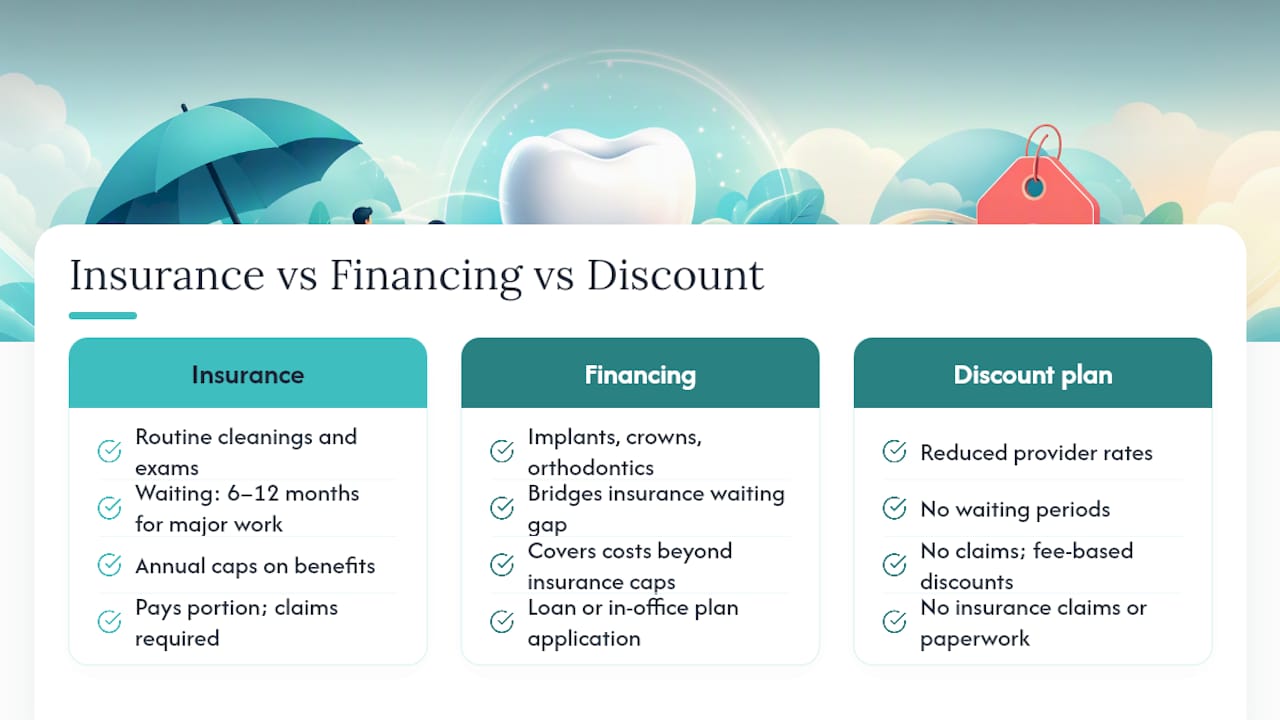
Pro Tip: If you’re weighing dental insurance versus a discount plan or straight financing, remember insurance usually caps annual benefits around $1,000 to $2,000 and imposes waiting periods on major work, so financing often covers the gap insurance leaves behind.
Who Qualifies for Dental Financing and How Hard Is Approval?
Unsecured personal loans and HELOCs typically want a credit score in the high 600s or better, verifiable income, and a manageable debt-to-income ratio. Healthcare credit cards and point-of-sale lenders are more forgiving. Many approve scores in the low 600s, and some tiered lenders work with borrowers in the 500s at a higher rate.
Most of these providers let you prequalify first. Prequalification uses a soft credit check that doesn’t affect your score, so you can compare real offers before committing to anything. The formal application that follows usually triggers a hard inquiry, which can ding your score slightly.
Expect to provide:
- A government ID and Social Security number.
- Proof of income or employment.
- A bank account or debit card for funding and payments.
Pro Tip: Prequalify with two or three lenders in the same week. Multiple soft checks won’t hurt you, and rate-shopping windows exist for a reason.
How Do You Choose the Right Financing Option?
Run every offer through the same checklist before signing anything:
- What’s the total repayment amount, including all interest and fees, not just the monthly payment?
- Is the interest deferred, and if so, does it apply retroactively if you’re late?
- Who actually holds the debt, the dental office or a separate lender?
- What’s the term length, and does it match how fast you can realistically pay it off?
- Are there origination fees, prepayment penalties, or late fees buried in the fine print?
At the dental office, ask for the written financial policy before agreeing to extensive treatment. The American Dental Association specifically recommends this step so patients know exactly who they’re paying and when. Ask who bills you, whether the office or the lender handles disputes, and request a payment schedule in writing.
With any lender, ask three things: can you prequalify without a hard inquiry, does interest start accruing immediately or only after a promo period ends, and what happens if a payment is late.
- No written terms offered? Walk away.
- Vague answers about “when interest starts”? Walk away.
- High-pressure to sign same-day without time to review? Walk away.
Pro Tip: Compare offers by total dollar cost over the full term, not by APR alone. A low-APR loan with a long term can cost more overall than a slightly higher rate paid off fast.
What Does the Application Process Look Like?
- Get a written treatment plan and cost estimate from your dentist.
- Prequalify with one or more lenders using a soft credit check.
- Compare offers, then submit a formal application, which triggers a hard inquiry.
- Sign the financing agreement and confirm the payment schedule in writing.
- Schedule treatment once funding is approved.
Prequalification is usually instant. Full funding can land the same day or take a few business days depending on the lender. The dental office should also have you sign an acknowledgment of its written financial policy, spelling out accepted payment methods, refund terms, and what happens if a plan lapses.
Pro Tip: Bring your cost estimate to prequalification, not after. Lenders size offers around the actual procedure cost, and vague numbers slow the process down.
What Are the Risks and Consumer Protections to Know?
Deferred interest is the trap that catches the most patients off guard. A card advertised as “no interest for 12 months” can charge interest back to day one if even a small balance remains when the period ends.
Deferred-interest medical credit cards carry a structural risk that standard consumer credit doesn’t: the cost of a missed deadline isn’t a late fee, it’s interest applied retroactively across the entire original balance.
The Consumer Financial Protection Bureau has flagged this repeatedly as a pattern that catches patients who assume “no interest” means no risk. Federal Truth in Lending rules require lenders to disclose these terms clearly, but disclosure only helps if you actually read it.
Practical protections: get every term in writing, prequalify before applying anywhere, compare total cost rather than monthly payment, and confirm in writing whether the office or the lender handles a refund if treatment changes mid-plan. For loans above a few thousand dollars, a quick conversation with a financial advisor or credit counselor costs nothing and can catch what a sales conversation glosses over.
Pro Tip: Set a calendar reminder 60 days before any promotional period ends. That’s enough runway to pay down the balance or refinance before retroactive interest kicks in.
Why We Talk About Financing Before Treatment Begins
Patients accept treatment plans more often when they understand the payment side before the clinical side gets complicated. That’s why staff here walk through options at the estimate stage, not after work has started. Offering a $99 cleaning package or a $49 emergency exam only helps if patients also know what a root canal or implant will actually cost to finance. We train our team to hand over a written financial policy before anything extensive begins, because a surprised patient is rarely a returning patient.

How South Littleton Family Dental Helps You Pay for Treatment
South Littleton Family Dental structures payment around what a treatment actually needs, not a one-size plan pushed on every patient. Whether it’s a same-day emergency exam, a phased plan for restorative work like implants and crowns, or a straightforward payment schedule for routine care, our office walks you through the real cost before you commit to anything.
Ask for our written financial policy at your first visit and bring any cost estimate you’ve already received, so we can map out a plan around your actual budget rather than a generic quote. If you’re dealing with a dental emergency and need to know your payment options fast, our emergency dental care page lays out what same-day treatment looks like locally. Call our Littleton office or request an appointment through our main site to start the conversation before the pain, or the bill, gets bigger.
Where to Learn More About Dental Financing Rules
- CFPB report on medical credit cards: explains deferred-interest risks in plain terms.
- ADA financial policy guidance: what a written policy should include.
- Truth in Lending Act overview (CFPB): federal disclosure rules for credit extended for care.
- HSA/FSA eligibility basics: confirms which dental expenses qualify for tax-advantaged funds.
Frequently Asked Questions
Is dental insurance worth it if I can finance instead? Insurance helps with routine cleanings and exams, but annual caps and waiting periods on major work mean financing often fills the gap for implants, crowns, or orthodontics.
Can I use my HSA for dental work? Yes. HSA funds cover eligible dental expenses when the treatment is medically necessary, and using pre-tax dollars effectively lowers your net cost.
Can I use my FSA for dental expenses too? Yes, FSA dollars work the same way for qualified dental care, though FSA funds are typically use-it-or-lose-it within the plan year, unlike HSA balances that roll over.
What’s the difference between a dental discount plan and insurance? A discount plan charges an annual fee for reduced provider rates with no waiting periods or claims, while insurance pays a portion of costs but caps benefits and often delays coverage on major procedures.
How long are typical dental insurance waiting periods? Many plans impose 6 to 12 months before covering major work like crowns or implants, which is exactly the gap financing options are designed to bridge.
What credit score do I need for financing dental implants? Personal loans and top-tier promotional cards generally want scores in the high 600s or above, while in-office plans and tiered point-of-sale lenders can work with scores in the 500s and low 600s.
This article is general information, not a substitute for advice from a qualified financial advisor. Consult a qualified financial professional about your own circumstances before acting on anything here.
Sources
- Medical credit cards and financing plans (CFPB)
- Considerations in developing a financial policy (ADA)
- Best dental loans (NerdWallet)
- Hard and soft credit inquiries (Citi)
- Files