

Most single-tooth implant cases run about 3 to 6 months from consultation to final crown, while cases needing bone grafts often stretch to 6 to 12 months or longer. The reason has almost nothing to do with appointments and everything to do with biology: your jawbone has to physically fuse to the implant before it can safely carry a crown. Some patients qualify for a same-day provisional tooth, but that’s the exception, not the rule.
TL;DR:
- Bone grafting procedures, such as sinus lifts or block grafts, typically add 2 to 6 months or more to the implant timeline due to healing and integration needs.
- Immediate implant placement after tooth extraction depends on bone stability and infection control, but most cases require a staged approach with healing periods.
- Osseointegration duration varies by jaw location, taking around 3 to 4 months for the lower jaw and 4 to 6 months for the upper jaw because of differences in bone density.
- Factors like smoking and uncontrolled diabetes slow healing, making staged procedures more cautious and extending the overall timeline.
- Final crown placement generally occurs 2 to 4 weeks after abutment attachment, once the implant is fully integrated and gum tissue heals.
Table of Contents
- Dental Implant Timeline: Consultation and Treatment Planning
- Tooth Extraction and Socket Preservation Timing
- Bone Grafting and Sinus Lifts: How Much Time They Add
- Implant Placement Surgery and the First Two Weeks
- Osseointegration: The Month-by-Month Healing Timeline
- Abutment Placement and Getting Your Final Restoration
- What Speeds Up or Slows Down Your Timeline
- What to Expect Day to Day During Treatment
- Publisher Perspective: Why Patience Pays Off
- Get Your Personalized Implant Timeline at South Littleton Family Dental
- Sources
- FAQ
Dental Implant Timeline: Consultation and Treatment Planning
Before anyone talks surgery dates, your dentist needs a full picture of your mouth and your health. That first visit typically includes:
- A clinical exam and full medical history review, with specific screening for diabetes control and smoking habits
- A CBCT scan to measure bone volume, density, and the location of nerves and sinuses in 3D
- A decision on whether you need grafting or staging before an implant can go in at all
Digital planning from a CBCT scan tells your dentist exactly how much bone you have to work with, which shapes every date that follows. For routine cases, surgery typically happens 1 to 3 weeks after that first visit. If you need medical clearance from your physician or a referral to a specialist, add several more weeks to that window.
Tooth Extraction and Socket Preservation Timing
If a damaged tooth needs to come out first, the extraction site itself dictates a chunk of your calendar. Clinicians generally choose between two paths:
- Immediate placement: The implant goes into the socket the same day as extraction, when bone quality and infection status allow it
- Staged placement: The socket heals first, sometimes with a bone graft packed in to preserve its shape before an implant is placed later
Socket preservation matters because a healing socket without support can lose up to half its width within months. Soft tissue over a preserved socket typically closes in 4 to 8 weeks, but the bone underneath needs longer to mature into something dense enough to anchor an implant securely. That gap between soft-tissue healing and true bone readiness is where a lot of patients get their timeline expectations wrong.
Bone Grafting and Sinus Lifts: How Much Time They Add
Grafting is the single biggest variable in any implant timeline, and it comes in several forms depending on where you’re missing bone:
- Socket grafts fill an extraction site to preserve width and height
- Guided bone regeneration (GBR) rebuilds a localized defect using membrane and graft material
- Block grafts address larger volume loss, often taken from elsewhere in the jaw or synthetic sources
- Sinus lifts (lateral or crestal approach) raise the sinus floor to create room for implants in the upper back jaw
Healing windows for these procedures typically run 2 to 6 months or longer, depending on the graft material and how much volume needed rebuilding. According to Mayo Clinic, bone grafting or sinus augmentation can add several months to the overall process simply because the graft itself needs to integrate before an implant can be placed on top of it.
Pro Tip: Ask your dentist directly whether your case allows a simultaneous graft-and-implant procedure or requires a graft-first, implant-later approach. Combining them saves calendar time but only works when there’s enough existing bone to stabilize the implant while the graft heals around it.
Implant Placement Surgery and the First Two Weeks
Surgery day itself is usually the shortest part of the entire process:
- Your dentist numbs the area and places the implant into the jawbone, using either a small flap incision or a flapless technique depending on your anatomy. Most single-implant procedures take 1 to 2 hours of chair time.
- In select cases, a same-day provisional tooth is attached, either a single crown for a front tooth or a full-arch temporary bridge for larger restorations. This depends heavily on bone stability at the time of placement, not just patient preference.
- Swelling and discomfort typically peak around day 2 or 3, then taper off steadily. Most patients stick to soft foods for about a week and return to desk-type work within 2 to 3 days, though physically demanding jobs may call for a longer break.
Osseointegration: The Month-by-Month Healing Timeline
Osseointegration is the process where living bone cells grow directly onto and around the implant surface, locking it in place at a microscopic level. This single biological step accounts for most of the total time in any implant case, which is why patient satisfaction improves so much when the invisible healing period is explained upfront rather than glossed over.
| Jaw location | Typical integration time | Why it differs |
|---|---|---|
| Lower jaw (mandible) | About 3 to 4 months | Denser bone integrates faster |
| Upper jaw (maxilla) | About 4 to 6 months | Naturally softer, more porous bone |
The upper jaw commonly takes longer to reach full integration than the lower jaw because of that density difference. Your dentist confirms readiness through a follow-up exam, updated imaging, and sometimes a stability test on the implant itself before clearing it for a permanent restoration. The ITI classification system groups placement timing into four categories, from Type 1 immediate placement through Type 4 delayed placement after four months or more, and choosing the right category for your specific anatomy is what keeps failure rates low.
Abutment Placement and Getting Your Final Restoration
Once the implant has fully integrated, the next phase moves faster because the biological heavy lifting is done. Here’s what typically happens:
- Your dentist attaches an abutment, the small connector piece that will eventually hold your crown
- Gum tissue around the abutment usually heals in about 2 weeks before impressions are taken
- A dental lab fabricates your final crown or prosthesis, which generally takes 2 to 4 weeks depending on the lab and material chosen
At your seating appointment, the final restoration gets checked for fit, bite, and appearance, then permanently secured. Most patients notice an immediate difference in chewing stability compared to the temporary phase.
What Speeds Up or Slows Down Your Timeline
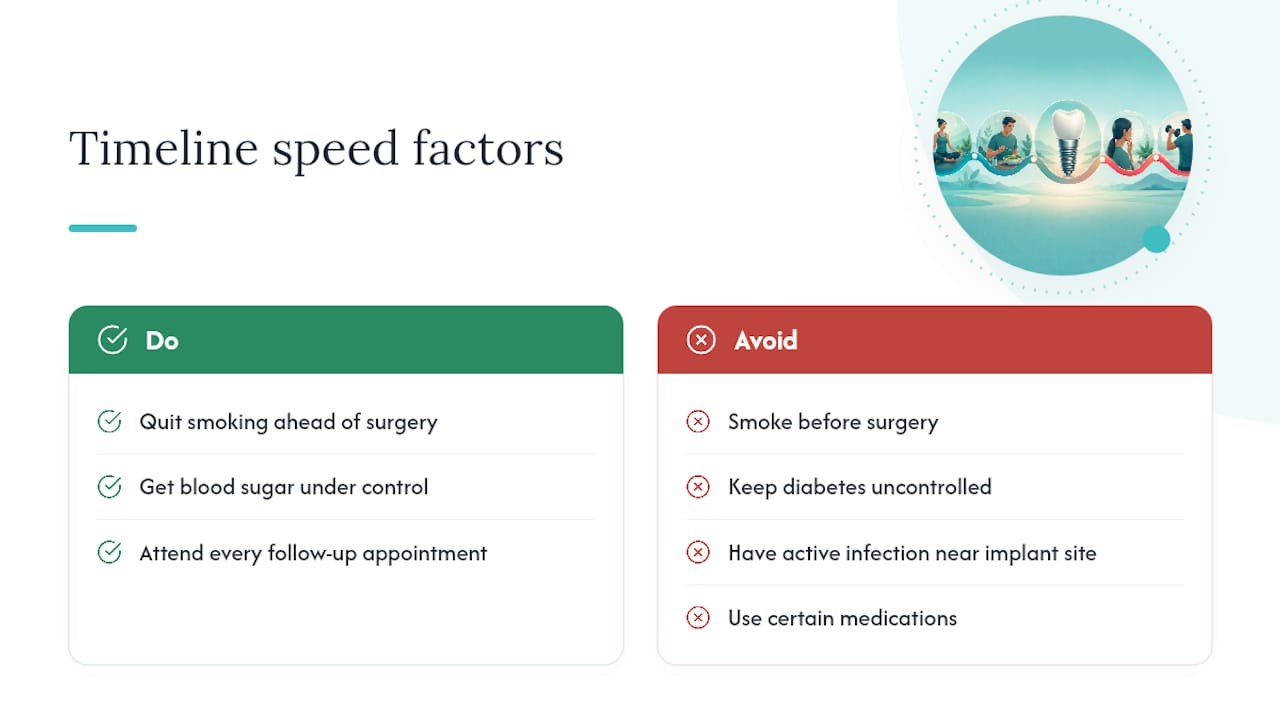
Several factors push your case toward the faster or slower end of these ranges. Poorly controlled diabetes and smoking both impair healing and raise the risk of implant failure, according to Mayo Clinic, so addressing both before surgery genuinely shortens your path. Certain medications, thin bone around the front teeth, or active infection near the implant site can also push your dentist toward a more cautious, staged approach. The practical fix is straightforward: quit smoking ahead of surgery, get blood sugar under control, and show up for every follow-up appointment on schedule.
What to Expect Day to Day During Treatment
Life during implant treatment follows a predictable rhythm once you know the milestones:
- First week: Stick to a soft diet, skip straws (suction can dislodge healing tissue), and use any prescribed rinse as directed.
- Weeks 2 through 8: Resume normal hygiene and light exercise as swelling resolves; your first follow-up usually lands around the 6 to 8 week mark.
- Pre-restoration check: A final exam and imaging confirm the implant is ready before your abutment and crown appointments are scheduled.
Pro Tip: Avoid chewing directly on the implant site with any temporary restoration until your dentist confirms it’s fully loaded. Biting too hard too soon is one of the more common, and easily avoidable, causes of setbacks.
Publisher Perspective: Why Patience Pays Off
Individualized planning using CBCT and a full health review beats guessing every time. Waiting for proper integration protects your results for decades, not months. Support like same-day emergency visits and flexible financing exists to make that wait easier, not to rush past it.
— Admin
Get Your Personalized Implant Timeline at South Littleton Family Dental
Every timeline in this guide is a range, not a promise, because your bone density, health history, and treatment needs are unique to you. Southlittletonfamilydental builds each implant plan around your own CBCT scan and health review rather than a generic calendar, so you get a realistic schedule instead of a guess.

Our dental implants service covers the full arc from initial imaging through final restoration, and our implant process page walks through what each appointment involves. If you’re unsure whether you’re a good candidate yet, our candidacy guide explains the health and bone factors we check first. Patients dealing with a broken tooth or urgent pain in the meantime can use our emergency dentistry option to get seen quickly rather than waiting in discomfort. Ready to find out where you land on the timeline? Schedule a consultation with a local dental provider and leave with an actual calendar instead of a rough guess.
Sources
The ranges in this guide draw from ITI’s timing classification system, Mayo Clinic’s surgical guidance, a peer-reviewed review of placement and loading protocols, and the StatPearls implant reference, which together shape how clinicians balance speed against long-term predictability.
This article is general information, not a substitute for advice from a qualified doctor. Consult a qualified healthcare professional about your own circumstances before acting on anything here.
- Timing of Dental Implant Placement: The Past, the Present, the Future – PMC
- Dental implant surgery – Mayo Clinic
- How Long Does the Full Dental Implant Process Take? – Smart Arches Dental Implants
FAQ
How Long Does a Single Implant Take Start to Finish?
A straightforward single-tooth implant with no grafting usually takes 3 to 6 months from consultation to final crown. Most of that time is osseointegration, the healing period where bone fuses to the implant, not appointment time.
Can I Get a Tooth the Same Day as My Implant?
Same-day provisional teeth are possible for some patients, but only when bone stability and anatomy support it, according to the ITI timing framework. Immediate placement can shorten your overall calendar time, but it requires careful case selection and isn’t right for every situation.
Does Bone Grafting Always Add Months to the Timeline?
Not always, but it usually adds some time, ranging from 2 to 6 months or longer depending on the type of graft used. Whether a graft can be placed at the same time as your implant or needs to heal first depends on your specific bone volume.
Why Does the Upper Jaw Take Longer to Heal Than the Lower Jaw?
The upper jaw, or maxilla, generally has softer, less dense bone than the lower jaw, so integration commonly takes 4 to 6 months compared with 3 to 4 months for the mandible. This is a normal anatomical difference, not a sign anything went wrong.
What Does South Littleton Family Dental Charge for Dental Implants?
Pricing depends on your specific case, including whether grafting or extractions are needed, so current costs are listed on the dental implants page. A consultation with CBCT imaging gives you an accurate quote based on your own anatomy.