
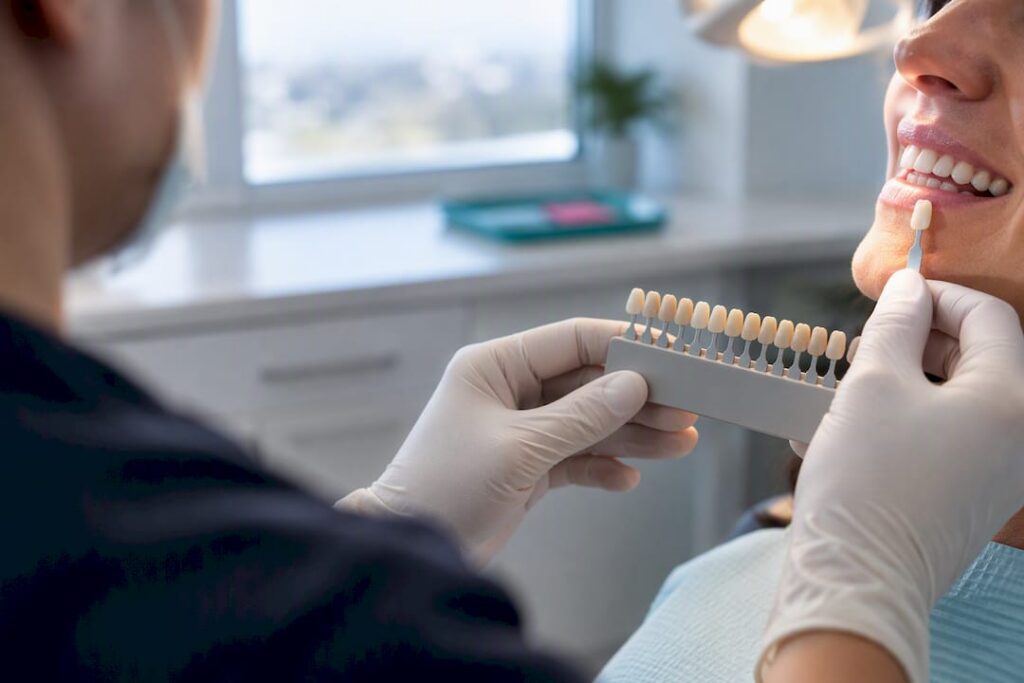
Tetracycline-stained teeth can usually be improved, but rarely erased with a single visit. Dentist-supervised bleaching is the standard first step for mild to moderate cases, since it preserves tooth structure and costs less than restorations. Severe or banded staining often needs veneers or crowns to mask the color fully. Expect the process to take weeks to months, with sensitivity often dictating the pace.
TL;DR:
- Tetracycline stains are embedded in the tooth structure, making them permanent and unresponsive to brushing or regular whitening toothpaste.
- Whitening treatments can lighten tetracycline staining over months, with brown stains responding better than gray or blue bands.
- Custom tray bleaching is the most controllable first option, often requiring months of nightly treatment, while in-office bleaching provides faster initial results.
- Restorative options like veneers or crowns become necessary when bleaching plateaus or for severe gray or banded stains, with porcelain veneers offering better long-term stain resistance.
- Accurate diagnosis, a detailed treatment plan, and managing sensitivity are key to success, with restorative masking as a backup if bleaching is insufficient.
Table of Contents
- How Does Tetracycline Cause Tooth Discoloration?
- Are Tetracycline Stains Permanent, or Can Whitening Fix Them?
- What Bleaching Options Work Best for Tetracycline Stains?
- When Should You Consider Veneers Instead of Bleaching?
- What Is Internal Bleaching, and Does It Treat Tetracycline Staining?
- How Do Dentists Diagnose and Plan Treatment for Stained Teeth?
- What Should You Ask at a Tetracycline Staining Consultation?
- A Practice-Level View on Treating Tetracycline Staining
- Getting a Personalized Plan for Tetracycline Staining in Littleton
- Sources
- FAQ
How Does Tetracycline Cause Tooth Discoloration?
Tetracycline binds to calcium during tooth formation, and that bond becomes permanent once the enamel and dentin mineralize around it. The drug doesn’t sit on the surface like coffee or tobacco stains. It gets built into the tooth itself, which is why brushing harder or switching toothpaste never touches it.
The 2024 literature review on tetracycline staining points to a specific window of vulnerability: roughly six months to six years of age, while crowns are still forming under the gumline. A child who took the antibiotic for an ear infection at age two might not show discoloration until adult teeth erupt years later.
What the stain actually looks like tells you something about how it happened:
- Yellow tones usually reflect lighter, shorter-term exposure.
- Brown shades often indicate longer exposure or a later stage of mineralization.
- Gray or blue-gray staining tends to be the hardest to treat and often signals heavier or more prolonged dosing.
- Horizontal bands across multiple teeth suggest the drug was taken in cycles, not continuously.
Severity tracks with dose, duration, and exactly which stage of tooth development was underway. A single dark tooth, by contrast, usually points to a different cause entirely, like trauma or a failed root canal, not developmental tetracycline exposure.
Are Tetracycline Stains Permanent, or Can Whitening Fix Them?
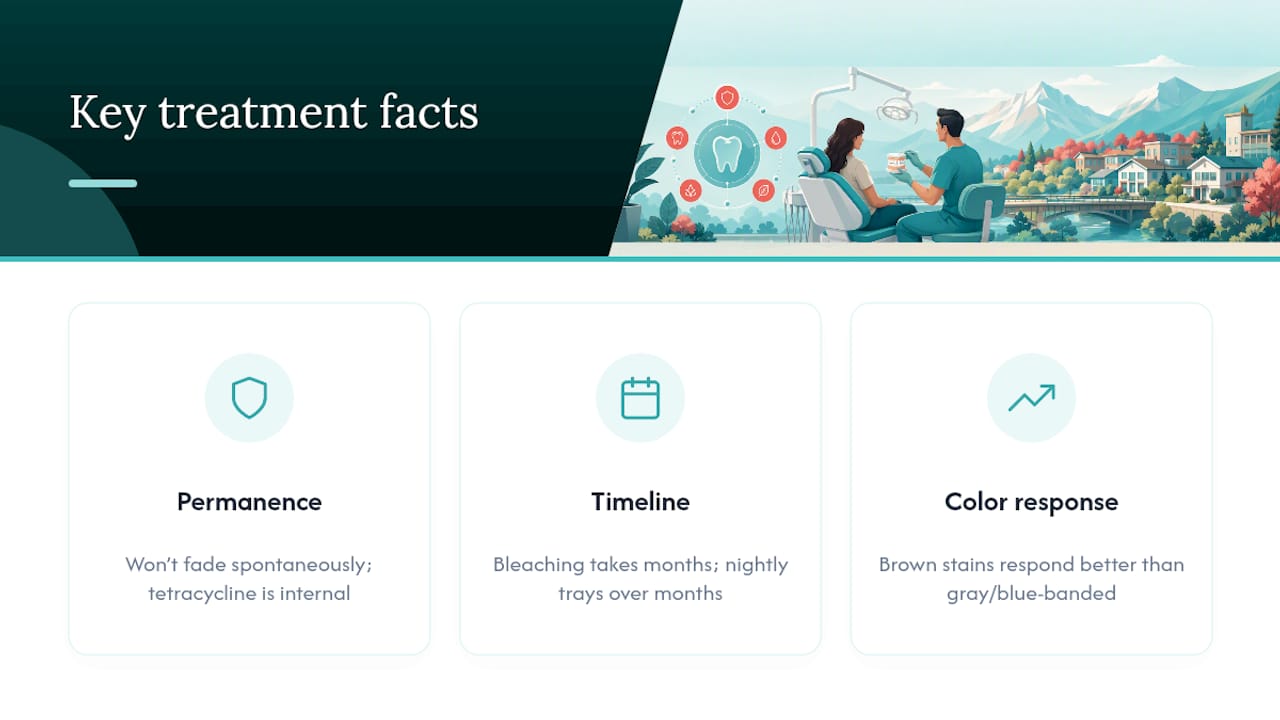
The staining itself is permanent in the sense that it won’t fade on its own. Because tetracycline is locked into the tooth’s internal structure, no amount of time or oral hygiene changes that. But permanent doesn’t mean untreatable. Bleaching can lighten intrinsic tetracycline discoloration meaningfully, even if it doesn’t always bring teeth back to a uniform natural white.
A 2021 clinical review identifies bleaching as the appropriate initial treatment for mild to moderate cases and is direct about the timeline: results can take months, not days. The American Dental Association puts a rough number on it, noting that tetracycline-related stains may need a prolonged period of nightly tray treatment over several months on average to show real improvement.
Brownish staining tends to respond better to bleaching than gray or blue-banded staining. That’s a useful thing to know going in, because it means two patients with tetracycline history can have very different outcomes from the identical treatment. Setting expectations before you start, rather than after months of trays, saves a lot of frustration.
What Bleaching Options Work Best for Tetracycline Stains?
Most dentists build a bleaching plan around one core idea: try the gentlest, most reversible option first, and escalate only if it stalls out. For tetracycline staining specifically, that usually plays out in stages.
- Custom tray home bleaching. A dentist takes an impression, fabricates trays, and prescribes carbamide or hydrogen peroxide gel worn for a set number of hours daily. This is the workhorse for tetracycline cases because it preserves enamel and gives the dentist control over concentration and duration. Expect a period measured in months, with checkpoints every few weeks to track color change.
- In-office high-concentration bleaching. A single session can lighten regular surface staining fast, but tetracycline stains typically respond more slowly and less completely to one-time in-office treatment alone. It’s often paired with take-home trays rather than used by itself.
- Light or laser activation. Some offices market laser-activated whitening as faster or stronger. A 2020 systematic review and meta-analysis found no clear advantage for laser activation over other light sources in sensitivity incidence, sensitivity intensity, or actual color change. A 2009 case report describes KTP-laser-assisted bleaching helping in one severe tetracycline case, but that’s a single documented case, not proof the technology outperforms standard trays.
Sensitivity is the real limiting factor for most patients, not the stain itself. Dentists manage it by lowering gel concentration, shortening daily wear time, adding desensitizing agents like potassium nitrate, or pausing treatment for a week to let enamel recover. If sensitivity doesn’t ease with those adjustments, that’s usually the signal to stop bleaching and talk about restorative masking instead of pushing the same protocol indefinitely.
Pro Tip: Take a phone photo of your teeth in the same lighting every two weeks during bleaching. Color change from tetracycline staining is gradual enough that day-to-day differences are invisible, but a two-week comparison usually shows real progress.

The Lumi & KoR™ teeth whitening system uses a staged approach along these same lines, adjusting concentration and timing based on how a patient’s teeth respond rather than running one fixed protocol for everyone.
When Should You Consider Veneers Instead of Bleaching?
Restorative masking becomes the practical answer when bleaching plateaus, when the stain is severe gray or blue banding, or when a patient simply doesn’t want to spend months in trays. It’s a trade of speed and predictability for a more invasive, more permanent procedure.
- Direct composite veneers are the more conservative restorative option. A dentist bonds tooth-colored resin directly onto the enamel in one visit, at lower cost than porcelain. The trade-off is that composite can stain and wear faster, often needing touch-ups within a few years.
- Porcelain veneers require shaving a thin layer of enamel to bond a custom ceramic shell over the tooth. A clinical study of 546 tetracycline-stained teeth restored with porcelain laminate veneers reported strong marginal adaptation and high patient satisfaction at the one-year mark under the conditions studied. Porcelain resists staining far better than composite but costs more and isn’t reversible.
- Crowns cover the entire tooth rather than just the front surface, typically reserved for teeth that are also structurally compromised, not just discolored.
Whichever restorative route you choose, maintenance matters. Marginal gaps can develop at the edge of a veneer over years, and porcelain can chip under enough force. Porcelain veneers hold color better long-term, but they still need periodic checkups to catch small issues before they become bigger repairs.
What Is Internal Bleaching, and Does It Treat Tetracycline Staining?
Internal bleaching is a specific procedure for a specific problem: a single tooth that has darkened after root canal therapy. A dentist places bleaching agent inside the pulp chamber of a non-vital tooth, sealed with a temporary filling, and lets it lighten the tooth from the inside out over one or more sessions.
An older four-year clinical report found good cosmetic outcomes with this technique in carefully selected non-vital teeth. That’s a meaningfully different clinical situation from generalized tetracycline staining across a full set of vital teeth, though. Internal bleaching only applies when a tooth is already root-canal treated and dark for that reason, not as a general strategy for developmental tetracycline discoloration across an intact, vital dentition.
How Do Dentists Diagnose and Plan Treatment for Stained Teeth?
A proper workup starts with history: roughly when tetracycline exposure occurred, what whitening you’ve already tried, and any existing fillings or crowns that will need shade-matching later. From there, a clinical exam and radiographs rule out decay, cracks, or failing restorations hiding behind the discoloration.
- Confirm whether staining is developmental (tetracycline, fluorosis) or from a single-tooth cause like trauma or a dead pulp, since these require very different treatment paths.
- Pulp testing when a single tooth looks notably darker than its neighbors.
- Shade planning before any restoration, since whitening the surrounding natural teeth first lets a dentist match veneer or crown shade to the final color rather than an intermediate one.
Sequencing matters more than people expect. Restoring a tooth before finishing whitening the rest of the mouth locks in a color that may no longer match once the natural teeth lighten further. Practices that stack treatments in a deliberate order generally get more predictable final results.
What Should You Ask at a Tetracycline Staining Consultation?
Walking into a consult prepared saves time and gets you a more accurate plan on the first visit.
- Bring your best estimate of when the tetracycline exposure happened and for how long, along with any old dental records or whitening history.
- Bring photos of your teeth in natural light if you have them from a few years back, since they show how the stain has looked over time.
- Ask what improvement range is realistic for your specific stain color and pattern, not a generic promise.
- Ask how sensitivity will be handled and what happens if it becomes uncomfortable partway through.
- Ask for a rough timeline and cost range for both bleaching and restorative options, so you can compare before committing.
Be cautious of anyone who guarantees full whitening before even seeing your teeth, pushes veneers before trying bleaching on mild to moderate staining, or can’t give you a clear sensitivity management plan.
A Practice-Level View on Treating Tetracycline Staining
Conservative, staged care wins more often than aggressive intervention. Starting with bleaching whenever a case allows for it protects healthy enamel and keeps restorative options open if the response falls short. Patients who understand the realistic timeline up front tolerate the process far better than those expecting overnight change, and sensitivity management deserves as much attention as the whitening protocol itself. Bring your history, ask direct questions, and expect a plan built around your specific stain, not a one-size protocol.
— Admin
Getting a Personalized Plan for Tetracycline Staining in Littleton
Tetracycline staining treatment generally follows evidence-based guidelines: bleaching first when possible, restorative masking if bleaching is insufficient, and clear discussion about timeline and sensitivity management. Care plans are adjusted based on patient response, with options including whitening systems, veneers for severe stains, and internal bleaching for single non-vital teeth.

Every plan starts with a real diagnostic exam, not a guess from a photo. If you’ve lived with tetracycline discoloration for years and want a straight answer on what’s realistic for your specific stain, book a consultation for teeth whitening and cosmetic options and get a treatment timeline built around your teeth, not a generic script.
This article is general information, not a substitute for advice from a qualified doctor. Consult a qualified healthcare professional about your own circumstances before acting on anything here.
Sources
- Tetracycline staining of the dentition: a review of the literature and report of a clinical case
- Bleaching: the initial treatment consideration for tetracycline-stained teeth
- Whitening | American Dental Association
- Effect of light activation on tooth sensitivity and color change during bleaching: a systematic review and meta-analysis
- Clinical evaluation of tetracycline-stained teeth treated with porcelain laminate veneers
- Internal bleaching of discolored endodontically treated teeth: four-year results
FAQ
Is Tetracycline Staining Permanent?
The staining itself doesn’t disappear on its own since it’s built into the tooth structure, not sitting on the surface. Bleaching can meaningfully lighten it, though full restoration to natural white isn’t guaranteed for every stain color, as the 2021 clinical review notes.
Why Are My Teeth Suddenly Staining Brown?
Sudden brown discoloration in adulthood is rarely new tetracycline staining, since that develops during childhood tooth formation. It’s more likely diet, coffee, tobacco, an aging filling, or in rarer cases a dying nerve in one tooth, all of which call for a proper diagnostic exam rather than assuming it’s the same cause.
Does Tetracycline Turn Your Teeth Yellow?
Yes, yellow is one of the more common shades tetracycline staining produces, particularly with lighter or shorter exposure during tooth development. Brown, gray, and banded patterns also occur depending on dose and timing, according to the 2024 literature review.
Can Antibiotics Cause Tooth Discoloration?
Tetracycline and related antibiotics can cause permanent intrinsic discoloration if taken during tooth development in early childhood, roughly between six months and six years of age. Most other antibiotics used today don’t carry this risk, but any staining history worth bringing up to a dentist during an exam.
Will Whitening Toothpaste Remove Tetracycline Stains?
No. Whitening toothpaste works on surface stains from food and drink, but it can’t reach discoloration built into the enamel and dentin, according to the ADA. Removing or lightening tetracycline staining requires dentist-supervised bleaching or restorative treatment.