
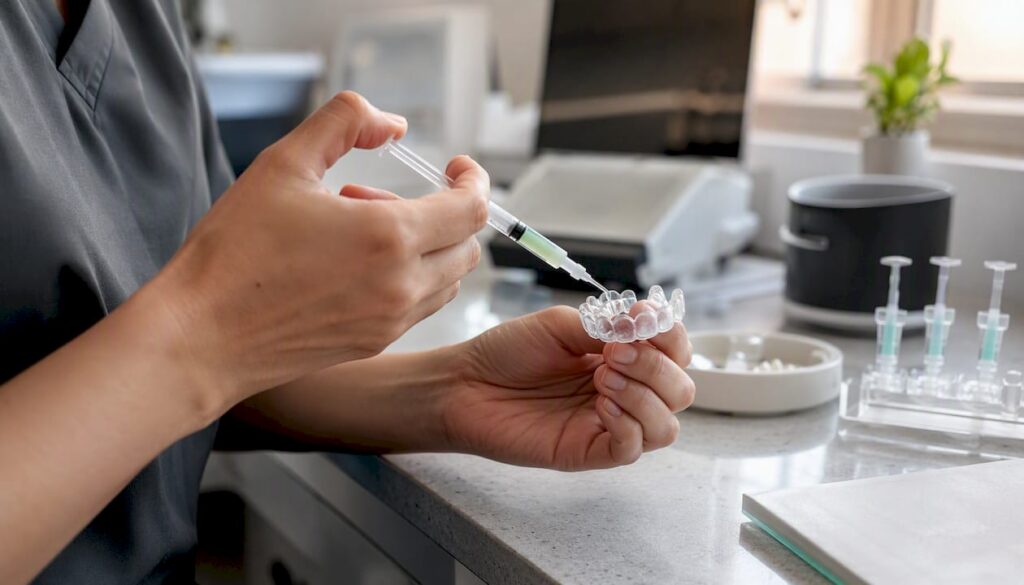
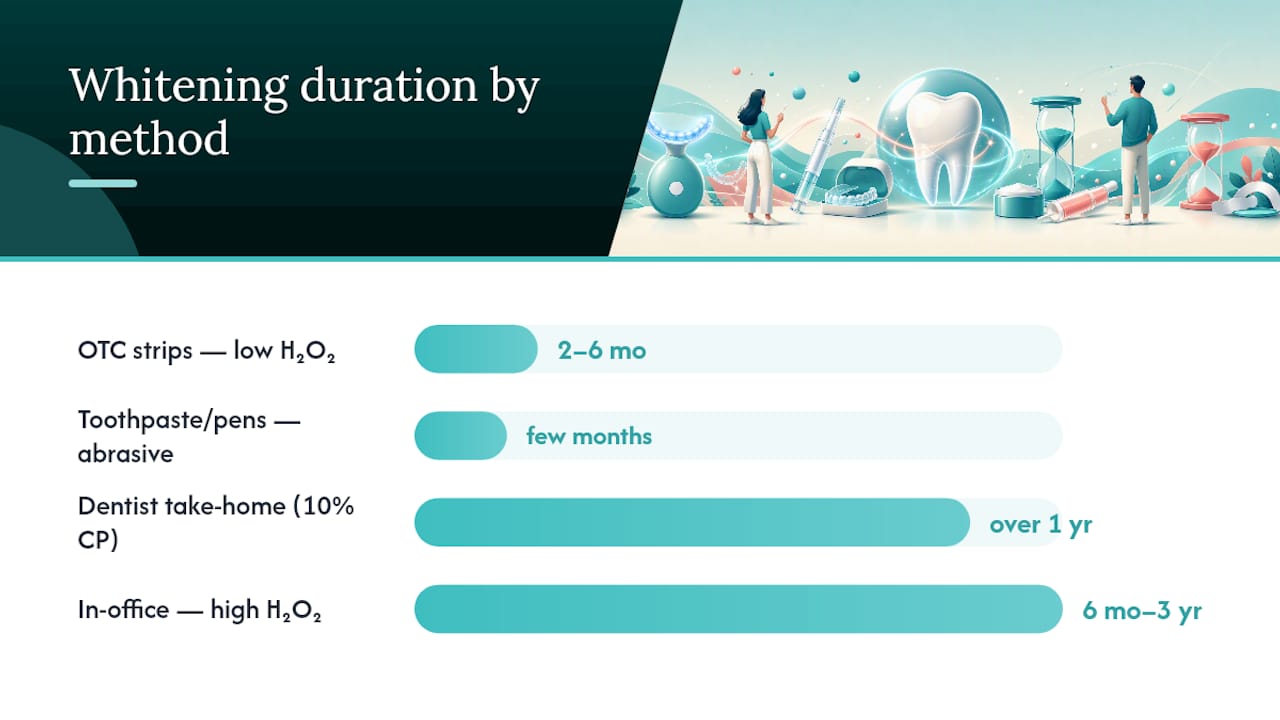
Teeth whitening results typically last for a variable period depending on the method used, with durations ranging from a few months to several years. Over-the-counter strips and whitening toothpastes tend to fade within a few months. Dentist-supervised take-home trays with carbamide peroxide often maintain results for a longer period, typically over one year. In-office chairside bleaching using high-concentration hydrogen peroxide can produce dramatic initial brightness, but some clinical evidence suggests it may show faster early color regression than supervised at-home regimens for certain patients, although durations vary.
Here’s a quick orientation by method:
-
OTC strips and whitening pens: typically a few months before noticeable fading
-
Dentist-prescribed take-home trays (carbamide peroxide): often maintain results for over one year with good habits
-
In-office chairside bleaching: striking initial results, but longevity varies widely depending on lifestyle
The clearest recommendation from clinical evidence: dentist-supervised options, combined with consistent lifestyle adjustments, extend results most reliably. A systematic review published in 2024 found that at-home carbamide peroxide under supervision was associated with longer-lasting whitening and fewer relapses compared with some in-office high-concentration hydrogen peroxide treatments.
Key takeaways
Dentist-supervised carbamide peroxide take-home trays consistently offer the best balance of longevity, safety, and cost over time compared with OTC products or single in-office sessions alone.
| Point | Details |
|---|---|
| Duration varies by method | OTC strips last a few months; dentist trays commonly last over one year; in-office results vary widely |
| Dehydration affects early results | Post-treatment brightness partly reflects tooth dehydration; true color stabilizes over 2–6 weeks. |
| Lifestyle is the main variable | Coffee, tea, tobacco, and skipped cleanings are the fastest routes to early fading. |
| OTC overuse carries enamel risk | Repeated unsupervised OTC use can increase enamel surface roughness; professional supervision reduces this risk. |
| Southlittletonfamilydental | Offers supervised Lumi and KoR™ whitening with custom trays, pre-treatment exams, and ADA-aligned protocols in Littleton, CO. |
Table of Contents
How long does teeth whitening last by method?
The gap between methods is real, and it matters before you spend money.
| Method | Active Agent | Typical Duration |
|---|---|---|
| OTC whitening strips | Low-concentration H₂O₂ | 2–6 months |
| Whitening toothpaste / pens | Abrasives or low H₂O₂ | generally a few months |
| Dentist take-home trays (10% CP) | Carbamide peroxide | often over one year |
| In-office chairside bleaching | High-concentration H₂O₂ | 6 months–3 years |
One nuance worth knowing: the brightness you see immediately after in-office treatment is partly a dehydration effect. Teeth lose moisture during the procedure and look whiter than they will once they rehydrate over the following two to six weeks. True long-term color should be assessed after that stabilization window, not the day you leave the chair.
An in-vitro comparison of whitening systems found that at-home products achieved better immediate outcomes than some in-office systems, but differences narrowed considerably at six months. That finding cuts against the assumption that the most expensive single appointment always wins on longevity.
The Cochrane review on bleaching agents confirmed short-term whitening effects across agents but rated the certainty of evidence as low to very low for many home-based methods, largely because most trials run only two weeks to six months. Treat duration ranges as realistic estimates, not guarantees.
Why your results may fade faster than someone else’s
Some factors you can change; others you cannot.
Modifiable factors that accelerate fading:
-
Coffee, tea, and red wine are the biggest dietary culprits. Chromogens in these drinks bind to enamel within hours of whitening.
-
Tobacco use (smoked or smokeless) stains teeth faster than almost any dietary habit and significantly shortens whitening duration.
-
Infrequent professional cleanings allow surface stain and tartar buildup to accumulate, dulling results between touch-ups.
-
Skipping maintenance products (whitening toothpaste, periodic tray use) lets color drift back without any corrective step.
-
Alcohol consumption can dry out oral tissues and alter the surface environment of enamel, potentially making it more receptive to staining agents.
-
Certain medications — notably antihistamines, antipsychotics, and some blood pressure drugs — can contribute to intrinsic discoloration over time.
Harder-to-change factors:
-
Intrinsic stains from tetracycline antibiotics taken during tooth development are notoriously resistant to peroxide bleaching. Results are possible but limited and slow.
-
Dental fluorosis (white or brown spots from excess fluoride during development) creates uneven color that bleaching can sometimes worsen.
-
Existing restorations — crowns, veneers, composite fillings — do not respond to peroxide. They stay their original shade while natural teeth whiten, creating a mismatch.
-
Enamel thickness varies by person and affects how light reflects off the tooth surface, influencing the perceived result.
Pro Tip: Schedule a professional cleaning one to two weeks before your whitening treatment. Starting with a clean, plaque-free surface lets the peroxide contact enamel directly rather than working through a biofilm layer, which meaningfully improves both the speed and the evenness of results.
How peroxide bleaching actually works
Hydrogen peroxide and carbamide peroxide are the two agents behind virtually every whitening product on the market. Carbamide peroxide breaks down into hydrogen peroxide and urea in contact with saliva, so it releases its active agent more slowly. That slower release is one reason supervised at-home carbamide peroxide regimens tend to produce more stable long-term color: the enamel is exposed to lower concentrations over longer periods rather than a single high-concentration hit.
Hydrogen peroxide penetrates enamel and dentin and oxidizes the organic chromogen molecules responsible for discoloration. The result is a lighter tooth shade. What it cannot do is change the underlying mineral structure of the tooth or alter the color of restorations.
The dehydration effect mentioned earlier is worth repeating here because it catches a lot of people off guard. Immediately post-treatment, teeth look brighter partly because they have lost moisture. As they rehydrate over two to six weeks, some of that apparent brightness settles back. This is normal and expected. Judging your final result before that window closes leads to unnecessary retreatment.
In-office treatments use higher-concentration hydrogen peroxide applied chairside, sometimes with a light or laser to accelerate activation. The ADA’s guidance on whitening covers these concentration ranges and expected treatment timelines in detail.
Side effects, safety, and when to call your dentist
Most people experience at least some sensitivity during or after whitening. The ADA reports that transient mild-to-moderate sensitivity occurs in a substantial fraction of users early in treatment. That is normal. What is not normal is sensitivity that persists beyond a few days after treatment ends, or sharp spontaneous pain.
Common side effects and typical timelines:
-
Tooth sensitivity: usually begins during treatment and resolves within one to three days after stopping. Using a potassium nitrate or fluoride toothpaste before and during treatment reduces it for most patients.
-
Gum irritation: often caused by the bleaching agent contacting soft tissue, especially with ill-fitting OTC trays. Resolves within a day or two once exposure stops.
-
Temporary white spots on gums: a sign of chemical burn from concentrated gel. Usually resolves in 24–48 hours.
When to see a dentist promptly:
-
Sensitivity that does not resolve within three to five days after treatment
-
Soft-tissue ulceration or persistent gum pain
-
Sharp, spontaneous toothache (may indicate pulp involvement)
-
Any reaction after using an OTC product that does not carry an ADA Seal of Acceptance
OTC products carry a specific risk that supervised products do not: repeated unsupervised use. Comparative research shows that nonprescription bleaching agents can cause greater enamel surface roughness and variable microhardness effects compared with professionally prescribed agents when used repeatedly without guidance.
Whitening is not appropriate for everyone. Children under 16, pregnant or breastfeeding patients, and individuals with large restorations, untreated cavities, or severe intrinsic staining should consult a dentist before attempting any whitening method. Bleaching an untreated cavity can cause significant pain and may worsen the decay.
A practical maintenance plan to make results last
Whitening is not a one-time fix. The teeth that stay white longest belong to patients who treat maintenance as a routine, not an afterthought.
-
Immediately after treatment (first 48 hours): avoid dark-pigmented foods and drinks — coffee, tea, red wine, tomato sauce, berries. Enamel is temporarily more porous right after bleaching and stains more easily during this window.
-
Daily habit: use a whitening toothpaste with fluoride. This removes surface stains before they set and supports enamel health. It will not re-bleach teeth, but it slows regression noticeably.
-
Every six months: schedule a professional cleaning and exam. Polishing removes surface stain that accumulates between touch-ups and keeps the baseline shade as bright as possible.
-
Touch-up schedule: use your dentist-issued trays or a controlled OTC strip regimen at the intervals below.
| Lifestyle Profile | Recommended Touch-Up Frequency |
|---|---|
| Low stain (minimal coffee/tea, non-smoker) | Every 12 months with dentist trays |
| Moderate stain (1–2 cups coffee/day) | Every 6–12 months with dentist trays |
| Heavy stain (heavy coffee, tea, or tobacco) | Every 3–6 months; discuss with dentist |
Pro Tip: Time your annual touch-up to coincide with your regular cleaning appointment. The cleaning removes surface stain and tartar first, so the whitening agent contacts clean enamel and works more efficiently. You get better results from the same amount of product.
Dentist-issued custom trays are the most cost-effective long-term tool here. You pay once for the trays and then only for refill gel. Compared with repeated in-office sessions, this approach keeps costs manageable while giving you professional-grade carbamide peroxide at home.
When whitening won’t work and what to do instead
Peroxide bleaching has real limits, and knowing them saves time, money, and frustration.
Situations where whitening produces limited or no results:
-
Porcelain crowns, veneers, and composite fillings do not respond to peroxide. If your front teeth include restorations, whitening the natural teeth around them creates a visible shade mismatch.
-
Tetracycline staining (gray or brown banding from antibiotic use during tooth development) is among the hardest discoloration to treat. Bleaching can lighten it somewhat over extended treatment, but full correction is rarely achievable.
-
White fluorosis spots can become more pronounced with bleaching as surrounding enamel lightens while the spots remain.
-
Severe intrinsic discoloration from trauma or pulp necrosis in a single tooth requires internal bleaching performed by a dentist, not external peroxide application.
Alternatives worth discussing with your dentist:
-
Porcelain veneers cover the front surface of teeth and can correct color, shape, and minor alignment simultaneously. They are a permanent cosmetic solution for cases where bleaching is insufficient.
-
Composite bonding is a less invasive and more affordable option for isolated discolored teeth, applied directly to the tooth surface.
-
Internal bleaching is performed on endodontically treated (root canal) teeth from inside the tooth chamber and is the appropriate route for single-tooth discoloration after trauma.
One practical planning note: if you are considering veneers or crowns on front teeth, whiten your natural teeth first and let the color stabilize. Your dentist can then match the restoration shade to your whitened teeth rather than the other way around. Restorative options at Southlittletonfamilydental include shade-matched porcelain veneers for exactly this scenario.
How Southlittletonfamilydental approaches whitening
Southlittletonfamilydental offers professional whitening through Lumi and KoR™ systems, both of which are supervised options that align with ADA guidance on concentration, tray fit, and follow-up. The practice provides custom take-home trays with dentist-prescribed carbamide peroxide as well as in-office chairside treatments, so patients can choose the method that fits their schedule and sensitivity tolerance.
What sets a supervised approach apart from a drugstore kit is not just the concentration of the gel. It is the pre-treatment exam that catches cavities, gum disease, or restorations that would make whitening painful or ineffective. It is the custom tray that fits precisely, reducing gel contact with gum tissue and the irritation that comes with it. And it is the follow-up that catches problems early.
Trust signals patients can expect at Southlittletonfamilydental:
-
ADA-aligned protocols for concentration and treatment timing
-
Pre-whitening exam to screen for contraindications
-
Custom-fitted trays for take-home regimens
-
Sensitivity management guidance built into the treatment plan
-
Affordable new patient options, including a $99 cleaning package and a $49 emergency exam
Pro Tip: Ask your dentist to document your baseline tooth shade before treatment using a shade guide. Having a recorded starting point lets you objectively track results and decide when a touch-up is actually needed rather than guessing.
Patients in Littleton, CO and the surrounding area can learn more about professional whitening options at Southlittletonfamilydental or book a consultation directly through the practice.
What the evidence actually tells you about whitening
The conventional wisdom says in-office whitening is the gold standard. Walk in, spend an hour, leave with a dramatically brighter smile. That narrative sells a lot of appointments, but the clinical picture is more complicated.
What the research actually shows is that the dramatic brightness you see immediately after an in-office session is partly a dehydration artifact. Once your teeth rehydrate over the following weeks, some of that brightness fades. Meanwhile, a patient using dentist-prescribed carbamide peroxide trays at home, consistently, over several weeks, often ends up with results that are just as good at six months and more stable at twelve.
The implication most people miss: the method matters less than the supervision and consistency. A high-concentration in-office treatment done once, followed by no maintenance, will fade faster than a moderate-concentration take-home regimen used with discipline. The patients who keep their results longest are not necessarily the ones who spent the most on a single session. They are the ones who scheduled their cleaning before treatment, avoided coffee for 48 hours afterward, and used their touch-up trays every six to twelve months.
The other thing worth saying plainly: OTC strips are not dangerous when used as directed. But “as directed” is doing a lot of work in that sentence. Repeated unsupervised use, especially with products that lack transparent concentration labeling, is where enamel surface roughness becomes a real concern. The convenience of a drugstore kit is genuine. The risk is not in using it once; it is in treating it as a substitute for professional oversight over years of repeated use.
If you are serious about maintaining a bright smile long-term, the smartest investment is a one-time set of custom trays from your dentist and a consistent cleaning schedule. Everything else is secondary.
Professional whitening in Littleton, CO
Skipping the dentist and relying on OTC strips might seem like the practical choice, but the math changes when you factor in how quickly those results fade and what repeated unsupervised use can do to enamel over time. Southlittletonfamilydental offers a supervised path that costs less over the long run than most patients expect.
The practice’s Lumi and KoR™ whitening programs include a pre-treatment exam, custom-fitted trays, and dentist-prescribed gel, so you get professional-grade carbamide peroxide with the tray fit and follow-up that OTC kits cannot provide. New patients can take advantage of a $99 cleaning, exam, and X-ray package to start with a clean baseline before whitening. For patients exploring a first visit, the free whitening offer is worth checking before booking. Call or book online at Southlittletonfamilydental to schedule your consultation in Littleton, CO.
This article is general information, not a substitute for advice from a qualified doctor. Consult a qualified healthcare professional about your own circumstances before acting on anything here.
Sources
The following sources informed this article and are worth reading directly for clinical detail and consumer guidance: