
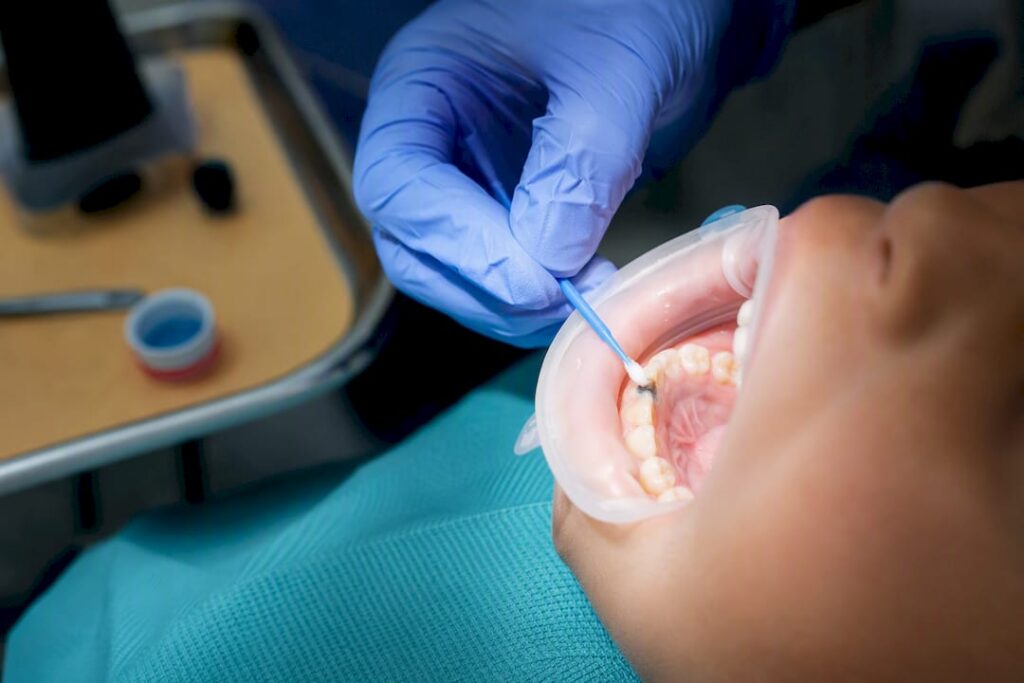
Silver diamine fluoride stops many active cavities in baby teeth without a drill, a needle, or sedation, and it usually works in a single one-minute application. The trade-off is permanent: any decay it treats turns black. It’s a real option for the right child, not a universal fix, and a dentist has to apply it as part of a monitored care plan with your informed consent.
TL;DR:
- Reapplication of SDF every six months improves decay arrest rates to as high as 80 percent compared to a single treatment.
- SDF is most suitable for children with multiple active lesions, limited access to care, or those who cannot tolerate traditional restorative procedures.
- The treatment causes permanent black staining of decay, which is less noticeable on back teeth and can be minimized with appropriate counseling.
- Follow-up visits within two to four weeks are essential to confirm lesion hardening, with additional applications often necessary for optimal results.
- SDF is a safe, cost-effective, chairside option primarily used to buy time until restorations are possible or necessary.
Table of Contents
- What Silver Diamine Fluoride Is and How It Works
- Is Silver Diamine Fluoride Safe? Side Effects and Who Should Avoid It
- Is Your Child a Good Candidate for SDF?
- How SDF Is Applied: The Chairside Process
- Does SDF Actually Work? What the Research Shows
- Talking About the Black Stain Before Treatment Starts
- What Happens After Treatment: Follow-Up and Restoration Timing
- Storage, Handling, and Shelf Life
- What Does SDF Cost, and Who Can Access It?
- Where SDF Stands With Dental Associations and Regulators
- Caring for Your Child’s Teeth After an SDF Appointment
- Clinic Perspective: How We Use SDF in Family Care
- Ready to Talk About SDF for Your Child?
- Sources
- FAQ
What Silver Diamine Fluoride Is and How It Works
Silver diamine fluoride, often shortened to SDF, is a liquid made of silver, fluoride, and ammonia. Each ingredient does a specific job. The silver kills the bacteria driving the decay. The fluoride helps re-harden the softened tooth structure around it. The ammonia keeps the silver stable in solution so it can be brushed directly onto a cavity.
Together, that combination does two things at once: it disinfects the lesion and encourages remineralization of the surrounding dentin, which is why guidance from the American Academy of Pediatric Dentistry recommends it as part of a broader caries-management program rather than a cure on its own.
For kids, the practical upside is significant:
- No drilling, no shots, and often no sedation, even for toddlers who can’t sit still for a filling
- Application takes about a minute per tooth, which matters for a child with limited patience or a strong gag reflex
- It costs far less than a restorative procedure done under general anesthesia
The catch is that SDF does not rebuild lost tooth structure. If a molar has a deep hole, the tooth is still missing that material, only now the decay inside it is inactive, which is why restoration may still be necessary. That’s why dentists usually frame SDF as a way to buy time, stop pain, and control infection until a restoration makes sense.
Is Silver Diamine Fluoride Safe? Side Effects and Who Should Avoid It
No systematic review has turned up serious adverse events from SDF use, which is part of why it’s gained ground as a first-line option for young or anxious patients. The ADA’s clinical overview notes it received FDA clearance for dentinal hypersensitivity and later breakthrough designation for research into caries arrest.
Quick fact: The most common reaction reported after SDF application is a metallic taste that fades within minutes, not a lasting side effect.
What parents should actually expect:
- Mild, temporary gum irritation if the liquid touches soft tissue during application
- A metallic taste immediately after treatment that resolves on its own
- Permanent black staining of the decayed area treated. This is expected, not a complication.
- Temporary gray or black staining on skin or clothing if the liquid contacts them before it’s dried
There are two situations where SDF is off the table. A known allergy to silver is an absolute contraindication. Dentists also use caution, or skip SDF altogether, when a tooth shows signs of pulpal involvement, like spontaneous pain, swelling, or a visible abscess, since those symptoms usually mean the decay has already reached the nerve and needs different treatment.
Is Your Child a Good Candidate for SDF?
SDF earns its reputation with specific kinds of patients, not every child with a cavity. A dentist will look at the whole picture before recommending it.
- High caries risk with multiple active lesions. Kids with several cavities at once often benefit most, since SDF treats decay quickly across many teeth in one visit instead of scheduling separate filling appointments.
- Pre-cooperative or very young children. Toddlers who can’t yet tolerate a full restorative procedure are frequently the best candidates, buying time until they’re developmentally ready.
- Special health care needs. Children with sensory sensitivities, anxiety disorders, or medical conditions that make sedation riskier benefit from a needle-free, drill-free option.
- Limited access to restorative care. Families waiting for a specialist referral or facing scheduling barriers can use SDF to stop a cavity’s progression in the meantime.
Restoration takes priority over SDF when there’s pulpal pain, when so much tooth structure is gone that biting function is compromised, or when the tooth is visible enough that a black spot isn’t acceptable to the family. A proper dental exam and X-rays are the starting point either way, since SDF is a treatment decision made after diagnosis, not instead of one.
How SDF Is Applied: The Chairside Process
The appointment itself is short, which is exactly the point for a child who struggles to sit still.
- Isolation and drying. The dentist isolates the tooth with cotton rolls or a similar barrier and dries the area completely. Moisture control matters because SDF works better, and stains less unpredictably, on a dry field.
- Application. A microbrush carries the SDF onto the cavity for roughly one minute. Clinicians follow AAPD chairside protocol limiting volume to no more than one drop per appointment, which is plenty to treat several lesions.
- Removing excess. Any liquid that hasn’t absorbed gets wiped away to reduce staining risk on nearby gum tissue or lips.
- Optional fluoride varnish. Some dentists follow up with a varnish application on other at-risk surfaces during the same visit.
In the United States, 38% SDF is the commonly used concentration in clinical practice and is the formula referenced in AAPD’s guideline. Reapplication schedules vary by risk level. Biannual application is common, though some children with more aggressive decay are seen more frequently.
Pro Tip: Ask your dentist to check the treated tooth again at the two to four week mark. That’s typically enough time to tell whether the lesion has hardened and darkened, both signs the decay process has actually stopped, versus needing a second application.
Does SDF Actually Work? What the Research Shows
Arrest rates reported across the literature vary considerably depending on the study, the population, and how many times SDF was applied. An umbrella review synthesizing 11 systematic reviews spanning research from 1970 to 2018 found a consistent direction of effect favoring SDF for both arresting existing decay and preventing new lesions, even though the exact numbers shift from paper to paper.
Pooled estimates tend to cluster closer to 65% to 80% when SDF is reapplied on a schedule rather than used once and left alone. That reapplication detail matters more than most parents expect. A single application can arrest a lesion, but the odds improve substantially with a second or third visit spaced months apart, which is part of why dentists build SDF into an ongoing plan instead of treating it as a one-time fix.
Compared with fluoride varnish, the two most-studied conservative options for primary teeth, SDF generally shows a stronger arrest effect in head-to-head trials and reviews, and a 2024 systematic review found that more frequent SDF applications correlated with better outcomes in several trials.
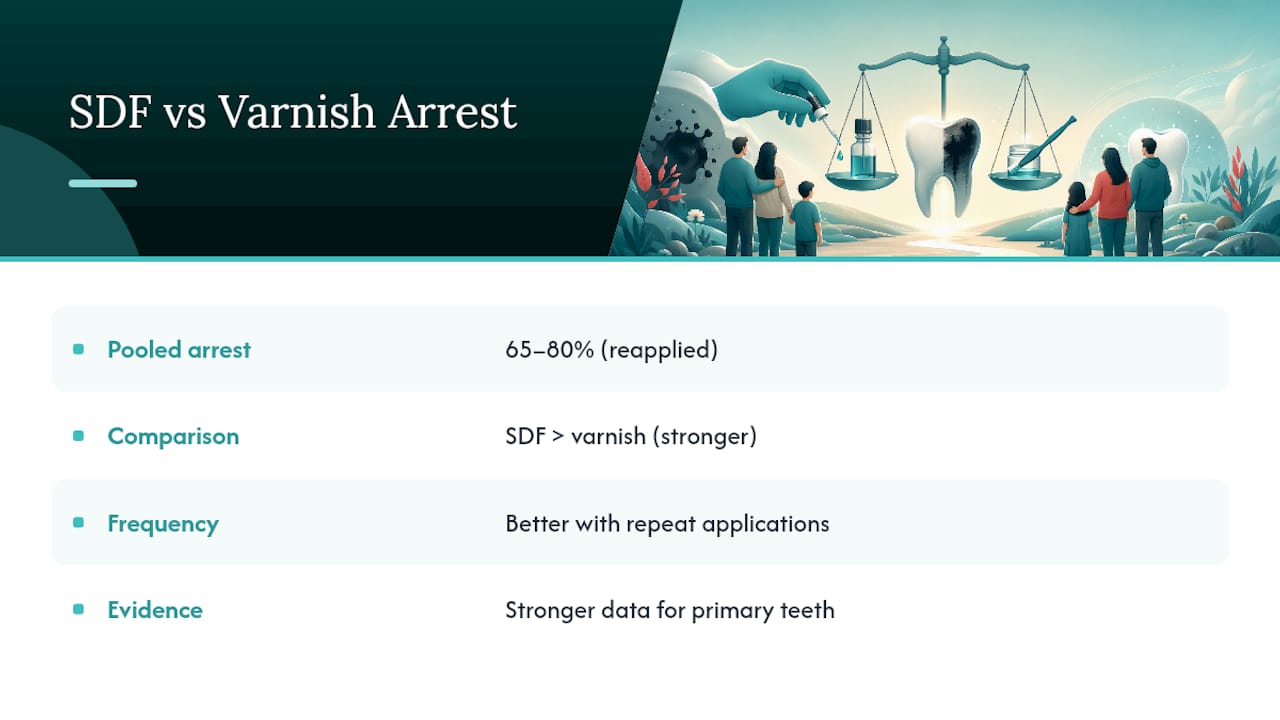
That said, the evidence has real limits worth knowing about. Studies vary a lot in design, follow-up length, and how “arrest” gets defined, which is exactly the kind of heterogeneity that makes it hard to give parents one clean number. Data on permanent teeth in children is thinner than data on primary teeth, so most of what’s known applies specifically to baby teeth rather than the six-year molars coming in behind them.
Talking About the Black Stain Before Treatment Starts
The staining conversation belongs before the appointment, not after. Any decayed area SDF treats will turn dark gray to black, and that color change is permanent on that specific spot of decay. It won’t spread to healthy enamel, but it also won’t fade over time.
A few things make that conversation easier:
- Showing before-and-after photos of treated teeth so parents see exactly what to expect, rather than imagining a worst-case outcome
- Discussing tooth location. Staining on a back molar is far less noticeable than staining on a front tooth, and parental acceptance studies consistently find families are more comfortable with posterior staining
- Mentioning potassium iodide as an option some dentists use immediately after SDF to reduce the surface staining, while being upfront that the evidence on how well it works is mixed and it may slightly reduce SDF’s antimicrobial punch
If a front tooth’s appearance is a real concern for your family, ask about staging a cosmetic restoration once the infection is under control. SDF buys the time to make that decision calmly instead of in an emergency.
What Happens After Treatment: Follow-Up and Restoration Timing
Most dentists want to see the tooth again within two to four weeks to confirm the lesion has actually hardened and darkened, the two signs that arrest is working. After that, recall visits get scheduled around your child’s individual risk level rather than a fixed calendar.
- If the lesion is still soft or hasn’t darkened, expect a second application rather than a switch to restorative treatment right away
- Biannual applications tend to produce better long-term arrest than a single treatment left alone
- Once a lesion is stable and your child is older, more cooperative, or has better access to care, that’s the natural point to discuss restorative options like a filling or crown to rebuild the tooth’s shape and function
SDF isn’t meant to be the last word on that tooth. It’s meant to remove the urgency so a restoration can happen on a reasonable timeline instead of as an emergency.
Storage, Handling, and Shelf Life
SDF comes in small dropper bottles, and how a clinic stores it actually affects how well it performs. Light and heat degrade the silver compound over time, so bottles are kept in a cool, dark environment, typically refrigerated, and used within the manufacturer’s stated shelf life once opened.
Handling matters just as much as storage. Because the liquid stains permanently, clinics use protective barriers, patient bibs, and strict isolation protocols to keep it off skin, clothing, and countertops. Staff are trained specifically on containment, since a single dropped bottle can leave a lasting mark on a chair, a floor, or a uniform.
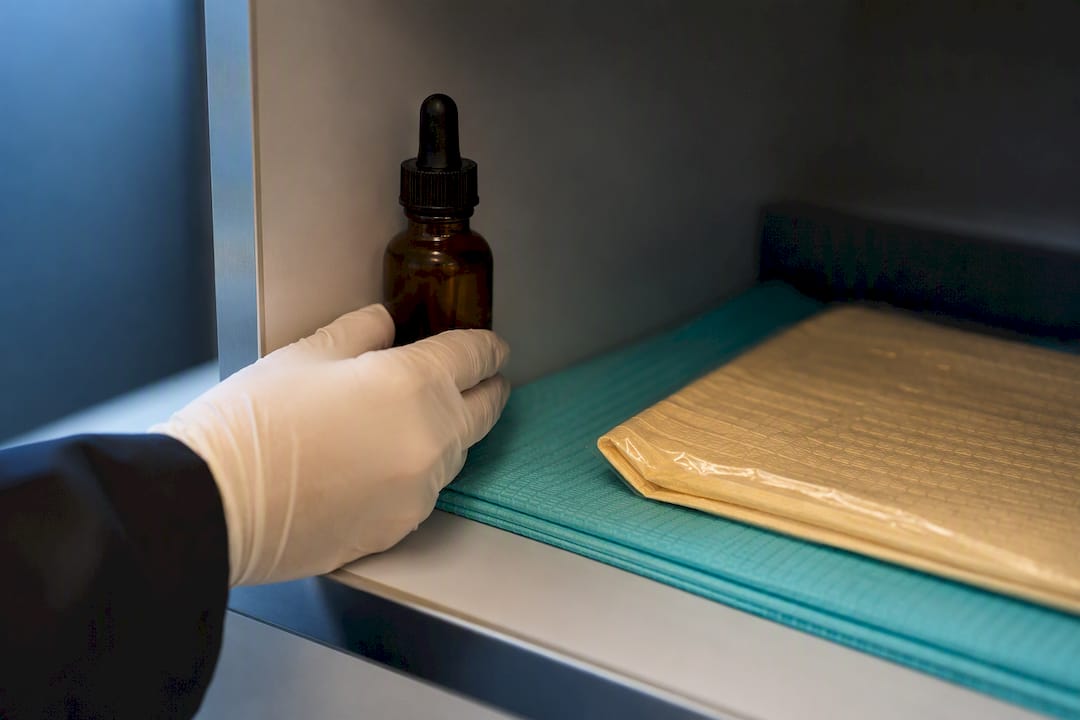
For parents, none of this is something you manage at home. SDF is a professionally applied product, not an over-the-counter treatment, and it isn’t dispensed for use outside a clinical setting. The practical takeaway is simpler: a well-run dental office treats SDF with the same care it treats any active pharmaceutical, and that handling discipline is part of what keeps the treatment predictable and safe.
What Does SDF Cost, and Who Can Access It?
One of SDF’s biggest advantages for families is price. Applying SDF to a tooth typically costs a fraction of a comparable filling, and definitely far less than a restorative procedure requiring sedation or general anesthesia. That lower cost is a major reason public health programs and school-based dental initiatives have adopted it for high-risk pediatric populations.
Insurance coverage for SDF varies by plan and by state, so it’s worth asking your dental office to check your specific benefits before the visit. Even without full coverage, the out-of-pocket cost tends to be manageable compared with restorative alternatives, especially when a child has several cavities that would otherwise mean multiple filling appointments.
Accessibility goes beyond price, too. Because SDF doesn’t require a drill, local anesthesia, or extended chair time, it works in settings where restorative care is harder to deliver, like mobile dental vans, school clinics, and practices serving kids who can’t yet tolerate a longer procedure. If cost or scheduling has been a barrier to getting your child’s teeth checked at all, a general dentistry visit is the place to start that conversation and find out what’s realistic for your situation.
Where SDF Stands With Dental Associations and Regulators
SDF’s regulatory story explains a lot about why it’s used the way it is. The FDA originally cleared it for treating dentinal hypersensitivity, and it later received breakthrough therapy designation specifically for research into arresting caries, a status the ADA’s clinical resource tracks in detail. That’s a narrower approval pathway than many parents assume, which is part of why professional guidelines, not just FDA clearance alone, shape how dentists actually use it.
The AAPD’s own recommendation is a conditional one: it endorses 38% SDF for arresting cavitated lesions in primary teeth as part of a comprehensive caries-management program, while noting the underlying evidence quality is still considered low by strict grading standards. That’s not a knock against the treatment. It’s a reflection of how caries research generally gets conducted, with variable study designs and populations that are hard to standardize.
Fact sheets from groups like the ADHA and ASTDD reinforce the same message dentists give in the chair: SDF is a real, guideline-backed tool, but it’s meant to be used under professional supervision with documented consent, not as a self-directed home remedy.
Caring for Your Child’s Teeth After an SDF Appointment
What you do in the days after treatment matters less than you might expect, since SDF’s job is largely finished the moment it’s applied and dries. Still, a few things help.
- Skip hard or sticky foods on the treated tooth for the rest of the day if it feels sensitive
- Expect the treated spot to darken further over the next 24 to 48 hours as the chemical reaction with the decayed tissue completes
- Keep up regular brushing with fluoride toothpaste. SDF doesn’t replace daily oral hygiene, it works alongside it
- Watch for any new pain, swelling, or sensitivity, and call the office if something changes rather than waiting for the next scheduled visit
- Bring your child back for the follow-up check, usually at two to four weeks, even if everything looks fine at home
The biggest mistake parents make isn’t anything dramatic. It’s assuming one SDF visit means the tooth is permanently handled and skipping the follow-up. Decay is a process, and SDF interrupts it. Confirming that interruption actually held is what the recall visit is for.
Clinic Perspective: How We Use SDF in Family Care
We reach for SDF when it genuinely serves the child in front of us, usually to avoid sedation for a toddler or deliver same-day relief for a painful tooth. Consent always includes photos of typical staining before we touch a tooth, and SDF gets paired with fluoride treatments and a real prevention plan, not used as a one-time fix. Call, and we’ll walk through whether it fits your child.
— Admin
Ready to Talk About SDF for Your Child?
If you’re weighing SDF against a filling, the first real step isn’t picking a treatment. It’s getting an exam that tells you which one your child actually needs. Southlittletonfamilydental keeps that first step low-stakes: our $99 new patient special covers the cleaning, exam, and X-rays that let us tell you honestly whether SDF, a filling, or watchful monitoring is the right call, and same-day appointments are available for kids in pain who can’t wait weeks for relief.

We document consent clearly, show you real photos of what staining looks like before we apply anything, and build a plan around your child’s actual risk level instead of a one-size-fits-all protocol. If your child has a cavity that’s been worrying you, book an evaluation with South Littleton Family Dental and get a straight answer instead of another night of guessing.
This article is general information, not a substitute for advice from a qualified doctor. Consult a qualified healthcare professional about your own circumstances before acting on anything here.
Sources
- Use of Silver Diamine Fluoride for Pediatric Dental Patients (AAPD)
- Umbrella review on SDF (PMC)
- SDF Fact Sheet (ADHA/ASTDD)
- Silver Diamine Fluoride (ADA)
- Systematic review on topical SDF (PubMed, 2024)
FAQ
Is SDF better than a filling?
SDF and fillings solve different problems. SDF stops active decay without removing tooth structure, while a filling restores the tooth’s shape after decay is controlled. Many children end up needing both at different stages.
How long does it take for SDF to turn black?
Staining typically starts within minutes of application and continues to darken over the following 24 to 48 hours as the reaction with decayed tissue completes.
What is the “zombie effect” of SDF?
The term describes the darkened, hardened appearance an arrested lesion takes on after SDF treatment. The decay looks alarming but is actually inactive, which is why dentists check hardness, not just color, at follow-up.
Is silver diamine fluoride safe for kids?
Systematic reviews have not found serious adverse events associated with SDF, and its main downside is permanent black staining of the treated decay rather than any lasting health risk. It should still be applied by a dental professional under informed consent, especially for children with a known silver allergy.