
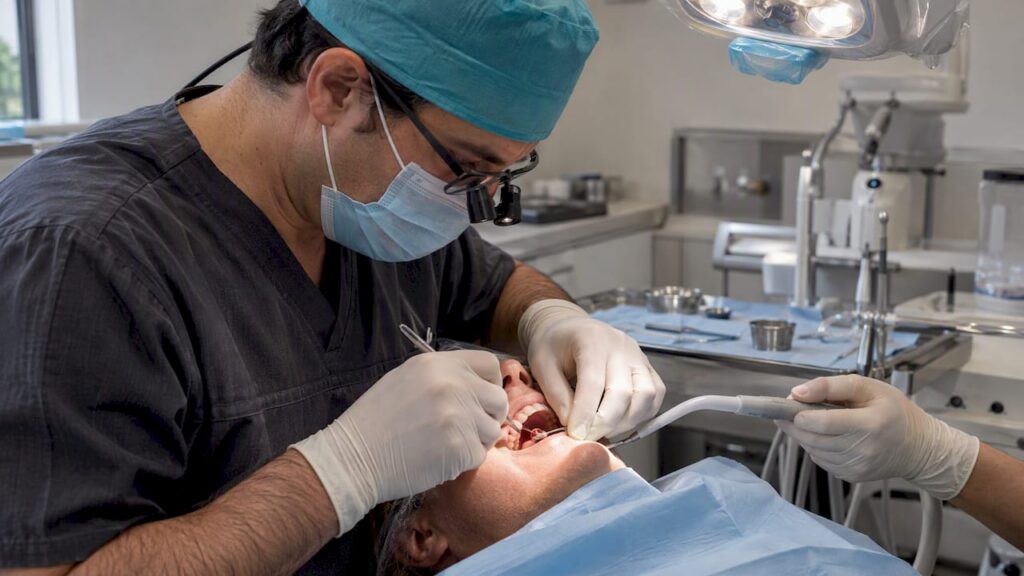
A bone graft adds bone or bone-substitute material to your jaw so a dental implant has something solid to anchor into. Not everyone needs one. About half of implant patients do, either before the implant or at the same visit, and whether you are in that half depends on how much healthy bone you have where the tooth is missing. Below: when a graft is needed, what the main types are, how it differs from a sinus lift, how long healing takes, and what to ask before you agree to treatment.
TL;DR
- A graft rebuilds jawbone volume so an implant can be placed securely. Roughly 50% of implant patients need one, before or during the procedure.
- Initial healing takes about a week, but the graft needs at least 3 months to mature. Larger grafts can take 9 to 12 months.
- A sinus lift is one specific kind of grafting, used in the upper back jaw. A “bone graft” is the broader term.
- Implants in grafted and non-grafted sites both show high long-term success, often 90% to 100% at 10 years.
- Smoking raises the risk of graft failure. Tell your dentist before planning begins.
Table of Contents
- Why an implant needs bone in the first place
- Do you actually need a bone graft?
- The four types of graft material
- Sinus lift vs. bone graft
- What the procedure feels like
- Bone graft healing time
- Risks and success rates
- Our perspective on grafting
- Questions to ask before you agree to a graft
- Getting evaluated in Littleton
- FAQ
- Sources
Why an implant needs bone in the first place
An implant is a small post that fuses with the jaw. That fusion, called osseointegration, only works if there is enough bone around the post, in height, width and density.
Bone is a use-it-or-lose-it tissue. After a tooth comes out, the bone that held its root starts to shrink. The ADA’s patient-facing Chairside Instructor explains it plainly: when there isn’t enough bone to support an implant, bone can be added through grafting.
Bone also disappears for other reasons: gum disease, an old infection, trauma, a long-standing denture, or a tooth that was pulled years ago and never replaced. The longer a space sits empty, the more bone is usually lost, which is why people who wait often hear “you’ll need a graft” at the consultation.
Do you actually need a bone graft?
Not always, and a good dentist will not assume you do. The American Dental Association’s news summary of a cross-sectional study of 299 patients and 897 implants noted that placement with or without lateral grafting may produce similar outcomes. The graft is a tool for a specific problem, not a default step.
The answer comes from your own anatomy. These are the situations where grafting comes up most often:
- A tooth was lost a long time ago. The ridge has thinned or flattened.
- An upper back tooth is missing. The sinus can sit low, leaving little bone height.
- An extraction is planned. Bone can be protected right away, a step often called socket preservation.
- Past gum disease or infection has eaten into the bone.
- Long-term denture wear has resorbed the ridge.
The only way to know is an exam with imaging. Your dentist measures bone height and width at the exact spot, checks the health of nearby teeth and gums, and looks at your medical history. Our page on dental implant candidacy walks through what we evaluate.
The four types of graft material
Graft material falls into four families. Each acts as a scaffold your own cells gradually replace with living bone.
| Type | Source | Key points |
|---|---|---|
| Autograft | Your own bone, taken from elsewhere in your mouth or body | Your body accepts it readily, but it needs a second surgical site |
| Allograft | Processed human donor bone from a tissue bank | No second site needed, widely used |
| Xenograft | Processed animal bone, commonly bovine | Acts as a long-lasting scaffold |
| Alloplast | Synthetic, such as calcium phosphate materials | No biological source, fully manufactured |
The Cleveland Clinic’s overview of dental bone grafts is a clear reference for how these differ. Your dentist picks based on the size of the defect, where it is and your health. Ask which material is planned and why. Any good answer will refer to your specific site, not a blanket preference.
Membranes and guided bone regeneration
Often the graft is covered with a thin barrier membrane that keeps fast-growing gum tissue out while slower bone fills the space. That approach is called guided bone regeneration, or GBR. A systematic review of GBR for implant placement describes it as a stable, effective method, while noting that the right technique depends on the patient’s bone anatomy and how much volume is needed.
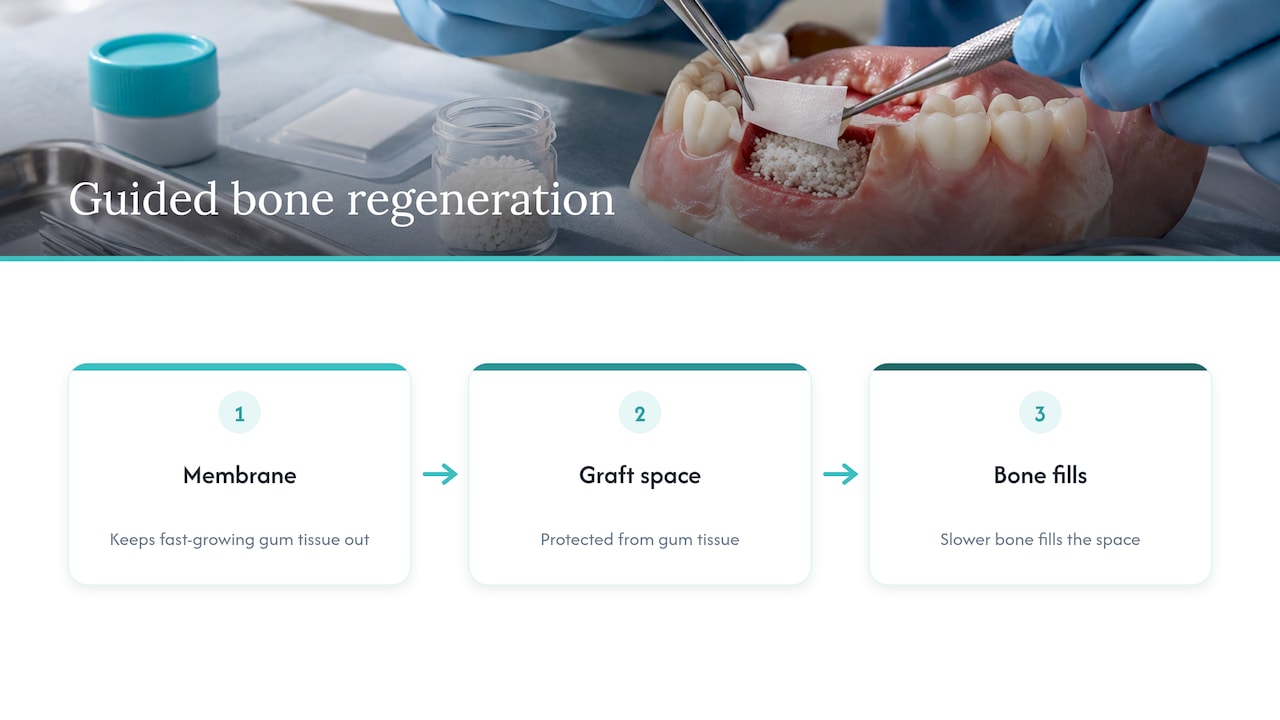
For immediate implants, a systematic review in the literature found that using grafting or GBR can help preserve the thickness of the outer bone plate and support soft tissue stability. That outer plate is often the part damaged when a tooth is lost.
PRF and your own blood
Some practices add platelet-rich fibrin (PRF), a material made from a small sample of your own blood, to support healing around a graft. We offer PRF treatment alongside our bone grafting and socket preservation services. Ask at your visit whether it makes sense for your case.
Sinus lift vs. bone graft
People search for these as if they were competing options. They aren’t.
A bone graft is the umbrella term: adding bone to the jaw anywhere it is deficient. A sinus lift (sinus augmentation) is a specific grafting procedure for the upper back jaw. The sinus membrane is gently raised and graft material is placed in the space beneath it, which builds bone height for molar and premolar implants. The AAOMS course on ridge and sinus augmentation lists both as key techniques for successful implants.
| Ridge or socket graft | Sinus lift | |
|---|---|---|
| Where | Upper or lower jaw | Upper back jaw only |
| Goal | Adds width or height, or preserves the socket | Adds height below the sinus |
| When | At extraction, or months or years later | When upper back bone is too thin |
| Implant timing | Same visit or after healing | Same visit if enough bone remains, otherwise after healing |
If you have a missing lower tooth, you will not need a sinus lift. If it’s an upper molar, it may come up. Your imaging will tell the story.
What the procedure feels like
Most grafts are done with local anesthetic, and many people say it feels like an extraction. Typical steps:
- The area is numbed, and sedation options are discussed if you’re anxious.
- The gum is gently opened to expose the bone.
- Graft material is packed into the site, sometimes with a membrane over it.
- The gum is stitched closed.
If the graft happens at the same moment as an extraction, the socket is filled right after the tooth is removed, which is the idea behind socket preservation. Read about our approach to bone grafting and socket preservation.
Expect soreness, some swelling and a few days of soft foods. Cleveland Clinic notes that it is normal to pass tiny fragments, like grains of sand or salt, from the site in the first days. Losing a large amount is a reason to call your dentist right away.
Bone graft healing time
There are two clocks running: how fast your mouth feels better, and how long the bone takes to mature.
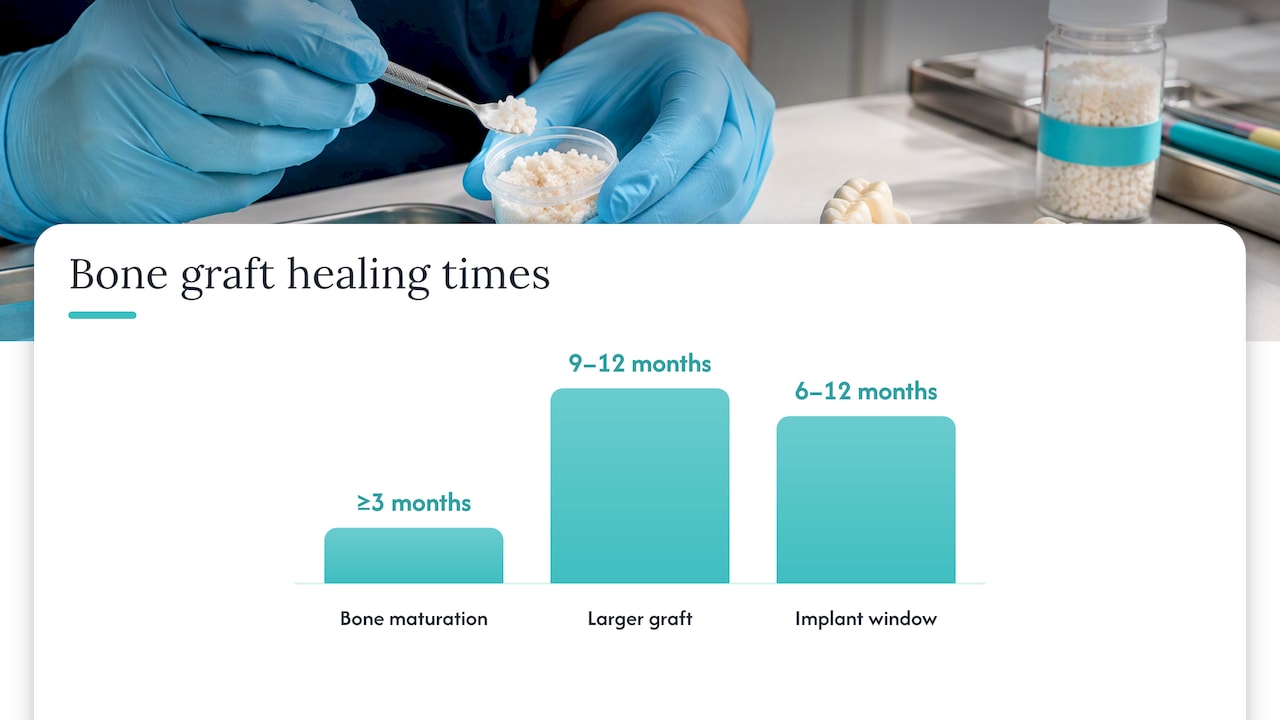
- Comfort: about one week for the initial healing.
- Bone maturation: at least 3 months, and for larger grafts sometimes 9 to 12 months, before an implant can go in.
- Window for the implant: the same source says that if a graft is placed ahead of an implant, the implant should ideally follow within 6 to 12 months, because a graft left too long can begin to shrink and lose density.
So a typical path is: graft, wait a few months, then implant, then healing, then crown. Our implant timeline lays out week-by-week care and time off work, and the implant process page shows how grafting fits in.
When enough bone is already present, a small graft may be done at the same visit as the implant, which shortens the road. That’s your dentist’s call after seeing your scan.
Risks and success rates
Bone grafting is routine, but it is surgery. Possible problems include infection, graft material that doesn’t integrate, and continued bone loss. AAOMS educators say around 30% of grafts may need additional intervention, which is why precise planning matters. That is a figure from a continuing-education course description, not a promise about any one practice, ours included.
The longer-term picture for implants is encouraging. A systematic review of implants in grafted and non-grafted sites reports high survival rates, often between 90% and 100% at 10 years of follow-up. The same review points out that long-term data are limited, so treat the range as a guide.
Smoking and healing
Smoking is a leading risk factor for graft failure and for peri-implantitis, an infection around the implant. Cleveland Clinic notes nicotine reduces blood flow and its effect on healing continues after the surgical site looks closed. If you smoke or vape nicotine, say so at the first visit. Stopping before and during healing is the single best thing you can do for the graft. Your physician or a cessation program can help you quit.
Warning signs after surgery
Call the office the same day for fever, swelling that grows after the third day, a bad taste or pus, bleeding that won’t stop with pressure, or loss of a lot of graft particles. Later on, bleeding or loosening around an implant is worth a prompt visit too. See our guide to implant failure signs.
Our perspective on grafting
We see the same worry in the chair again and again: “If I need a graft, does that mean something went wrong?” No. It means bone has changed since the tooth was lost, and that is biology, not blame.
Our approach is to explain your options in plain language, show you the scan, and build a plan around your situation instead of a template. For some patients that means protecting the socket the day a tooth comes out, so a graft later may not be needed at all. For others it means grafting first and giving the bone time. We would rather tell you honestly that you need to wait than rush an implant into thin bone.
We also know that nervous patients often put this off for years, and waiting is usually what makes the bone loss worse. If anxiety is what’s keeping you away, tell us. We build visits around comfort, and a first conversation costs nothing but time.
— Admin
Questions to ask before you agree to a graft
- How much bone do I have, and how much do I need at this site?
- Is a graft required, or could a shorter implant or a different design work?
- Which material do you recommend, and why for my case?
- Will the graft happen at the same visit as the implant, or first?
- How long until the implant, and what happens if my healing runs slow?
- What is the full cost, including the graft, implant, crown and follow-up visits? Is any of it covered by my dental plan?
- Who does the surgery, and what do you do if something goes wrong?
On cost: grafting is a separate line item from the implant, and dental plans vary in what they cover. We don’t publish a price for grafting because it depends on the size and type of the graft. Our implant cost page explains what drives the total, and we can check your benefits at the visit.
Getting evaluated in Littleton
If you are missing a tooth, have been told you lack bone, or need an extraction and want to protect the site, start with an exam. We offer implants, bone grafting, socket preservation, PRF and oral surgery at our Littleton, CO office, and we can map out the sequence for your mouth. Our dental implants overview shows how the pieces fit together. For a toothache or broken tooth, our emergency dentistry service offers same-day care, and an emergency exam is $49.
FAQ
How painful is a bone graft for dental implants?
Most patients describe the procedure itself as comfortable because the area is numbed. Afterward, expect soreness and swelling that usually eases over the first week, which matches the roughly one-week initial healing Cleveland Clinic describes. Your dentist will advise on pain relief that suits your health history.
How long do bone grafts last for dental implants?
Once the graft has turned into your own living bone, it behaves like the rest of your jaw. The caveat is timing: if the implant is delayed well beyond 6 to 12 months after grafting, the graft can start shrinking. Good oral hygiene, regular checkups and not smoking help protect the bone around the implant.
How successful is bone grafting for implants?
Implants placed in grafted sites have shown high survival rates, often 90% to 100% at 10 years in a systematic review. Individual results vary with your health, habits and the size of the defect. Some grafts do need a second procedure, so planning matters.
Is a sinus lift the same as a bone graft?
A sinus lift is a type of bone graft, used only in the upper back jaw to add height beneath the sinus. A bone graft more broadly can be done on the upper or lower jaw to add width, height or to preserve a socket after extraction. Your scan shows which applies to you.
Can the graft and implant be done in one visit?
Sometimes. If you have enough bone to anchor the implant but need a bit more volume around it, the graft can go in at the same time. When the bone is very thin, the graft usually goes first and the implant follows after healing.
Sources
- Cleveland Clinic: Dental Bone Graft
- AAOMS CE Online: Innovative Solutions in Bone Grafting
- Dental Implants Placed in Grafted and Non-Grafted Sites: A Systematic Review
- Guided Bone Regeneration for Bone Augmentation: A Systematic Review
- Is Bone Graft or Guided Bone Regeneration Needed When Placing Immediate Dental Implants?
- ADA News: Impact of lateral bone grafting on implant outcomes
- ADA: The Chairside Instructor, page 42