

A stained filling is not always a failed filling. Often the dark edge or yellow-brown tint on a tooth-colored filling is surface staining that a dentist can polish or refurbish. Sometimes it signals a leaking seal or decay underneath, and then replacement is the right call. The hard part is telling the two apart by eye, and that takes an exam and usually an X-ray.
This guide explains why composite fillings stain, which options exist, how a dentist decides, and what a replacement visit involves. If you are in Littleton, CO, we can look at the filling with you and give you a straight answer.
TL;DR
- Most stains on white fillings start at the surface or the edge. Many can be monitored, polished or refurbished without replacing the whole filling.
- Replacement makes sense when there is decay under the filling, a crack, a failed seal, or deep stain that no polish can reach.
- Replacing a filling removes more healthy tooth, so a filling that is only discolored is not an automatic candidate.
- Silver diamine fluoride leaves a permanent black stain that often cannot be polished off a composite.
- Book an exam if a filling looks darker, feels rough, catches floss or hurts. Do not wait for pain.
Table of Contents
- Why composite fillings stain over time
- Stain or failing filling: signs to look for
- Your options: monitor, polish, repair or replace
- How a dentist decides if the filling and tooth can be saved
- What replacing a stained composite filling involves
- The risks of replacing a filling that is only discolored
- Black stains from silver diamine fluoride
- Is a gray new white filling normal?
- What about whitening a stained filling?
- How to keep fillings looking natural
- Our perspective
- See us for a stained filling in Littleton
- FAQ
- Sources
Why composite fillings stain over time
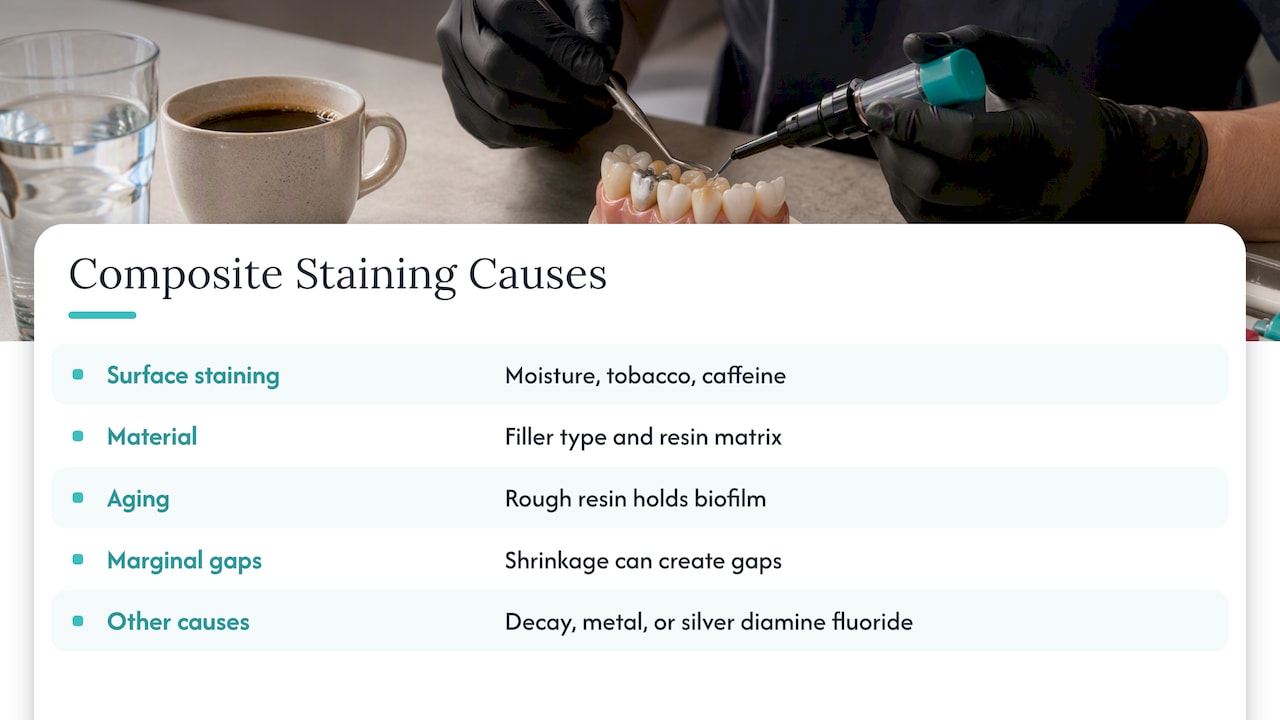
A composite filling is a tooth-colored resin bonded to the tooth. The American Dental Association notes that resin composites can be susceptible to staining and discoloration. Several things drive it.
Surface staining. Research on discolored resin restorations points to moisture, tobacco and caffeine as contributors to extrinsic discoloration, and the type of filler and resin matrix in the material also plays a part.
Roughening with age. The same research notes that aging can roughen the resin surface, which makes it easier for biofilm to stick. Micro-cracks, scratches and rough edges give coffee and wine places to cling, which is why an old filling stains faster than a fresh, glassy one.
Gaps at the margin. Composite shrinks slightly as it hardens. The ADA says that polymerization shrinkage can lead to marginal gaps and weaken the bond to the tooth. A thin dark line around a filling is often where stain has crept into such a gap.
Something else entirely. A dark shade seen through the tooth can be decay beneath the filling, an old metal filling showing through enamel, or a treatment such as silver diamine fluoride. That is why color alone never settles the question.
Stain or failing filling: signs to look for
Surface stain usually looks even, sits on the filling or its edge, and the filling feels smooth to your tongue. Warning signs call for a visit sooner:
- A dark line or shadow that widens along the edge
- A rough, chipped or ledge-like spot
- Floss that shreds or catches next to the filling
- Sensitivity to cold, sweets or biting
- A filling that is more than a decade old and has never been checked on an X-ray
For more on timing and what the evidence says about lifespan, see our guides on when to replace an old filling and how long fillings last.
Your options: monitor, polish, repair or replace
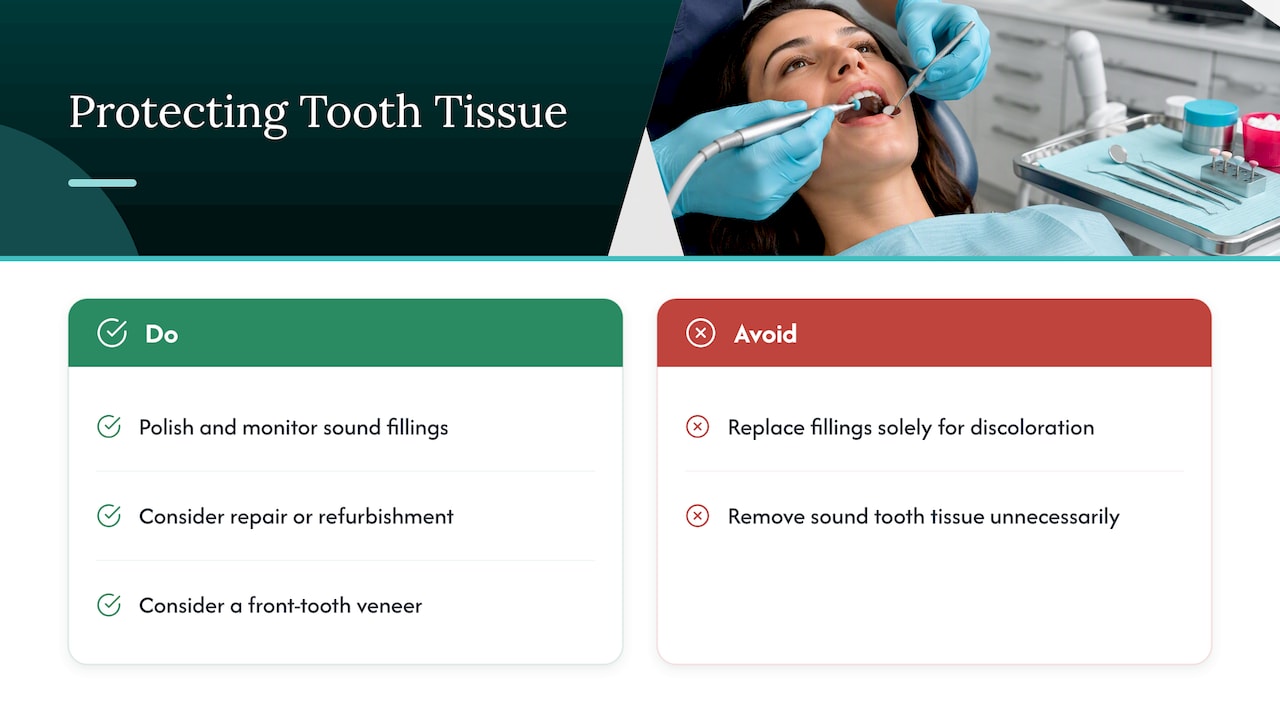
Research on repairing restorations describes a range of responses. Minor shortcomings such as an unfavorable color or staining may simply be monitored, superficial defects can be refurbished, and localized defects can be repaired. Replacement is reserved for bigger problems.
| Option | What it is | Usually fits |
|---|---|---|
| Monitor | Check at regular exams, photograph, X-ray as needed | Mild, stable stain with a sound, smooth filling |
| Polish or refinish | Smoothing and repolishing the surface | Surface stain, slight roughness |
| Refurbish or repair | Reshaping or adding new material to a defective area | A stained or chipped edge, a small localized defect |
| Replace | Remove the whole filling and place a new one | Decay underneath, cracks, failed seal, deep stain |
The same literature says that marginal staining on front-tooth composites can often be handled by refinishing and, if needed, refurbishment, while stain that has penetrated deeply may require replacement. A 2019 position paper adds that repair removes only the defective part and adds material, which can preserve tooth structure and shorten treatment.
When replacement is the better choice
Replacement is appropriate when the filling is undermined by extensive decay or cracked cusps, or when heavy penetrating staining prevents an acceptable look. A German and Swiss study of 544 replaced restorations found that an older restoration, marginal imperfections (especially cracks), visible recurrent decay and pain were the indicators that supported replacing a filling. In that same study, softened dentin was found after removal in 69.8% of cavities, which shows why a dark edge deserves a proper look rather than a guess.
How a dentist decides if the filling and tooth can be saved
The Journal of the American Dental Association describes the steps. The dentist checks whether the filling is intact, cracked, worn or no longer sealed. An explorer can test the margins, and radiographs can reveal decay under the filling or between teeth.
That last point matters. If decay reaches the pulp, which holds the tooth’s nerve and blood supply, it often leads to root canal treatment or even loss of the tooth. JADA also advises that catching a failed filling on an X-ray and treating it promptly can reduce the need for more extensive work, and that you should not wait for pain or a visible crack.
A realistic exam for a stained filling looks like this:
- Visual check in good light, often with magnification or photos
- Feeling the margins and surface for roughness or gaps
- Bitewing X-rays to look under and beside the filling
- A conversation about what bothers you: looks, feel, sensitivity
- A recommendation that matches the findings, which may be “leave it, polish it” as often as “replace it”
Patient factors count too. Dry mouth, a high-sugar or acidic diet, grinding, and difficulty with daily brushing all change how long a restoration lasts. If you help care for an older relative, these oral care for seniors steps cover the daily habits that protect existing fillings and cut down on costly visits.
What replacing a stained composite filling involves
If replacement is needed, it means complete removal of the old restoration, usually with some additional loss of tooth structure. In practice, a visit generally goes like this:
- The area is numbed so you feel pressure, not pain.
- The old composite is removed and the tooth is checked for decay or cracks.
- Any decay is cleaned out and the tooth is prepared for bonding.
- New composite is placed in layers, shaped to your bite and hardened with a curing light.
- The filling is finished and polished to a smooth surface.
Most fillings are done in a single visit. If the remaining tooth is too thin or cracked to hold a filling, the dentist may recommend a crown instead. You can see how we handle these in our restorative dentistry services.
The risks of replacing a filling that is only discolored
It is tempting to swap out any filling you dislike. The trade-off is real. The research on restoration repair warns that replacing a filling can remove sound tooth tissue, enlarge the cavity, weaken the tooth and potentially injure the pulp.
Every replacement starts a cycle in which the cavity gets a little bigger. So a good dentist asks two questions: is the filling failing, and is the stain bad enough to justify losing more tooth? If the answer to both is no, polishing and monitoring protect your tooth best. If the stain bothers you and the filling is sound, a repair or refurbishment, or a cosmetic option such as a veneer on a front tooth, may be a fair middle path. Our guide to veneer timelines for porcelain and composite explains those choices.
Black stains from silver diamine fluoride
Parents of young children should know about one special case. Silver diamine fluoride (SDF) can stop decay without drilling, but it can cause permanent black staining on the tooth and on existing composite restorations. If that stain is deep, it typically cannot be polished off, and the restoration may need to be replaced. Ask about this before consenting. We cover consent, cost and the trade-offs in our page on silver diamine fluoride for parents.
Is a gray new white filling normal?
Sometimes a brand-new composite looks a little gray or darker than the tooth next to it. Light passes through enamel and dentin, and a filling that sits over a darker area of the tooth, or one placed in a deep cavity, can take on a shadowed look. Fresh fillings can also look different when the tooth is dry or just after the visit, before it rehydrates. If a new filling still looks off after a couple of weeks, tell your dentist. A shade adjustment or a small refinement is a reasonable request.
A gray tooth, as opposed to a gray filling, is a different matter. A tooth that darkens after a knock needs an exam, and our guide on what to do when a tooth turns gray explains the steps. Deep, tooth-wide discoloration may also call for internal tooth bleaching rather than a new filling.
What about whitening a stained filling?
Whitening gels change natural tooth color, not resin. They will lighten the tooth around a filling, and the filling can then look darker by comparison. The common advice is to whiten first if you want a brighter smile, then replace or refinish any fillings to match the new shade. Research on bleaching discolored resin has looked at whether bleaching can improve stained composites, but results depend on the material and the type of stain, so ask before you assume it will work. Our Lumi & KoR teeth whitening page explains what professional whitening does.
How to keep fillings looking natural
You cannot make composite stain-proof, but you can slow it down.
- Start with a smooth finish. Careful finishing and polishing reduces micro-cracks and irregularities that affect how a restoration looks long term.
- Rinse after coffee, tea and red wine. Water cuts the contact time on the surface.
- Do not smoke. Tobacco is one of the contributors to surface discoloration.
- Keep cleanings on schedule. Professional polishing removes surface stain before it sets in.
- Protect against grinding. A nightguard prevents chips and rough spots where stain collects.
- Prevent new cavities. Fewer cavities means fewer fillings. Adults with deep grooves can ask about sealants for adults.
Our perspective
We would rather protect a tooth than sell a filling. When someone walks in asking us to replace a stained filling, we start with an exam and X-rays, because color alone doesn’t tell us whether the tooth is healthy. If the filling is sealed and smooth, we will usually talk through polishing or monitoring first and explain what replacement would cost you in healthy tooth.
When the filling is leaking, cracked or sitting on decay, we say so plainly and show you why on the images. Many of our patients arrive anxious about dental visits, so we explain each step, go at your pace and build a care plan around your teeth, your budget and your goals. We offer same-day care when something can’t wait, and we look at the whole mouth rather than one spot, so the plan fits your needs.
— Admin
See us for a stained filling in Littleton
If a filling has darkened, feels rough or just bothers you, our team can examine it, take X-rays when needed and tell you whether to monitor, polish, repair or replace. We place tooth-colored composite fillings and crowns as part of our restorative dentistry care, and general exams are available through general dentistry. For sudden pain or a broken filling, see our emergency dentistry service. Call us or book through our website to ask about current new-patient offers and payment options.
FAQ
Can a stained composite filling be polished instead of replaced?
Often, yes. Surface stain and minor roughness can usually be removed by refinishing, and edge defects can sometimes be refurbished or repaired. Deep stain that has penetrated the material may not come out, and then replacement is the better option.
Does a dark edge on my filling mean there is a cavity?
Not always, but it can. A dark edge may be stain in a tiny gap, or decay forming beneath the filling. Only an exam and an X-ray can tell, so have it checked rather than waiting for pain.
Is replacing a filling bad for my tooth?
It can be. Removing the old filling usually takes away some more tooth structure, and the research warns it can weaken the tooth and irritate the pulp. That is why a filling should be replaced because it is failing, not only because of its color.
Will whitening fix stained fillings?
No. Whitening lightens natural enamel, not resin, so a stained filling can stand out more afterward. If you plan to whiten, do it first, then have your dentist match or refinish your fillings.
Sources
- Materials for Direct Restorations, American Dental Association
- Effect of Bleaching Agents on Discoloured Resin-Based Composites
- Investigating the Mechanisms of Discoloration in Modern Restorative Materials
- Factors influencing repair of dental restorations
- Reparative Dentistry: Possibilities and Limitations
- Repair of restorations, FDI policy statement
- Decision criteria for replacement of fillings
- When a filling needs to be replaced, JADA
- Pennsylvania Dental Journal, January 2017
- Oral care steps for seniors